Your supplier sends through the new price list in February. You read it, you feel a bit sick, you write back asking if there is any movement on the unit price. They come back with two per cent. You take it, because the alternative is qualifying a new factory and losing four months of trading.
What’s in This Article
That is not a negotiation. That is a price review you lost before you opened the email.
Here is the part most Aussie founders never sit with. APQC’s procurement benchmarking found that a 1% reduction in direct material cost correlates with a 0.8% lift in EBITDA margin for median performers. Nothing else on your profit and loss converts that cleanly. Not a 1% conversion rate win, not a 1% cut to ad spend. And yet the typical operator spends about thirty minutes a year on the one conversation that moves it.
The founders who reliably pull two to four points out of their cost of goods are not better hagglers. They walk into the call with six levers instead of one, and they already know which of the six their supplier can afford to give away.
Start With the Number That Actually Matters: Landed Cost Per Unit
Ex-factory price is not your cost. It is the largest line inside your cost, which is a different thing, and confusing the two is why so many negotiations go nowhere.
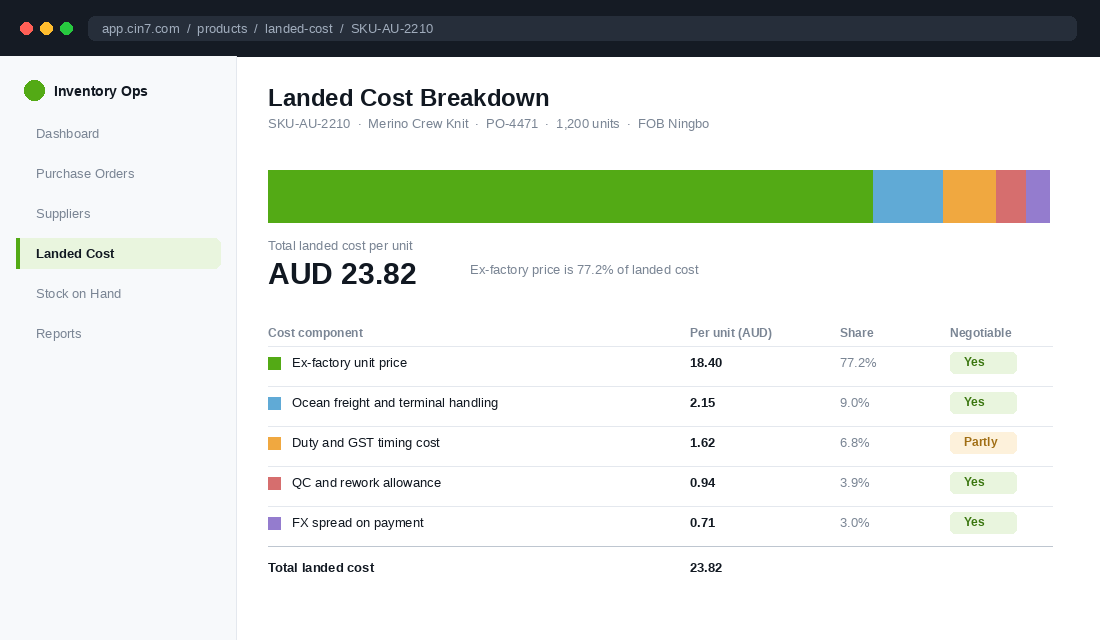
Take a typical Aussie apparel SKU landing at AUD 23.82 a unit. The ex-factory price is 18.40. The other 5.42 is ocean freight and terminal handling, duty and the GST timing cost, a quality allowance for the units that come back, and the FX spread you pay when you settle the invoice. That is 22.8% of your cost sitting outside the number you spend the whole meeting arguing about.
Two things make this bigger for Australian importers than for our US counterparts. First, Australia calculates customs duty on the FOB value rather than the CIF value, so who owns the freight leg directly changes what you pay the Australian Border Force. Second, the freight line is genuinely volatile. Q1 2026 market data put a 40HQ from Shenzhen to Sydney at roughly USD 1,500 to 2,100, and then July 2026 FCL rates jumped about 49% from June on an Oceania peak season capacity crunch. A cost line that swings by half in a month is a cost line worth negotiating.
Before you book the call, build the breakdown. If you have not done that work yet, start with our Shopify landed cost playbook and get a real per-unit number for your top ten SKUs by spend. You cannot negotiate a cost you have never itemised.
Lever 1: Commit to the Year, Not to the Order
Most founders negotiate order by order. You place a purchase order for 1,200 units, you ask for a break, the factory quotes off their 1,200 unit band, and you both go again in eight weeks.
Your supplier does not care about your purchase order. They care about their production planning. A factory that can slot your work into a known schedule twelve months out runs at higher utilisation, buys raw materials in bigger lots, and carries less idle labour risk. That is worth real money to them, and it is the cheapest thing you own.
Change the shape of the ask:
- Quote the annual number, not the order number. “We will do 14,400 units across the next twelve months in six drops” prices very differently to six separate requests for 2,400.
- Ask for the band, then ask what gets you to the next one. If 15,000 units gets a better rate, you now have a concrete target rather than a vague hope.
- Put a floor under it, not a ceiling. Commit to a minimum you would buy anyway. Never commit to your optimistic forecast, because a commitment you break costs you more credibility than the discount was worth.
- Ask for the band to apply retrospectively. Some suppliers will true up at year end if you hit the volume. That costs them nothing today and it de-risks the commitment for you.
Koala, founded in November 2015 by Dany Milham and Mitch Taylor, ended up running manufacturing partners across Australia, Asia and Europe rather than consolidating with one. They tried for a long stretch to find suitable Australian manufacturers and found the local industry had not invested in the technology to scale with their demand. The lesson for a smaller operator is not “go offshore”. It is that your volume commitment only gives you a position if a partner actually wants the volume. Split your spend across three factories and you have three weak positions instead of one strong one.
Lever 2: Rewrite the Payment Split Before You Touch the Price
A 30% deposit and 70% on bill of lading is the default for a reason. It is the supplier’s default, not yours, and almost nobody challenges it.
Cash tied up in goods that are floating on the water for three weeks is cash you cannot put into stock, ads or a second product line. If you are paying 70% at the port of loading and the vessel takes 20 to 27 days to reach Sydney, plus another three to five days for customs and inland delivery, you have funded roughly a month of somebody else’s working capital.
Everyone else in your supply chain is already playing this game. Australian small businesses waited an average of 24.1 days to be paid in the March quarter of 2026 and were paid 6.9 days late on top. Large businesses settled only 68.2% of small supplier invoices inside 30 days, and the slowest fifth percentile blew out to 64 days against an average agreed term of 29. Terms are a currency in this market. You are allowed to spend it.
Openers that work better than “can we do net 60”:
- Split the back end. Move 30 / 70 to 30 / 40 / 30, with the final third due 30 days after arrival. You are not asking for less money, only for a later third.
- Trade certainty for time. Offer to pay the deposit earlier, or by telegraphic transfer instead of a letter of credit, in exchange for the tail moving out.
- Price the concession honestly. If your working capital costs you 12% a year, 30 days of deferral on 40% of a 762,300 spend is worth about 7,600 to you. Knowing that number stops you trading it away for a token unit price cut.
- Ask for a discount for early settlement instead. Some factories with tight cash will happily give 2% for payment fourteen days earlier. If your cash is cheaper than theirs, take the trade in that direction.
Lever 3: Change the Incoterm and You Change the Customs Bill
Incoterms decide who arranges freight, who carries the risk, and where the handover happens. They also decide the value your duty is calculated on, which is why this lever is worth more in Australia than most founders assume.
Three positions cover almost every Shopify importer:
- EXW looks cheapest and rarely is. You take on origin-side freight, export documentation, terminal handling and export clearance in a country you are not standing in. The headline number drops and the landed number often does not.
- FOB is the sensible default once you have a forwarder. The supplier gets the goods loaded on the vessel, you control the ocean leg, and you get a clean handover point. It gives you real cost visibility without asking you to run customs clearance in Ningbo.
- DDP is for testing, not for scale. It is a good way to trial a new supplier with a small order because they handle everything. It is a poor way to run your main line, because every cost is bundled into one number you cannot interrogate.
The negotiation move is not simply “switch to FOB”. It is to ask the supplier to quote you both ways on the same order, then compare landed cost rather than invoice cost. Roughly half the time the FOB quote plus your own forwarder rate beats their DDP number by more than a point, because their freight is a profit centre. The other half you learn they have a genuinely better freight rate than you do, which is worth knowing before you spend a year fighting for it.
One more piece of housekeeping. If you are settling in USD and selling in AUD, the exchange rate is quietly moving your cost of goods every month. Our Shopify FX playbook covers the six levers there, and it pairs directly with this conversation. There is no point winning 1.8% on an Incoterm and giving 3% back on a spot rate.
Lever 4: Buy Shorter Lead Times, Not Just Cheaper Units
Lead time does not appear anywhere on your invoice, which is exactly why it gets ignored. It shows up instead as safety stock, as end of season markdowns, and as the three best sellers you were out of during your biggest week.
Do the arithmetic on your own numbers. If a SKU sells 40 units a week and your total lead time is 45 days production plus 25 days on the water, you are carrying ten weeks of cover before you have sold a single unit. Cut production from 45 days to 28 and you free about two and a half weeks of stock. On a 762,300 annual spend that is real cash back on the balance sheet, plus fewer markdowns at the tail.
How to actually get it:
- Pre-position the raw materials. Ask the factory to hold fabric, componentry or packaging against your annual commitment. Production time collapses when the input is already on the floor.
- Book the slot, then confirm the quantity. Many factories will hold a production window on a forecast and let you finalise units two weeks out. That is optionality, and it is usually free.
- Split the shipment. Air freight the first 15% so you can trade while the sea container is in transit. Expensive per unit, cheap compared to being out of stock for three weeks.
- Write the lead time into the agreement with a consequence. A stated 28 day lead time with no penalty is a wish. A stated 28 day lead time where anything past day 35 ships at the supplier’s freight cost is a term.
Lever 5: Put a Price on Defects
Most Aussie founders absorb quality problems silently. A 3% defect rate becomes a refund, a replacement, a return shipping label and a slightly worse review score, and none of it ever lands back on the supplier who caused it.
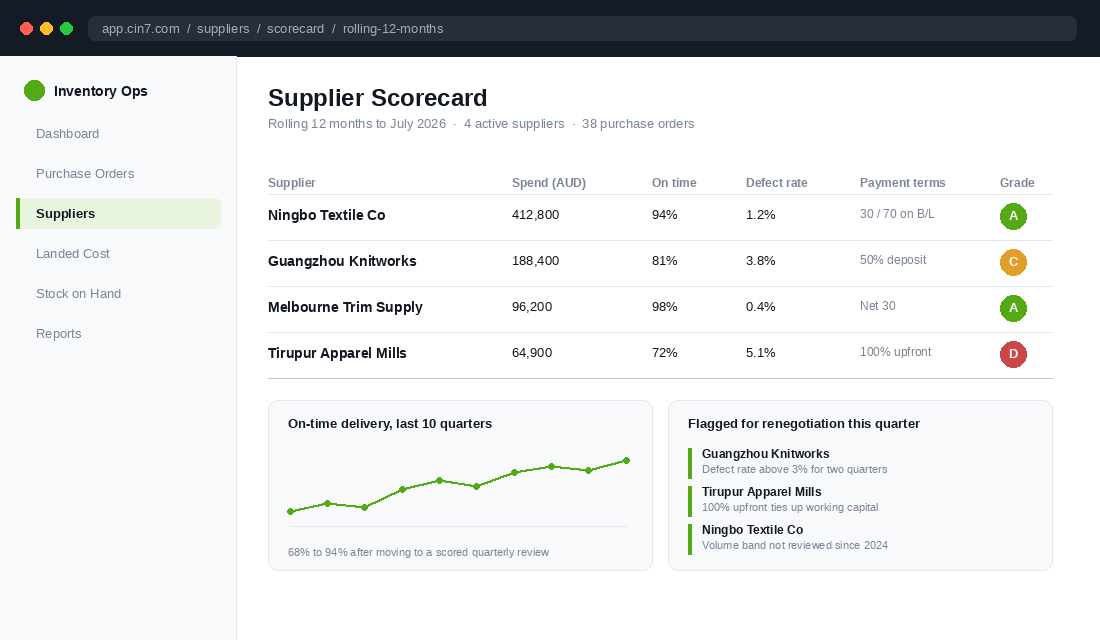
Quantify it once and the conversation changes completely. At 3.8% defects on 188,400 of annual spend, you are wearing about 7,160 in product cost alone, before you count the support hours and the freight both ways. Walk in with that figure and you are no longer complaining about quality. You are presenting an invoice.
What to ask for, in order of how easy it is to win:
- Free replacement units on the next production run for anything documented as a manufacturing fault, with photos and order references.
- A pre-shipment inspection you do not pay for once the defect rate goes above an agreed threshold, typically 2%.
- A defect allowance built into the price so the supplier ships 1,220 units and invoices 1,200. Factories often prefer this to a cash credit.
- Freight on returns to origin carried by the supplier where a whole batch fails.
Who Gives A Crap is worth studying here. They wanted to manufacture in Australia and found only a small number of recycled tissue producers locally, none of whom would partner with them. When they moved production offshore they did not pick on price. They chose a partner with an on-site recycling facility specifically because it gave them better quality control over the input. International sales now outstrip their Australian sales. Quality control was the selection criterion, and it turned into the thing that let them scale.
Lever 6: Trade Forecast Visibility, Not Loyalty
“We have been with you for four years” is not a lever. Your supplier has customers who have been with them for fourteen. Loyalty is table stakes and everyone claims it.
What a factory genuinely wants is certainty about the future, because uncertainty is what costs them money. Ardent Partners found the average procurement team sources only 44% of their addressable spend, while world-class teams get to 60%, and contract compliant spend sits at 59.5% average against 74.9% for the best. Translated into supplier language: most buyers are unpredictable, and the ones who are not get treated differently.
Things you can offer that cost you very little:
- A rolling twelve month forecast, updated monthly. Even a rough one. Sent on the same day each month so they can plan around it.
- Your product roadmap for the next two seasons so they can plan tooling and material sourcing rather than react to it.
- A reference or a case study they can use with other Australian brands. For a factory trying to win Western customers this has real commercial value.
- Consolidation. Moving a second product line to them, if they earn it. Read our second product line playbook before you promise that, because the wrong second line will cost you more than the discount returns.
The Prep Sheet You Build Before You Get On the Call
Never negotiate live off the top of your head. Build one page and hold it in front of you. It takes about two hours and it is the highest paid two hours in your year.
Six rows, five columns. One row per lever.
- The lever. Written as the specific change, not the goal. “Payment split from 30 / 70 to 30 / 40 / 30”, not “better terms”.
- Your opening ask. Deliberately above what you expect, but not so far that you lose credibility on the first sentence.
- Your walk-away. The point below which you would rather keep the current arrangement. Decide it before, never during.
- Annual value in dollars. Not a percentage. Percentages let you talk yourself out of things. A number does not.
- What you give for it. Every ask needs a matching offer. Volume, forecast, earlier deposit, a longer term, a reference.
Then order the rows by win probability and open with your second highest. Opening with your biggest ask invites a flat no that sets the tone. Opening with a small one you are confident of winning gets a yes on the board, and a supplier who has already said yes once is measurably more likely to say it again.
Two rules for the call itself. Never take the first improved offer, even a good one, because there is always a second concession behind it. And never negotiate the unit price first, because it is the number they defend hardest and the fight over it poisons everything else on the sheet.
Track It, or You Will Renegotiate the Same Thing Next Year
A concession you cannot measure is a concession that quietly disappears. The agreed 28 day lead time drifts back to 41 over three orders and nobody says anything, because nobody is looking.
Cin7 Core is the tool most Aussie operators in the 40k to 500k a month range land on, because it handles purchase orders, landed cost allocation and supplier performance in one place and sits behind Shopify rather than replacing it. As of March 2026 the published plans are USD 349 a month Standard, USD 599 Pro and USD 999 Advanced, and the Unleashed product starts from AUD 399 a month including GST. Budget realistically for setup: most Australian implementations land between 6,000 and 25,000 ex GST in consulting fees over three to twelve weeks.
Setting up the tracking takes an afternoon once the platform is live:
- Go to Settings, Reference Books, Additional Product Costs and create one cost type per line in your landed cost model: Ocean Freight, Terminal Handling, Customs Duty, QC Allowance, FX Spread.
- In Purchase, Advanced Purchase, turn on landed cost allocation and set the allocation method to by value for mixed cartons or by weight for single category shipments.
- On every purchase order, enter the additional cost lines straight from the forwarder invoice and the customs entry. Cin7 pushes the allocated figure into the average cost of the SKU, so your true cost updates automatically.
- Add three custom fields to the supplier record: Agreed Lead Time (days), Agreed Payment Split and Volume Band Review Date. These are the three things that silently drift.
- Schedule the Supplier Performance report to email you on the first Monday of each month, and add a variance column comparing actual receipt date against the agreed lead time.
- Pull defect quantities from Reports, Inventory, Product Movement Details filtered to your returns-to-supplier location, so the defect rate on your scorecard is a real figure rather than a feeling.
If a platform at that price is premature for where you are, a Google Sheet with one tab per supplier and the Shopify cost per item field kept current will get you 80% of the way. The tooling matters far less than the discipline of reviewing it quarterly.
Why Six Small Wins Beat One Big Ask
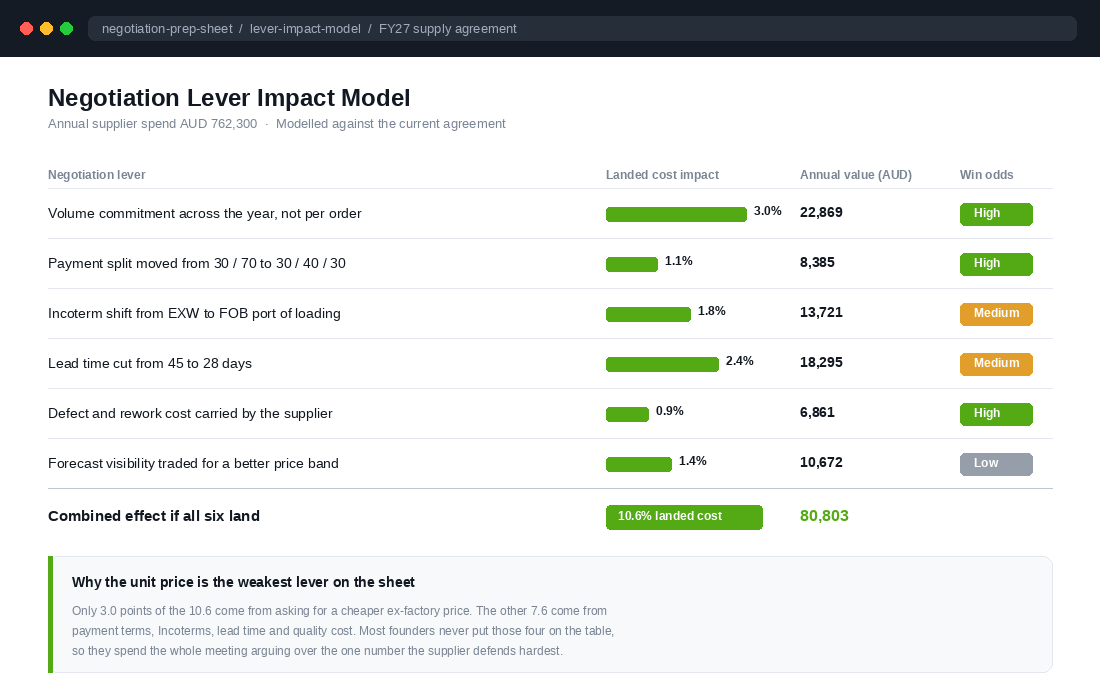
Run the six levers on a 762,300 annual spend and the arithmetic gets interesting. Volume commitment returns 3.0%. The payment split adds 1.1%. The Incoterm shift is worth 1.8%, the lead time cut 2.4%, defect cost 0.9%, and forecast visibility traded for a better price band another 1.4%.
That is 10.6% of landed cost, or roughly 80,800 a year. And only 3.0 of those 10.6 points came from asking for a lower ex-factory price. The other 7.6 came from four levers most founders never even put on the table.
Now put that back through the APQC relationship. A 10.6% cut in direct material cost is not a 10.6% margin story, it is closer to an eight point lift in EBITDA margin. There is no campaign, no app and no landing page test in your business that does that. And unlike a conversion win, this one does not decay when the traffic mix changes. It compounds every single unit you buy for the rest of the year.
The other thing that compounds is the relationship itself. A supplier who has agreed to six specific, measured terms is a supplier who now has skin in your growth. When freight rates spike 49% in a month, or a container gets rolled two weeks out from your biggest campaign, the buyer with a scorecard and a signed set of terms gets the phone call. The buyer who emails once a year asking for two per cent does not.
Book the call for six weeks out. Spend the first three building the landed cost breakdown and the scorecard, and the next three modelling the six levers with real dollar values. Then walk in with a page instead of a hope.
Better buying only shows up as profit if you are measuring the right number. Once you have won the cost back at the supplier, check what it actually did to your contribution margin per product, because that is the figure that tells you whether you can afford to scale spend behind the range.
Inside eCommerce Circle, supplier terms and cost of goods are one of the core pillars we work on with every member, because they move margin faster than almost anything else on the list. If you want a second opinion on yours before your next price review, let’s talk.