Most Aussie Shopify owners hire the same way. You get busy, you find someone good, you agree on an hourly rate that feels fair, and you start paying them. Nobody looks up an award. Nobody checks a classification level. The rate sounds generous, everyone is happy, and the business grows.
What’s in This Article
Then one of three things happens. A former employee makes a call to the Fair Work Ombudsman. Your accountant spots a super payment that landed late. Or you go to sell the business and the buyer’s lawyer asks for four years of payslips.
Here is why this matters more in 2026 than it did two years ago. Intentional wage underpayment became a criminal offence under the Fair Work Act on 1 January 2025. A company can be fined up to 8.25 million dollars, or three times the underpayment, whichever is greater. An individual can be fined up to 1.65 million dollars and face up to ten years in prison. That is not a fine you absorb. That is a business-ending event.
The good news is that this is one of the few problems in ecommerce with a definite right answer. Unlike your ad account or your conversion rate, employment compliance has a correct setting you can reach and then maintain. Here are the seven checks, in the order I would run them with a member.
Check 1: Work Out Which Award Actually Covers Each Role
This is the check almost every founder skips, and it is the one everything else depends on. Award coverage is decided by the nature of the work, not by whether you have a shopfront. Running online only does not put you outside the system.
For a typical Australian Shopify business you are usually looking at three awards.
- General Retail Industry Award (MA000004). Covers employees of online and mail-order retailers, including people picking, packing, dispatching and handling customer sales. If your warehouse is attached to or operated by the retail business, your pick and pack team usually sits here too.
- Storage Services and Wholesale Award (MA000084). Applies where you run a stand-alone warehousing or distribution operation rather than a fulfilment area inside a retail business. Bigger operations with dedicated 3PL-style facilities often land here.
- Clerks Private Sector Award (MA000002). Covers administrative and clerical work. Your bookkeeper, admin assistant and often your office-based coordinator.
Two things trip people up. First, one business can be covered by more than one award at the same time, because coverage attaches to the role, not the company. Second, some roles are genuinely award free, usually senior managers on a salary well above the award, but “I pay them well” is not the test on its own.
Once you know the award, you have to pick the classification level, which is where the real errors live. A pick and pack casual is not automatically Level 1. Someone who trains others, runs stock counts or handles cash is usually a level higher than the founder assumed.
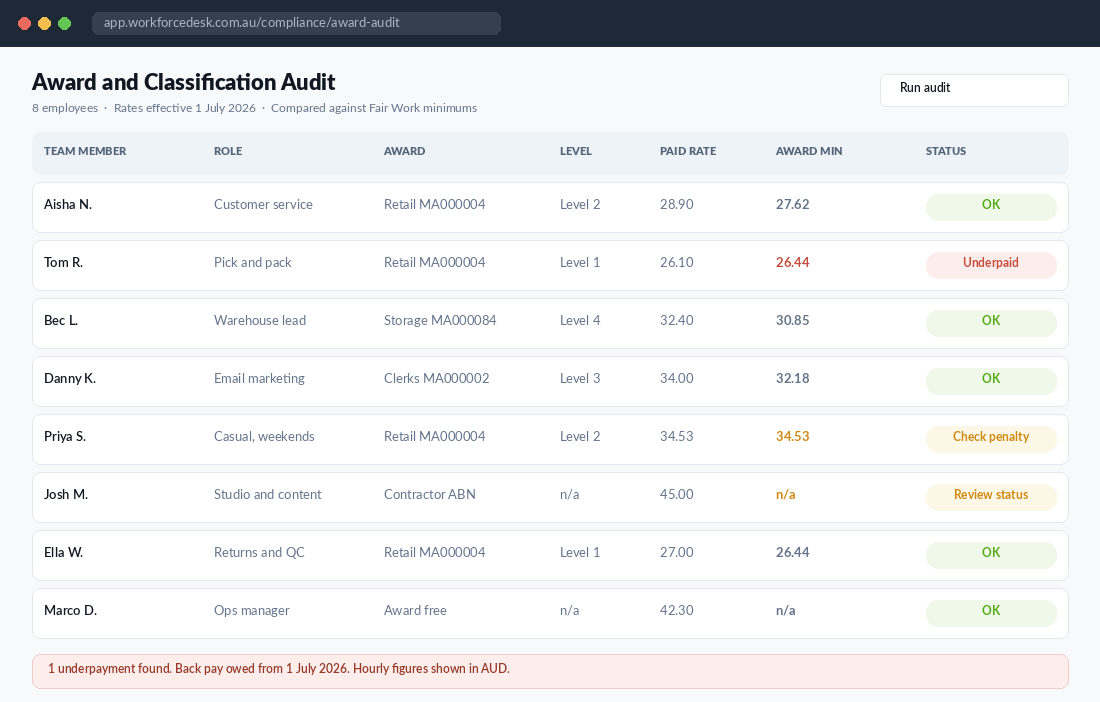
Do this in a spreadsheet this week. One row per person: name, role, award, classification level, employment type, hourly rate or annual salary. Use the Fair Work Ombudsman’s Pay and Conditions Tool to confirm the minimum for each row. It is free, it is the regulator’s own calculator, and it takes about ten minutes per person.
Check 2: Reset Every Base Rate Against the 1 July 2026 Minimums
Rates moved, and they moved hard. From 1 July 2026 the national minimum wage is 26.44 dollars an hour, or 1,004.90 dollars for a 38 hour week, after a 5.97% increase from the Fair Work Commission’s Annual Wage Review. Every modern award minimum rate went up 4.75% on the same date.
Think about what that means if you set a rate in 2024 and never touched it. A rate that comfortably cleared the minimum two years ago can be underneath it today, and you would have no idea, because nothing in Shopify or your payroll software tells you. The underpayment accrues quietly every fortnight.
The fix is a calendar entry, not a project. Put a recurring task on 1 July every year that says: pull the new award rates, compare every row in the audit sheet, adjust anything that is short, and back pay from 1 July. Do the same review whenever someone changes role, because a promotion usually changes the classification level.
If you find a historical shortfall, do not sit on it. Employers can self-report to the Fair Work Ombudsman and enter a cooperation agreement, and in those circumstances the Ombudsman may agree not to refer the conduct for criminal prosecution. There is also a safe harbour for small business: if you have fewer than 15 employees and you have complied with the Voluntary Small Business Wage Compliance Code, the Ombudsman must not refer suspected underpayments for criminal prosecution. Fixing it yourself is dramatically cheaper than being found.
Check 3: Penalty Rates and Loadings Are Where the Money Leaks
Base rate compliance is the easy half. The expensive half is everything layered on top, and ecommerce is unusually exposed because so much of the work happens outside ordinary hours.
- Casual loading. Currently 25% on top of the base rate under most awards. It is not optional and it does not replace penalty rates.
- Weekend and evening penalties. Under the retail award, work on Saturdays, Sundays and after certain hours attracts higher rates. If your dispatch crew smashes through a Sunday backlog at flat rate, that is an underpayment.
- Public holidays. The rate is significantly higher, and Australian ecommerce runs straight through several of them.
- Overtime. Triggered by hours beyond the ordinary span, and it applies to casuals too under most modern awards. “They agreed to it” does not switch it off.
- Minimum engagement. Most awards require a minimum shift length. Calling someone in for a 90 minute pick session can legally cost you three hours.
Peak trading is where this concentrates. If you are rostering extra hands across BFCM weekend or the December dispatch crunch, the penalty rate maths belongs in your labour budget before you commit to the roster, not after. We worked through the full staffing model in the Peak Season Staffing Playbook, and the compliance layer is the part most brands cost incorrectly.
One more trap. An annualised salary can absorb penalties and overtime, but only if it is properly structured and only if it passes a reconciliation. You have to check, at least annually, that the salary paid was at least what the person would have earned under the award for the hours they actually worked. Skip the reconciliation and the salary arrangement gives you no protection at all.
Check 4: Payday Super Changed Your Cash Flow on 1 July 2026
This is the change most Aussie founders have not fully absorbed yet, because it is quiet and it is operational rather than dramatic.
The super guarantee rate is 12% of ordinary time earnings, the final step of the legislated schedule that landed on 1 July 2025. That part is stable. What changed on 1 July 2026 is the timing. Under the payday super reforms, super contributions now move in step with the pay cycle rather than quarterly, and the contribution has to reach the employee’s fund within seven days of payday.
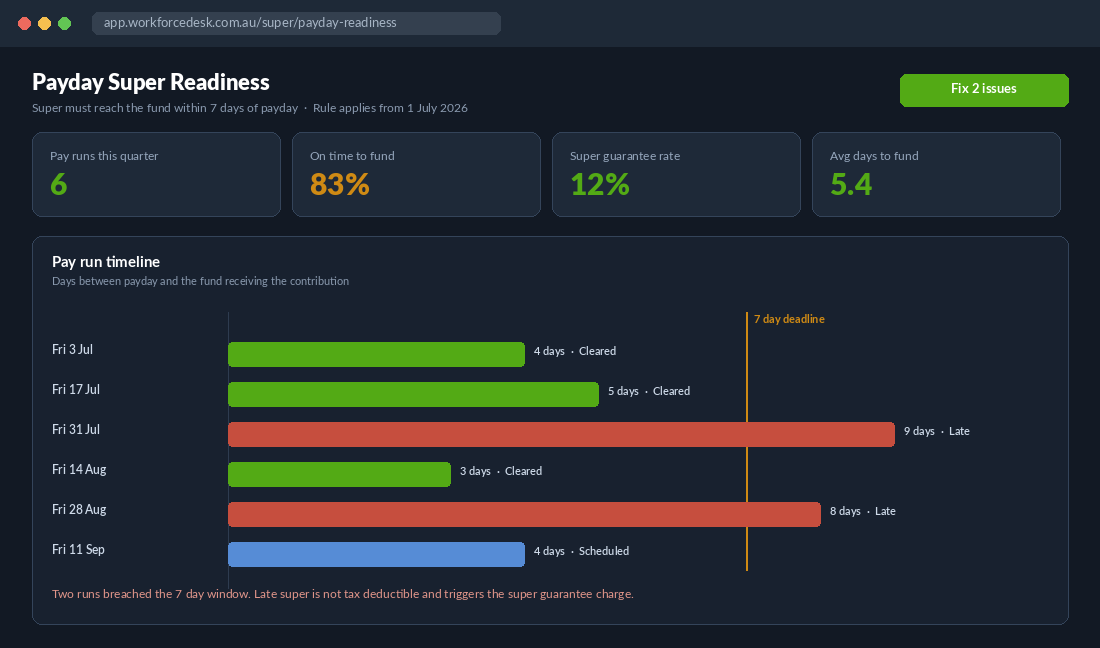
Read that timing point carefully, because it is the bit that catches people. The clock stops when the money lands in the fund, not when it leaves your account. A clearing house can take several business days. If you pay on a Friday and submit on the following Wednesday, you may already be outside the window.
Late super is expensive in a way that stings twice. It triggers the super guarantee charge, and unlike ordinary super contributions, it is not tax deductible. You pay more and you cannot claim it.
The cash flow consequence is real for an inventory business. Quarterly super let founders use that money as short-term working capital between BAS periods, often without consciously deciding to. That float is gone. If you have been buying stock with money that was always going to be super, rebuild your cash forecast now with super treated as a fortnightly outflow rather than a quarterly one.
Check 5: Test Every Contractor Against the Whole Relationship
Most Aussie Shopify teams run at least partly on ABNs. A VA on a retainer, a content person two days a week, a customer service contractor who has been with you eighteen months. Sometimes that is genuinely a contracting relationship. Often it is an employee with an invoice.
The test is not what the contract says. It looks at the real substance of the whole relationship: who controls how and when the work is done, whether the person can delegate to someone else, who carries the commercial risk, who supplies the tools, whether they work for anyone else, and whether they are presented to the outside world as part of your business.
Get it wrong and the bill is not just back pay. You are exposed to unpaid super, unpaid leave entitlements, payroll tax in some states, and sham contracting penalties on top. The person who does forty hours a week only for you, on your systems, under your direction, with no ability to send a substitute, is very likely an employee no matter what the invoice header says. We break the whole test down signal by signal in Contractor or Employee, and if you have anyone on an ABN, that is the next thing to read.
Check 6: Answer Casual Conversion Notices Within 21 Days
The employee choice pathway replaced the old casual conversion regime, and it puts the initiative with the employee rather than the employer.
A casual can give you written notice that they want to move to permanent employment once they have been employed for at least six months, or twelve months if you are a small business employer. Small business employers with 15 or fewer employees have been in scope since 26 August 2025, so there is no longer a category of Australian ecommerce business this does not touch.
Your obligation is specific and time-bound. You must respond in writing within 21 days. You can only refuse on defined grounds: the person still genuinely meets the casual definition, there are fair and reasonable operational grounds, or accepting would breach a required recruitment or selection process. “It does not suit us right now” is not one of them.
Practically, do two things. Set up a shared inbox or a single owner for these notices so one does not sit unread in someone’s personal email while the 21 days runs out. And write the response template now, while nothing is urgent, with the three refusal grounds spelled out so whoever answers is not improvising under time pressure.
Check 7: Keep Seven Years of Records, Because the Burden of Proof Flipped
Employers must keep employee records for seven years and issue payslips within one working day of payday. That is the boring version. Here is the version that should get your attention.
If you fail to keep proper records or issue payslips, and someone later alleges an underpayment, the burden of proof shifts to you. You have to disprove the allegation. Without records, you usually cannot. In practice a missing timesheet folder converts a contested claim into a claim you lose by default.
What you actually need on file for each person: employment type and start date, the award and classification you have assigned, the rate paid and every change to it, hours worked including start and finish times for casuals and anyone entitled to penalties or overtime, leave accrued and taken, super contributions with fund details and payment dates, and any written agreements including annualised salary arrangements and their reconciliations.
The single highest-value habit here is time capture. If your casuals are not clocking in and out through a system, you are relying on memory to defend a claim years later. Rostering software that timestamps shifts is not a nice-to-have once you have more than two or three casuals. It is your evidence.
The Tool Stack That Makes This Boring
You do not need enterprise HR software to run a compliant eight person team. You need three things wired together.
- The Fair Work Pay and Conditions Tool. Free, run by the regulator. Use it to confirm award, classification and applicable penalty rates. This is your source of truth, not a blog post and not what another founder told you.
- Rostering and time capture. Deputy is the common Australian choice. It timestamps shifts, enforces minimum engagement rules and exports approved hours straight into payroll.
- Payroll with award interpretation. Employment Hero Payroll and Xero Payroll both handle award rules, penalty calculations, super and single touch payroll reporting.
Setting up Deputy properly takes an afternoon. Create one location per physical site including your warehouse, then create an area for each function such as pick and pack, customer service and studio. Assign the correct award and classification level to each employee inside their profile rather than leaving it blank. Turn on the setting that requires employees to clock in and out from a fixed device or with location capture, because a self-reported timesheet is weaker evidence. Set the minimum shift length for each area to match the award. Then connect the payroll integration and run one pay cycle in parallel with your existing process, comparing the two outputs line by line before you switch over.
Budget roughly a day of your time and a few hundred dollars a month across the stack for a team of this size. Compare that against three times an underpayment.
The Compliance Scorecard You Run Every Quarter
Copy these seven rows into a sheet. Review them on the first Monday of every quarter, and always on 1 July. Green, amber or red against each one, with a named owner and a date.
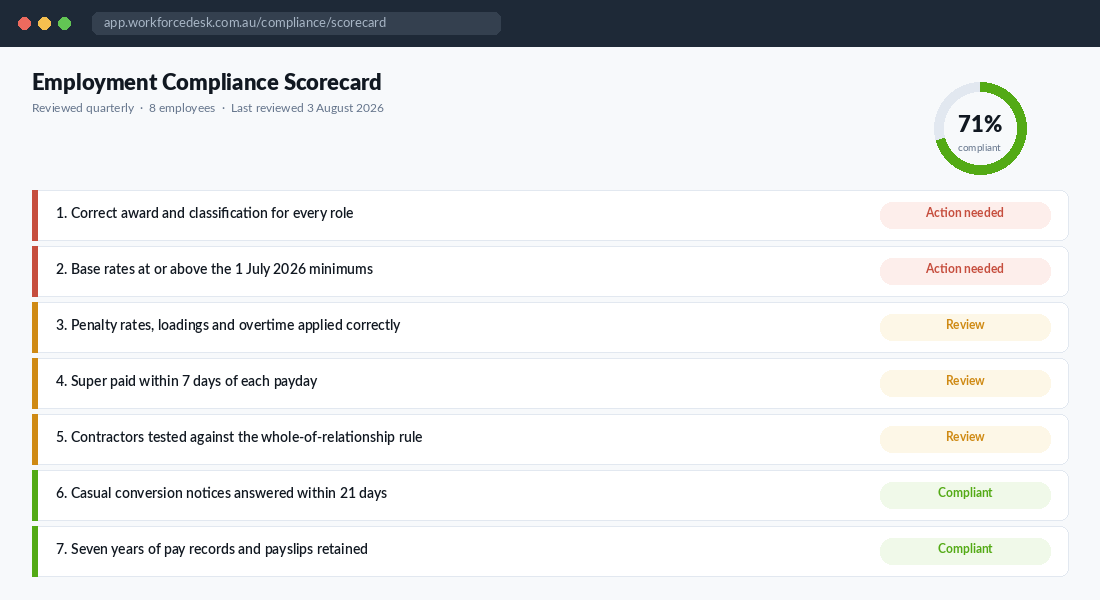
- Award and classification correct for every role. Re-check whenever anyone changes duties, not just when they change title.
- Base rates at or above current minimums. Hard deadline of 1 July each year.
- Penalties, loadings, overtime and minimum engagement applied. Spot check two payslips against the Pay and Conditions Tool every quarter.
- Super reaching funds within seven days of payday. Check the fund receipt date, not the submission date.
- Every contractor tested on the substance of the relationship. Re-test annually, because relationships drift toward employment over time.
- Casual conversion notices answered in writing within 21 days. One named owner and a template ready.
- Seven years of records and payslips retained. Including timestamped hours for every casual.
If you only do three, do numbers one, two and four. Award and classification is the foundation everything else sits on, the annual rate reset is the failure that compounds silently, and payday super is the one that changed most recently.
Why This Compounds More Than It Looks
Each check on its own looks like admin. Together they change three things about your business, and only one of them is about avoiding penalties.
The first is risk. A misclassification does not cost you once. It costs you every fortnight, silently, until someone finds it, and then it costs you retrospectively across every affected person for the whole period. A small error found in year one is a few thousand dollars. The same error found in year four, across four people, with super and interest and penalties on top, is a number that can take the business down.
The second is your ability to hire well. Good operations people in Australian ecommerce ask about award coverage, rostering systems and how leave is handled. A founder who can answer those questions in one sentence looks like someone worth working for. A founder who says “we keep it pretty casual” tells an experienced candidate exactly what the next two years will feel like. If you are about to bring on your first proper hire, get this settled before you post the ad, not after, and pair it with the First Hire Playbook.
The third is what the business is worth. Employment liabilities are one of the first things a buyer’s adviser looks for, because they are quantifiable, they survive the sale and they are easy to find. Clean records with a documented quarterly review is a line item that disappears from due diligence. Undocumented ABN arrangements and no timesheets is a price reduction or an indemnity you carry for years.
Start with the audit sheet. One row per person, this week. Most founders who run it for the first time find one thing wrong, and it is nearly always cheaper to fix on a Tuesday morning than to explain later.
This is general information for Australian Shopify operators, not legal advice. Employment law turns on the specifics of each role, so confirm your position with the Fair Work Ombudsman or an employment lawyer before you make changes.
Inside eCommerce Circle, getting the team structure right is one of the core pillars we work on with every member, because most founders stay the bottleneck far longer than they need to. If you want a second opinion on how your team is set up, let’s talk.