Every year the same thing happens. You spend August and September obsessing over inventory, creative and offers. You build a beautiful BFCM campaign calendar. Then the orders land, and the whole thing bottlenecks at a folding table in your warehouse where two people are trying to pack 600 parcels a day with a label printer that keeps jamming.
What’s in This Article
Australians spent a record 6.8 billion dollars over the Black Friday to Cyber Monday weekend in 2025, up 4% on the year before, and online sales across the broader two-week window climbed 9.3% to hit 8 billion. Australia Post moved almost 111 million parcels across November and December, up 7.6% year on year, peaking at more than 3 million parcels in a single day on 8 December. That is 3,075 parcels every minute for over a month.
Here is what most founders get wrong. They treat peak season staffing as a November problem. It is an August problem. The brands that come out of December with their margin intact and their team still speaking to each other started the staffing conversation while everyone else was still arguing about discount depth.
This is the 5-phase system we run with founders inside eCommerce Circle. It turns a revenue forecast into a headcount plan, an onboarding schedule and a peak operating rhythm, so the busiest six weeks of your year do not depend on you personally packing boxes until 11pm.
Phase 1: Convert Your Revenue Forecast Into Labour Hours (August)
A revenue forecast is useless for staffing. “We want to do 400k in November” tells you nothing about how many humans you need on the floor. You need to convert dollars into three separate load numbers: orders, support tickets and pick hours.
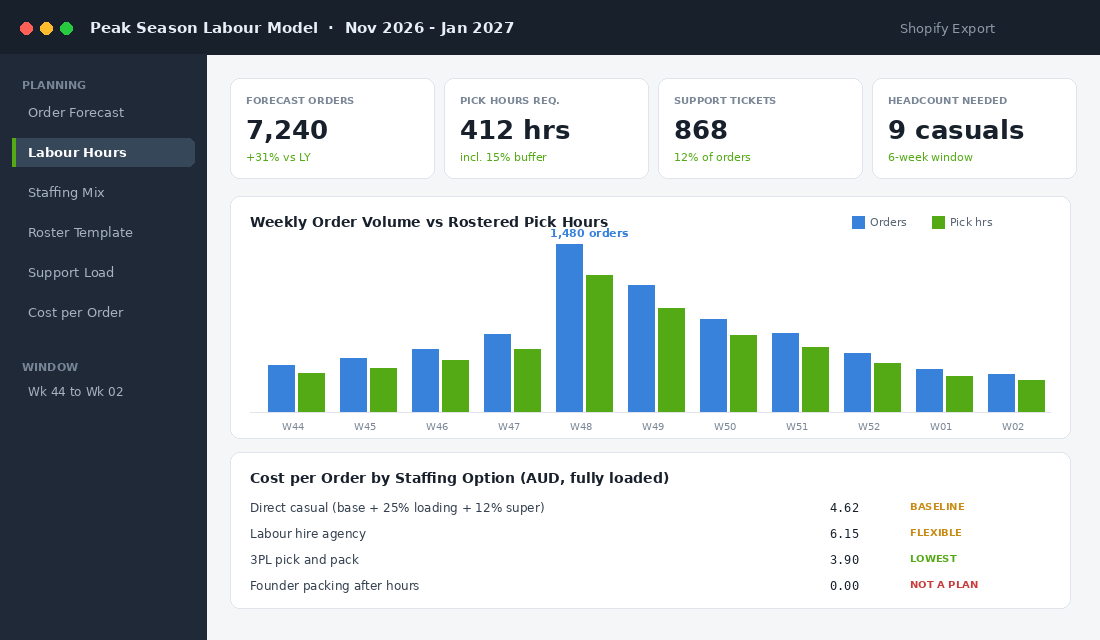
Start with orders. Take your forecast revenue for each week of the peak window and divide by your expected AOV during that window. Note that AOV usually drops during BFCM because discounting pulls the average down, so if your normal AOV is 120 dollars, model peak at 100 to 110 unless you are running a genuine bundle strategy. Fewer dollars per order means more orders per dollar, which means more labour.
Then convert orders into pick hours using your own throughput data, not an industry average. Pull your last BFCM: how many orders did you dispatch, and how many total warehouse hours were paid that week? That gives you your real orders-per-hour rate. Most small Aussie operations sit somewhere between 12 and 25 orders per person per hour depending on SKU count, pick path and whether you are gift wrapping.
- Weekly order forecast. Revenue divided by peak-adjusted AOV, week by week from the first week of November to the second week of January.
- Pick hours required. Orders divided by your real orders-per-hour rate, then add 15% for restock, returns processing and the inevitable reprint.
- Support ticket load. Model tickets at 8 to 15% of order volume during peak. Anything above 15% is a signal your delivery promise or your product pages are not doing their job.
- Dispatch cut-off pressure. Map your courier pickup times against your pick hours. If you need 60 hours of picking done before a 2pm daily pickup, you cannot staff that with one shift.
This is the single most valuable hour you will spend all quarter. Once you have a weekly labour hours number, every staffing decision that follows becomes arithmetic instead of anxiety. Pair this with your BFCM inventory planning so your stock arrival dates and your labour ramp are on the same timeline.
Phase 2: Choose Your Staffing Mix Before You Advertise a Single Role (September)
You have four levers, and most founders only ever pull one. Pulling the right combination is what protects your contribution margin through December.
- Direct casuals. You hire, you induct, you roster, you pay. From 1 July 2026 the National Minimum Wage is 26.44 dollars an hour, and casuals get a 25% loading on top, taking the floor to 33.05 dollars an hour before penalty rates. Check your actual modern award, because most warehouse and retail awards sit above the national floor.
- Labour hire. You pay an agency a marked-up hourly rate and they carry the recruitment, payroll and replacement risk. More expensive per hour, dramatically cheaper if you would otherwise burn recruitment cycles. Warehouse casual turnover in Australia runs at 60 to 90% annually, and each turnover event costs 2,000 to 4,000 dollars in recruitment and ramp-up.
- 3PL overflow. Australian 3PL pick-and-pack sits around 2 to 5 dollars per order in 2026. Run the maths against your fully loaded internal cost per order. Many founders discover their in-house cost is higher than they assumed once loading, super and supervision are counted.
- Automation instead of headcount. Every ticket your helpdesk deflects is a support hour you do not have to buy. Gorgias reports that brands pushing automation past 60% nearly tripled ticket volume while human hours grew just 6%.
Do not forget superannuation. The Super Guarantee is 12% of ordinary time earnings and casuals are entitled to the full rate with no minimum earnings threshold. More importantly, Payday Super starts 1 July 2026: contributions must reach the fund within 7 business days of each payday, not quarterly. If your cash flow model assumed you could sit on super until January, rebuild it now.
A practical rule of thumb: use direct casuals for your baseline peak load, labour hire for the volatile top 20 to 30%, and a 3PL relationship for genuine overflow. If you are considering the 3PL route, read our breakdown of when a 3PL actually beats in-house fulfilment before you sign anything.
Phase 3: Hire and Onboard in October, Not November
Amazon’s Australian arm recruits its seasonal pick and pack workforce in October, bringing on around 1,800 extra people before the festive peak. Not because they are slow, but because a body on the floor in November who has never picked an order is a liability, not capacity. An untrained picker in week one is roughly 40 to 50% as productive as a trained one, and they slow down the person supervising them.
The 3PL industry standard is to lock forecasts and staffing plans with partners 60 to 90 days before Black Friday. Apply the same standard internally. Your last sensible hire date is the second week of October.
Australian hiring data shows 15 to 30% of new hires leave or are separated within the first 12 months, and a bad permanent hire costs between 30 and 150% of first-year salary. For a six-week casual you will not feel that full number, but you absolutely feel it as a hole in your roster on the Monday after Black Friday.
Three things make peak hiring work:
- Hire 20% more than your model says. Some will not show. Some will not last. Over-hiring by a fifth is cheaper than a missed dispatch cut-off on Cyber Monday.
- Run a paid trial shift in late October. Two hours on a real (quiet) picking session tells you more than any interview. Pay them properly for it.
- Write the SOPs before they arrive. A casual should be able to pick, pack and dispatch from a laminated one-pager without asking you a question. If your process only exists in your head, you have not hired help, you have hired a second job for yourself.
This is where a documented process library earns its keep. Our 25-SOP library covers the pick, pack, returns and escalation procedures most stores need. Build them in September, test them in October, rely on them in November.
Phase 4: Install a Peak Operating Rhythm (November)
Peak season breaks businesses that run on ad hoc decisions. What you need is a cadence so tight that nobody has to ask what happens next.
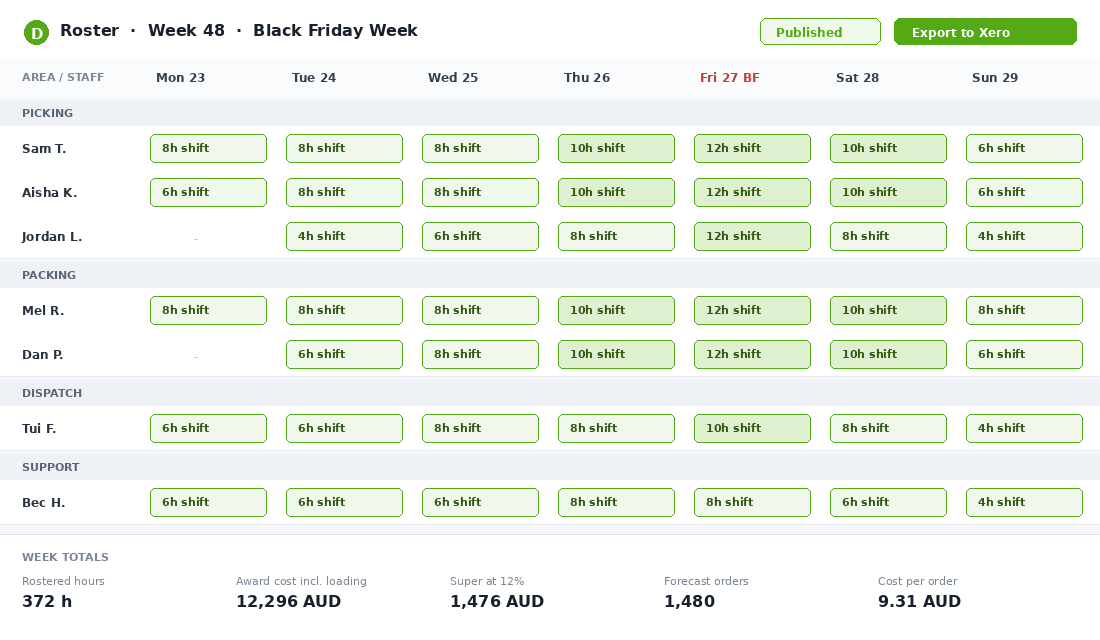
The tool that solves most of this for Australian operators is Deputy. It handles rostering, shift swaps, time and attendance, and (critically) award interpretation, so a casual working a Sunday penalty rate on top of their 25% loading is calculated correctly instead of by you at midnight in a spreadsheet. It syncs to Xero, MYOB and QuickBooks for payroll.
Setting it up takes about an afternoon:
- Create your Location and set the physical address, then define Areas (Picking, Packing, Dispatch, Support) so you can roster by function rather than by name.
- Add each casual, assign their modern award and classification level, and let Deputy pull the correct base rate, loading and penalty structure.
- Connect your payroll system under Integrations so approved timesheets export straight through without rekeying.
- Build a template roster for a standard peak week, then copy it forward across November and December and adjust for known spikes.
- Turn on shift acknowledgement and geo-fenced clock-in so you know before 7am who is actually turning up.
Alongside the tooling, run a fixed daily rhythm through the peak weeks:
- 7:45am huddle, 10 minutes standing up. Yesterday’s dispatched count, today’s target, anything blocking (stock, packaging, printer).
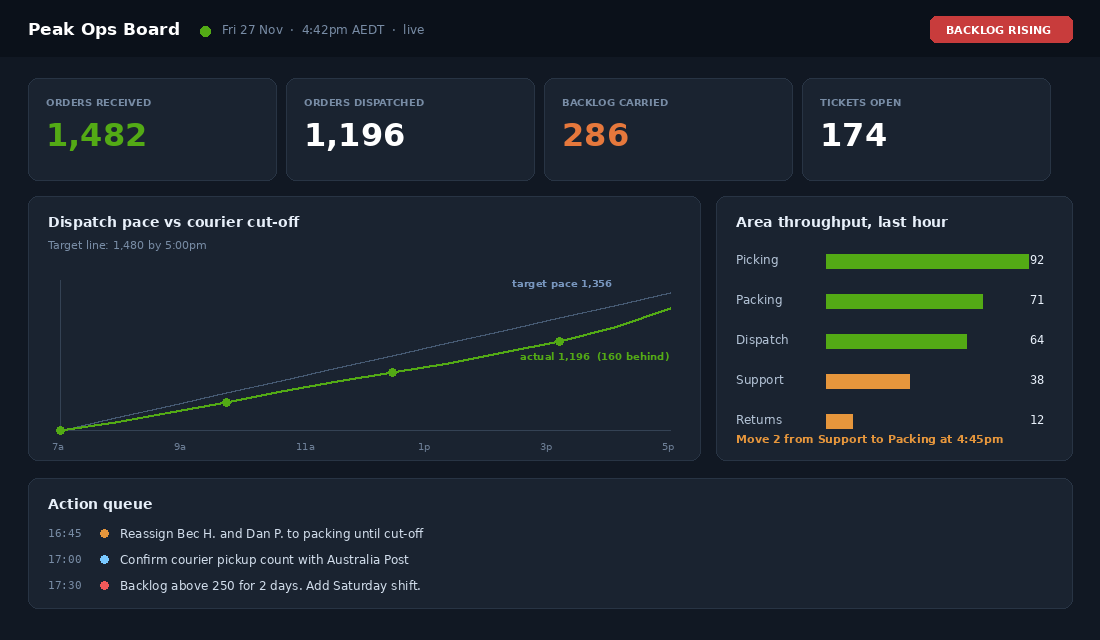
- Midday checkpoint. Are we on pace for the courier cut-off? If not, who moves from support to packing for two hours?
- End of day board. Orders received, orders dispatched, backlog carried, tickets open. Four numbers, written where everyone can see them.
- Sunday reset, 30 minutes. Next week’s roster confirmed, packaging stock counted, one process fixed.
The backlog number is the one that matters. If orders received exceeds orders dispatched three days running, you have a capacity problem that will become a customer service problem in about five days and a review problem in about ten.
The Support Desk Is the Half of Peak Staffing Everyone Underestimates
Founders model warehouse labour and then forget that every parcel creates a potential conversation. Support volume does not just scale with orders during peak, it scales faster, because delivery anxiety climbs as Christmas gets closer and the same customer will email twice about the same order.
Two thirds of your peak tickets will be the same four questions: where is my order, can I change my address, does this arrive before Christmas, and how do I return it. Every one of those is answerable without a human if you do the work in October.
- Publish cut-off dates everywhere, in writing. A dated banner, a line on every product page, and a line in the order confirmation email. Vague delivery language is the single biggest generator of peak tickets.
- Automate order status. A self-service tracking page and an automated “where is my order” flow in Gorgias, Zendesk or Re:amaze removes the highest-volume ticket type entirely. Brands running automation above 60% grew ticket volume nearly threefold while human support hours rose just 6%.
- Write 15 canned replies in October. Not 50. The top 15 cover the vast majority. A casual with a good macro library handles peak support after two hours of training.
- Set an honest response-time expectation. An auto-reply saying “we reply within 48 hours during our Black Friday sale” beats silence and stops the follow-up email that doubles your queue.
Roster support the same way you roster the warehouse: named person, named hours, named backup. The failure mode we see most often is a support inbox that is technically everyone’s job on 25 November, which means it is nobody’s job by 27 November.
Phase 5: Wind Down Deliberately and Keep the Good Ones (December to January)
Most founders let peak staff simply evaporate in late December. That is a wasted asset. You have just spent six weeks training people on your product, your systems and your standards, and warehouse casual turnover already runs at 60 to 90% annually across the industry. Being deliberate here is a genuine competitive advantage.
January is not quiet, either. Returns land, and for apparel and gifting brands the January returns wave can consume a third of the labour that December dispatch did. Roster for it.
- Rank everyone in week three of December. A, B or C on reliability, speed and attitude. Do it while it is fresh.
- Make an offer to your A players before they leave the building. Ongoing casual shifts, a part-time role, or first call for next peak. The conversation costs nothing.
- Keep 30 to 40% of peak capacity through the second week of January to absorb returns and restocking.
- Run a 45-minute debrief in the first week of February. What broke, what held, what you would hire differently. Write it down and put it in the calendar for next August.
Brands like Hismile on the Gold Coast run this as standard practice, with teams across operations and marketing rostered into warehouse support during peak windows, then returned to their core functions. Who Gives A Crap built the same muscle as it scaled from a small Melbourne team to shipping into more than 30 countries. The pattern is the same at every size: treat the peak workforce as a repeatable asset, not a one-off panic hire.
Why the Five Phases Compound
Each phase looks like an operational chore on its own. Run together, they change the economics of your biggest trading period.
Phase 1 gives you a labour hours number, which means Phase 2 becomes a cost comparison instead of a guess. Because you decided your mix in September, Phase 3 lets you hire in October at normal market rates rather than bidding against every other retailer in the country in the second week of November. Because you hired early, Phase 4’s operating rhythm runs with trained people who already know your pick path, so your daily huddle is about numbers instead of instructions. And because the peak ran smoothly, Phase 5 gives you A players who will come back next year, which shrinks Phase 3 for the following season.
That last loop is the whole point. The founder doing this for the third year is hiring returning casuals in October at a fraction of the recruitment cost, with SOPs already written and a roster template already built. The founder doing it for the first year is on Gumtree on 20 November paying a premium for whoever is available.
Meanwhile the market keeps getting heavier. 3.1 million Australian households shopped online during the 2025 Black Friday window, up 9.2%, and Australia Post’s parcel volumes were up 23% year on year in the peak week. Demand is not the constraint for most Aussie Shopify brands. Throughput is.
Your Peak Season Staffing Checklist
Copy this into a doc and work backwards from Black Friday. Every item has a month attached for a reason.
- August week 1. Build the weekly order forecast for November to mid-January using peak-adjusted AOV.
- August week 2. Calculate your real orders-per-hour rate from last year’s payroll and dispatch data.
- August week 3. Convert to weekly pick hours plus 15% buffer. Model support tickets at 8 to 15% of orders.
- September week 1. Price all four options: direct casual (base plus 25% loading plus 12% super), labour hire, 3PL per order, automation.
- September week 2. Lock the mix. Confirm 3PL capacity and forecasts in writing, 60 to 90 days out.
- September week 3. Rebuild the cash flow forecast for Payday Super timing on all peak wages.
- September week 4. Write or refresh the pick, pack, dispatch and returns SOPs.
- October week 1. Advertise roles. Target 20% above modelled headcount.
- October week 2. Final hire date. Anyone after this is a bonus, not a plan.
- October week 3. Paid trial shifts. Rostering tool configured with awards and payroll integration.
- October week 4. Full dress rehearsal day at forecast peak volume. Find the bottleneck now.
- November. Daily huddle, midday checkpoint, end-of-day board, Sunday reset. Track backlog daily.
- December week 3. Rank every casual A, B or C. Make offers to the A players.
- January weeks 1 to 2. Retain 30 to 40% of peak capacity for the returns wave.
- February week 1. Debrief. Write the changes. Diarise the whole checklist for next August.
None of this is glamorous. It is a spreadsheet, a roster and four numbers on a whiteboard. But the difference between a peak season that adds 30% to your annual profit and one that adds stress, refunds and a stack of one-star reviews is almost never the campaign. It is whether the operation behind the campaign could carry the load.
Inside eCommerce Circle, peak season planning is one of the core pillars we work on with every member, and staffing is the part most founders leave until it is too late to fix. If you want a second opinion on your November plan while there is still time to change it, let’s talk.