You paid a creator $800 for a reel. It did 140,000 views on her account, drove 60 clicks to your store, and then it died. Three weeks later you are back in Ads Manager wondering why your cost per purchase keeps climbing while your creative budget keeps growing.
What’s in This Article
Here is what most Aussie Shopify brands do next. They download the video, strip the creator’s audio, upload it to their own ad account, and run it from the brand handle. It works for about a fortnight. Then the CPM creeps up, the comments dry up, and the creative gets retired as another failed test.
The brands beating you on CAC are running the exact same video from the creator’s handle instead of theirs. In a 90-account benchmark, whitelisted creator ads beat brand-page UGC ads by 20 to 35% on cost per acquisition, and Meta’s own partnership ad data shows a 19% lower CPA, a 53% higher click-through rate and 71% higher brand lift against standard delivery. Same asset. Same audience. Different name at the top of the post.
What Whitelisting Actually Is, and Why Meta Renamed It
Whitelisting is the arrangement where a creator gives your ad account permission to run paid ads that appear to come from their handle. The post shows their name, their profile photo, their follower count and their comment history. Your pixel, your budget, your targeting, your landing page.
Meta has folded this into Partnership Ads (previously called branded content ads). TikTok calls its version Spark Ads. The mechanics differ slightly, the outcome is the same: the ad borrows the trust of an account your customer already follows.
Why it works is not complicated. A person scrolling has a trained reflex for brand handles. The logo appears, the brain files it as an ad, the thumb keeps moving. A creator handle does not trigger that reflex in the same way, and the engagement history already attached to the post gives the algorithm a stronger starting signal. Posts amplified through the creator handle have shown roughly a 4.4x lift in CPM efficiency over the identical post run from a brand account.
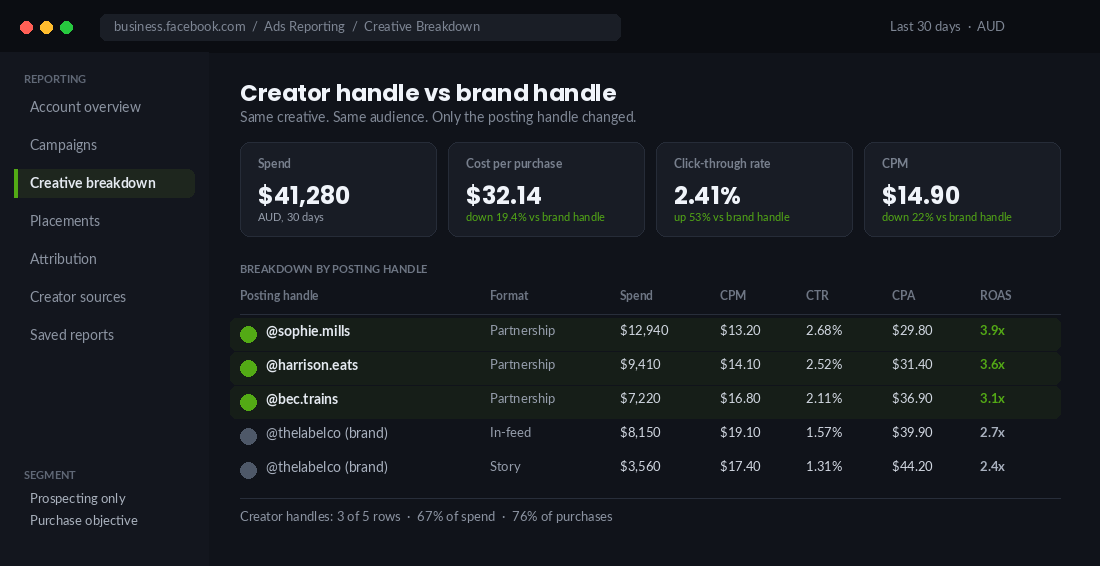
TikTok tells a similar story. TikTok’s own documentation puts Spark Ads at 69% higher conversion than standard in-feed ads, and a cross-platform analysis of more than 310,000 TikTok ad sets found Spark Ads averaging 6.1% engagement versus 2.5% for standard in-feed placements, with a 134% higher completion rate.
None of that is free. Whitelisting adds a rights fee, an admin burden and a compliance obligation. The six layers below are how you capture the performance without inheriting the mess.
Layer 1: Pick Creators on Save Rate, Not Follower Count
The single most expensive mistake in this whole system is paying rights fees to the wrong creator. A 200,000 follower account will quote you four to six times what a 15,000 follower account quotes, and will very often perform worse when you put money behind it.
Follower count measures reach the creator already gets for free. You are not buying reach. You are buying reach at your budget, so what you actually need is a signal that predicts how a piece of content behaves when a cold audience sees it.
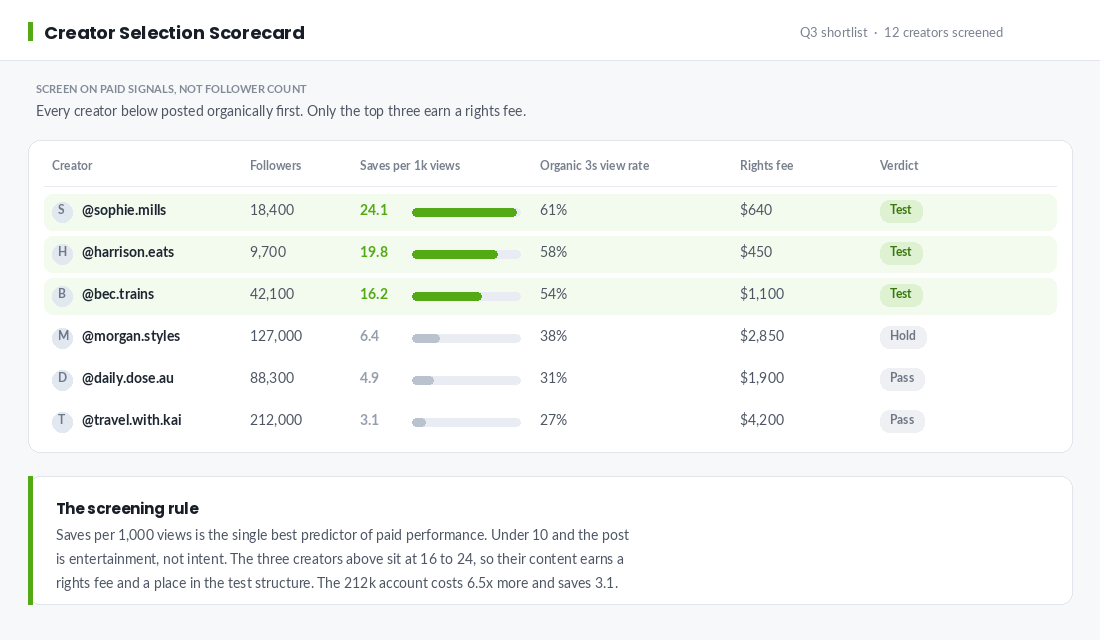
The best free proxy is saves per 1,000 views on their organic content. Saves mean intent. Somebody watched, decided the thing was worth returning to, and filed it. Likes are politeness. Saves are consideration.
- Under 10 saves per 1,000 views. Entertainment content. It will get views and no purchases. Pass.
- 10 to 15. Borderline. Worth a single gifted post to see how the content lands before you pay for rights.
- 15 and above. This is your shortlist. Pay for the content, pay for the rights, and put budget behind it.
Run the second screen on the first three seconds. Ask for a screenshot of their analytics showing the organic 3-second view rate on their last five posts. Anything above 50% means their hooks work on people who do not follow them, which is exactly the audience your prospecting budget will buy.
Bondi Sands built its creator programme by hand-picking talent across Australia, New Zealand, the UK and the US rather than chasing the biggest available accounts, and Frank Body famously grew on the back of customer and creator content rather than polished studio work. Both prove the same point: fit and content quality outrank audience size every single time.
Layer 2: Build the Permission Chain Before You Build the Campaign
This is where most brands lose a week. Partnership ads need three separate permissions to line up, and they are granted in three different places. Miss one and your ad sits in review or simply refuses to publish.
Here is the exact sequence for Meta. Do it in this order.
- Creator turns on branded content tools. In their Instagram app: Settings, then Creator tools and controls, then Branded content. They add your business account to their approved partners list.
- Creator grants partnership ad permission. Same menu, the option to allow your brand to promote their content. This can be granted per post or as standing permission with an expiry date. Ask for standing permission with a date, not per post, or you will be chasing them every time you want to test a new cut.
- Creator tags your brand as a paid partner on the post. Advanced settings on the post itself, then the paid partnership label. Without this label the post cannot be used as a partnership ad, and under Australian rules it should carry the label anyway.
- You claim it in Ads Manager. Create your ad, choose Use existing post, switch to the Partnership ad tab, and paste the creator’s post ID or select the post from your approved partners list.
- You set the creator as a co-authored source if you want dual delivery. This lets the ad serve to both the creator’s audience signals and your own custom audiences.
For TikTok the equivalent is the ad authorisation code. The creator goes to their post, taps the three dots, selects Ad settings, turns on Ad authorisation, sets a duration of 7, 30 or 60 days, and sends you the generated code. You paste it into TikTok Ads Manager under Spark Ads. Note the ceiling: TikTok caps a single authorisation at 60 days, so a long-running winner needs a diarised renewal.
If you are running more than about six creators at once, the manual chase becomes the bottleneck. Tools like Superfiliate and Lumanu handle the permission requests, the code collection and the expiry reminders in one place. Below six creators, a shared spreadsheet and a calendar reminder does the job for nothing.
Layer 3: Price the Rights Properly, Then Track the Expiry
Creator rate cards separate the content fee from the usage fee, and if you do not ask about usage upfront you will get an awkward invoice later. The market rates are reasonably consistent.
- 30 day usage window. Typically 20 to 50% on top of the base content rate.
- 60 day window. 50 to 75% on top.
- 90 day window. 75 to 100% on top.
- Editing rights (adding overlays, changing captions, cutting new versions) add another 25 to 50%.
- Perpetual rights commonly price at three to five times the base fee. Almost never worth it for a Shopify brand, because the creative fatigues long before the licence does.
In monthly terms, a micro creator between 10,000 and 100,000 followers usually sits between $150 and $500 a month for whitelisting access. Mid-tier accounts between 100,000 and 500,000 run $500 to $2,000. Budget those figures in AUD and remember that Australian creators registered for GST will add 10% on top, which needs to sit in your customer acquisition cost, not your general overhead.
A workable split for a creator budget is roughly 50 to 60% on creator fees, 20 to 30% on usage rights and amplification, 10 to 15% on platform or agency costs, and 5 to 10% held back as contingency. If your rights line is sitting near zero, you are not running whitelisting. You are running gifting and hoping.
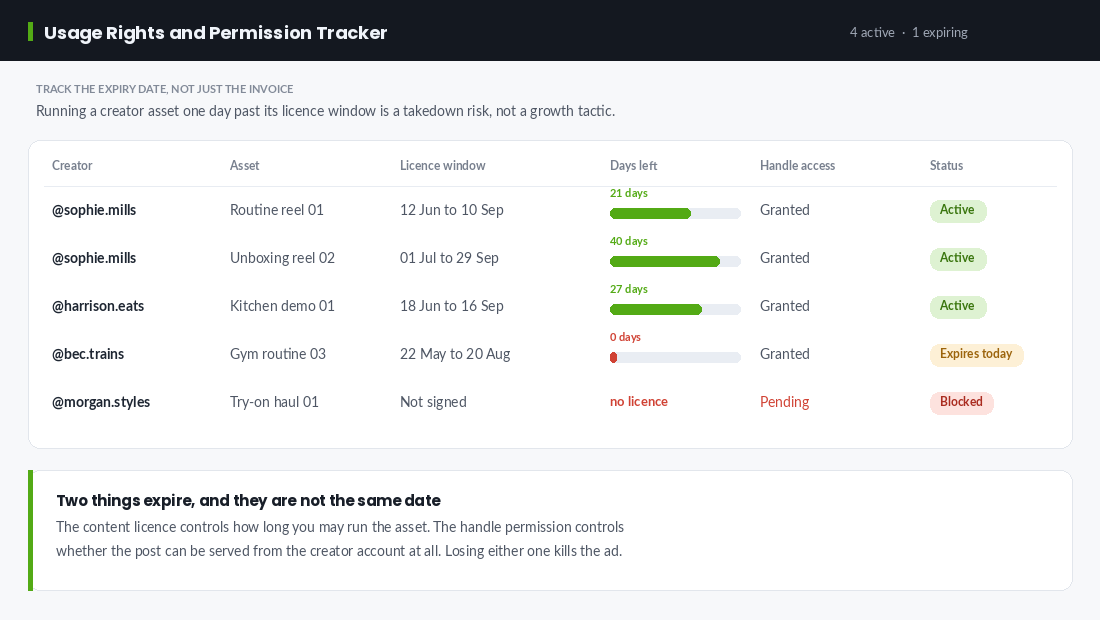
Two clocks run at once and they rarely share a date. The content licence governs how long you may run the asset. The handle permission governs whether the ad can serve from the creator’s account at all. A creator can revoke handle access in two taps without telling you, which kills a live ad set mid-flight. Track both dates in one sheet, and set a reminder 14 days before the earlier of the two.
Layer 4: Disclose It Properly, or the Regulator Will Do It For You
Australia is no longer a soft jurisdiction on this. The AANA Code of Ethics requires that a commercial relationship be clear, obvious and upfront to the audience, expressed in plain language such as #ad, Advertising, Paid Partnership or Branded Content. The Australian Consumer Law sits underneath it and prohibits misleading conduct.
In March 2026 the ACCC issued its first financial penalty against a brand for undisclosed influencer promotion, fining PhotobookShop $39,600 across two infringement notices covering 107 separate occasions where influencers were instructed not to disclose gifted product. That was gifting, not even paid amplification.
Three rules that keep you clean:
- The platform label is not optional. The paid partnership tag is required for the ad to run as a partnership ad anyway, so use it and stop worrying about it.
- Gifted product counts. If you sent free stock, a commercial relationship exists and it must be disclosed, whether or not money changed hands.
- Never instruct a creator to hide the relationship. That instruction is the thing the ACCC fined a brand for, and it lives forever in an email thread.
Write the disclosure requirement into the brief rather than leaving it to the creator’s judgement. It costs you nothing in performance. The disclosure label has never been the reason a creator ad underperformed.
Layer 5: Structure the Test So You Actually Learn Something
Whitelisting fails most often because brands run one creator ad next to eleven brand ads inside the same ad set, then read the blended result and conclude nothing. If you cannot isolate the handle variable, you have not tested it.
Set it up like this:
- One campaign, purchase objective, prospecting only. Keep retargeting out of it. Warm audiences will flatter any creative.
- Two ad sets with identical targeting and identical budget. Ad set A runs the asset from the brand handle. Ad set B runs the identical asset as a partnership ad from the creator handle.
- Minimum budget of 30 times your target CPA per ad set. If you are aiming for a $35 cost per purchase, that is roughly $1,050 per side, which is the point where the numbers stop being noise.
- Run for seven full days. Weekday and weekend behaviour differ enough in Australian retail that a five day read will mislead you.
- Judge on cost per purchase and CPM, not on ROAS. ROAS at low spend swings on a single large order.
Once you have a winner, keep feeding it. Brands that rotate creator content every two to three weeks hold higher ROAS than brands running the same hero video for a month, which means your creator pipeline matters as much as any individual asset. That is the same logic behind the creative testing engine: volume of shots on goal beats one perfect ad.
Layer 6: Measure Against the Brand Handle, Not Against Last Month
The dangerous version of this measurement is comparing your creator ads in October against your brand ads in September. Seasonality, competitor spend, promotions and audience saturation all moved. You will draw the wrong conclusion with total confidence.
Compare within the same window, on the same audience, with the same creative. That is the only clean comparison available inside an ad account, and it answers exactly one question: does the handle change the outcome for us, at our price point, in our category?
Three numbers tell you whether to scale:
- CPM delta. If the creator handle is not delivering cheaper impressions, the trust advantage is not showing up in auction terms and the rights fee is unlikely to pay for itself.
- Cost per purchase delta. Your target is at least a 15% improvement. Below that, the rights fee eats the gain once you add it back into your true cost per acquisition.
- Fully loaded CPA. Add the content fee and the rights fee to your media spend before you compare. A 25% better CPA on a media-only basis can be worse than the brand handle once the creator invoice is included.
For anything beyond a single ad set comparison, platform reporting is not the referee. Use a holdout or a survey question at checkout, the same way you would when assessing any channel claim. The incrementality playbook covers how to run that properly on an Australian-sized account.
The Creator Whitelisting Brief You Can Copy
Send this before any money moves. It removes about 80% of the back and forth, and it doubles as the paper trail if a dispute ever comes up.
- Deliverable. One vertical video, 20 to 40 seconds, filmed in natural light, hook in the first two seconds, product visible by second five.
- Content fee. Stated in AUD, exclusive of GST, paid within seven days of approval.
- Usage window. Specific start and end date. Name the platforms covered (Meta, TikTok, both).
- Handle permission. Standing partnership ad permission for the same window, granted before payment is released.
- Editing rights. State plainly whether you may recut, add captions, or change the on-screen text.
- Disclosure. Paid partnership label required on the post. Non-negotiable.
- Exclusivity. Category exclusivity for the licence period, or explicitly none. Do not leave it silent.
- Renewal terms. Agreed rate to extend the window by another 30 days, locked in now rather than negotiated when the ad is winning.
That last line is the one founders skip and later regret. The moment an asset becomes your best performer, your negotiating position disappears. Price the renewal while nobody knows whether the video works.
Why the Layers Compound
Run any one of these layers alone and you get a modest result. Run all six and the effects stack in a way that shows up in your monthly numbers.
Better creator selection lifts the ceiling on every asset you licence. The permission chain means you are actually able to run the good ones instead of watching them expire in a folder. Correct rights pricing keeps the fully loaded CPA honest, so you scale winners rather than illusions. Disclosure keeps the account and the brand out of trouble. A clean test structure tells you which creators to re-book, which feeds selection again next quarter.
What you end up with is a repeatable pipeline instead of a series of one-off collaborations. Three to five creators producing content every month, each with live permissions and dated licences, feeding a prospecting structure that has a permanent cost advantage over the brand handle. That is a different business to the one paying $800 a reel and hoping.
If you are still building the front end of that pipeline, start with the influencer marketing playbook and get the sourcing and briefing right first. Whitelisting only amplifies what the creator already made. It cannot rescue a bad asset, and it will happily spend your budget proving it.
Inside eCommerce Circle, creator-led paid is one of the core pillars we work on with every member, because it is one of the few levers left that lowers acquisition cost without touching price. If you want a second opinion on your creator programme, let’s talk.