There is a number sitting in your Shopify account that has never been yours. Every order collects GST on behalf of the Australian Taxation Office, and every payout that lands in your bank carries it. It looks exactly like revenue, because it arrives exactly the way revenue does.
What’s in This Article
Then the quarter closes, the BAS is due, and the money is in inventory. Or in Meta. Or in the freight invoice nobody forecast.
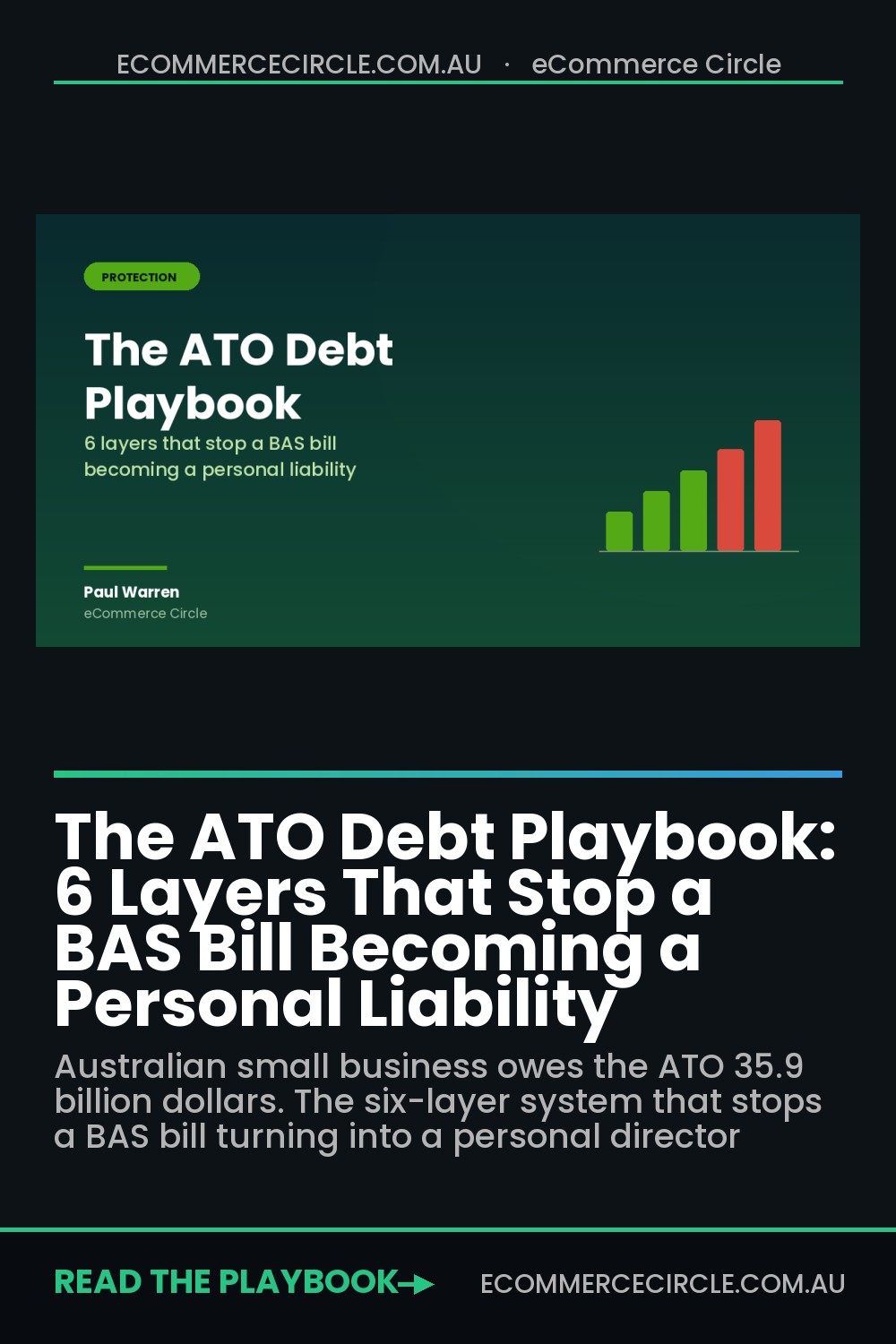
Australian small businesses now owe the ATO $35.9 billion in collectable debt, out of $54.2 billion owed across every taxpayer type. That is 1,338,387 small businesses carrying an average of $26,797 each, and the figure has climbed 118 per cent since 2018-19.
Almost none of those founders decided to borrow from the tax office. They simply spent money that felt like theirs.
Here is the part most operators find out too late. Once a tax debt gets old enough, it stops being a cash flow problem and becomes a personal one.
The ATO issued more than 84,000 director penalty notices in FY24-25, up from around 26,700 the year before. Those notices do not care whether your store had a good quarter.
This playbook is the six-layer system we work through with Aussie Shopify operators so a BAS bill never turns into a personal liability. None of it is complicated. All of it has to be running before you need it.
Why GST Money Feels Like Revenue and Never Is
Run a $220,000 month through a Shopify Payments account and the payout that hits your bank is one clean lump, net of processing fees. Inside that lump is roughly $20,000 of GST you collected for someone else. Take off your input tax credits on stock, freight, apps and ads, and you are still likely holding $11,000 to $14,000 that belongs to the ATO.
Now add PAYG withholding on any wages, plus superannuation guarantee, plus PAYG instalments once the ATO has put you on the system. For a lot of Aussie DTC brands the real number sitting inside the bank balance is somewhere between 8 and 13 per cent of gross sales.
The trap is not greed. It is timing. Stock has to be bought months before it sells.
Ad spend has to go out today. The BAS is not due for another eleven weeks. Every one of those decisions looks rational in isolation, and the tax reserve quietly funds all of them.
If you have not built a forward view of cash yet, start with our 8-week rolling cash forecast. Everything below assumes you can see more than one week ahead.
Layer 1: The Tax Account Split (One Account, One Rule)
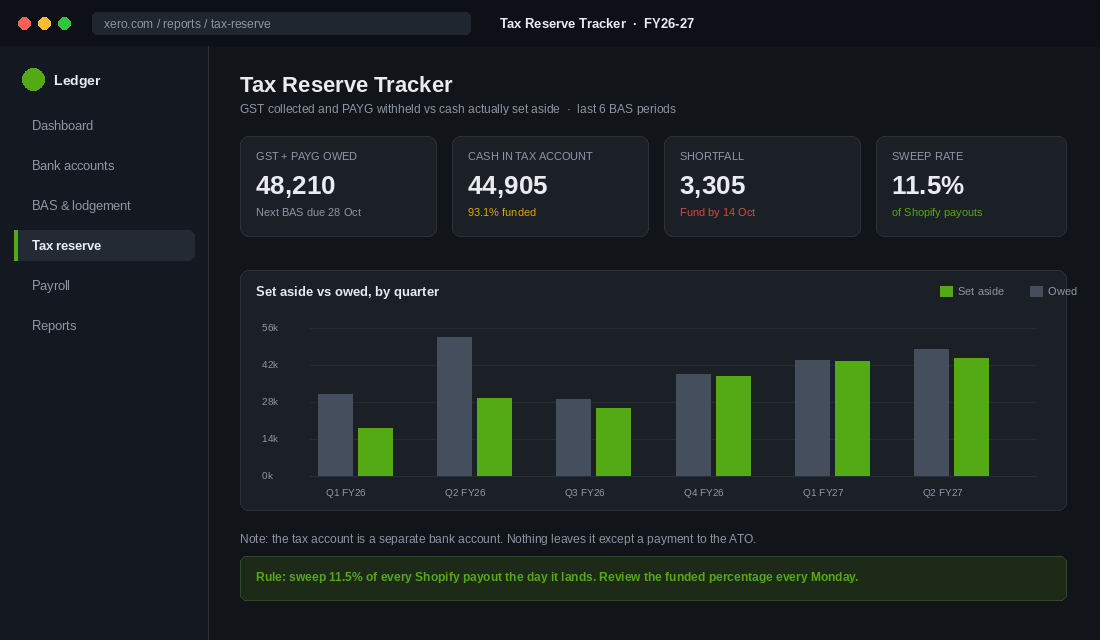
The single highest-return hour you will spend this month is opening a second business transaction account with no debit card attached to it, and calling it something obvious like TAX. Not a savings goal inside your main account. A separate account you have to make a deliberate decision to raid.
Then set your sweep rate. Do not guess it:
- Pull the last four BAS lodgements. Add net GST payable, PAYG withholding and PAYG instalments across those four quarters.
- Add twelve months of superannuation guarantee if you have employees.
- Divide by gross sales for the same period. That percentage is your sweep rate. Most Aussie DTC brands land between 8 and 13 per cent.
- Round up, never down. An over-funded tax account is a buffer. An under-funded one is a surprise.
Then automate it. Shopify Payments pays out on a predictable cycle, so set a recurring transfer for the day after your usual payout lands, or transfer the sweep manually every Monday while you look at the numbers anyway. Whichever you choose, the rule is the same: nothing leaves the TAX account except a payment to the ATO.
Founders who do this report the same thing. The business feels poorer and it makes better decisions.
That is not a coincidence. You were never as liquid as your bank balance suggested.
Layer 2: Know Your BAS Number Every Monday, Not Every Quarter
Most operators discover the size of their BAS the week it is due. That is the worst possible time to find out, because every lever that could have fixed it closed weeks ago.
Fix it inside Xero. Here is the setup, in order:
- Connect Shopify properly. Use an integration that posts a daily summary journal with correct GST codes (A2X for Shopify is the common choice) rather than one invoice per order. Order-level syncing wrecks the ledger and makes GST coding unreliable at volume.
- Create a clearing account per gateway. Shopify Payments, PayPal, Afterpay and Zip each get their own. Payouts reconcile against the clearing account, not against sales.
- Reconcile weekly, not monthly. Once the feed is clean this takes about 20 minutes. Anything sitting unreconciled for more than seven days is a coding error waiting to become a BAS error.
- Pin the Activity Statement report. In Xero go to Accounting, then Reports, then Activity Statement, set the period to the current quarter to date, and add it to your favourites. That is your live BAS number.
- Run the GST Reconciliation report monthly. It catches the classic Aussie DTC mistakes: GST claimed on international freight, GST coded on GST-free products, and duplicated gateway fees.
Put two figures side by side in your weekly numbers review: BAS owed to date, and TAX account balance. If the second is smaller than the first, you have a decision to make this week, not in eleven weeks. Our month-end close playbook shows where this sits in the wider reporting rhythm.
Layer 3: Lodge On Time Even When You Cannot Pay
This is the layer that costs Australian founders the most, and it is the one that costs nothing to get right.
Lodging and paying are two separate obligations. Plenty of operators delay lodging a BAS because they cannot pay it, on the logic that the bill is not real until it is filed. The opposite is true.
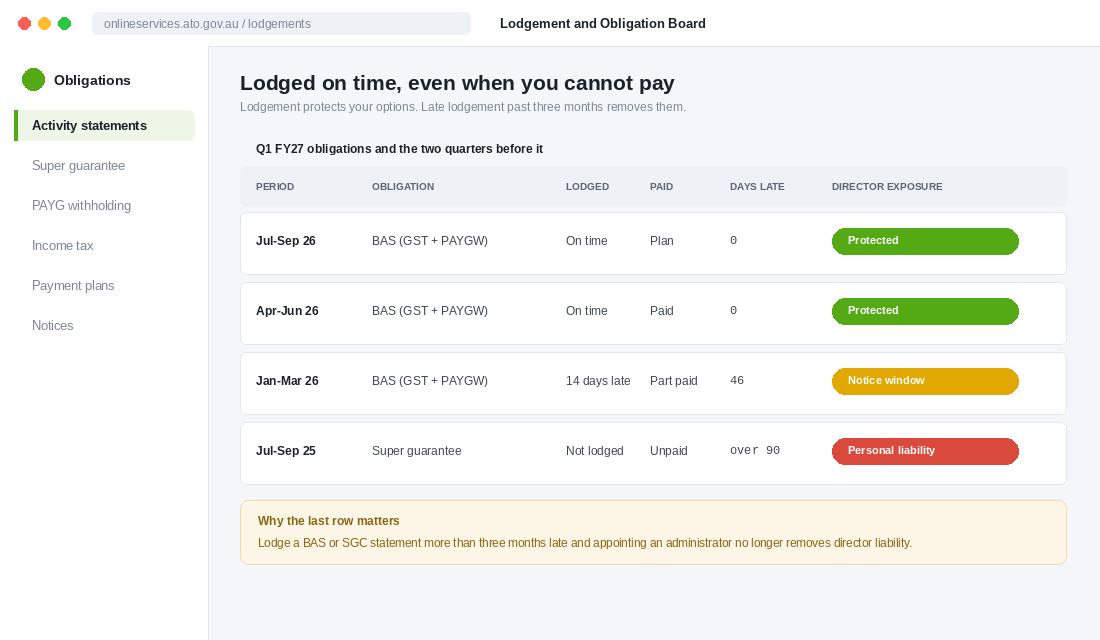
Lodging on time keeps your options open. Late lodgement closes them permanently.
Here is the mechanism. A director penalty notice can make you personally liable for unpaid PAYG withholding, superannuation guarantee charge and GST. There are two versions:
- The 21-day notice. Issued where the company lodged its statements on time. You have 21 days to pay, appoint a voluntary administrator, appoint a small business restructuring practitioner, or place the company into liquidation. Take one of those steps and the director penalty is remitted.
- The lockdown notice. Issued where a BAS, IAS or SGC statement was not lodged within three months of its due date. The penalty is already locked in. Appointing an administrator or a liquidator no longer removes your personal liability.
Two details catch people out. The 21 days runs from the date on the notice, not the date you open the envelope, and the notice goes to the address ASIC has on file for you personally.
If you moved house and never updated ASIC, the clock can be almost expired before you know a notice exists. Check your ASIC-registered address today.
Superannuation is the harshest of the three. Unpaid super becomes a superannuation guarantee charge, and lodging the SGC statement late does not soften it. If you are ever choosing which obligation to fund first, super is rarely the one to defer.
Layer 4: The Payment Plan Is the Shield, Not the Shame
Founders avoid ringing the ATO because they expect a fight. In practice, engagement is the thing that switches off the firmer actions. Garnishee notices, directions to pay, director penalty notices and credit reporting are all aimed at businesses that are not engaging.
If you owe $200,000 or less you can usually set a plan up yourself without speaking to anyone:
- Log in to Online services for business with your myGovID and RAM link.
- Select Accounts and payments, then Payment plans, then Add.
- Choose an upfront payment and a frequency. Weekly or fortnightly plans mirror Shopify payout cycles far better than monthly ones.
- Accept the terms and save the confirmation reference number in your finance folder.
- Set the direct debit for the day after your largest recurring payout lands, not the first of the month.
Two warnings. First, a plan you default on is worse than a plan you never asked for, because it removes the “engaging effectively” protection at the exact moment you need it.
Build the instalment off your worst month in the last twelve, not your best. Second, general interest charge keeps accruing while the plan runs, so a long plan on a big balance is expensive finance, which brings us to the next layer.
If the number is genuinely beyond what trading can service, get a registered liquidator or your accountant in the room early. Small business restructuring appointments reached roughly 3,000 in 2024-25, up from 1,425 the year before and 448 the year before that. The tool works, but only while there is still a business to restructure.
Layer 5: Price the Interest Before You Use the Tax Office as a Lender
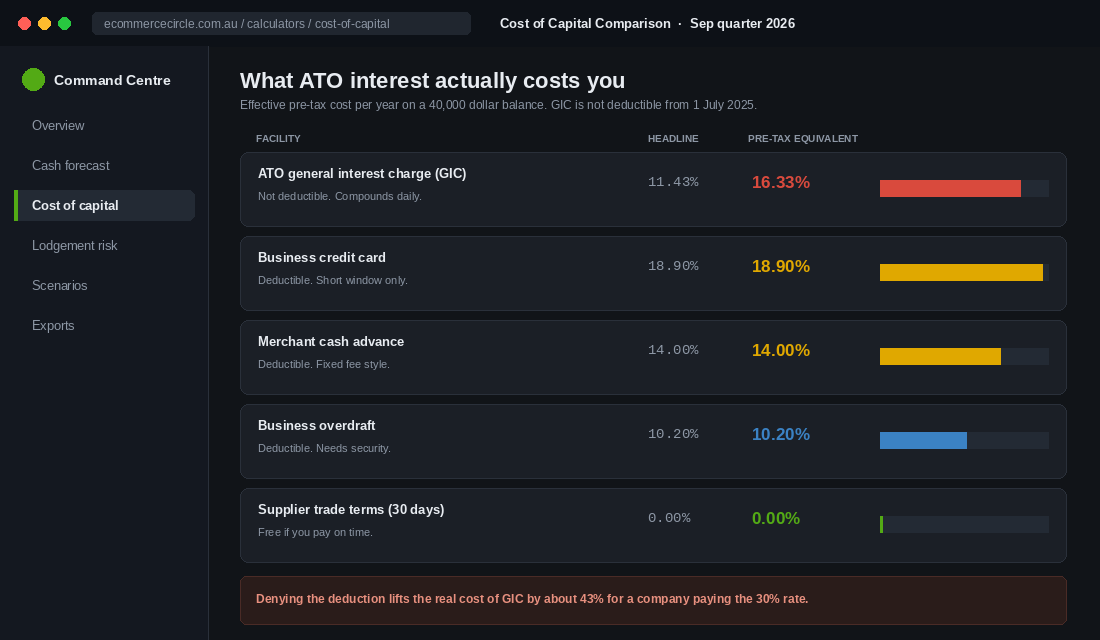
For years, carrying an ATO balance was quietly one of the cheapest forms of finance available to a small business, because the general interest charge was tax deductible. That changed on 1 July 2025. GIC and shortfall interest charge incurred on or after that date are no longer deductible, regardless of which income year the underlying debt relates to.
GIC for the quarter beginning 1 October 2026 is 11.51 per cent, up from 11.43 per cent in the July quarter, and it compounds daily. For a company paying the 30 per cent rate, losing the deduction lifts the true cost to roughly 16.4 per cent in pre-tax terms.
Run the numbers on a $40,000 balance carried for a year. That is about $4,600 in interest.
Under the old rules a company on 30 per cent effectively wore around $3,200 of it after the deduction. Now it wears the entire $4,600, and none of it buys you a single unit of stock.
So use a simple decision test before you let a BAS slide to fund a purchase order. If you would not sign an unsecured 16 per cent loan to buy that inventory, do not fund it with GST. Most of the time, the cheapest capital in a Shopify business is supplier terms you negotiated properly and the stock order you decided not to place.
Layer 6: Protect the Credit File Before Anyone Else Sees It
This is the layer nobody sees coming, and for a Shopify brand it is the one that does commercial damage fastest.
The ATO can disclose your business tax debt to credit reporting bureaus when four conditions line up: you have an ABN and are not an excluded entity, you have one or more debts totalling $100,000 or more overdue by more than 90 days, you are not engaging effectively to manage the debt, and there is no active Tax Ombudsman complaint about the intent to report. The ATO sends a Notice to Disclose first and generally allows 28 days to respond. After that, updated records go to the bureaus weekly.
Note what sits in the middle of that list. A payment plan you are complying with counts as effective engagement, so the disclosure does not happen even if the balance is well over $100,000. Layer 4 is what protects Layer 6.
Once the flag lands on your file, the pain arrives in a specific order for an ecommerce brand:
- Suppliers tighten terms. Net 30 becomes 50 per cent deposit, usually at the exact moment you are placing peak-season orders.
- Your 3PL asks for a bond or moves you to weekly prepay.
- Freight forwarders switch to cash against documents, which means containers do not move until funds clear.
- Inventory finance dries up. Every trade finance and revenue-based lender in Australia pulls credit files as step one.
- Merchant and BNPL facilities get reviewed. Rolling reserves and payout delays are common outcomes.
Your supply chain finds out before your customers do, and the timing is almost always wrong. The two most instructive Australian examples are not tax stories on the surface. Mosaic Brands collapsed in late 2024 owing somewhere between $361 million and $392 million, with administrators forming the view it may have traded while insolvent for close to four years. Booktopia went into administration carrying about $60 million in creditor debt and roughly $12 million of unfulfilled customer orders across around 150,000 orders. In both cases the solvency question surfaced years after the first warning signs did.
The wider picture is not gentle either. 13,413 companies entered external administration in the year to 31 May 2025, up 34.2 per cent on the same period a year earlier.
What Happens When the Six Layers Run Together
Individually these look like admin. Run together, they change the way the business makes decisions.
The tax account split (Layer 1) means the bank balance you look at is genuinely yours, so stock and media decisions are made off real numbers rather than borrowed ones. The weekly BAS number (Layer 2) means you can see a shortfall eight weeks out, when you can still change a purchase order or hold a campaign. On-time lodgement (Layer 3) keeps your director liability remittable, which keeps every other option on the table.
The payment plan (Layer 4) converts a crisis into a scheduled cost, and it is also the thing that keeps the credit file clean (Layer 6). Pricing the interest honestly (Layer 5) stops you drifting into the habit, because once you see 16 per cent pre-tax you stop treating a late BAS as free.
The operators who run all six do not have better quarters than everyone else. They just never have a bad quarter that turns into a bad year. That is the whole game.
The BFCM Trap: Why Your Biggest Quarter Creates Your Biggest BAS
For most Aussie Shopify brands, the October to December quarter is the one that breaks the tax account. Sales spike in late November, the BAS for that quarter is not due until 28 February, and January is usually your slowest month. The bill lands when cash is thinnest.
There is a second, quieter reason. Much of your peak stock was bought in July, August and September, so you already claimed those GST credits on the previous BAS.
The December quarter carries a lot of GST collected and relatively few credits against it. Your net GST as a share of sales is often higher in this quarter than any other.
Worked example: a brand that turns over $680k in the quarter
Imagine you run a Sydney gifting brand that normally does $150,000 a month. October comes in at $150,000, November at $320,000 with BFCM, and December at $210,000. That is $680,000 for the quarter, and about $61,800 of it is GST.
Because the peak stock was paid for in September, input credits for the quarter come to perhaps $22,000. Net GST payable is around $40,000, before PAYG withholding and super.
If the TAX account was swept at a flat 8 per cent, it holds about $54,400. That covers it, but only just once wages are added, and only if nothing was raided in January.
Now run the version where the founder skipped the sweep in November “because cash was tight”. Leave $40,000 unpaid for 90 days at 11.51 per cent and it costs about $1,140 in non-deductible interest. That is small next to what a missed lodgement or a defaulted plan can do.
- Lift your sweep rate for November and December by 2 to 3 points above your normal rate. Drop it back in February once the BAS is paid.
- Sweep daily during BFCM week, not weekly. Payouts are large and arrive fast, and so do the temptations to reinvest them.
- Pencil the 28 February payment into your cash forecast now, next to your January stock order, so the two never surprise each other.
If you want the full peak-season picture, our BFCM target maths shows how to plan revenue and margin together, the Profit First playbook explains how a TAX account fits into a wider account structure, and the GST playbook covers the coding mistakes that inflate a BAS.
Your 30 Minute Tax Debt Audit
Block half an hour this week and work through this in order. Most Aussie founders find at least two gaps.
- 1. Check your ASIC address. Five minutes on ASIC Connect. If a director penalty notice went out today, would it reach you?
- 2. Confirm every lodgement is filed. Log in to Online services for business and check activity statements and SGC statements. Anything unlodged for more than three months is your first priority, ahead of paying anything.
- 3. Calculate your real sweep rate. Last four BAS lodgements plus twelve months of super, divided by gross sales for the same period.
- 4. Open the TAX account if you do not have one, with no card attached.
- 5. Compare owed against held. Live BAS number versus TAX account balance. Write both figures down.
- 6. Set the sweep. Recurring transfer, weekly, the day after your usual Shopify payout.
- 7. Pin the Activity Statement report in Xero and add it to your Monday review.
- 8. Check the aged balance. Anything over 90 days old and heading toward the $100,000 threshold needs a payment plan this week.
- 9. Price the interest. Multiply your ATO balance by the current GIC rate (11.51 per cent for October to December 2026). That is a real, non-deductible annual cost. Compare it to your net profit.
- 10. Book the conversation. If any of the above turned up something ugly, your accountant this week is cheaper than an insolvency practitioner next quarter.
One honest caveat. This is general information for operators, not tax or legal advice, and every structure is different.
Rates, thresholds and rules change. Use this to work out which questions to ask, then have the specific conversation with your registered tax agent or accountant.
The founders who get burned are almost never the ones who had a bad month. They are the ones who had a bad month and then stopped looking.
Look at it early enough and a tax debt is just an expensive line item you manage down. Look at it late and it is the thing that decides whether you still own the business.
Inside eCommerce Circle, protecting the business from itself is one of the core pillars we work on with every member, right alongside the growth work. If you want a second opinion on where your numbers actually sit, come and start in Connect, or if you would rather talk it through first, let’s talk.