You knew three months ago. Maybe six. There is someone on your team who is not doing the job, and you have been telling yourself a story about why now is not the right time to deal with it.
What’s in This Article
Peak season is coming. They are going through something at home. You do not have the bandwidth to run a hiring round. The story changes, the outcome does not. The work still is not getting done, your best people are quietly absorbing the slack, and you are the one packing orders at 9pm on a Tuesday.
Here is what that costs. Research across Australian HR data puts a bad permanent hire at somewhere between 30% and 150% of that person’s first year salary once you count recruitment, onboarding, lost output and the replacement round. On a 70,000 dollar fulfilment coordinator that is roughly 21,000 to 105,000 dollars, and most of it burns quietly while you decide whether to say something.
The thing keeping you frozen is real too. Unfair dismissal lodgements at the Fair Work Commission hit 16,500 in 2024 to 2025, up 11% year on year, inside 44,075 total lodgements that ran 24% above the five year average. You have heard the horror stories from other founders. So you do nothing, which is the single option guaranteed to cost you money.
This playbook solves both halves. A way to work out whether the person can actually be saved, a 30 day structure that gives them a fair shot at it, and the Australian process rails that make an exit clean and boring if it comes to that.
Why Founders Wait Nine Months to Have a Ten Minute Conversation
The delay is not laziness. It is avoidance dressed up as patience, and the data on it is blunt. Among managers who put off a hard conversation, 34% delay it by a month or more and 25% delay it by a year or longer. Around 69% of managers report being uncomfortable communicating with their people at all.
For a Shopify founder the avoidance is worse, because you hired them. Admitting the person is not working feels like admitting you got the hire wrong, the brief wrong, or the onboarding wrong. Often you did. That is uncomfortable, and discomfort is a powerful reason to check Meta Ads Manager instead.
Meanwhile the cost compounds in three directions at once:
- Your output. You reabsorb the work you hired out. Founder hours go back into picking, replying to tickets, or fixing product data instead of buying, offers and range.
- Your good people. A performers notice. They carry the load, they see nothing happen, and they start updating their CV. You do not lose the underperformer first, you lose the person next to them.
- Your evidence. Every month you say nothing is a month of tolerated performance. If you eventually need to exit the person, twelve months of silence followed by a sudden dismissal reads badly to everyone, including a Commission member.
The kindest thing you can do for someone who is not performing is tell them early, in plain words, with a number attached. The cruellest thing is to say nothing for nine months and then sack them in a five minute meeting.
Step 1: Work Out Which of the Four Causes You Actually Have
Before you write a warning letter, work out what you are actually dealing with. Almost every underperformance case in a small ecommerce team traces back to one of four causes, and three of them are yours to fix.
Clarity
They do not know what good looks like. There is no number, no standard, no definition of done. You assumed it was obvious because it is obvious to you. Test it by asking them to tell you, without notes, the three outcomes their role is measured on. If they cannot, the problem is clarity and the fix takes a week.
Capability
They know the target and cannot hit it yet. Missing skill, missing training, missing system access. Test it by watching them do the task once. If the method is wrong rather than the effort, this is trainable. Give it a defined window and a specific piece of training, not a vague offer of support.
Capacity
They know the target, they can hit it, and there are not enough hours in the role to do so. This is the most common one in Aussie DTC teams and the one founders miss most often, because roles here grow by accretion. The coordinator you hired for dispatch is now also doing customer service, supplier chasing and Instagram. Test it by mapping their week in hours against the job you think they have.
Commitment
They know the target, they can hit it, they have the time, and they are not doing it. This is the only one that is genuinely a performance problem. It is also far rarer than founders assume, which is exactly why you run the other three tests first.
If you skip this diagnosis you will run a performance process against a capacity problem, lose the person, hire an identical replacement, and watch the exact same thing happen in five months. That is not a people problem. That is a role design problem, and it will follow you into the next hire.
Step 2: Rewrite the Role Scorecard Before You Judge Anyone Against It
You cannot fairly performance manage someone against a standard that lives only in your head. Before the first conversation, write the role down properly: three to five outcomes, each with a number, a measurement source and a frequency.
For a fulfilment coordinator in a store doing 400 orders a week, that looks like this:
- Orders picked per hour: 26. Measured weekly from Shopify order timestamps.
- Pick accuracy: 99.5% or better. Measured from returns tagged wrong item.
- Same day dispatch: 96% or better on orders placed before the 1pm cut-off. Measured from the carrier manifest close time.
- Stock count variance: under 2% at each monthly cycle count.
Four lines. Every one of them countable from a system you already pay for. Nothing about attitude, nothing about being a team player, nothing you would have to argue about later.
If you have never built one of these, start with our Shopify hiring scorecard playbook, which covers how to define the outcomes at the point of hire so you are not reverse engineering them under pressure. Then run the numbers for the last 8 to 12 weeks before you say a word to anyone.
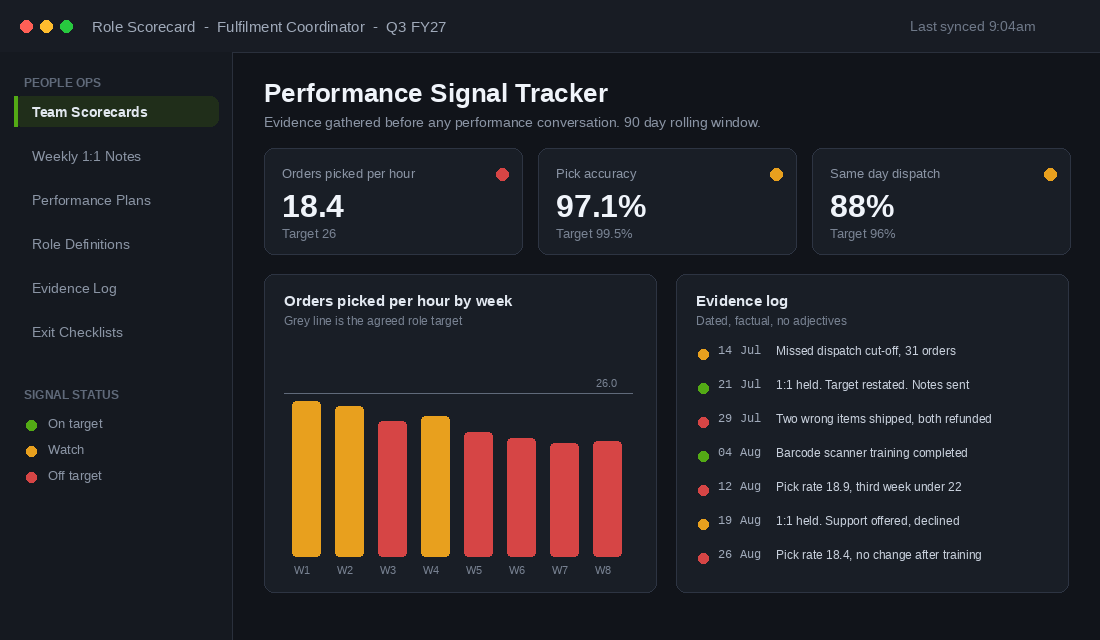
Two rules for the evidence log. Write entries the day they happen, and write facts with no adjectives. Pick rate 18.9, third consecutive week under 22 is evidence. Seems checked out lately is a liability. If you would be embarrassed to read the line aloud to the person, do not write it.
Step 3: Run the First Conversation Like an Operator, Not a Mate
Most founders get this conversation wrong in the same way. They soften it so heavily that the person leaves the room believing everything is fine, then feel blindsided six weeks later when nothing has changed.
Book 30 minutes, in private, in the diary. Not in the warehouse, not on the way to the car. Then follow four beats.
- State the gap with the number. “The role target is 26 orders picked per hour. For the last eight weeks you have averaged 19.9. I want to talk about the gap.”
- Stop talking. Let the silence sit. This is where you find out whether it is clarity, capability, capacity or commitment, and you will only hear it if you do not fill the gap yourself.
- Ask the diagnostic question. “What is getting in the way of hitting 26?” Then the follow up that matters most: “What would you need from me to get there?”
- Agree the next step and the date. Something specific happens, and you both know when you are looking at it again.
Send a short written summary the same day. Three or four lines, no legalese: what you discussed, the target, what was agreed, when you next meet. That email is not you building a case. It is you making sure two people remember the same conversation.
If this is the first time you have run structured performance conversations at all, put the rhythm in place before you need it. Our performance review playbook covers the weekly 1:1 and scorecard cadence that stops these issues reaching crisis point in the first place.
Step 4: Build a 30 Day Plan With Numbers, Not Vibes
If one honest conversation and a fortnight does not shift things, move to a formal plan. Most Australian small business plans run 30 to 60 days. For a fulfilment or customer service role, 30 days is plenty. For a marketing or buying role where results lag, 60 to 90 days is fairer.
A plan that holds up has six components. Miss any of them and you have written a warning letter with extra steps.
- The specific gap. Current performance versus the role target, with the numbers.
- Three measurable outcomes. Never more than three. Each one countable, each one inside the person’s control.
- The support you are providing. Training, a shift change, a tool, time with a senior person. Name it and diarise it.
- Weekly check-ins with dates. Booked in the calendar now, notes sent the same day.
- The review date. One date where you both know the decision gets made.
- The consequence, in writing. That if the plan is not met, employment may end. Uncomfortable to write. Legally and morally essential.
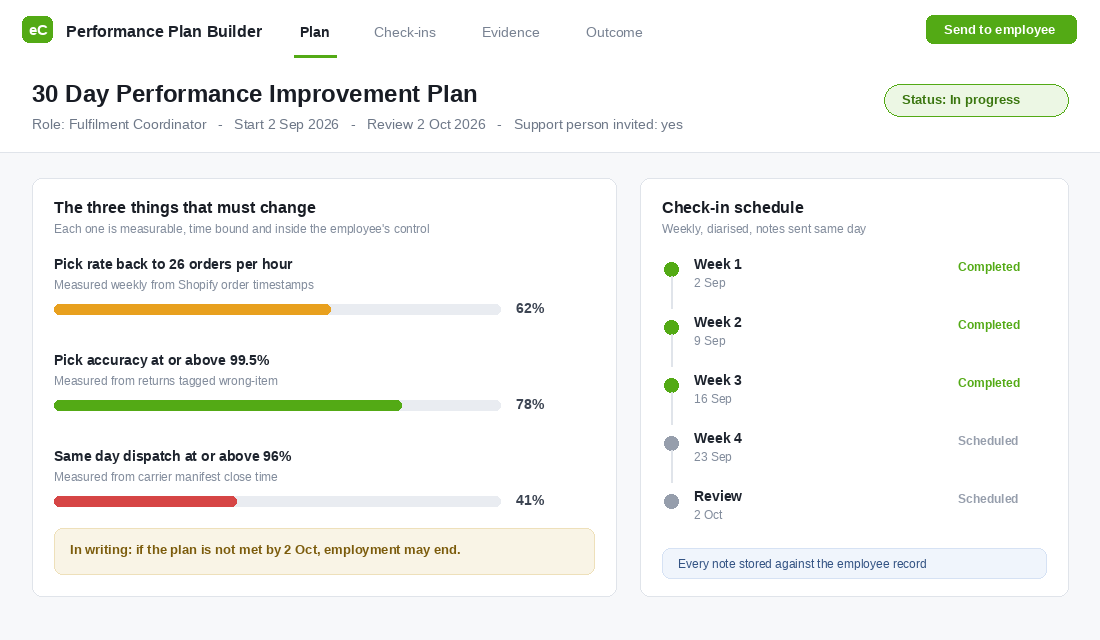
You do not need expensive software for this. A shared doc and a recurring calendar invite will do the job. If you want templates that are kept current against Australian requirements, Employment Hero is the platform most Aussie small businesses land on. Setup takes about an afternoon:
- Create the employee record and upload the signed contract and position description.
- Load your role scorecard outcomes as the performance objectives against that record.
- Use the formal written warning and performance improvement plan templates from the template library rather than writing your own from scratch.
- Diarise the weekly check-ins and attach each set of notes to the employee file the same day.
- Store the final review outcome against the record so the whole history sits in one place.
The Fair Work Ombudsman also publishes free first and second warning letter templates and a performance conversation guide at fairwork.gov.au. For a store with five staff, that plus a calendar is genuinely enough.
Step 5: Know the Australian Rails Before You Book the Meeting
This is where founders get hurt, and it is almost never because the reason was wrong. It is because the process was.
Start with the two thresholds that decide whether a claim is even available:
- Small business means fewer than 15 employees, counted as a simple headcount including casuals employed on a regular and systematic basis.
- The minimum employment period for a small business is 12 months, compared with 6 months for larger employers. Under 12 months, an employee generally cannot bring an unfair dismissal claim. That does not make the dismissal risk free, since general protections and discrimination claims have no such qualifying period.
If you are a small business and you follow the Small Business Fair Dismissal Code, a dismissal is deemed fair. The Code has a checklist, and while completing it is not compulsory, filling it in and filing it at the time of dismissal is one of the cheapest pieces of insurance in your business.
Beyond the Code, section 387 of the Fair Work Act sets out what the Commission actually weighs up. In plain English: was there a valid reason relating to capacity or conduct, was the person told about it, were they given a chance to respond, were they warned about unsatisfactory performance before being dismissed, and were they allowed a support person at the discussion.
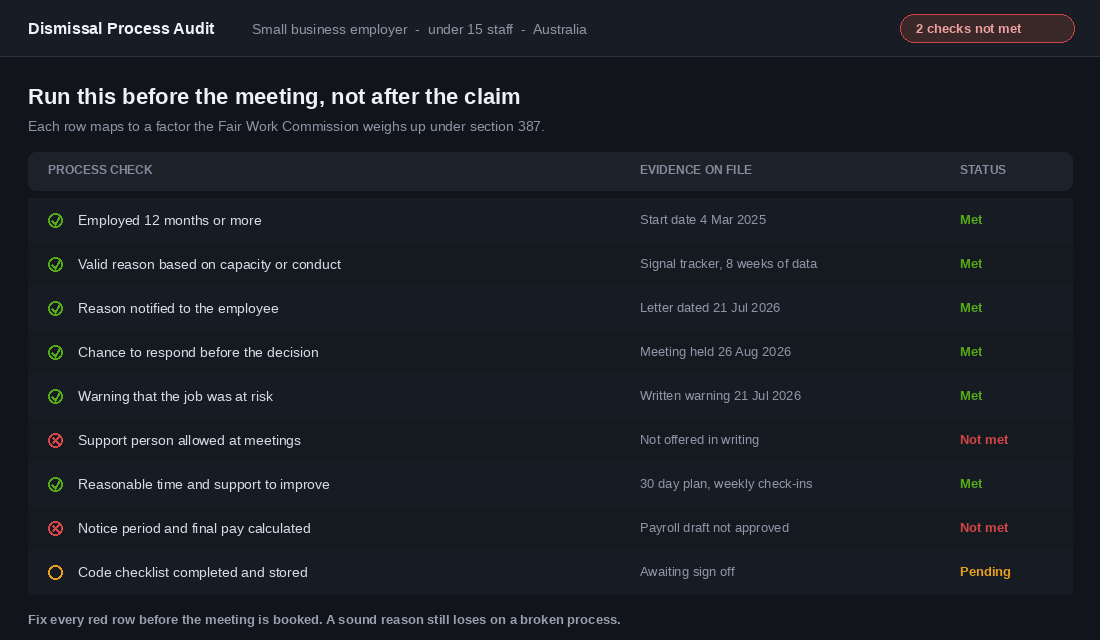
Two things worth internalising. First, there is no legal rule requiring three written warnings, despite what every pub conversation says. What matters is that the person knew, had a chance to respond, and had a reasonable opportunity to improve. Second, the absence of any warning before dismissing for poor performance is one of the most reliable ways to lose.
If a claim does land, the numbers are less apocalyptic than the folklore. The application fee sat at 89.70 dollars in 2025 to 2026. Roughly 79% of matters referred to conciliation resolve there, and close to 90% resolve without a Commission member making a determination. The median settlement is around 8,704 dollars, with the compensation cap at 95,050 dollars and the high income threshold at 190,100 dollars for dismissals on or after 1 July 2026.
So the real risk for a founder is rarely a maximum payout. It is a few thousand dollars, plus your time, plus weeks of distraction during a period you cannot afford it. All of which is avoidable with a process you could run on a single page.
This is general information for Australian employers, not legal advice. Employment law is fact specific. Before you dismiss anyone, check the Fair Work Ombudsman guidance for your situation, and get advice on anything unusual.
Step 6: Exit Cleanly, Then Close the Loop With the Team
If the plan is not met, the decision is already made. The meeting is not where you decide, it is where you communicate. Keep it to ten minutes, have a second person present, and cover the outcome, the notice period, the final pay and the return of access and equipment.
Have the numbers approved by payroll before you walk in. Notice under the National Employment Standards runs from one week for under a year of service up to four weeks, with an extra week for employees over 45 with at least two years of service. Accrued annual leave is paid out. Getting final pay wrong turns a clean exit into a wage claim.
Lock down access the same day. Shopify admin and staff permissions, Klaviyo, the 3PL portal, the shared inbox, Slack, the password manager, the ad accounts, and anything on the phone plan. This is the part founders leave for next week and then regret. Our key person departure playbook has the full access lockdown and knowledge capture checklist, and it applies whether the person resigned or you exited them.
Then tell the team, same day, in one calm sentence. Something like: “Sam has finished up with us today. I am covering dispatch this week and we will talk about the role on Monday.” No detail, no defence, no story. Your remaining people are watching how you handle it, and dignity here buys you more trust than any all-hands speech.
Finally, before you post the job ad, go back to your diagnosis. If the cause was capacity, hiring the same role again just resets the clock. Split the role, or cut something out of it, before you fill it.
The Compound Effect of Deciding Early
Look at what the six steps actually do together. The scorecard turns a feeling into a number. The number makes the conversation possible. The conversation surfaces the real cause. The plan gives a good person a genuine path back, and gives you an honest answer inside 30 days instead of nine months. The process rails make the worst case boring.
The founders who run this well are not tougher than you. They are just faster. They find out in six weeks what most operators take a year to admit, and that speed is worth more than the individual outcome. Half the time the person turns it around, because it was clarity or capacity and nobody had ever said the number out loud. The other half, you free the seat while you still have the cash and the calm to fill it properly.
There is a second order effect that matters even more. When your team sees that standards are real, measured and applied consistently, your A players stop carrying dead weight and start trusting that effort gets noticed. That is how a five person Aussie DTC team starts operating like a fifteen person one.
The Underperformance Decision Framework
Save this. Run it in order, and do not skip a stage because the next one feels faster.
- Week 0 – Diagnose. Clarity, capability, capacity or commitment. Three of the four are yours to fix.
- Week 0 – Define. Write the role scorecard: three to five outcomes, each with a number, a source and a frequency.
- Week 0 – Evidence. Pull 8 to 12 weeks of actual data. Start a dated log of facts with no adjectives.
- Week 1 – Conversation. Thirty minutes, private, state the gap with the number, ask what is getting in the way, agree a next step. Written summary same day.
- Week 3 – Decide. Movement in the numbers means keep coaching. No movement means move to a formal plan.
- Weeks 3 to 7 – Plan. Three measurable outcomes, named support, weekly diarised check-ins, one review date, consequence stated in writing.
- Review date – Audit. Run the process audit: valid reason, notified, chance to respond, warning given, support person offered, reasonable time to improve, Code checklist completed.
- Exit day – Execute. Ten minute meeting with a second person present, payroll approved beforehand, all access revoked same day, team told in one calm sentence.
- Week after – Redesign. Fix the role before you refill it, especially if the cause was capacity.
Print it. Stick it in your ops folder next to your SOPs. The next time your gut tells you something is off with someone on the team, you will have a sequence to run instead of nine months of hoping it sorts itself out.
Inside eCommerce Circle, People is one of the ten pillars we work on with every member, and underperformance is the conversation founders bring to the room more often than almost anything else. If you want a second opinion on a call you are sitting on right now, let’s talk.