Most Aussie Shopify retailers meet private label the same way. A supplier lifts their wholesale price. Or a brand you have carried for four years signs a distribution deal with the competitor down the road. Or you look at a category doing solid volume and work out that you are earning about 33 cents on the dollar for the privilege of warehousing, photographing, marketing and shipping somebody else’s brand. So you open a browser tab and start searching for contract manufacturers.
What’s in This Article
That is the wrong entry point, and it is why most house brand attempts stall somewhere between the second sample round and the first purchase order. The question was never whether you can get something made with your logo on it. Anyone with a credit card and a bit of patience can do that. The real questions are whether the category deserves a house brand at all, whether your balance sheet can carry a minimum order run, and whether you have enough repeat demand to sell through it before the cash you tied up starts hurting.
Here is the number that should reframe the whole conversation. Anko, Kmart’s own brand, now accounts for 85 per cent of Kmart’s total sales and generated more than four billion dollars in a single six month period. Kmart Australia turned over A$11.4 billion in FY2025 with A$1.05 billion in operating income. That is not a discount retailer with a few home brand lines bolted on. That is a product company that happens to own shops.
Anko Is 85 Per Cent of Kmart, and That Number Should Change How You Think
Australian retailers have historically been shy about own brand. Private label sits at roughly 18 per cent of the Australian market. In the UK it is closer to 47 per cent. Across Europe’s six biggest grocery markets, Circana recorded private label hitting a record 50 per cent unit share. We are years behind, which means the runway here is longer than most operators assume.
The direction of travel is obvious in the numbers the listed retailers publish. In Coles’ most recent results, total sales revenue grew 2.9 per cent while own brand revenue grew 8.6 per cent, and the premium Coles Finest range grew 20.4 per cent. Own brand is not just growing faster than the total business. The premium end of own brand is growing fastest of all, which kills the old assumption that house brand only works at the cheap end.
Demographics back it up. Gen Z now spends 18.4 per cent of their wallet on private label, a share projected to pass Baby Boomers by the middle of 2026. The customer who grew up buying Anko and Coles Finest does not carry the brand snobbery your parents did. They are buying the product, not the badge.
None of that means you should launch a house brand. It means the customer objection you are most worried about is smaller than you think, and the constraint is almost always operational, not commercial.
The Real Reason to Own the Product Is Not the Margin
Margin is the reason founders start looking. Control is the reason the good ones follow through.
When you resell someone else’s brand, you do not control the price, because they set the recommended retail and often police it. You do not control availability, because when they have a stock issue, so do you. You do not control distribution, because nothing stops them appointing three more Australian stockists or going direct to consumer themselves next quarter. And you do not control the customer relationship as fully as you think, because the customer credits the brand for the product and credits you for the delivery.
Own the product and all four of those flip. You set the price. You decide the pack size and the variant range. Nobody else can sell it. And the customer who loves it can only get it from you, which is the single cleanest retention mechanic in retail.
Adore Beauty is the Australian ecommerce example worth studying. They launched Viviology in 2022 as a standalone cosmeceutical range with six SKUs at $35 to $55, then AB LAB in 2023 with locally made SPF at $39.95, then acquired iKOU in July 2024 which added more than 300 products to the owned portfolio. Own brand ranges now contribute more than 6 per cent of total revenue with a stated target above 8 per cent by FY27. That is a listed beauty retailer treating own brand as a structural margin lever, not a side project.
Run the Contribution Maths Before You Run the Sample
The most common private label mistake in Australia is comparing percentages instead of dollars. Retailers typically price own brand 15 to 30 per cent below the comparable national brand while holding gross margins above 40 per cent, against 25 to 35 per cent on the branded equivalent. On paper the private label wins easily. Across US consumer packaged goods, private label gross margin runs about 30 per cent higher than national brands.
Now do it in dollars. A five dollar national brand at 25 per cent margin returns $1.25. A $3.50 private label at 40 per cent returns $1.40. Fifteen cents. If the private label sells at a lower unit velocity, or ties up four months of cash in a minimum order run, or generates a slightly higher return rate while you dial in the spec, that fifteen cents evaporates and then some.
So build the comparison at the contribution line, not the gross margin line. Landed cost, inbound freight, pick and pack, postage, returns provision, payment fees, and any category specific cost like temperature controlled storage. If you have not built a contribution model per SKU yet, start with our contribution margin playbook and get that right before you brief a single supplier.
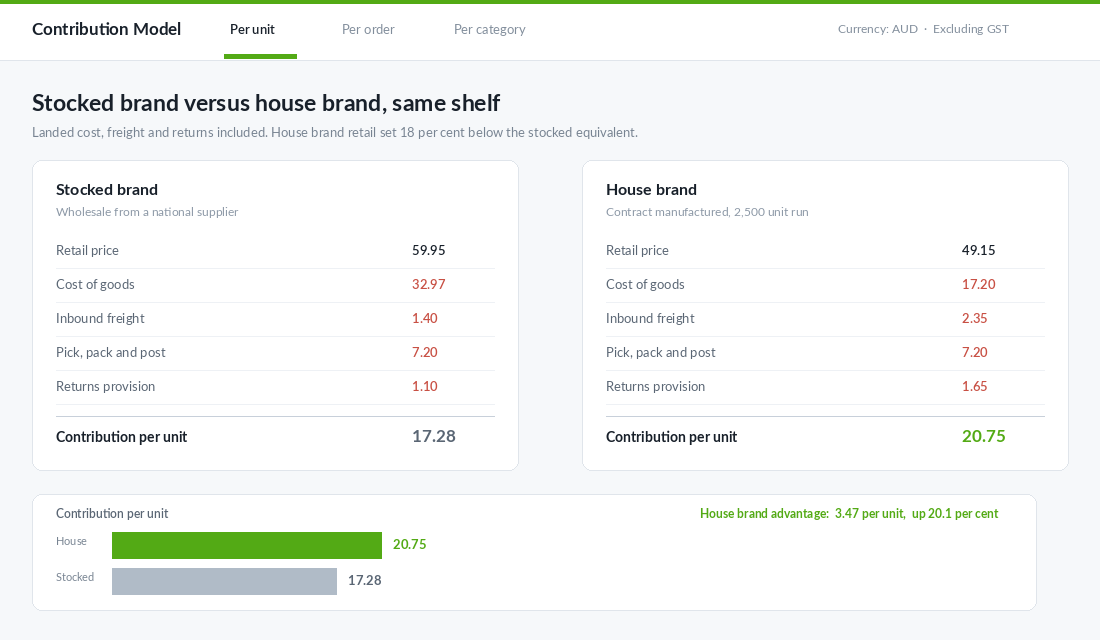
A worked example from a pet category. The stocked brand retails at $59.95, costs $32.97 landed, and after freight, fulfilment and returns leaves $17.28 contribution. The house brand equivalent retails at $49.15, a deliberate 18 per cent under the incumbent, costs $17.20 to manufacture and land, carries slightly higher freight and a slightly higher returns provision while the spec settles, and leaves $20.75. That is a 20 per cent lift in contribution per unit while the customer pays less.
That is the shape you are looking for. If your model does not produce at least a 15 to 20 per cent contribution lift per unit at a lower retail price, the house brand is not worth the operational load.
The Five Gates That Decide Which Categories Earn a House Brand
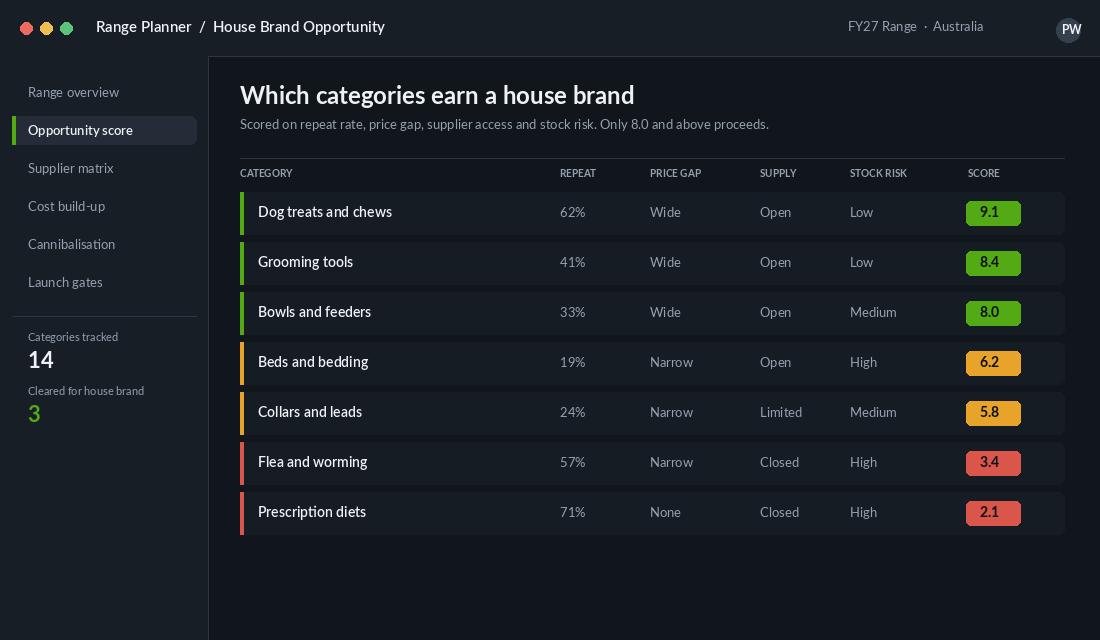
Not every category in your range is a candidate. Score each one out of ten across five gates, and only move on categories scoring 8.0 or above. Most retailers find they have two or three, not twenty.
- Gate 1: Repeat rate. Own brand compounds through repurchase. Consumables, refills and anything with a natural replenishment cycle above about 35 per cent repeat are where the economics work. One-off purchases like furniture are the hardest place to start.
- Gate 2: Price gap. Is there a visible gap between the branded price and what the product plausibly costs to make? Wide gaps mean brand equity you can undercut. If the incumbent is already priced near cost, there is nothing for you to capture.
- Gate 3: Supplier access. Can you actually get it made at a quality your customers will accept, at a volume you can fund? Some categories are effectively closed by regulation, formulation IP, or tooling costs. Check this before you get emotionally attached.
- Gate 4: Incumbent brand strength. If customers search for the brand by name, they are buying the brand, not the product. Attacking a category where the incumbent has genuine pull is expensive. Look for categories where customers search by attribute instead.
- Gate 5: Stock risk. Variant count is the killer. A product with one SKU is a manageable bet. A product with five colours across six sizes is thirty SKUs and thirty separate minimum order runs. Start where the variant tree is small.
Score honestly and the list gets short fast. In the pet example above, dog treats scored 9.1 because repeat is 62 per cent, the price gap is wide and supply is open. Prescription diets scored 2.1 because supply is closed and the brand does all the work. Both feel like “good categories” in a planning meeting. Only one of them is.
What First Shipment Really Costs, in Cash and in Months
Founders budget for the unit cost and forget everything around it. Here is the honest list.
- Minimum order quantities. Standard private label MOQs commonly run 1,000 to 5,000 units per SKU. Stock formula personal care can sometimes start at 100 to 250 units. Custom packaging, custom closures or bespoke formulation push both MOQ and lead time up sharply.
- Lead time. A 1,000 unit MOQ with a 30 to 45 day production window is the most common configuration in international manufacturing. Add sample rounds before it and sea freight after it. From first brief to sellable stock on your shelf, ninety days is optimistic and five to six months is realistic.
- Samples. Budget for three rounds, not one. Each round costs money and adds two to four weeks. The retailers who ship good product are the ones who did not skip round three.
- Artwork, packaging and compliance. Label design, barcodes, country of origin claims, ingredient or materials declarations and any Australian standards testing your category requires. This is a real line item, not a rounding error.
- Cash held. Deposit on order, balance before shipping, then freight and duty, then however long the stock sits before it sells. On a 2,500 unit run at $17 landed that is roughly $42,500 out the door, months before the first dollar comes back.
That last point is where most house brand programs die. It is not a product problem, it is a working capital problem. Model the cash cycle before you commit, and if the answer is tight, read our inventory funding playbook and sort the funding structure first. Ordering first and financing later is how good ranges end up discounted at Boxing Day just to free the cash.
One practical lever most operators do not ask for: manufacturers will often trade MOQ against lead time or against a forward volume commitment. Paying setup costs separately, accepting a longer production window, or committing to a second run at agreed volumes can halve your first order. Ask. The worst answer is no. Our product sourcing playbook covers how to run that negotiation properly.
Brand Architecture: Endorsed, Standalone, or Silent
Once the category is chosen, decide how visibly the house brand is yours. There are three workable options and picking the wrong one costs you either trust or flexibility.
Endorsed
The house brand carries your retail name. Coles Finest and Anko both work this way. The advantage is instant trust transfer, because customers who like your store extend that to the product. The cost is that a quality failure lands directly on your retail brand, and it caps how far you can sell the product outside your own store.
Standalone
The house brand looks like an independent brand with no visible link to you. Adore Beauty took this path with Viviology, built with a named dermal therapist. It gives you room to build genuine brand equity, price at premium, and eventually wholesale it. It costs more, because you are launching a brand from zero rather than borrowing yours.
Silent
The product carries no meaningful branding at all. Refills, accessories, consumables and replacement parts often sit here. Cheapest to run, lowest equity, and perfectly reasonable for the long tail where nobody is choosing on brand anyway.
Most Aussie retailers should start endorsed on the safest category, learn the supply chain, and only go standalone once they have shipped two successful runs.
The Deemed Manufacturer Trap Most Aussie Retailers Walk Into
This is the part almost nobody covers, and it is the one that can genuinely hurt you.
Under the Australian Consumer Law, the definition of manufacturer is broad. If you buy goods made overseas and sell them under your own brand in Australia, you can be treated as a deemed manufacturer even though you never touched a production line. Both the actual overseas manufacturer and you as the local deemed manufacturer can be concurrently liable to consumers for breaches of the consumer guarantees, and that liability cannot be contracted away.
There is a specific mechanism worth knowing. If a consumer gives a supplier written notice asking who manufactured the goods, and the supplier does not respond within 30 days, the supplier can be deemed the manufacturer. If your supplier records live in a former staff member’s inbox, you will not answer that in 30 days.
Four things to put in place before your first order lands:
- Traceability by batch. Every production run recorded against a supplier, a date, a specification and a purchase order. Store it somewhere that survives staff turnover.
- A written supply agreement that allocates responsibility for product safety, compliance with Australian standards, recall costs and indemnities. A pro forma invoice is not a supply agreement.
- Product liability insurance that explicitly covers deemed manufacturer activity. Many standard retail policies do not, because they were written for a business that only resells.
- A recall plan you have actually read. Who calls whom, how you contact affected customers from your Shopify order data, and what the refund and replacement position is.
None of this is expensive. All of it is unpleasant to arrange after something goes wrong.
Cannibalisation Is the Point, If You Aim It Properly
Every founder asks whether the house brand will eat the branded sales it sits next to. Yes. That is the plan. The skill is choosing what you eat.
Aim the house brand at the weakest incumbent in the category, not the strongest. Take the third-ranked brand’s shelf, the one customers buy on price rather than preference. That is the sale you most want to convert, because the customer was never loyal to it.
Do not aim it at your hero supplier. If one supplier accounts for a meaningful share of your revenue and they see your house brand undercutting their flagship line, expect the terms conversation to get difficult. Retail chains can absorb that fight. A $2m Shopify store cannot.
On price, the workable band is 15 to 30 per cent below the branded equivalent. Below 15 per cent and the customer does not see a reason to switch. Above 30 per cent and you have signalled that the product is inferior, which is exactly what a premium own brand cannot afford. Coles Finest growing at 20.4 per cent shows what happens when own brand is positioned on quality rather than cheapness.
Set a cannibalisation budget before launch. Something like: we accept that 40 per cent of house brand volume will come from our own existing branded sales, and we still need incremental contribution to be positive after that. Write the number down. Otherwise you will argue about it in month three with no baseline.
Set Up the Measurement Before You Set Up the Factory
You cannot manage a house brand program you cannot see. Most Shopify stores already have the reporting they need and simply have not switched it on, because the Cost per item field sits empty on most variants.
Here is the setup, and it takes an afternoon.
- Populate Cost per item on every variant. In Shopify admin go to Products, open a product, and under Pricing enter the Cost per item. Use fully landed cost, not the factory quote. Bulk edit or a CSV import will do the whole catalogue far faster than clicking through.
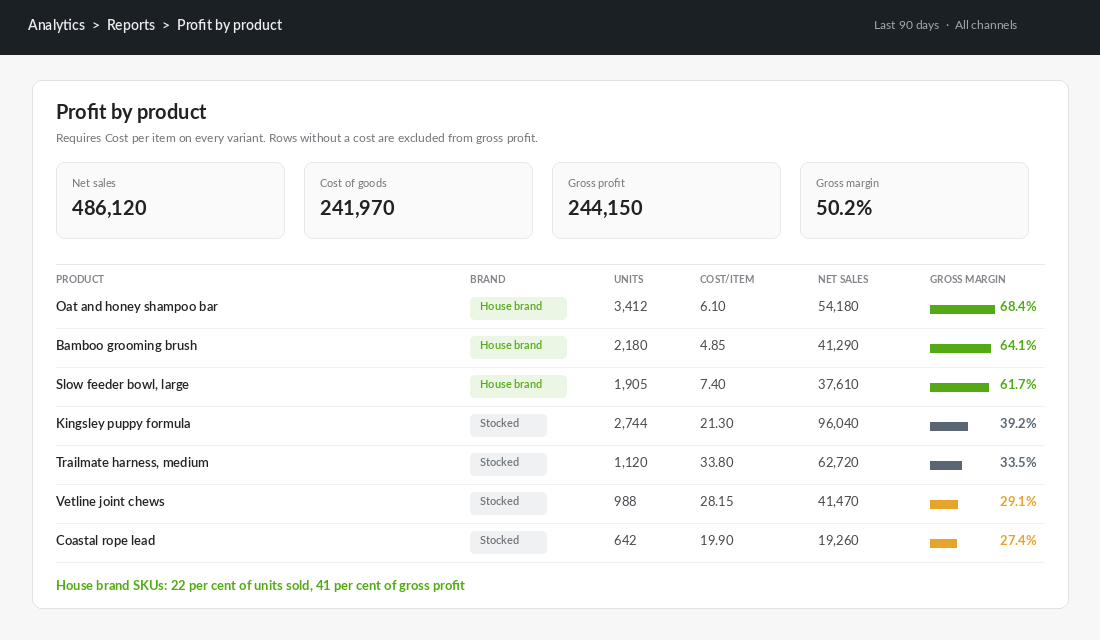
- Open the profit reports. Analytics, then Reports, then the Profit section. Shopify calculates gross profit and margin per order, per product and per variant from that one field. Variants missing a cost are excluded, so the report is only as complete as your data.
- Tag house brand SKUs. Add a product tag such as house-brand so you can filter and compare the two portfolios side by side rather than eyeballing a list.
- Layer in the costs Shopify does not know about. Payment processing under Finances then Payouts, your plan fee under Settings then Plan, plus freight and advertising. Gross profit is the starting point, not the answer.
- Review monthly against the launch model. Units, sell-through rate, contribution per unit and the cannibalisation number you wrote down before launch.
The reason to do this before the first purchase order is simple. If you set the baseline after launch, you will never be able to prove whether the house brand added contribution or just moved it around.
The Twelve Month House Brand Sequence
Everything above works as a sequence, not a checklist. Run it in this order and the risk drops at every stage.
- Months 1 to 2. Score every category against the five gates. Build the contribution model for the top three. Populate Cost per item across the whole catalogue and set your baseline in Shopify.
- Months 3 to 4. Shortlist manufacturers for the single highest scoring category. Brief the spec properly. Run sample round one. Negotiate MOQ against lead time and forward volume.
- Months 5 to 6. Sample rounds two and three. Lock artwork, packaging and compliance. Sign the supply agreement with product safety and indemnity terms. Confirm insurance covers deemed manufacturer exposure.
- Months 7 to 8. Place the first order at the smallest MOQ you can negotiate. Build the product page, photography and launch email flow while the container is in transit. Write down the cannibalisation budget.
- Months 9 to 10. Launch into your existing customer base first, not paid traffic. Your repeat buyers are the cheapest proof of concept you will ever get. Watch sell-through weekly.
- Months 11 to 12. Review contribution per unit against model, decide on reorder quantity, and only then score the second category. One product done properly beats four done at once.
The compounding is the whole point. The first house brand SKU teaches you the supply chain, the compliance layer and the cash cycle. The second one costs a fraction of the effort because the infrastructure already exists. By the fifth, house brand is a capability rather than a project, and that is when the margin story starts showing up in the annual accounts rather than in a spreadsheet.
Kmart did not build Anko in a year. They built a product organisation over a decade and then let it take 85 per cent of the business. You do not need that scale. You need one category that clears all five gates, a supply agreement that protects you, and the discipline to measure it properly from day one.
If your house brand model does not deliver at least 15 to 20 per cent more contribution per unit at a lower retail price, the category has told you no. Listen to it and go score the next one.
Inside eCommerce Circle, product and margin architecture is one of the core pillars we work on with every member, because it is the lever most Aussie operators leave completely untouched. If you want a second opinion on whether your range is ready for a house brand, let’s talk.