Your Shopify dashboard says you did $84,000 last month. Your bank account says you have $6,200 and a BAS due in nine days. If that gap has ever made you feel sick on a Sunday night, you are not bad at business. You are running the same bank structure as almost every founder we meet: one account, everything in, everything out, and “profit” is whatever happens to be left over.
What’s in This Article
Most brands manage cash by looking at the balance. That number is a lie. It includes the ATO’s GST, next month’s stock order, the Meta invoice that has not hit yet, and money that was supposed to be your wage. Poor cash flow is the single most cited reason Australian small businesses fail, with ASIC data showing it is named as a primary cause in 47% of SME insolvencies. Almost none of those businesses were unprofitable on paper. They just never separated the money.
The founders who sleep well do something different. They split revenue into purpose-built bank accounts the moment it lands, using fixed percentages, on a fixed rhythm. This is Profit First, adapted for a Shopify store where nearly half your revenue walks straight back out the door as stock. Here is the exact system, the percentages that work for Aussie DTC brands, and how to set it up in an afternoon.
Why “Revenue Minus Expenses Equals Profit” Keeps Failing You
Standard accounting says Sales minus Expenses equals Profit. Mathematically true. Behaviourally useless. When profit is what is left at the end, there is never anything left at the end, because expenses expand to fit the cash available. Every founder has watched a good month get eaten by a “quick” reorder, a new app, and a bigger ad budget that felt affordable at the time.
Profit First flips the formula: Sales minus Profit equals Expenses. You take profit (and tax, and your pay) off the top, then run the business on what remains. It works because it uses a limit you already respond to. You do not check your P&L before spending. You check your bank balance. So the system makes the bank balance tell the truth.
The pressure on Aussie operators has only gone one way. The Australian Securities and Investments Commission recorded 14,152 companies entering external administration in FY2025-26, roughly 75% higher than the pre-COVID 2018-19 year, and around 95% of them had fewer than 20 staff. A CommBank and UNSW survey found close to 80% of Australian SMEs experienced significant cash flow impacts in the past 12 months. One in six now lose more than $2,500 a month to late payments alone. You cannot control the economy. You can control whether the ATO’s money is sitting in your operating account pretending to be yours.
If you have not already built a forward view of your cash, start with our 8-week rolling cash flow forecast. Profit First is the operating layer that sits on top of it.
The Ecommerce Twist: Quarantine Stock Before You Allocate Anything
The original Profit First book by Mike Michalowicz was written for service businesses, where nearly every dollar of revenue is real revenue. A Shopify store is different. If you sell a $100 product with a $40 landed cost, only $60 of that sale is yours to allocate. Run the standard percentages on the full $100 and you will strip cash out of the business faster than the stock cycle can replace it.
Cyndi Thomason’s Profit First for Ecommerce Sellers adapts the model with one critical change: an Inventory account that is funded first, before profit, tax, or pay. Every allocation percentage is then calculated on Real Revenue (sales minus cost of goods), not gross sales. For most product brands, cost of goods including inbound freight lands somewhere between 35% and 50% of net sales, so a 45% inventory allocation is the sensible default until your own numbers tell you otherwise.
Two rules make the Inventory account work on Shopify:
- Fund it from every payout, not when the supplier invoice arrives. If your reorder cycle is 90 days, you should have three months of COGS sitting in that account by the time the purchase order goes out. That is what turns a supplier deposit from a crisis into a bank transfer.
- Use landed cost, not the supplier’s unit price. Freight, duties, packaging, and the 3PL receiving fee all live in this account. If you have never worked out your true cost per unit, our contribution margin audit walks through it line by line.
Get this step right and the rest of the system becomes simple arithmetic. Get it wrong and Profit First will make you feel rich for two months and then starve your next stock order.
The 6 Accounts Every Shopify Store Needs (And What Goes In Each)
You need six bank accounts. It sounds like a lot. In practice, every major Australian business bank lets you open an extra transaction account in a few minutes from the app, and most charge nothing for the additional accounts. The friction is deliberate: money should be slightly annoying to move out of the accounts it is not supposed to leave.
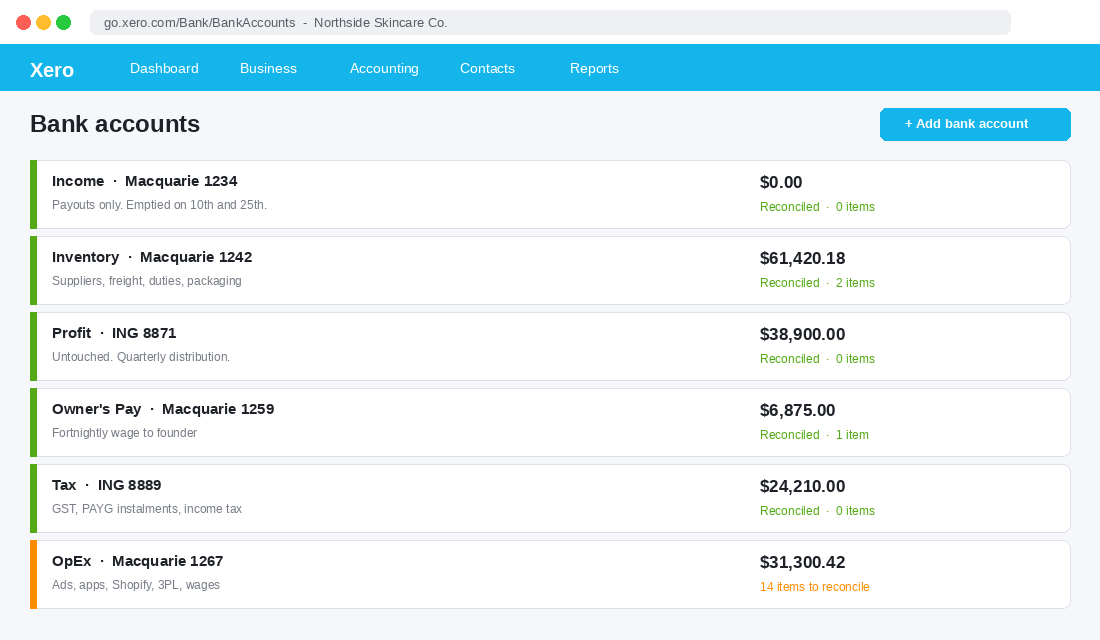
- 1. Income. Where every Shopify Payments, PayPal, and Afterpay payout lands. Nothing is ever paid from here. It is a holding pen, emptied on allocation day.
- 2. Inventory (COGS). Supplier payments, inbound freight, duties, packaging. Funded first, at your COGS percentage of gross sales.
- 3. Profit. Untouched. Distributed quarterly (more on that below). This is the account that proves the business is a business and not an expensive hobby.
- 4. Owner’s Pay. Your wage. Paid to you on a schedule like any employee. If you are drawing “whatever is there” you are not paying yourself, you are borrowing from your own company.
- 5. Tax. GST collected, PAYG instalments, and company or personal income tax. This money was never yours. Our Shopify GST playbook covers exactly what you owe and when.
- 6. Operating Expenses (OpEx). Everything else: ads, apps, Shopify fees, wages, 3PL, contractors, software. This is the only account your team should ever see the balance of.
Advanced operators add a seventh Ad Spend account carved out of OpEx, so the Meta and Google budgets have a hard ceiling that is not negotiable at 11pm during a good-looking ROAS week. If paid media is more than 15% of your revenue, do this from day one.
The Allocation Percentages That Work for Aussie DTC Brands
Here is where most founders stall, because the percentages in the book assume a US service business. Below are the target allocation percentages we use with Circle members, calculated on Real Revenue after the Inventory account has taken its cut. They are targets, not starting points. You will grow into them.
- Under $500k per year in sales: Profit 5%, Owner’s Pay 35%, Tax 15%, OpEx 45%. At this stage the founder is the workforce, so pay is high and OpEx is lean.
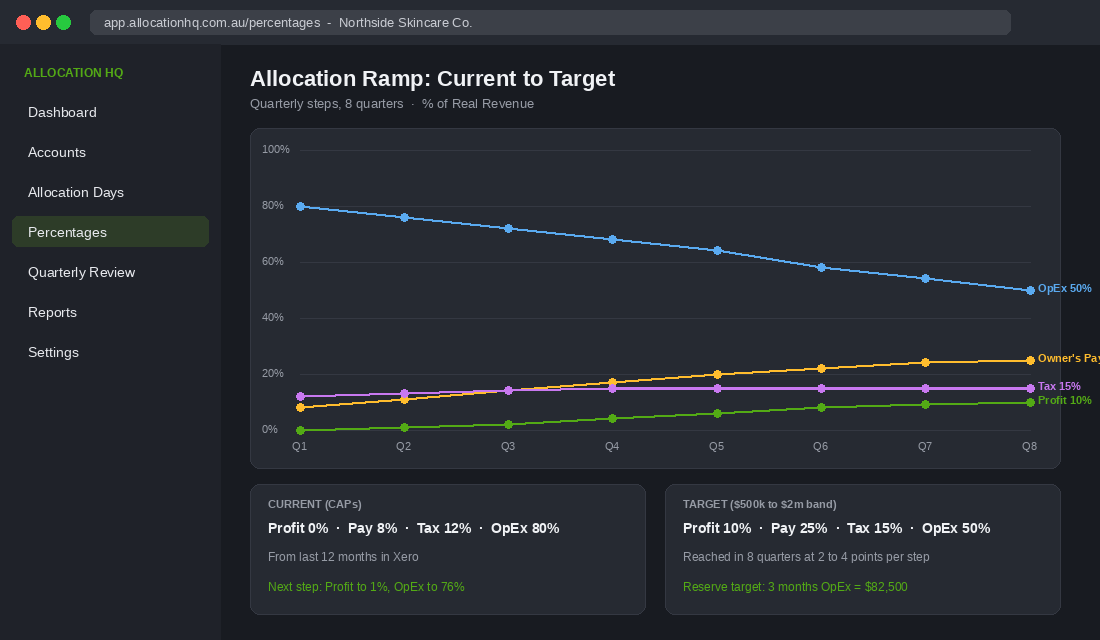
- $500k to $2m per year: Profit 10%, Owner’s Pay 25%, Tax 15%, OpEx 50%. You are hiring, spending on ads, and paying a 3PL. Owner’s Pay drops as a percentage but rises in dollars.
- $2m to $5m per year: Profit 12%, Owner’s Pay 15%, Tax 15%, OpEx 58%. The business now funds a real team and the founder is paid a market salary rather than a share of the pie.
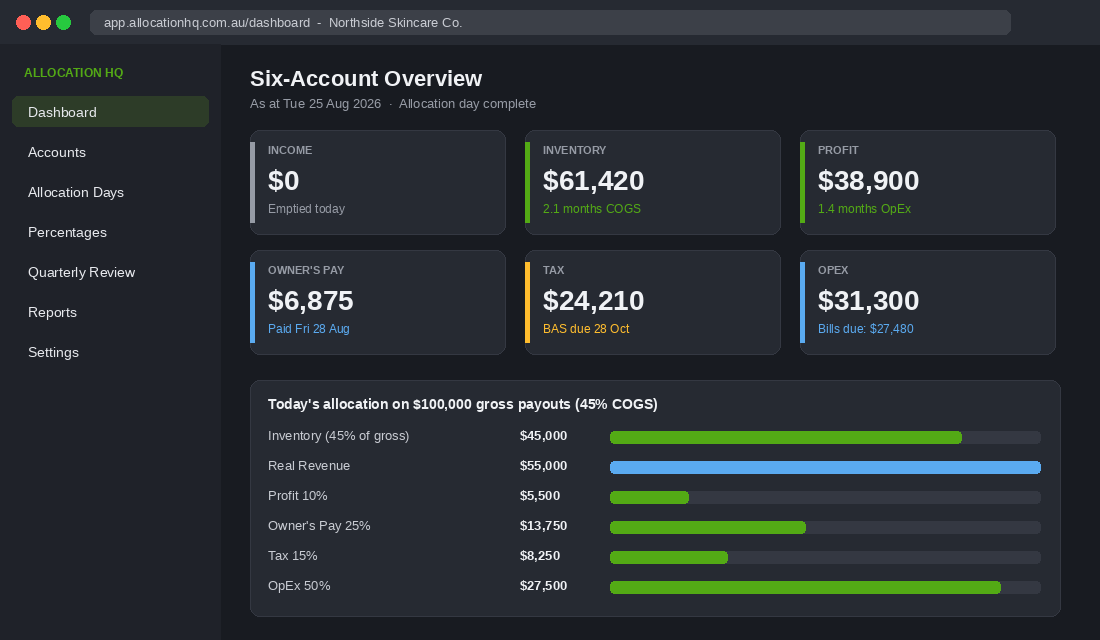
Work the maths on a $100,000 month with 45% COGS. Inventory takes $45,000 first. Real Revenue is $55,000. At the $500k to $2m band, that is $5,500 to Profit, $13,750 to Owner’s Pay, $8,250 to Tax, and $27,500 to OpEx. If $27,500 does not cover your ads, apps, wages, and fulfilment for the month, you have just learned something your P&L was hiding. Do not fix that by shrinking the Profit allocation. Fix it by cutting the expense.
On the Tax account: 15% of Real Revenue is a starting estimate, not a promise. GST is 10% of your taxable sales but you also claim credits on stock and expenses, so your net GST is usually far lower than a flat 10%. Company tax at the 25% base rate applies to profit, not sales. Ask your accountant for a figure based on last year’s actual liabilities and adjust quarterly. Under-funding this account is the mistake that ends businesses.
Start Where You Are: The Current Allocation Percentage Method
Do not jump straight to the targets. If you are currently paying yourself nothing and running 70% OpEx, moving to the model overnight will bounce a supplier payment in week two and you will abandon the whole thing. Instead, run this three-step process.
- Step 1: Calculate your Current Allocation Percentages (CAPs). Pull the last 12 months from Xero. Total sales, total COGS, total owner drawings, total tax paid, total everything else. Express each as a percentage of Real Revenue. This is your honest starting line. For most founders it looks like Profit 0%, Owner’s Pay 8%, Tax 12%, OpEx 80%.
- Step 2: Set your first quarter’s percentages one notch closer to target. Move Profit from 0% to 1%. Move Owner’s Pay up 3 points. Move OpEx down 4 points. Small enough that nothing breaks. Real enough that you feel the constraint.
- Step 3: Adjust every quarter, never mid-quarter. Each quarter, shift another 2 to 3 points toward target. Most brands reach their target allocation percentages within 18 to 24 months. The slowness is the point. You are retraining how the business spends.
A 1% Profit allocation on $55,000 of monthly Real Revenue is $550. It feels pointless. Do it anyway. The habit of money leaving the operating account and not coming back is worth more than the dollars in month one. By month twelve it is a $10,000 buffer that did not exist before, and you will not remember missing it.
The 10/25 Rhythm: When to Allocate and When to Pay
Profit First runs on a twice-monthly rhythm: allocations and bill payments on the 10th and 25th of each month. Everything that lands in Income between those dates just sits there. On the day, you move the money to the five working accounts using your percentages, then pay bills from OpEx and suppliers from Inventory.
Batching bills to two days a month does three things. It stops the drip of daily “just this one” payments that make spending invisible. It gives you two fixed moments to see whether OpEx can actually cover the bills due, which is the earliest possible warning that costs are drifting. And it takes about 40 minutes each time, which is less than most founders spend worrying about money per day.
Shopify stores with high daily payout volume sometimes prefer weekly allocations so the Income account never balloons. Either cadence works. What does not work is allocating “when I get around to it”. Put both dates in your calendar as non-negotiable, the same way you would a BAS deadline, because in practice that is what they are.
One exception: the Tax account. If you are on quarterly BAS, move a rough GST estimate across on every allocation day rather than trying to catch up in the last two weeks of the quarter. If you are on monthly BAS or PAYG instalments, the 10th and 25th rhythm lines up neatly with the ATO’s 21st and 28th due dates.
Quarterly Profit Distributions (And Why You Only Take Half)
Every quarter, the Profit account is split in two. Half is paid to the owners as a distribution, on top of Owner’s Pay. This is the reward for running a profitable business and the reason the discipline is worth keeping. Spend it on something that is not the business. That is a rule, not a suggestion. The moment profit distributions get reinvested into “just one more stock order”, you have rebuilt the old system with extra steps.
The other half stays in the Profit account as a retained reserve. The target is three months of operating expenses sitting untouched. At $27,500 per month of OpEx, that is an $82,500 buffer. It is the difference between a Meta ad account ban, a supplier factory fire, or a two-month port delay being a very bad week and being the end of the company.
Once the reserve hits three months of OpEx, you have choices most founders never get to make: a bigger distribution, paying down Shopify Capital or a bank facility early, or funding a new product line from cash instead of debt. Profit First does not stop growth. It makes growth something you fund on purpose.
Setting It Up: Bank, Xero, and 90 Minutes
You do not need a special app. You need a bank that makes extra accounts free and instant, and a bookkeeping system that reconciles them without pain. Here is the setup we recommend, using Xero because it is what the majority of Aussie Shopify brands already run.
- Open the accounts. In your business banking app, open five additional transaction accounts and rename them: Inventory, Profit, Owner’s Pay, Tax, OpEx. Your existing everyday account becomes Income. Move Profit and Tax to a different bank if you can. Out of sight matters.
- Point every payout at Income. In Shopify admin, go to Settings, then Payments, then Manage under Shopify Payments, and update the payout bank account. Do the same in PayPal and Afterpay. From now on, no money enters the business anywhere else.
- Move every direct debit to OpEx. Shopify subscription, apps, Klaviyo, Meta, Google, 3PL. Update the payment method on each. Supplier payments and freight forwarders move to Inventory. This takes an hour and you will find at least two subscriptions you forgot you had.
- Connect all six bank feeds in Xero. Accounting, then Bank accounts, then Add bank account. Each account appears as its own feed. The Chart of Accounts stays the same. Transfers between your own accounts are coded as Transfers, not income or expenses, so your P&L is unaffected.
- Build a Xero bank rule for each recurring supplier and app. Accounting, then Bank accounts, then Bank rules. Once set, reconciliation of six accounts takes about the same time as reconciling one used to.
- Create a one-page allocation sheet. One row per allocation day with Income balance, COGS percentage, Real Revenue, and the four allocation amounts. Google Sheets is fine. A formula does the maths; you do the transfers.
If your bank supports scheduled transfers based on a percentage, or you use an accounting-integrated account that offers automatic percentage splits on incoming payments, automate it. If not, the manual transfers on the 10th and 25th are the most valuable 40 minutes of your month, because they force you to look.
The Three Ways Founders Break Profit First (and How to Not)
We have watched hundreds of Aussie Shopify founders implement this. The ones who fail do so in one of three predictable ways.
- They “borrow” from Tax or Profit to cover OpEx. Once. Then twice. Then the accounts are just labels. The fix is a rule: if OpEx cannot pay a bill, the bill waits or the expense gets cut. The Profit and Tax accounts are not a line of credit. If you need one, arrange an actual overdraft and keep the system intact.
- They set the Inventory percentage too low. Usually because they used the supplier’s unit price and forgot freight, duties, and the 3PL receiving fee. Recalculate landed cost every quarter, especially after a freight rate change or a new supplier. When Inventory is short, the temptation to raid Profit is overwhelming.
- They skip a peak-season adjustment. BFCM and December can double your Income account while stock for January is already paid for. Real Revenue spikes, allocations spike, and the founder takes a huge distribution in January just as sales crater. Before peak, agree with yourself that the December Profit allocation is held in the reserve half until the March quarter closes.
There is also a quieter failure: treating a fat OpEx account as permission. If OpEx builds up a surplus over a few months, that is not spare money. It is a sign your percentages are off. Shift the excess to Profit at the next quarterly review and tighten OpEx by that amount.
How the Six Accounts Work as One System
Each account on its own is just a bucket. Together they change how decisions get made. Inventory funded from every payout means a purchase order is a transfer, not a negotiation with your own fear. A fixed OpEx balance means ad spend has a ceiling that is set on a calm day, not a hopeful one. A funded Tax account means BAS is an admin task, not a quarterly emergency. A growing Profit reserve means one bad supplier, one banned ad account, or one slow quarter is survivable.
And Owner’s Pay landing on the same day every fortnight does something to how you run the company. You stop making decisions from scarcity. You stop saying yes to a wholesale order at 20% margin because you need cash this week. You start choosing growth that is worth funding, because for the first time you can see, in six numbers on a Tuesday morning, exactly what the business can afford.
Profit First does not make more sales. It makes sure the sales you already have turn into a business you actually own.
Your Profit First Setup Checklist
- Pull 12 months from Xero and calculate your Current Allocation Percentages on Real Revenue.
- Work out true landed COGS as a percentage of net sales (freight, duties, packaging, 3PL receiving included).
- Open five extra transaction accounts: Inventory, Profit, Owner’s Pay, Tax, OpEx. Rename your current account Income.
- Redirect all payouts (Shopify Payments, PayPal, Afterpay) to Income.
- Move every direct debit and card-on-file to OpEx; suppliers and freight to Inventory.
- Connect all six bank feeds in Xero and set bank rules for recurring payments.
- Set first-quarter percentages one notch toward target. Profit starts at 1% minimum.
- Book the 10th and 25th in your calendar for allocations and bill runs. Book a 30-minute quarterly review to move percentages.
- Confirm a Tax percentage with your accountant based on last year’s actual GST, PAYG, and income tax.
- Write down the rule: Profit and Tax are never touched to cover OpEx. Sign it. Stick it above the desk.
Inside eCommerce Circle, cash discipline is one of the core pillars we work on with every member, because a profitable P&L and an empty bank account are the most common combination we see. If you want a second opinion on your allocation percentages, let’s talk.