Most Aussie Shopify founders treat New Zealand as a rounding error. They tick “ship internationally” in Shopify, leave prices in AUD, let Kiwi shoppers eat a $25 shipping fee, and then wonder why New Zealand sits at 1% of orders forever.
What’s in This Article
That is a mistake, because New Zealand is the easiest export market you will ever get. Same language, same time zone (give or take two hours), same shopping calendar, a Shopify-dominated retail landscape, and a customer who already knows your brand from Instagram. LSKD was doing $10 million a year in online sales to New Zealand before it opened a single store there. That did not happen by accident. It happened because they treated NZ like a market, not a shipping zone.
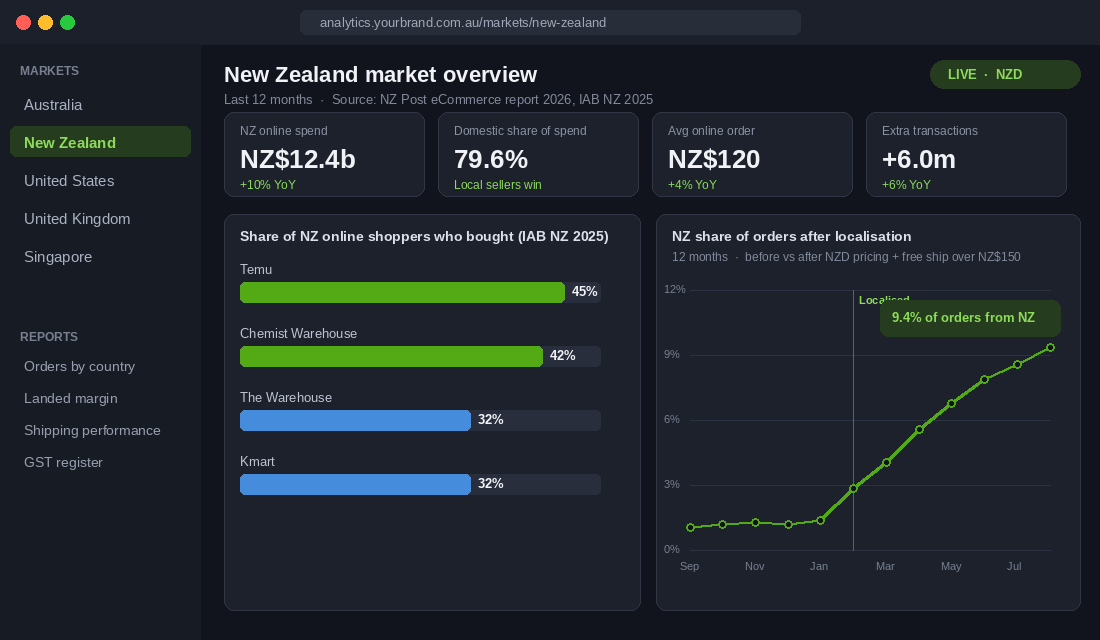
The numbers back it up. NZ Post’s 2026 eCommerce report found almost one in four retail dollars in New Zealand is now spent online, roughly NZ$12.4 billion a year, up about 10% year on year. The average online order sits at NZ$120. And here is the part most founders miss: domestic retailers still hold 79.6% of that spend. Kiwis prefer to buy from sellers who feel local. If you can look local without being local, you win a share of a market that is growing faster than Australia’s.
This is the 5-step system we use with eCommerce Circle members who want NZ to become a real second market: size it, price it, ship it, tax it, and launch it properly. Follow it and New Zealand can go from 1% of orders to 8 to 12% inside a year, at margins that hold up.
Why New Zealand Beats the US as Your First Export Market
Every founder wants the US. It is big, it is glamorous, and it is where the money is supposed to be. It is also where Aussie brands go to burn cash. US shipping from Australia takes 10 to 20 days, US customers expect two-day delivery, and you are competing against every DTC brand on earth for the same Meta impressions.
New Zealand is the opposite. Five things make it the smartest first move:
- Your ads already reach them. Kiwis follow Aussie brands, watch the same TikToks, and read the same reviews. Most brands we work with already have 3 to 6% of their Instagram followers in NZ before they do anything deliberate.
- Shopify is the local default. Of roughly 41,700 tracked NZ ecommerce stores, 68.5% run on Shopify. Kiwi shoppers are used to Shopify checkouts, Shop Pay, and Afterpay. Your store will feel familiar the moment it loads.
- Amazon is not the gravity well. In Australia, Amazon sets the delivery expectation. In NZ, it is a secondary player. The traffic leaders are Trade Me and, increasingly, Temu, which now reaches 45% of NZ online shoppers. That leaves room for a branded Aussie store with fast trans-Tasman shipping.
- Shipping is a real advantage. Australia Post International Standard lands in NZ in 5 to 10 business days. A parcel from a US brand takes two to three times that. You are the fast option for once.
- The rules are simple. One tax (15% GST), one threshold (NZ$1,000), one registration trigger (NZ$60,000 of sales in 12 months). No state-by-state sales tax, no tariff schedule, no customs broker for most orders.
The catch is that Kiwis are demanding. The IAB New Zealand 2025 Commerce Report found NZ shoppers care more about free shipping and easy returns than Australian shoppers do. When asked what annoys them about buying from Australia, 41% said expensive shipping and 20% said slow shipping. Fix those two things and you have removed the main reasons they do not buy.
Step 1: Size the Opportunity Before You Spend a Dollar
You are not guessing here. You already have NZ data sitting in three places. Pull it before you touch a setting.
- Shopify Analytics. Open the Sales by billing country report for the last 12 months. Note NZ orders, NZ revenue, and NZ average order value. Then open Sessions by country. If NZ sessions are 4% of traffic but 1% of orders, you have a conversion gap, not a demand gap. That gap is what this playbook fixes.
- Meta and Google Ads. Check the geographic breakdown. Most Aussie accounts are leaking 2 to 5% of impressions into NZ because the audience was set to “Australia and New Zealand” by an agency years ago. You are already paying to reach them. You are just not converting them.
- Klaviyo. Segment by country = New Zealand. Count the profiles. A 40,000-person list will usually have 1,500 to 3,000 Kiwis in it who have never been sent a single NZ-relevant email.
Now run the sizing maths. Take your NZ sessions, apply your Australian conversion rate (not your current NZ one), and multiply by your Australian AOV. That is the revenue you would already be earning if NZ converted like home. For a $2 million brand with 4% NZ traffic, that number is usually $60,000 to $90,000 a year of revenue you are leaving on the floor before spending anything new on acquisition.
One caution on benchmarks. New Zealand has no official online-share statistic. NZ Post says about 25% of retail dollars are online because it counts every online card transaction, including supermarkets. Pure-play estimates from IBISWorld and ECDB land nearer 10 to 15%. If you are a DTC brand, benchmark against the pure-play number. Compare yourself against the 25% figure and NZ will look more saturated than it is for a brand like yours.
One more signal worth watching: ANZ-Roy Morgan consumer confidence in NZ fell to about 80 in April 2026, a three-year low. Kiwis are still buying online (transaction volumes rose 6%) but they are hunting value. NZ Post’s own research found 46% of Kiwi shoppers now put discounts and special offers above everything else when choosing where to buy. That shapes your launch offer in Step 5.
Step 2: Price in NZD (and Do Not Just Convert)
Showing a Kiwi an AUD price is the single biggest conversion killer in trans-Tasman ecommerce. It signals “foreign store, surprise fees coming.” Shopify Markets fixes this in ten minutes, but only if you set it up properly.
Here is the setup we recommend:
- Create a dedicated New Zealand market in Settings, then Markets. Do not lump it into “International” with 150 other countries. NZ gets its own pricing, shipping, and content.
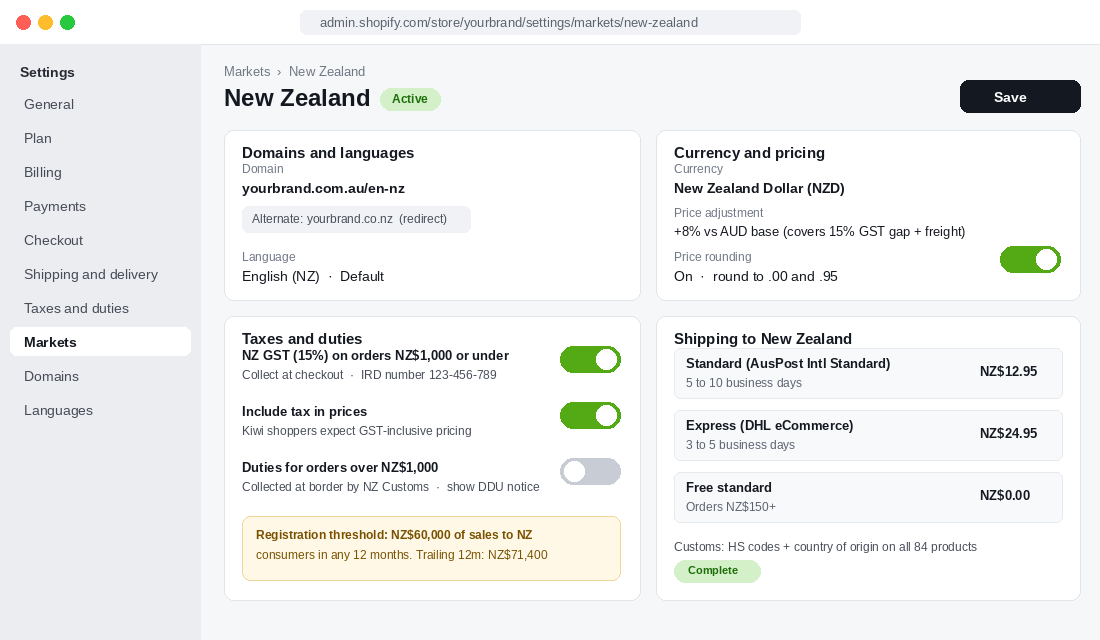
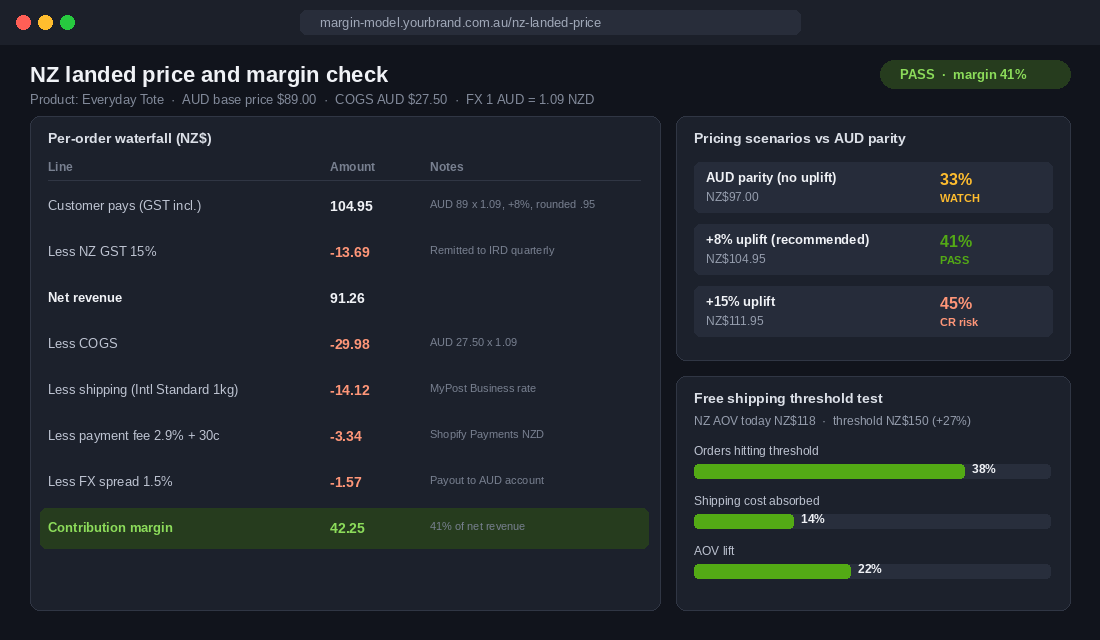
- Currency: NZD, with price rounding on. Shopify’s rounding rules mean a Kiwi sees NZ$104.95, not NZ$103.87. Rounded prices convert better and look like you meant them.
- Add a price adjustment of 6 to 10%. This is where founders get nervous, so here is the logic. Your AUD prices include 10% Australian GST. NZ GST is 15%. Shipping across the Tasman costs more than domestic. A flat conversion at parity leaves you 5 to 8 points of margin short on every NZ order. An 8% uplift covers the GST gap and most of the freight difference, and Kiwis still see a price that is competitive with buying the same product from a US or UK store.
- Include tax in prices. NZ shoppers, like Australians, expect the price on the page to be the price they pay. A checkout that adds 15% at the last step will get abandoned.
- Use a subfolder, not a separate store. yourbrand.com.au/en-nz keeps your SEO authority in one place and lets Shopify auto-redirect Kiwi visitors. If you own the .co.nz domain, point it at the subfolder. You do not need a second Shopify store until NZ is 15% or more of revenue and you want local inventory.
DARCHE, the Australian camping brand, did exactly this. It used Shopify’s international sales tools to launch darche.co.nz as its first export market, running off the same catalogue and admin as the Australian store, before looking further afield. No second build, no second team.
One practical note on currency. If you are on Shopify Payments, you can accept NZD and get paid out in AUD. Shopify takes a currency conversion fee (currently around 1.5% in Australia) on top of the card fee. Build that into your margin model rather than discovering it in your payout report. If you already read our FX playbook on stopping the Aussie dollar eating your margin, the same levers apply here in reverse: a strong NZD is your friend, a weak one means revisiting the uplift.
Step 3: Ship Like a Local (the Shipping Rules That Convert Kiwis)
Remember the IAB finding: 41% of Kiwis say expensive shipping is their main gripe with Aussie stores, and 20% say slow shipping. Your shipping page is doing more selling (or un-selling) than your product page for this market.
Here is the shipping architecture that works:
- Standard: Australia Post International Standard. New Zealand is Zone 1, the cheapest international band. With a MyPost Business account you save up to 35% off retail depending on volume, which puts a 1kg parcel in the NZ$13 to NZ$16 range landed. Quote 5 to 10 business days and it usually arrives in 4 to 7.
- Express: DHL eCommerce or Australia Post International Express. Offer it at cost plus a small margin, 3 to 5 business days. Around 15 to 20% of Kiwi buyers will pay for it, mostly for gifts.
- Free shipping over a threshold. Set it 20 to 30% above your NZ AOV. If NZ orders average NZ$118, the threshold is NZ$150. This is the same logic as our free shipping threshold playbook, just priced in NZD with the higher freight cost baked in.
- Show the NZ shipping promise on the product page. “Ships from Australia, 5 to 7 business days to NZ, free over NZ$150.” Kiwis do not mind that it comes from Australia. They mind not knowing.
- Sort out customs data once. Every product needs an HS code and country of origin in Shopify. It is 20 minutes of admin that stops parcels sitting in Auckland for a week. Australia Post requires it for International Standard now anyway.
Returns are the second half of this. Kiwis rate easy returns above Aussies do, and a “return it to Melbourne at your own cost” policy kills repeat purchase. The pragmatic fix at under $50,000 a year of NZ revenue is a NZ Post returns label bought through a tool like Starshipit or Shippit, with the cost split (you cover it for faults, customer covers change of mind, exchange free). Past about NZ$200,000 a year, a small NZ 3PL for returns and fast replenishment starts to pay for itself, and at that point you also need to think about NZ GST under the ordinary rules because the stock is physically in New Zealand.
If you want the full detail on making delivery speed a conversion lever rather than a cost line, our delivery promise playbook covers the on-page mechanics.
Step 4: Handle NZ GST Properly (It Is Simpler Than You Think)
This is the step that scares founders into doing nothing, so let’s make it plain. New Zealand’s rules for overseas sellers have been stable since December 2019 and they are simple.
- Low value goods (NZ$1,000 or less per item, excluding GST). If you sell NZ$60,000 or more to NZ consumers in any 12-month period, you must register with Inland Revenue (IRD) and charge 15% GST at checkout. Under NZ$60,000 you can choose not to register, and the goods enter NZ without GST being collected at the border.
- High value goods (over NZ$1,000 per item). GST and any duty are charged at the border by NZ Customs, and the customer pays before delivery. If you sell big-ticket items, say so clearly on the product page.
- Business customers. If a GST-registered NZ business gives you its GST number, you do not charge GST on their order. Handy if you take wholesale or corporate orders.
- Stock held in NZ. The moment you use a NZ 3PL, you are no longer a “low value imported goods” seller. You register under the ordinary rules instead. Same 15%, different form.
Registering is a 20-minute online process through IRD, returns are quarterly, and Shopify handles the collection once you turn on tax for the NZ market and enter your IRD number. The bit to get right is the threshold watch. Set a monthly reminder to check trailing-12-month NZ sales in Shopify. Cross NZ$60,000 and you have to register from that point, so it is better to see it coming at NZ$45,000 than to discover it at NZ$75,000.
Margin-wise, the 15% is the reason for the Step 2 price uplift. If you show a Kiwi the same NZ$-converted price you show an Australian, you are absorbing an extra 5 points of tax. Our cross-border duty playbook goes deeper on the border mechanics for every market, but for NZ, the summary is: register when you hit the threshold, collect at checkout, include it in the price, and move on.
Step 5: Launch NZ Like a Market, Not a Setting
Here is where the LSKD story matters. Founder Jason Daniel did not just turn on NZ shipping. He sent a team member to live in a van and drive from Northland to Christchurch building the community in person, because he saw that most Australian brands that come to New Zealand leave the community “to the side.” When LSKD finally opened its Takapuna store in late 2024, 705 customers came through on day one, the brand’s biggest store launch ever. The online business had already earned that.
You do not need a van. You need to do five things in the first 30 days:
- Email the Kiwis you already have. Build a Klaviyo segment for NZ profiles and send a three-email launch: “We now price in NZD and ship free over NZ$150”, a founder note about why NZ matters to you, and a launch offer. Expect this segment to convert at 2 to 3 times your normal campaign rate because you have never spoken to them properly before.
- Lead with value, not a discount. Kiwis are value-hunting right now, but a 20% off code trains them to wait for the next one. Free express shipping for the first 14 days, or a NZ-only bundle, delivers the value signal without cutting your base price.
- Split NZ out in your ads. Duplicate your best Meta campaign with a NZ-only audience and NZ-specific creative (“Now shipping to NZ in 5 days, priced in NZD”). Budget NZ$50 to NZ$100 a day. Because NZ CPMs are typically 15 to 25% lower than Sydney or Melbourne, the same creative often produces a cheaper CAC than home. Our members regularly see NZ ROAS 10 to 30% above their Australian campaigns in the first quarter.
- Seed 5 to 10 Kiwi creators. Gift product to NZ micro-creators in your category. Kiwi audiences respond to Kiwi voices, and the content doubles as social proof on your en-nz pages.
- Localise the words that matter. You do not need a new site. You need “NZ” in the announcement bar, NZD on every price, a shipping FAQ that mentions NZ Post and Auckland, and a reviews widget filtered to show NZ reviewers first if your app supports it. Trust is built in the details.
Then measure NZ as its own line. Create a Shopify report filtered to NZ for orders, revenue, AOV, conversion rate, and shipping cost as a percentage of revenue. Review it monthly alongside your Australian numbers. If NZ conversion is within 20% of Australia by month three, you have a real market. If it is not, the problem is almost always shipping cost or a price that still looks foreign.
The Tool: Shopify Markets, Set Up in 10 Steps
Shopify Markets is built into every plan, so there is no app to buy. Here is the exact sequence for a NZ market:
- Go to Settings, then Markets, and click Add market. Name it New Zealand and add New Zealand as the only country.
- Under Domains and languages, choose Subfolder and set the suffix to en-nz. Turn on automatic redirection so Kiwi visitors land on the NZ version.
- Under Currency and pricing, set the currency to NZD. Turn on price rounding and choose the rounding rule (.95 or .00).
- Set a price adjustment of 6 to 10% for the NZ market. Review any products where the rounded NZ price lands awkwardly against a psychological threshold and set a fixed price for those.
- Under Taxes and duties, turn on collecting GST for New Zealand and enter your IRD number once registered. Turn on “include tax in prices” for this market.
- Under Shipping and delivery, create a New Zealand shipping profile with Standard, Express, and a free-over-threshold rate. Do not reuse your generic international zone.
- Bulk-edit products to add HS codes and country of origin. Shopify’s bulk editor handles this in one pass.
- In Shopify Payments, confirm NZD is enabled and note the conversion fee in your margin model.
- Set up a Klaviyo segment for NZ profiles and add a NZ-specific block to your welcome flow (“Ships to NZ in 5 to 7 days, free over NZ$150”).
- Place a test order from a NZ address (a VPN or a Kiwi mate works) and check the price, GST line, shipping options, and confirmation email all read correctly in NZD.
The whole setup is under two hours for a store with fewer than 200 products. If you want a deeper walkthrough of the Markets feature set itself, our Shopify Markets playbook covers the five levers in detail.
The Four Mistakes That Keep NZ at One Percent
- Charging a flat NZ$25 shipping fee. On a NZ$80 order that is a 31% surcharge. It is the single biggest reason Kiwis abandon Aussie carts. Get a MyPost Business account, price shipping at cost, and add a free threshold.
- Pricing at AUD parity. It feels generous. It quietly costs you 5 to 8 points of margin on every order because of the GST gap and freight. Use the uplift.
- Ignoring the NZ$60,000 threshold. Founders either register too early (and add admin they do not need yet) or cross it and do not notice. Watch the trailing 12 months monthly.
- Treating NZ as Australia with a different postcode. Kiwis notice when a brand cannot be bothered. One NZ-specific email, NZD pricing, and a shipping promise that names NZ Post is the minimum. LSKD built a $10 million market by going further than that.
The Compound Effect: What NZ Is Worth to a Two Million Dollar Brand
Run the maths on a $2 million Aussie Shopify brand with 4% of sessions from NZ and a 2.2% Australian conversion rate. Today, NZ converts at 0.8% because of AUD pricing and a NZ$25 shipping fee, so it produces about $28,000 a year.
Localise pricing and shipping and NZ conversion moves to 1.8%. Same traffic, and NZ revenue is now roughly $65,000. Add a NZ-only Meta campaign at NZ$75 a day returning a 3.5x ROAS, and you add another $90,000 to $100,000 of revenue. Email the NZ segment properly and the repeat rate lifts because Kiwis are no longer paying a penalty to come back.
Net result: NZ moves from 1.4% of revenue to around 8% inside 12 months, roughly $160,000 of largely incremental revenue at a 38 to 42% contribution margin. That is $60,000 to $65,000 of contribution from a market you were already reaching, before you touch the US.
And it de-risks the business. A second market with its own seasonality, its own consumer confidence cycle, and its own ad auction means a soft month in Australia is no longer a soft month for the whole company.
Your NZ Launch Checklist
Print this, work through it in order, and tick each item off. The whole thing is a fortnight of part-time work.
- Pulled 12 months of NZ sessions, orders, AOV, and conversion from Shopify Analytics
- Checked Meta and Google geo reports for NZ impressions already being bought
- Built a Klaviyo segment of NZ profiles and counted it
- Created a dedicated New Zealand market in Shopify with the en-nz subfolder
- Set NZD with rounding and a 6 to 10% price adjustment
- Turned on GST-inclusive pricing for NZ and set a trailing-12-month threshold reminder
- Registered with IRD if NZ sales are at or over NZ$60,000 in any 12 months
- Opened a MyPost Business account and priced Standard shipping at cost
- Set a free shipping threshold 20 to 30% above NZ AOV
- Added HS codes and country of origin to every product
- Wrote a NZ returns policy with a NZ Post label option
- Added the NZ shipping promise to product pages and the announcement bar
- Placed a test order from a NZ address and checked every step in NZD
- Sent the three-email NZ launch sequence
- Duplicated the best Meta campaign with a NZ-only audience and NZ creative
- Gifted product to 5 to 10 NZ creators
- Built a monthly NZ-only report and set a conversion target within 20% of Australia
Inside eCommerce Circle, finding and converting the prospects you are already reaching is one of the core pillars we work on with every member, and New Zealand is usually the fastest win on the list. If you want a second opinion on your NZ numbers before you flip the switch, let’s talk.