You have a new product idea. Maybe it is a second colourway, maybe a whole new category. You have priced it, briefed the supplier, and you are about to put down a deposit on 1,000 units. And the only people who have told you it is a good idea are your team, your partner, and a supplier who gets paid either way.
What’s in This Article
This is how most Aussie DTC founders make product decisions. Gut feel, a few Instagram comments, and a hope that the customers will show up. Then the stock lands, sells at half the forecast, and spends the next 18 months being discounted out the door. NIQ BASES looked at more than 21,000 product launches and found that once a new product disappoints customers, its chance of succeeding in market drops to roughly 5%. Nielsen puts the share of new consumer products that fail to survive their first year at around 85%.
The brands that avoid this trap have a structural advantage the rest do not: a small, hand-picked group of real customers who see every idea before it becomes a purchase order. Not a survey. Not a poll. A standing panel of 10 to 12 people who know your product, buy it repeatedly, and will tell you the truth. That is a customer advisory board, and building one is the highest-return research investment a store doing $50k to $500k a month can make. Here is the 5-step system we use with eCommerce Circle members to set one up in 30 days.
Why a Standing Panel Beats Every Survey You Have Ever Sent
Surveys tell you what a random slice of your list thinks on a Tuesday. A customer advisory board tells you what your best customers think, in context, with follow-up questions, over time. The difference shows up in the quality of the answer. A survey respondent picks “somewhat likely” from a dropdown. A board member holds your prototype, tells you the zip catches on the lining, and then tells you she would still pay $20 more for it if you fixed the zip.
The demand is there. MakerSights surveyed consumers and found 75% said being asked for feedback on future products would make them more likely to buy from that brand, rising to 83% among 18 to 34 year olds. Two thirds said they wished they had more opportunities to give their favourite brands feedback. Meanwhile 43% of retail product teams in the same study named “understanding customer preferences” as their toughest go-to-market challenge. Customers want to be asked. Brands are not asking.
There is a retention dividend too. The same study found 22% of consumers named “having a say in what products are made” as a driver of loyalty. Board members are your top 10% by spend already. Giving them a seat at the table turns them from repeat buyers into owners. Every brand we have watched run this properly reports the same thing: board members buy more, refer more, and defend the brand in comment sections without being asked.
Step 1: Recruit the Right 10 (Not the Loudest 10)
The board is only as good as the people on it. The mistake most founders make is inviting whoever replies fastest to an Instagram story. You end up with a panel of enthusiastic fans who love everything, which is worse than no panel at all because it gives false confidence. Recruit on evidence, not enthusiasm.
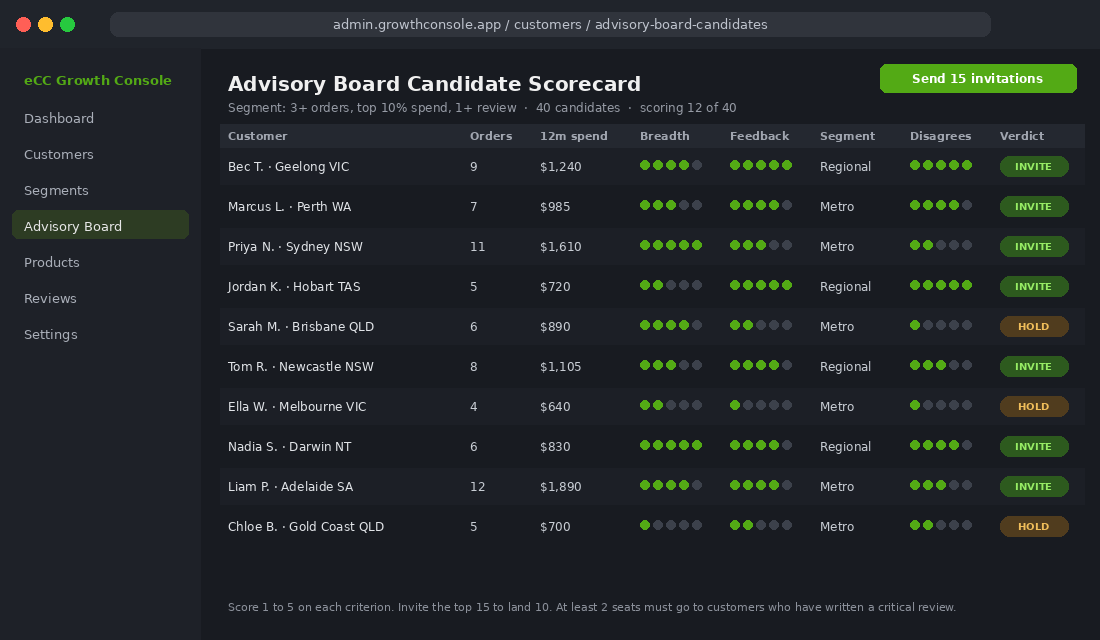
Start in Shopify. Build a customer segment with three filters: three or more orders in the last 12 months, total spend in your top 10%, and at least one product review or support conversation on record. That last filter matters. You want people who already talk to you. From that list, shortlist 40 and score each on four criteria:
- Breadth of use. Have they bought across your range, or one hero SKU on repeat? You want both types, but you need to know which is which.
- Quality of past feedback. Read their reviews and support tickets. Specific, constructive, occasionally critical is gold. “Love it!!!” five times is not.
- Segment coverage. If 30% of your revenue comes from regional Australia, 3 of your 10 seats should too. Same for age, life stage, and product category.
- Willingness to disagree. The customer who once emailed you a three-paragraph note about your shipping packaging is your first invite.
Invite 15 to land 10. Send the invitation from your personal email, not the marketing platform, and make it a real letter: why them specifically, what the commitment is (one 60-minute video call per quarter, plus two or three short asks in between), and what they get. Compensation does not need to be cash. A $150 store credit per session, first access to every launch, and their name on a “Founding Board” page on your site is plenty at this size. Aim for a 12-month term with a rotation of three or four seats each year so the panel does not calcify into a fan club.
If you want a script for the individual conversations before you assemble the group, the founder-led customer interview playbook covers the 9 questions that get past polite answers.
Step 2: Write a One-Page Charter So It Does Not Become a Chat Group
Without a charter, an advisory board drifts into a WhatsApp group where people share holiday photos and you occasionally drop a product shot. The charter is one page and it answers five questions: what the board is for, what it is not for, how often it meets, what members commit to, and what the brand commits back.
The “what it is not for” line is the one founders skip and regret. Your board is not customer service. It is not a place to complain about a late parcel. It is not a discount channel. Write that down, say it in the kickoff call, and enforce it kindly the first time someone tests it. The board exists to answer one type of question: should we build this, and if so, how?
The brand’s commitments are just as important. Commit to three things in writing:
- You will close the loop. Within 14 days of every session, members get a short note on what you heard, what you are doing about it, and what you decided not to do and why.
- You will show them things first. Every concept, sample, and price change goes to the board before it goes anywhere else. That is the real currency here.
- You will not sell to them in sessions. No pitching, no upsell, no “while I have you”. The moment a board call feels like a sales call, the honest feedback stops.
Set the cadence at quarterly for the full group call, with a maximum of one asynchronous ask per month in between (a photo of a sample with three questions, a two-option vote, a 5-minute form). More than that and you burn the panel out inside six months. The best boards we see are used sparingly and taken seriously.
Step 3: Run Sessions That Produce Decisions, Not Opinions
A 60-minute quarterly call with 10 customers is a lot of goodwill to spend. Spend it on decisions you are about to make with real money attached. The agenda that works is three blocks of 20 minutes, each built around one live question.
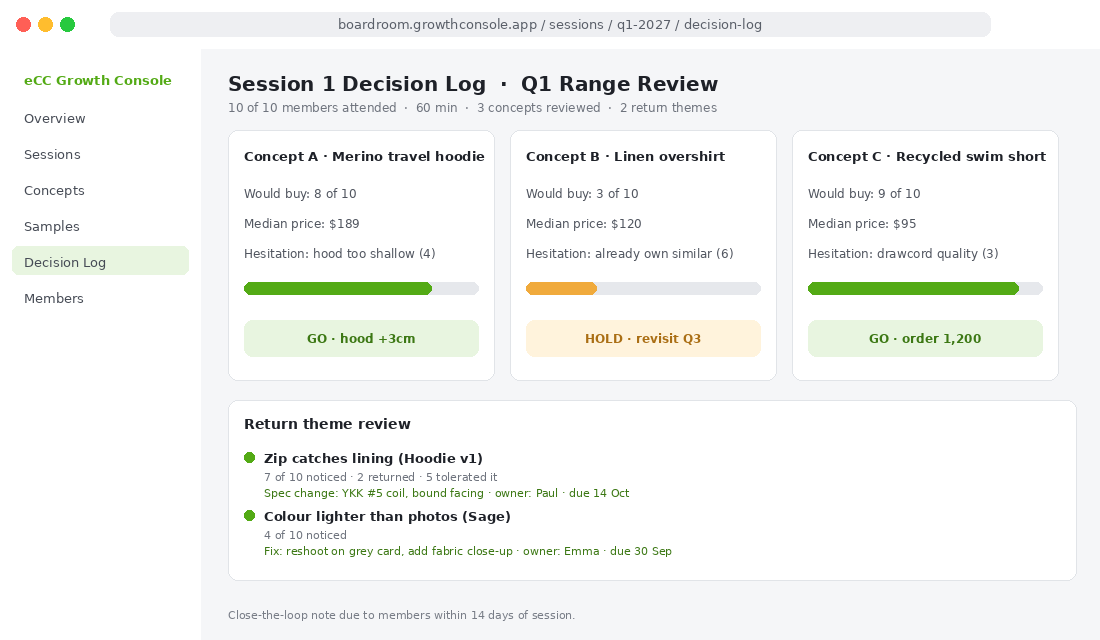
Block one is the range question. Show two or three product concepts you are considering for the next season, one at a time. For each, ask three things: would you buy this, at what price, and what would stop you? Do not ask “do you like it”. Everyone likes everything on a video call. Ask for money and hesitation. Glossier ran this exact loop through blog comments before it had a board and turned 385 responses into 40 formulations and one cleanser that is still a bestseller a decade later. The insight the brand had not thought of (customers wanted pH-balanced) came from the crowd, not the chemist.
Block two is the fix question. Bring your top two return reasons or support themes from the quarter and ask the board what they have noticed. This is where the zip-catches-on-the-lining detail surfaces. You will hear things your returns data cannot tell you, because the customer who tolerated the flaw never returned the product.
Block three is the open door. Ten minutes for “what have we missed”. Some quarters this is nothing. Some quarters it is the reason you launch a product you never had on the roadmap. LSKD, the Queensland activewear brand, built its reputation on this move: when a customer requested a colourway on Facebook, the team said they would make it if the comment hit 500 likes, then worked directly with that customer on the exact shade. That is a board decision made in public, and it is a big part of why the brand’s community runs at roughly 60% repeat customers.
Record every call (with permission), and have someone other than you take notes. Your job on the call is to ask follow-up questions, not to type. Within 48 hours, turn the notes into a one-page decision log: the question, what the board said, what you decided, and the date. That log is the asset. After four quarters you have a documented record of why your range looks the way it does.
Step 4: Put Samples in Their Hands Before You Put Stock on a Boat
Concept feedback is useful. Sample feedback is where the money is. The gap between “I would buy that” on a call and “I wore it for three weeks and the seam split” is the gap between a good launch and a warehouse full of markdowns. The American Society for Quality estimates the cost of quality (returns, rework, replacements, and warranty) runs at 15 to 20% of sales for a typical business, and up to 40% for the worst. Your board is the cheapest quality-control department you will ever hire.
The protocol is an in-home use test, the same method the big consumer goods companies run, scaled to a 10-person panel:
- Ship pre-production samples to every member at least 8 weeks before your bulk order deadline. That is the window you need to change a spec with most Asian suppliers without blowing the timeline.
- Give them a two-week use brief. Not “try it and tell us what you think”. Specific: wear it three times, wash it twice, use it in the situation you bought the last one for. Ask them to photograph anything that surprises them.
- Collect feedback on a 5-question form at the end of the fortnight: what worked, what failed, what would you change, what would you pay, would you buy this over what you have now. Keep it under five minutes to complete.
- Look for the 3-of-10 rule. One person hating a feature is a preference. Three of ten flagging the same thing is a spec change. Ten of ten loving it is a signal to increase the order.
SURI, the sustainable electric toothbrush brand, went through roughly 20 iterations before launch and tested with dentists and customers throughout. Co-founder Gyve Safavi describes the goal as a “minimal lovable product”, not a minimum viable one. The difference is a panel telling you what lovable means before you commit to 5,000 units of viable.
One Aussie caveat: if your product has a safety or compliance angle (kids, skin, electrical, food), the board does not replace mandatory testing. It sits in front of it, catching the problems that would otherwise reach the certified lab as a surprise.
Step 5: Measure the Board Like a Channel
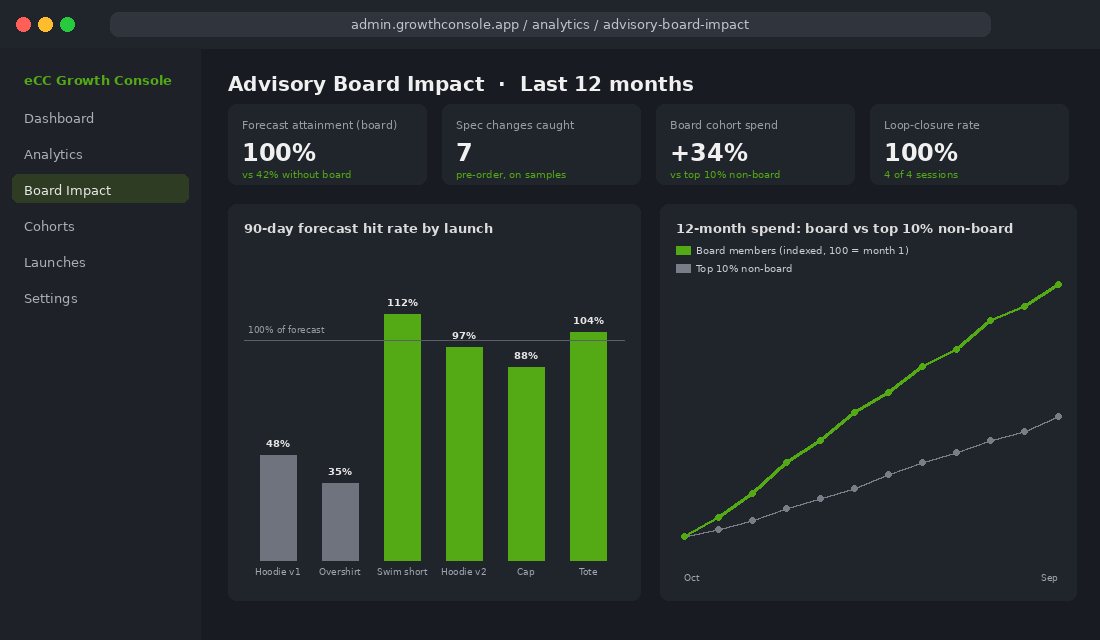
If you cannot show the board is worth the time, it will be the first thing dropped when Q4 gets busy. So measure it. Four numbers, reviewed once a quarter, on the same one-page log as your decisions.
- Launch hit rate. Of the products the board reviewed before launch, what share hit their 90-day sales forecast? Compare it with the products you launched without the board. This is the headline number.
- Spec changes caught pre-order. Count them. Every change made on a sample instead of on 1,000 units is a saved reorder or a saved markdown. Put a dollar figure next to each one, even a rough one.
- Board member value. Track the panel’s 12-month spend, order frequency, and referrals against your top 10% who are not on the board. Expect the board cohort to run 20 to 40% ahead. If it does not, the board is not feeling heard.
- Loop-closure rate. What share of sessions got a “here is what we did with your feedback” note within 14 days? Anything under 100% and the next session will be quieter.
This is also where the board earns its keep on pricing. Before any price move, run the two-question version of the price sensitivity survey past the panel first. Ten informed answers from your best customers will tell you more about your real ceiling than 500 responses from people who bought once in 2024.
The Tool Stack: Run It on What You Already Pay For
You do not need a community platform to do this. At 10 to 12 members, the whole thing runs on Shopify, Klaviyo, and a video call. Here is the five-step setup that takes about an hour:
- 1. Build the candidate segment in Shopify. Customers, then Segments, then create a segment with
number_of_orders >= 3 AND amount_spent >= [your top-10% threshold] AND last_order_date > -365d. Export to a sheet and score against the four criteria in Step 1. - 2. Tag accepted members. Add the customer tag
advisory-boardin Shopify. It syncs to Klaviyo as a profile property, so you can build an “Advisory Board” list in one click and exclude them from promotional blasts during test windows. - 3. Create one Klaviyo sign-up form for applications. Five fields: name, email, what they buy, what they would change, and availability. Route it to the board list with a “pending” property until you approve them.
- 4. Set the calendar. Four quarterly Google Meet or Zoom sessions booked 12 months out, with a Google Form (or Klaviyo form) for each in-home test. Consistency beats fancy.
- 5. Keep the decision log in one shared doc. Notion, Google Docs, whatever the team already opens. One page per quarter: questions, board answers, decision, date, owner.
Once you pass 20 members or start running multiple panels (say, a men’s and a women’s board), a paid community tool like Circle starts to earn its fee. Before then it is overhead.
Four Ways Founders Break Their Own Board
We have watched enough of these launch to know where they go wrong. The failures are almost never the customers. They are the founder.
- Filling it with fans. A board of superfans validates everything. If nobody on your panel has ever returned a product or written a 3-star review, you have built an applause track, not an advisory board. Recruit at least two members who have been critical in writing.
- Asking and then ignoring. Nothing kills a board faster than a founder who runs the session, nods, and ships the original plan anyway. You do not have to agree with the board. You do have to tell them why you disagreed.
- Over-asking. A monthly 40-question survey plus weekly polls plus a “quick favour” every time you have an idea. Members are customers with jobs. One structured session a quarter plus one light ask a month is the ceiling.
- Letting it go quiet. A board that meets in February and then hears nothing until August is dead by September. Put the four dates in the calendar on day one and treat them like supplier deadlines.
The Compound Effect: What Ten Honest Customers Are Worth
Run the numbers on a store doing $150k a month with four product launches a year. Say each launch is a $40,000 purchase order and, without the board, one launch in four under-performs badly enough to be cleared at a 40% markdown. That is $16,000 of margin gone, plus the cash tied up for six months, plus the ad spend that pushed a product nobody wanted.
Now put a board in front of every launch. You will not catch every miss, but you will catch most of the obvious ones, and you will fix a spec or two on the launches that do go ahead. Halve the miss rate and you keep roughly $8,000 a year in margin on launches alone. Add the spec changes caught on samples (call it two a year at $3,000 to $5,000 each in avoided returns and rework), and the retention lift on 10 members who now spend 30% more and refer a friend each. The total sits comfortably between $25,000 and $40,000 a year, for a cost of four video calls, ten sample kits, and about $6,000 in store credit.
The bigger return is not on the spreadsheet. It is the range you have in 24 months, shaped by people who pay for it, instead of by whatever your supplier had in the showroom. That is the moat. It compounds with the broader work covered in the brand community playbook and gives every product launch a validated starting point instead of a guess.
Your 30-Day Advisory Board Launch Checklist
Copy this into your task manager and work down it. Thirty days from now you will have a functioning board and your first session booked.
- Days 1 to 3: Build the Shopify segment (3+ orders, top 10% spend, one review or ticket). Export and score 40 candidates on breadth, feedback quality, segment coverage, and willingness to disagree.
- Days 4 to 7: Write the one-page charter. Purpose, not-for, cadence, member commitments, brand commitments (close the loop in 14 days, show first, never sell in session).
- Days 8 to 14: Send 15 personal invitations from your own inbox. Offer a 12-month term, one 60-minute call per quarter, $150 credit per session, first access to every launch.
- Days 15 to 21: Tag accepted members
advisory-boardin Shopify. Build the Klaviyo list. Book all four quarterly sessions in the calendar now. - Days 22 to 28: Prepare session one: two or three concepts for the next range, your top two return reasons, and the three questions per concept (would you buy, at what price, what stops you).
- Day 30: Run the kickoff. Record it, have someone else take notes, and publish the decision log within 48 hours. Send the close-the-loop note by day 44.
Inside eCommerce Circle, knowing your customers well enough to build what they will actually buy is one of the core pillars we work on with every member. If you want a second opinion on how you are making product decisions right now, let’s talk.