Open your best-selling product page on your phone right now. Somewhere under the add to cart button there is probably a line that says “Ships in 2 to 5 business days” or “Delivery 3 to 7 days depending on location”. You wrote it three years ago. It has never been tested. It is quietly costing you sales on every single session.
What’s in This Article
Here is why. Baymard Institute’s large-scale checkout research found that 41% of ecommerce sites still show shipping speed instead of a delivery date, and that when test participants were given only a duration they came to a complete halt trying to work out when the parcel would actually turn up. They counted on their fingers. They wondered whether the weekend was included. Some of them left. Baymard’s meta-analysis of 50 studies puts the average cart abandonment rate at 70.22%, and 21% of abandoners say delivery was too slow. A meaningful chunk of that 21% never actually knew how slow it was. They just could not tell, so they assumed the worst.
Meanwhile the Australia Post eCommerce Report shows 3 in 4 Australian shoppers say a good delivery experience makes them shop online more, and 69% want a range of delivery options at checkout. The demand for clarity is not subtle. This playbook is the six-step system we run with members to turn a vague shipping blurb into a specific, defensible delivery promise, and then to actually keep it. It ends with a 12-point audit you can run on your own store this afternoon.
“Ships in 2 to 5 Business Days” Is Not a Promise
A promise has a date. A range has an escape hatch. Your customer knows the difference even if they could not explain it, and their brain treats the two completely differently.
When someone reads “2 to 5 business days” they do three pieces of mental arithmetic. First, does “ships” mean leaves the warehouse or lands on my doorstep? Second, is today counted? Third, what happens across the weekend? Every one of those is friction at the exact moment you want a decision. Baymard’s testing shows shoppers consistently resolve that ambiguity by assuming the slowest outcome, which means your 2 day metro delivery gets mentally priced as 5 days plus a weekend.
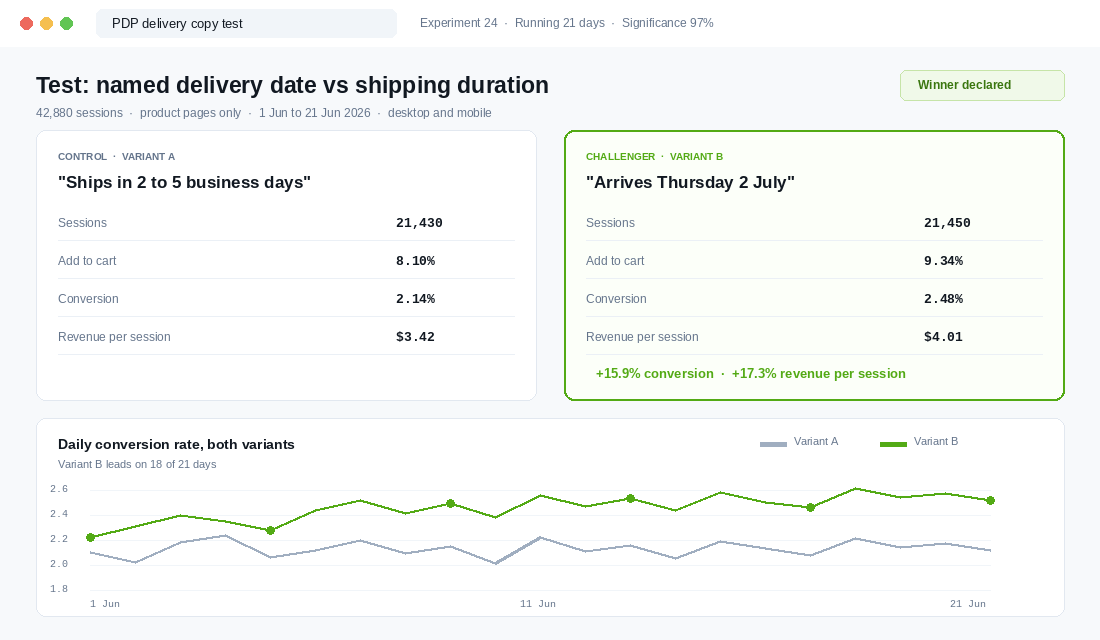
Compare that to “Arrives Thursday 2 July”. No arithmetic. No weekend question. A named day the customer can hold you to, and one they can check against the birthday, the trip, or the dinner party they are buying for. Direct-to-consumer brand Maude ran this exact swap as an A/B test on the product page and recorded a 12% lift in conversion and a 10% lift in profit. That is not a redesign. That is a sentence.
The reason most Aussie founders have not made the swap is not laziness. It is fear. You are worried that if you name a date and Australia Post has a bad week, you own the complaint. That fear is legitimate, and it is exactly why the first step is measurement, not copywriting.
Step 1: Measure Your Real Dispatch and Transit Times Before You Promise Anything
You cannot promise a date you have never measured. Most stores are running on a lead time somebody guessed during launch week, and nobody has checked it since the 3PL changed carriers.
Export your last 500 fulfilled orders from Shopify. You want four columns: order created timestamp, fulfilment created timestamp, destination postcode, and carrier delivery scan date. Shopify gives you the first three natively. The fourth comes from your carrier portal or your tracking app. If you use a 3PL, ask them for a delivery scan report. They have it.
Now calculate two separate numbers, and never blend them:
- Handling time. Order created to fulfilment created, in business days. This is entirely within your control. If your median is above 1 business day, that is an operations problem, not a shipping problem.
- Transit time. Fulfilment created to delivery scan, in business days, split by postcode zone. This is the carrier’s number. You buy it, you do not control it.
Take the 90th percentile of each, not the average. Averages lie when a handful of remote deliveries drag the tail. If 90% of your Melbourne metro orders land within 2 transit days, that is your Melbourne number. Promise the 90th percentile and you will keep the promise nine times out of ten, which is the standard you want before you put a date anywhere near a customer.
One warning that catches a lot of stores. Run this analysis excluding your pre-order and backorder SKUs, then handle them separately. Nothing destroys promise accuracy faster than a fourteen-line pre-order range inheriting the same delivery rule as your in-stock hero product.
Step 2: Put a Named Date on the Product Page, Not a Range
Once you have the numbers, the copy writes itself. Handling time plus transit time, rolled forward across business days and public holidays, equals a date. Show that date above the fold on the product page, near the add to cart button, in text large enough to read on a phone.
The format that tests best is short and human:
- Best: “Arrives Thursday 2 July”. One date, day name included so nobody has to check a calendar.
- Acceptable: “Arrives Wed 1 to Fri 3 July” if your 90th percentile genuinely spans a couple of days. A two-day named window still beats a five-day duration.
- Avoid: “Ships within 48 hours”. The customer does not care when it leaves. They care when it lands.
Put it in the same visual block as your other purchase-decision signals. If you have already built a proper product page structure, this slots straight into the trust row under the buy button. If you have not, our 9-block product page framework shows where the delivery block sits relative to price, reviews and returns.
Two Australian brands to look at for reference. The Iconic pushed its same-day cut-off out to 6pm in Sydney and Melbourne and now offers 3-hour delivery windows for premium members, plus a Twilight service where an order placed between 5pm and 8pm is delivered between 6pm and 10pm. Koala asks for your postcode at checkout to return an accurate estimate, and offers free 4-hour or same-day delivery in metro Sydney, Melbourne, Brisbane, Adelaide and Perth on weekdays for orders placed before 3pm. Neither is asking the customer to do maths. Both have made the delivery promise a product feature.
Step 3: Set a Dispatch Cut-Off and Show the Clock
A dispatch cut-off is the time of day after which an order rolls to the next business day. Most stores have one operationally. Almost none of them tell the customer.
Publishing the cut-off does two jobs at once. It makes the promised date credible, because the customer can see the logic. And it creates honest urgency, which is the only kind worth having. “Order in the next 4 hr 12 min to get it Thursday” is true, verifiable, and it resets every day. Compare that to a fake countdown timer that reloads when you refresh the page, which Australian consumer law takes a dim view of and which savvy shoppers spot instantly.
Some rules for getting the cut-off right:
- Set it 60 to 90 minutes before your actual pick deadline. You need buffer for order review, fraud holds and the odd address correction.
- Display it in the shopper’s timezone, not yours. A Perth shopper looking at a 1pm AEST cut-off at 10am their time has three hours, not none. Get this wrong and you lose WA orders every single afternoon.
- Kill the countdown on weekends and public holidays. Nothing looks more amateur than a Saturday timer counting down to a Monday dispatch.
- Load the public holiday calendar for every state you ship from. A Melbourne warehouse needs AFL Grand Final Friday and Melbourne Cup Day in the calendar or every promise that week is wrong.
Step 4: Solve the Postcode Problem Before It Solves You
This is where Australian stores get punished in a way American playbooks never mention. A single national delivery promise does not survive contact with this country’s geography.
If your warehouse is in Melbourne, a metro VIC order and a Darwin order are not remotely the same shipment. One is next day. One can be seven business days plus a buffer. Publish a single “3 to 5 days” promise across both and you have simultaneously undersold Melbourne and lied to Darwin. You lose conversions in your biggest market and you generate support tickets in your smallest.
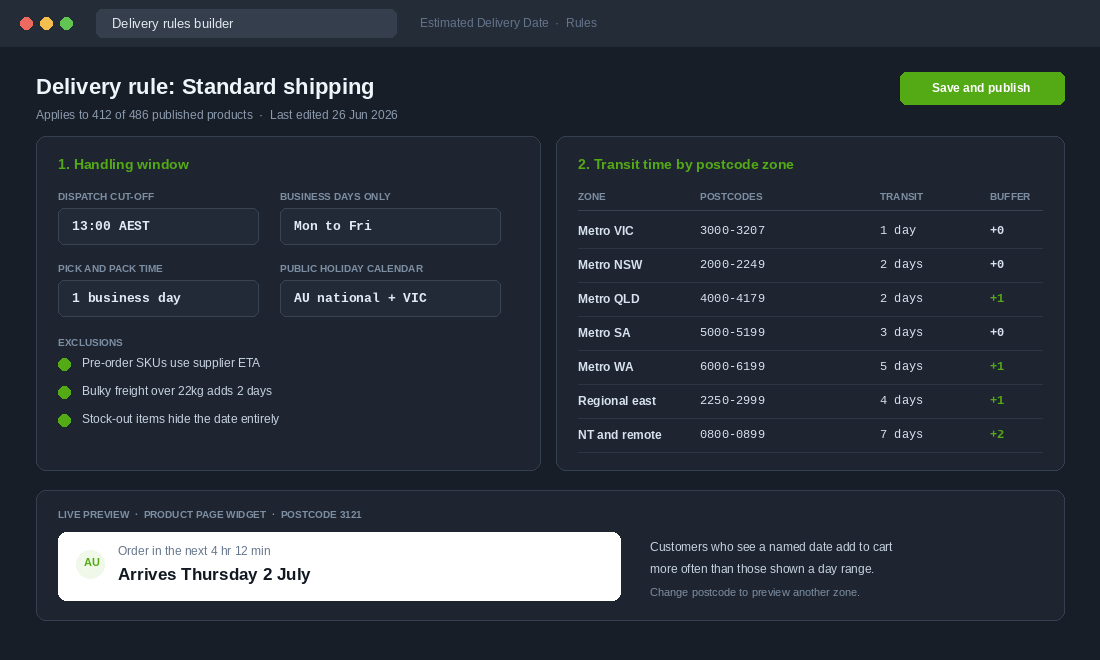
The fix is postcode zones. Build five to seven of them, each with its own transit number and its own safety buffer:
- Metro east coast (Melbourne, Sydney, Brisbane, Canberra). Your volume zone. Tightest promise, zero or one day buffer.
- Metro south and west (Adelaide, Perth, Hobart). Add a day, add a buffer. Perth in particular runs longer than most operators expect.
- Regional east coast. Usually one to two days beyond the nearest metro.
- Regional remainder and Tasmania. Two-day buffer minimum.
- NT and remote. Be genuinely conservative here. This is where promise accuracy goes to die.
Then ask for the postcode early. A small “Enter your postcode for an accurate delivery date” input on the product page does two things: it makes the promise specific, and it captures intent data you can use later. Stores that do this well see the promise widget become one of the highest-interaction elements on the page.
While you are in the shipping settings, this is a good moment to sanity-check what you charge as well as what you promise. Our free shipping threshold playbook covers how to set a threshold that lifts average order value without quietly eating your contribution per order.
Step 5: Carry the Same Date Through Cart, Checkout and Confirmation
The most common failure we see is a store that nails the product page and then drops the promise entirely. Customer sees “Arrives Thursday 2 July” on the PDP, adds to cart, and the cart drawer says nothing. Checkout offers “Standard shipping, 2 to 8 business days”. Confirmation email says “We will let you know when it ships”.
Three different messages about the same parcel. Every inconsistency is a small withdrawal from the trust account, and the last one arrives right when buyer’s remorse is strongest.
The date needs to appear, unchanged, at five points:
- Product page. Above the fold, near add to cart.
- Cart drawer. One line under the subtotal. If the cart contains a slower item, show the slowest date and say so.
- Checkout shipping step. Rename the shipping method itself. “Standard (arrives Thu 2 July)” beats “Standard, 2 to 8 business days”. This is what Australia Post’s finding about shoppers wanting a range of delivery options is really about: they want to compare outcomes, not descriptions.
- Order confirmation email. The date in the subject line or the first line of the body.
- Order tracking page. Promised date against current carrier status, side by side.
That last one is worth building properly rather than sending customers to a raw carrier page. Our order tracking page playbook covers how to turn it from a support deflection tool into a second-purchase surface.
Step 6: Track Promise Kept as a Weekly Number
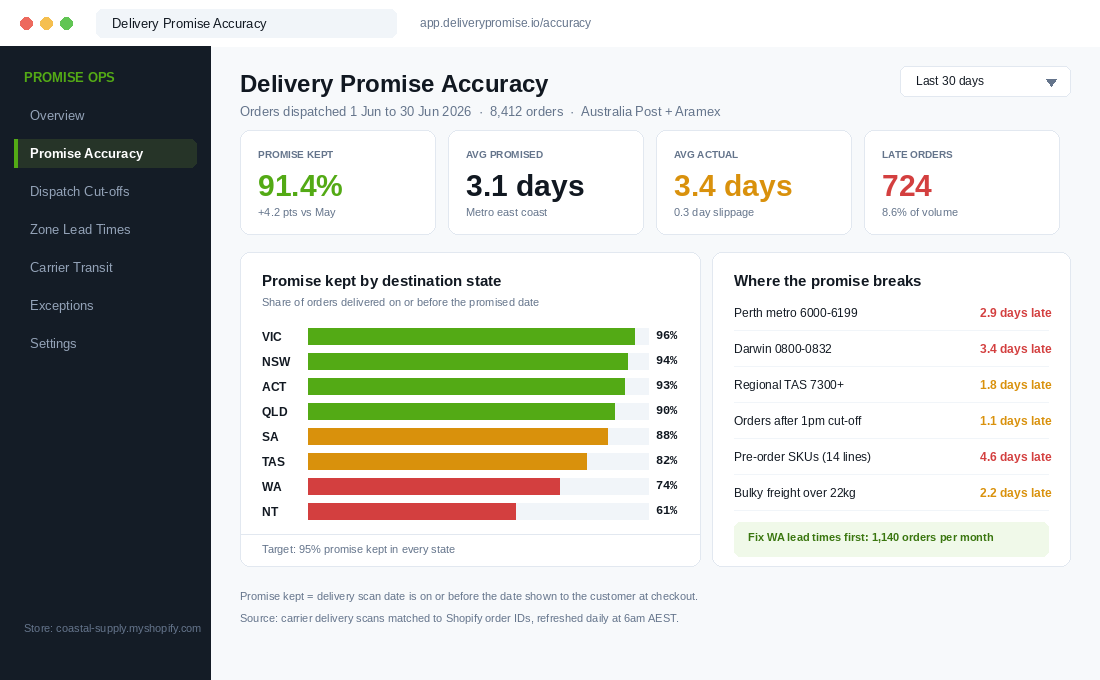
Here is the metric almost nobody in Australian ecommerce reports on, and the one that decides whether any of this works: promise kept percentage. The share of orders where the carrier delivery scan lands on or before the date you showed the customer.
Calculate it weekly. Segment it by destination zone, by carrier, and by whether the order was placed before or after the cut-off. Set a floor of 95% and treat anything below as an operations incident, not a shipping quirk.
What you will find in the first month is predictable and useful. One zone will be dragging the whole number down, usually WA or NT. One carrier service level will be systematically slower than its published transit. And a chunk of your misses will be orders placed within ninety minutes of the cut-off, which tells you the cut-off is set too late for your pick team.
None of those are copywriting problems. They are all fixable with a buffer adjustment or a conversation with your 3PL. If you have not pressure-tested that relationship recently, the 3PL playbook walks through the service level questions worth asking at renewal.
The Tool and the Half-Hour Setup
You do not need a developer for this. The Shopify app ecosystem covers it well, and the good options are inexpensive.
Our default recommendation is Estimated Delivery Date ‑ ETA by SetuBridge, currently sitting at a 4.9 rating across roughly 449 reviews. It handles processing time, dispatch date, transit time, holidays, lead days and cut-off times, and it can push the calculated date to product pages, collections, cart, checkout and email notifications. Essent Estimated Delivery Date (5.0 across roughly 809 reviews) and NS Estimated Delivery Date are both solid alternatives, and NS in particular does a nice animated timeline if that suits your brand.
Whichever you pick, the setup sequence is the same:
- Install and set your handling window first. Pick and pack time in business days, dispatch cut-off in your warehouse timezone, business days Monday to Friday.
- Load the public holiday calendar for your warehouse state plus the AU national dates. Every app worth using has this built in.
- Build your postcode zones from the Step 1 analysis. Enter the 90th percentile transit for each, then add the buffer separately so you can tune it later without losing the underlying number.
- Create exception rules for pre-order SKUs, bulky freight over your carrier’s standard weight break, and out-of-stock lines. Out-of-stock items should hide the date entirely rather than show a wrong one.
- Place the widget under the add to cart button on the product template, then in the cart drawer, then in the checkout shipping method name.
- Preview against three postcodes before you publish: your busiest metro, Perth, and a regional postcode. If any of the three looks wrong, the zone table is wrong.
- Run it as an A/B test for at least two weeks if your traffic supports it. Named date against your existing duration copy, product pages only, add to cart rate as the primary metric.
Budget thirty to forty minutes for the configuration and a couple of hours for the Step 1 data pull. The data pull is the part people skip, and it is the part that makes the whole thing safe.
What Happens When the Six Steps Compound
Individually these look like small UX tweaks. Stacked, they change the economics of the store, and they do it in three places at once.
At the top, they lift conversion. A named date removes the single biggest unanswered question on the product page. That is where the Maude test’s 12% came from, and it is why add to cart tends to move before checkout completion does.
In the middle, they cut support load. “Where is my order” is the highest-volume ticket in Australian ecommerce, and most of it is not a delivery failure. It is an expectation failure. When the date is set once and repeated at five touchpoints, WISMO volume drops without you hiring anyone.
At the back, they drive repeat purchase. This is the part founders underrate. Australia Post’s research is blunt about it: 3 in 4 shoppers say a good delivery experience makes them shop online more. A parcel that arrives on the day you said it would is not a logistics event. It is a brand promise kept, at the exact moment the customer is paying most attention. That is a retention lever disguised as an operations metric.
The compounding effect is that each step makes the next one cheaper. Measurement makes the date safe. The date makes the cut-off credible. The cut-off makes the urgency honest. Honest urgency makes the checkout consistent. Consistency makes the promise-kept number trackable. And a tracked number means the next improvement is obvious instead of guessed.
Peak Season: How to Hold the Promise When Volume Triples
Your delivery promise is only as good as your worst week, and for most Australian stores that week falls between Black Friday and mid-December. A promise that holds at 40 orders a day and collapses at 140 is not a promise, it is a seasonal apology generator.
The failure is almost never the carrier. It is dispatch. Your 24-hour dispatch SOP assumes one person picking and packing at a normal pace, and peak quietly turns that into a two-day queue while your product page keeps quoting the old date.
- Measure your dispatch ceiling before peak, not during it. How many orders can your team physically pack in a day at full tilt? Most single-site Australian operations land between 120 and 250 units per packer per day depending on product complexity. Write the number down. That is your capacity line.
- Build a peak promise, not a peak excuse. Two weeks before your biggest sale, widen the promised date by one business day across the board. Customers accept a longer promise made in advance. They do not accept a broken one made confidently.
- Automate the switch. Set the dispatch buffer as a variable in your delivery date app or metafield rather than editing copy across 40 templates. Shopify metafields plus a theme snippet handles this in about half an hour, and it means you can widen or tighten the promise in one place at 9pm on a Friday.
- Trigger on a queue metric, not a date. Widen the promise automatically when unfulfilled orders older than 24 hours cross a threshold you set. This is the single change that turns peak delivery from reactive firefighting into an operating rule.
- Publish the last-order-before-Christmas date early. Put it on the product page, in the cart, and in a site banner from late November. Stores that publish it clearly get a demand pull-forward into early December, which flattens exactly the peak that would have broken them.
- Book carrier capacity in writing. Australia Post and the major couriers cap volumes at peak. If you have not confirmed your allocation by October, your December promise is built on an assumption.
Run this alongside your peak inventory planning. The two are the same problem seen from different ends: inventory decides whether you have the stock, dispatch capacity decides whether the customer gets it when you said they would.
What to Do the Day You Break the Promise
You will break it. A carrier depot floods, a supplier ships short, a packer calls in sick during your biggest week. The question is not whether the promise fails, it is what happens in the six hours afterwards. Handled well, a broken promise costs you almost nothing. Handled badly, it costs you the customer and a review.
The rule is simple and almost nobody follows it: you tell them before they notice. The moment a customer works out for themselves that their parcel is late, you have moved from a logistics problem to a trust problem, and the second one is far more expensive to fix.
- Detect it automatically. A flow that fires when an order passes its promised dispatch date without a tracking number. Klaviyo can trigger this off a metafield or a fulfilment event. If a human has to notice, nobody will.
- Lead with the new date. Not an apology paragraph. The customer wants one piece of information and everything before it is noise. “Your order will now arrive Thursday 14th. Here is why, and here is what we are doing.”
- Say what went wrong in one plain sentence. “Our courier’s Melbourne depot is running two days behind after the storms.” Specific reasons get forgiven. “Unforeseen delays” does not.
- Offer something proportionate. Refund the shipping cost automatically on any order more than two business days past promise. It usually costs $9 to $15 and it converts a complaint into a story the customer tells positively. Do not offer a discount code on the next order as the primary remedy. It reads as a sales tactic at the exact moment goodwill matters most.
- Do not let it hit your support queue first. Every “where is my order” ticket costs 8 to 12 minutes of someone’s day. Proactive delay emails typically cut those tickets substantially in peak, which is real money at volume. If tickets still spike, a properly staffed live chat is cheaper than losing the customers who did not bother to ask.
Then close the loop internally. Log every broken promise with a reason code, and review the codes monthly against your promise kept percentage. Three months of data will tell you whether you have a carrier problem, a supplier problem, or a capacity problem, and those three have completely different fixes. Founders who skip this step spend years switching couriers to solve a dispatch problem.
The brands customers forgive are not the ones that never run late. They are the ones that told the truth first, gave a new date they then kept, and made the whole thing feel handled. That is a system, not a personality trait, and you can build it in an afternoon.
The 12-Point Delivery Promise Audit
Run this on your own store today. Score one point each. Anything under 8 and delivery is leaking sales for you right now.
- 1. Named date on the product page. A specific day, not a duration, above the fold.
- 2. Date accounts for the postcode. Melbourne and Darwin do not see the same number.
- 3. Dispatch cut-off is published. The customer can see the deadline, not just guess at it.
- 4. Countdown is real. It resets daily, disappears on weekends, and survives a page refresh.
- 5. Public holidays are loaded. Warehouse state plus national dates.
- 6. Pre-order and backorder SKUs have their own rule. They never inherit the in-stock promise.
- 7. Out-of-stock items hide the date. Better silent than wrong.
- 8. Cart drawer repeats the date. Slowest item wins when the cart is mixed.
- 9. Checkout shipping methods are named with dates. Not “2 to 8 business days”.
- 10. Confirmation email leads with the date. Subject line or first paragraph.
- 11. Tracking page shows promised against actual. Side by side, no carrier redirect.
- 12. Promise kept percentage is reported weekly. Segmented by zone, with a 95% floor.
Most stores we audit score between 2 and 4 on the first pass. The first three points alone are usually a fortnight of work and the largest conversion movement available to a store that has already optimised its product page copy and imagery. Start there.
The bigger shift is philosophical. Stop treating delivery as something that happens after the sale and start treating it as part of the offer. Price, product, proof and promise. Three of those probably get board-level attention in your business. The fourth is sitting in a settings page nobody has opened since 2023.
The promise you make on the product page is only as good as the warehouse behind it. If yours is under strain, our guide to choosing an Australian 3PL is the next thing to read.
Inside eCommerce Circle, the delivery promise is one of the core Platform pillars we work on with every member, because it sits right where operations and conversion meet. If you want a second opinion on yours, let’s talk.