Pull up your Meta Ads Manager and look at last month’s prospecting spend. Now ask a simple question: how much of that money went to people who were already on your Klaviyo list? For most Aussie Shopify stores the honest answer is “no idea”, and the real number is ugly. Trackbee’s analysis of DTC ad accounts found that roughly 50% of total spend lands on existing customers and previously engaged audiences, and most of that spend is not incremental.
What’s in This Article
Here is the frustrating part. You already own the data that fixes this. Every email address, phone number and order in your Shopify and Klaviyo accounts is a first-party signal that Meta and Google will happily accept, hash, match and use for targeting or exclusion. Most founders just never wire it up. They let the pixel guess who their customers are, and the pixel guesses badly.
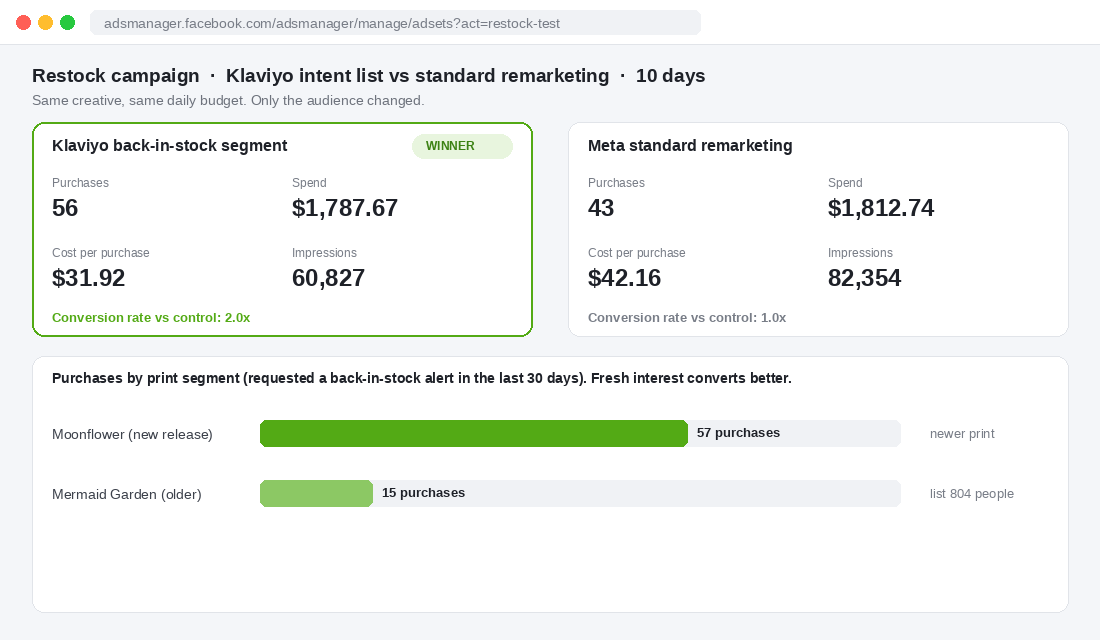
The brands that get this right run a very different ad account. Gold Coast swimwear label Kulani Kinis synced Klaviyo back-in-stock segments into Meta and doubled their conversion rate while reaching 50,000 fewer people, dropping cost per acquisition from US$42.16 to US$31.92 against standard Meta remarketing. Same creative, same budget, better list. This article is the five-list system I walk members through to do the same thing, plus the setup steps, the match-rate maths and the Australian privacy rules you need to respect while you do it.
Why Your Pixel Is the Weakest Audience Signal You Own
Everyone panicked about the death of the cookie, then Google backed down. In April 2025 Chrome confirmed it would not deprecate third-party cookies and would not even roll out the user-choice prompt it had promised. So the pixel still works in Chrome. That is not the point.
The point is that Safari has blocked third-party cookies since 2020, iOS App Tracking Transparency gutted Meta’s in-app signal in 2021, and Australian shoppers are disproportionately on iPhones. Your pixel sees a fraction of your actual customers, and when it builds a “purchasers” audience from that fraction, the exclusion it produces is full of holes. Shopify’s own numbers make this plain: when Shopify Audiences compared its identity-matched “Existing Customers Plus” list against standard ad platform pixel lists, it excluded 40% more real customers on average. Four in ten of your buyers were leaking through the pixel exclusion.
A customer list works differently. You upload (or auto-sync) hashed emails and phone numbers, the platform matches them against logged-in accounts, and the match is deterministic. Google reports most advertisers land a Customer Match rate between 29% and 62%. Meta customer lists typically match 40% to 60% on email alone and 60% to 75% when you add phone and name. Neither is perfect, but both are built from people you actually know, not from a cookie that may or may not have survived a browser update.
The uncomfortable stat that should get you moving: Lunio found fewer than a quarter of advertisers exclude audiences on every campaign they run, and 6.4% never use exclusions at all. If you have already built server-side tracking to recover conversion signal, first-party audiences are the other half of that job. One fixes what the platform measures. This fixes who it targets.
The 5-List System
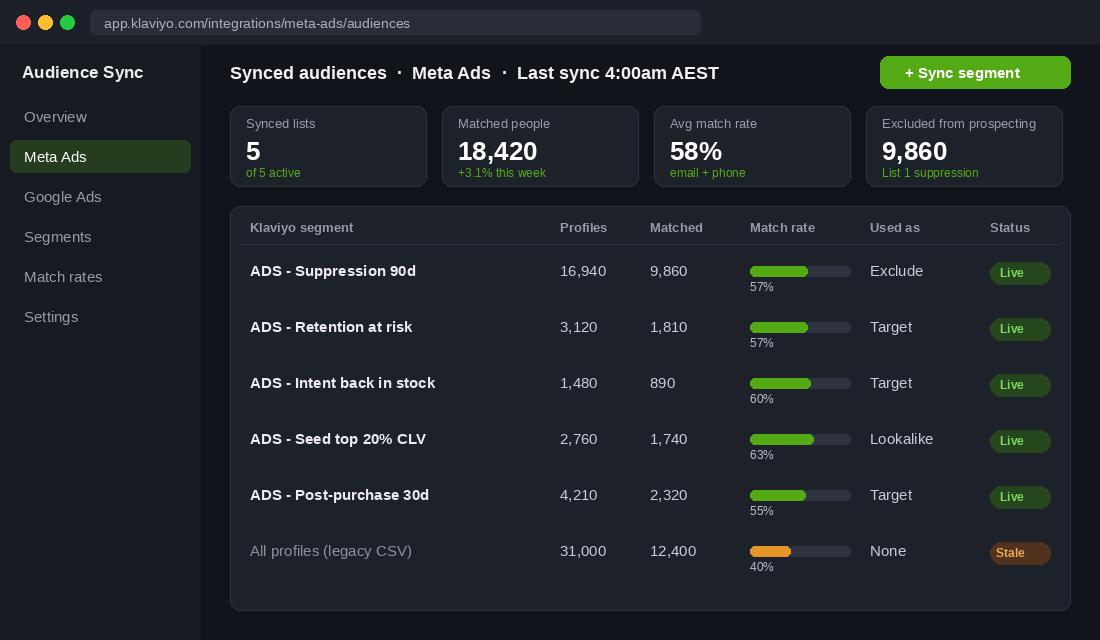
Do not try to sync every Klaviyo segment you own. Ad platforms need audiences big enough to learn from (Meta’s algorithm struggled with Kulani Kinis’ 300-person European segments and thrived on 3,000-person US ones), and you need a structure you can actually maintain. Five lists, each with one job, cover 95% of what a Shopify store needs.
List 1: The Suppression List (Stop Paying to Re-Acquire Your Own Customers)
This is the list that pays for the whole project. Build a Klaviyo segment of everyone who has placed an order in the last 90 days, everyone with an active subscription, and everyone with an open support conversation. Sync it to Meta and Google, then exclude it from every prospecting campaign you run.
- Recent purchasers (0 to 90 days). They are going to buy again through email, SMS and habit. Paying a prospecting CPM to reach them is pure waste. Brands that layer purchaser exclusion, email-list exclusion and clean prospect/retarget separation typically cut wasted prospecting spend by 15% to 25% with no drop in conversion volume.
- Active subscribers. Nothing burns goodwill faster than a “20% off your first order” ad landing in the feed of someone paying you every month.
- Open support tickets. Someone waiting on a refund does not need to see your Advantage+ creative. Klaviyo Service or a Gorgias tag can feed this segment automatically.
Set the purchase window by your natural reorder cycle. A skincare brand with a 45-day replenishment cadence should suppress for 30 days, not 90, or the retention list below never gets a look-in. A furniture brand can suppress for a year.
List 2: The Retention List (Reach the Customers Who Stopped Opening Email)
Your RFM segmentation already tells you who is drifting. The “at risk” and “needs attention” segments are customers who bought two or three times, then went quiet, and have not opened an email in 60 days. Email cannot reach them any more. Meta can.
Build the segment in Klaviyo (placed order at least twice, last order more than 90 days ago, has not opened email in 60 days), sync it, and run a small always-on campaign with a “we’ve added new stuff since you were last here” angle. Budget it at 5% to 10% of your retargeting spend. The CPA on this list is usually the lowest in the account because these people already trust you; they just forgot.
List 3: The Intent List (Turn Hand-Raisers Into a Paid Audience)
This is the Kulani Kinis play. Every store collects small, high-intent signals that never make it to the ad account: back-in-stock requests, quiz completions, wishlist adds, size-guide views on a specific product, browse-abandon on a hero SKU. Each one is a person telling you exactly what they want.
Kulani Kinis built a Klaviyo segment per print of people who had requested a back-in-stock alert in the last 30 days, synced each to Meta, and ran restock ads using the exact creative that sold the print at launch. Their Moonflower print segment alone produced 57 purchases. The whole test delivered 56 purchases for US$1,787 against 43 purchases for US$1,812 from standard Meta remarketing, on 60,827 impressions versus 82,354.
Start with one or two hero products, not your whole catalogue. Segment on “subscribed to back in stock for product X in the last 30 days” or “viewed product X three or more times in 14 days, no order”. Newer interest converts better than old; their months-old Mermaid Garden segment underperformed the fresh ones even though it was the bigger seller at launch.
List 4: The Seed List (Give the Algorithm Your Best Customers, Not All of Them)
Meta lookalikes and Google’s similar segments are only as good as what you feed them. Most stores seed a lookalike from “all purchasers”, which teaches the algorithm to find more people who bought once on a 40% off code and never came back.
Seed from your top 20% by predicted lifetime value instead. Klaviyo calculates predicted CLV on every profile; build a segment of profiles above your 80th percentile with two or more orders, sync it, and create a 1% lookalike in Meta from that audience. Klaviyo’s own data puts lookalikes built from high-value segments at 20% to 40% better ROAS than lookalikes from all purchasers. In Google, use the same list as an audience signal inside Performance Max; Google’s best-practice documentation reports a 5.3% conversion uplift when advertisers apply Customer Match lists as campaign signals.
If your catalogue has a clear gender or category split, seed separately. Sneaker Politics in the US builds lookalikes from Klaviyo’s predicted-female purchasers rather than Meta’s patchy profile gender data, precisely because “we could blow so much money showing women’s shoes to guys that aren’t going to buy them.”
List 5: The Post-Purchase List (Extend Your Flows Into the Feed)
Your post-purchase email flow has a 40% to 50% open rate at best. Half your new customers never see the care guide, the cross-sell or the reorder nudge. Sync the “ordered in the last 30 days, first order” segment to Meta and run the same content as an ad, with a tiny budget and no discount.
Melbourne workwear brand Cargo Crew did exactly this. They took the garment care guide from their post-purchase email flow and served it as a Meta ad to recent buyers. The campaign was designed as a customer-experience play, not a revenue play. It became one of their best-performing ads at a 29.9x return on ad spend, because bulk buyers who saw it reordered. This is also where your review request, your referral offer and your “complete the set” cross-sell belong.
Note the tension with List 1. Your suppression list excludes recent buyers from prospecting; your post-purchase list targets them with retention content. That is intentional. The two lists live in different campaigns with different objectives, and the exclusion only applies to acquisition spend.
Match Rate Maths: Why Your List Only Half Works
Upload 10,000 customers and Meta will tell you it matched 4,800. Founders see that and assume the tool is broken. It is not; it is telling you something about your data capture.
- Email alone matches 40% to 60%. Consumer Gmail and iCloud addresses match best. Work addresses barely match at all, which is why B2B-heavy lists look terrible.
- Adding phone plus name lifts it 10 to 30 points. Meta and Google both report multi-identifier uploads push match rates to 60% to 75%. If you are not collecting mobile numbers at checkout and in your pop-up, you are throwing away a third of your matchable audience. Shopify’s checkout can require phone for shipping; Klaviyo’s two-step forms capture it on the pop-up.
- Lists decay 2% to 4% per month. People change email addresses and phone numbers. A CSV you uploaded in March is materially worse by September. This is the whole argument for auto-sync over manual upload.
- Google now expires lists at 540 days. Since 7 April 2025 every Customer Match list has a maximum lifespan of 540 days and needs at least 100 members added or updated in that window to stay live. A synced Klaviyo segment refreshes itself; a one-off upload quietly dies.
Run the audience overlap audit once your lists are live. It will show you how many real people your five lists actually reach after matching, which is the number that matters, not the segment count in Klaviyo.
How to Build It: Klaviyo to Meta and Google in Five Steps
Klaviyo’s native ad integrations are the tool I recommend for any store under about AUD 5 million a year. They are free on every plan, they re-sync automatically, and they mean you never export a customer CSV to your desktop again (which your privacy officer, if you had one, would thank you for). Shopify Audiences is the alternative for Shopify Plus stores, but it currently requires selling into the US or Canada, so most Aussie brands are better off with Klaviyo.
- Step 1: Build the five segments in Klaviyo. Use the definitions above. Name them with a prefix like “ADS – Suppression 90d” so anyone in the team knows these feed live ad campaigns and should not be edited casually.
- Step 2: Connect Meta. In Klaviyo go to Integrations, search Meta Ads, and authenticate with a Business Manager login that has admin on the ad account. Choose the ad account, then toggle “Sync to Meta” on each of the five segments. Klaviyo creates a matching Custom Audience in Meta and updates it automatically as the segment changes.
- Step 3: Connect Google Ads. Same path: Integrations, Google Ads, authenticate, then under Connections pick each Klaviyo segment and either choose an existing Customer Match audience or type a new name to create one. Your Google account needs a clean policy history to be eligible; accounts with under 90 days of history or under US$50,000 lifetime spend can use lists for Observation and Exclusions but not yet for direct Targeting, which still covers List 1 and the Performance Max signal use of List 4.
- Step 4: Wire the exclusions. In every Meta prospecting ad set, add the synced suppression audience under Exclude. In Google, add the Customer Match list as an exclusion at campaign level on Shopping, Search and Performance Max. This is the step most founders skip because it lives in a different screen from the audience setup.
- Step 5: Create the lookalike and the retention campaign. In Meta Audiences, create a 1% Australia lookalike from the synced seed segment. Then build one small retention campaign using Lists 2 and 5 with a daily budget you will not miss. Check match rates in Meta’s audience panel after 24 hours; anything under 40% means your data capture needs work before you scale spend.
The Advantage+ Trap
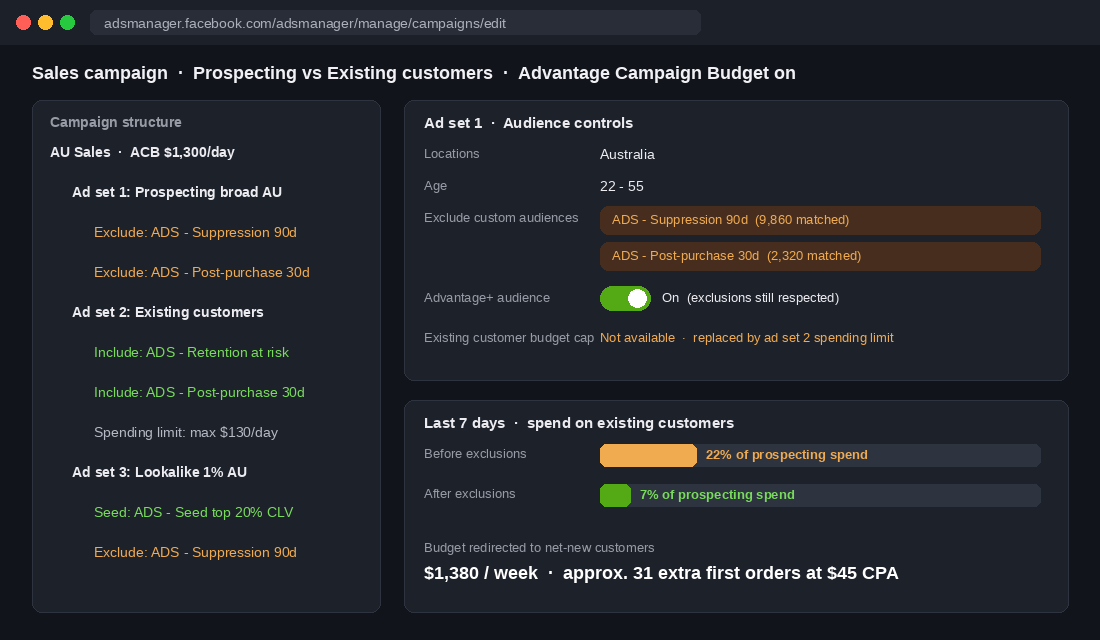
Here is the catch nobody warned you about. Meta’s Advantage+ Shopping Campaigns used to include an “existing customer budget cap” that let you limit spend on your defined customers to, say, 10%. Meta removed it in February 2025 during the Advantage+ Sales rollout, and its own help centre now says the equivalent has to be done manually. If you are running pure Advantage+ with no manual exclusions, your suppression list is doing nothing.
Meta’s recommended workaround is the one I use with members. Run a manual Sales campaign with two ad sets under Advantage Campaign Budget: one targeting the synced customer list only, one targeting broad Australia with the customer list excluded. Set an ad set spending limit on the customer ad set to replicate the old cap. You keep most of the algorithm’s freedom on the prospecting side and you regain control over what you spend on people you already own. Pair it with the funnel-stage structure in the retargeting playbook and your account finally has clean walls between acquisition and retention.
Consent, Hashing and the Australian Privacy Rules
You are disclosing customer personal information to Meta and Google. Yes, it is hashed before it leaves Klaviyo and the platforms say they delete unmatched records, but a hashed email is still personal information under Australian law, and the reform train is not stopping.
The first tranche of Privacy Act reform passed in December 2024 with higher penalties and a new statutory tort for serious invasions of privacy that commenced in June 2025. The second tranche, the Privacy Amendment (Personal Data Protection) Bill 2026, is in consultation until 18 September 2026 and specifically tightens direct marketing rules and the standard for consent: voluntary, informed, current, specific and unambiguous, with pre-ticked boxes and dark patterns restricted. The privacy compliance playbook covers the full picture; for audience sync, four rules keep you clean.
- Say it in your privacy policy. One plain sentence that you share hashed contact details with advertising platforms to show relevant ads and to avoid showing ads to existing customers. Most Shopify policy templates do not include this.
- Never sync unsubscribed or suppressed profiles for targeting. Build every targeting segment with “can receive email marketing” as a condition. Suppression lists are the one exception, because excluding someone from ads is in their interest, but check your policy wording covers it.
- Do not upload purchased or scraped lists. Both Meta’s Custom Audience terms and Google’s Customer Match policy require data you collected directly with appropriate notice. Third-party lists also match terribly, so there is no upside.
- Keep the sync, kill the CSV. Manual exports sitting in Downloads folders are the data-breach story you do not want to tell the OAIC inside the proposed 72-hour notification window.
The Five Numbers to Check Every Monday
- Match rate per list. Target 50% plus on Meta and 40% plus on Google. Falling match rate means data capture is slipping at checkout or the pop-up.
- Prospecting spend on existing customers. Pull a Shopify report of orders from ad-attributed sessions where the customer had a prior order. Under 10% is the goal. Above 25% means your exclusions are not applied everywhere.
- CPA by list versus broad. Intent and retention lists should beat your blended CPA by 25% or more. If they do not, the creative is generic; make it specific to why the person is on the list.
- Lookalike versus broad ROAS. A seed-list lookalike should hold a 15% to 30% ROAS edge over broad for the first 60 to 90 days. When the gap closes, Meta’s broad targeting has learned what the lookalike knew, and you can fold the budget together.
- List size trend. Each list should grow week on week. A flat intent list means your back-in-stock and quiz capture points are not being promoted.
Four Mistakes That Waste the Whole Setup
- Syncing “all profiles” as one giant audience. It is not a strategy, it is a bigger retargeting pool. Five lists with five jobs beat one list with none.
- Excluding purchasers from retention campaigns. Founders set the suppression list at ad account level and wonder why the post-purchase campaign delivers nothing. Exclusions belong on acquisition ad sets only.
- Judging a 300-person list by CPA. Below about 1,000 matched people the algorithm cannot optimise and the results are noise. Pool small intent segments (all back-in-stock requests, not per product) until the list clears that line.
- Manual CSV uploads in BFCM week. The list you upload on 1 November is 5% stale by Cyber Monday and full of people who bought during the sale you are now suppressing them from. Set up sync in September, not November.
The Compound Effect on a Two Million Dollar Store
Take an Aussie store doing AUD 2 million a year with AUD 40,000 a month in Meta and Google spend, a 30% repeat rate and a blended CPA of AUD 45. Before the five lists, a conservative 20% of prospecting spend is landing on existing customers: AUD 8,000 a month buying orders that email would have brought in for nothing.
Wire up List 1 properly and you recover most of that, call it AUD 6,000 a month redirected into real prospecting, which at AUD 45 CPA is about 130 net-new customers a month you were not getting before. Move 10% of retargeting budget to Lists 2, 3 and 5 at a CPA a third lower than blended and you add roughly 40 more orders a month from people who already trust you. Seed the lookalike from your top 20% and shave 15% off prospecting CPA on the portion of budget that runs through it.
Stack those together and the store adds somewhere between AUD 15,000 and AUD 25,000 a month in revenue on the same ad budget, or AUD 180,000 to AUD 300,000 a year, with better customers and fewer annoyed subscribers. That is why the suppression list alone justifies an afternoon in Klaviyo’s integration settings.
Your 30-Day First-Party Audience Checklist
- Week 1: Build and connect. Create the five Klaviyo segments with the ADS prefix. Connect Meta Ads and Google Ads integrations. Toggle sync on all five. Confirm audiences appear in both platforms.
- Week 2: Wire exclusions. Add the suppression audience to every prospecting ad set in Meta and every campaign in Google. Restructure any pure Advantage+ campaign into the two-ad-set manual version with a spending limit.
- Week 3: Launch retention and intent. Turn on one retention campaign (List 2) and one intent campaign (List 3) at 5% to 10% of retargeting budget each, using creative that names why the person is on the list.
- Week 4: Seed and measure. Create the 1% lookalike from List 4 and run it against broad in a split test. Record the five Monday numbers as your baseline. Update the privacy policy sentence. Turn on phone capture at the pop-up if it is not already on.
Inside eCommerce Circle, first-party audiences sit under Promotion as one of the core pillars we work on with every member, because it is the fastest way to make the ad budget you already have work harder. If you want a second opinion on how your lists are wired, let’s talk.