Most Shopify founders find out they have a finance problem the same way: a supplier deposit and a BAS payment land in the same fortnight, the bank balance drops to a number that makes you feel sick, and the accountant you pay once a year has no idea because they will not see your books until October. You are doing $150k a month and running the money side of the business off the Shopify Payments balance and a gut feeling.
What’s in This Article
The wrong approach is treating “the accounts” as one job that one person does. It is actually three jobs. Recording what happened (bookkeeping), staying compliant and lodging correctly (accounting and tax), and deciding what to do next with the cash (finance strategy). Founders bundle all three onto a suburban accountant, or worse onto themselves at 11pm, and then wonder why they never have a P&L they trust.
The brands that scale cleanly separate those jobs and add each layer at the right revenue stage. The stakes are not small. ASIC’s insolvency reports show inadequate cash flow was cited in 52% of business failures, and a 2025 UNSW and CommBank study found nearly 80% of Australian small businesses had their cash flow hit in the previous 12 months. This is the roadmap for building a finance function that fits a $40k a month store and still works at $500k a month.
The Three Finance Jobs Founders Keep Confusing
Before you hire anyone, get clear on what each role actually does. The titles get thrown around interchangeably, and that confusion is why founders pay senior rates for junior work and junior rates for work that needs a senior brain.
- Bookkeeper: records the past. Reconciles bank feeds, splits Shopify payouts into sales, fees, refunds and GST, enters supplier bills, runs payroll, keeps Xero clean. Backward looking. Weekly or fortnightly cadence. In Australia most small businesses pay between $300 and $1,000 a month; ecommerce brands sit at the top of that range because of transaction volume and multiple gateways.
- Accountant or tax agent: keeps you compliant. Lodges BAS and income tax, advises on structure (sole trader, company, trust), handles ATO correspondence, prepares year-end financials. Usually quarterly and annual. This person is essential and almost never the right person to help you decide whether to fund a $200k inventory order.
- Fractional CFO: decides the future. Builds the 13-week cash forecast, models inventory funding, sets margin targets by channel, prepares you for a lender, an investor or a buyer. Forward looking. Australian ecommerce engagements typically run $3k to $12k a month, and the market benchmark is fees landing between 0.5% and 2% of revenue.
Here is the test. Ask your current finance person: “What will our cash balance be in week 9, and what happens to it if I bring the summer order forward a month?” A bookkeeper cannot answer that. A tax agent will not. A CFO, fractional or otherwise, will have the spreadsheet open before you finish the sentence. If nobody in your business can answer it, that is the gap.
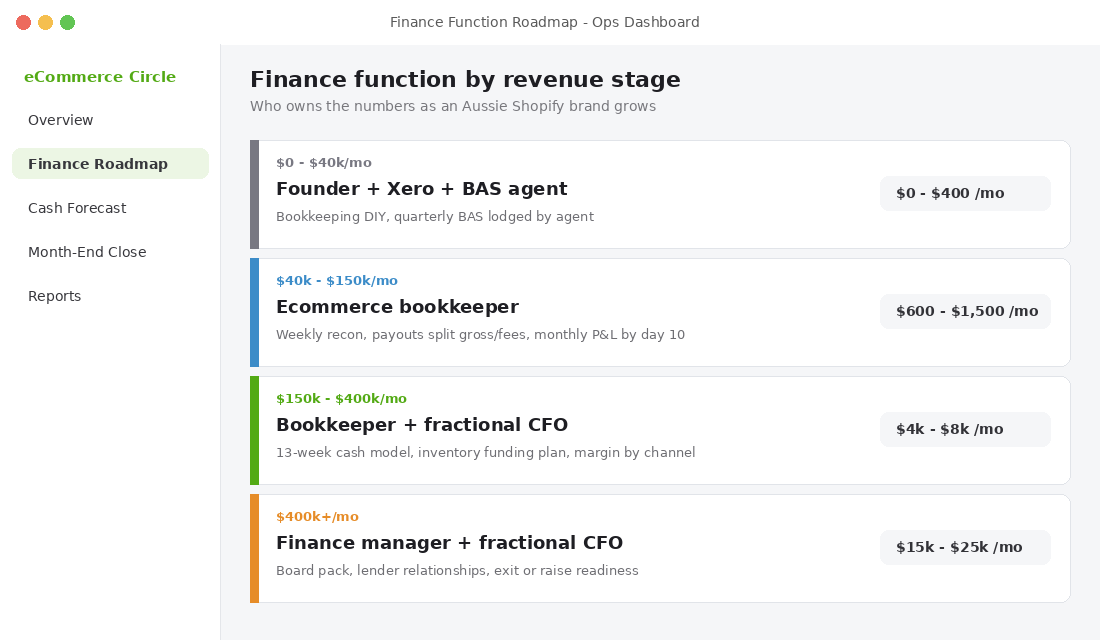
Stage 1: Under 40k a Month (Founder, Xero and a BAS Agent)
At this stage you should not be paying for a CFO and you probably should not be paying a full bookkeeper either. What you need is a clean system you can maintain in two hours a week, and a registered BAS agent who lodges your quarterly return and stops you making structural mistakes.
The non-negotiable is a proper payout connector between Shopify and Xero. The native Shopify to Xero integration posts orders in a way that rarely matches the bank deposit, because it misses fees, refunds and gateway timing. That mismatch is where founders lose faith in their numbers. Use A2X or Link My Books instead; both post each Shopify Payments payout as a summarised journal that splits gross sales, refunds, gateway fees and GST so it reconciles to the cent.
- Set up A2X in one sitting. Install from the Shopify App Store, connect Xero, then map each line type: sales to a Sales account, Shopify Payments fees to Merchant Fees, refunds to a contra-sales account, GST to your GST liability. Turn on the setting that posts by payout, not by order. Run it on the last three months of payouts and confirm each one matches a bank line.
- Separate every gateway. Afterpay, PayPal and Zip each settle on their own timetable and take their own fees. Each needs its own clearing account in Xero. Mixing them is the single most common reason a store’s revenue in Xero disagrees with Shopify by 3 to 6%.
- Book a Friday money hour. Reconcile the week, enter supplier bills with their real due dates, and glance at the next four weeks of outgoings. At this stage that is the whole finance function, and it is enough.
What you are building here is the habit of trusting the numbers. If Xero is a mess at $30k a month, you will hire a bookkeeper at $100k a month to clean up a mess instead of to run a system, and you will pay for six months of catch-up work before you get a single useful report.
Stage 2: 40k to 150k a Month (Hire an Ecommerce Bookkeeper, Not a Generalist)
Somewhere past $40k a month, the Friday money hour turns into a Friday money afternoon and then quietly stops happening. This is when you hire a bookkeeper, and the word that matters is ecommerce. A generalist bookkeeper who mostly does tradies and cafes will treat a Shopify payout as revenue, post Afterpay settlements as sales, and let your inventory sit on the balance sheet at whatever number you gave them in 2024.
Budget $600 to $1,500 a month for a bookkeeper who already runs A2X or Link My Books for other Shopify stores. Ask for three current ecommerce clients as references. Then ask the question that separates the good ones: “How do you handle COGS each month?” If the answer involves a stocktake or an inventory app like Cin7 or Unleashed feeding a monthly COGS journal, you have found a real one. If the answer is “we expense purchases when you pay for them”, walk away, because your gross margin will swing 20 points a month depending on when the container landed.
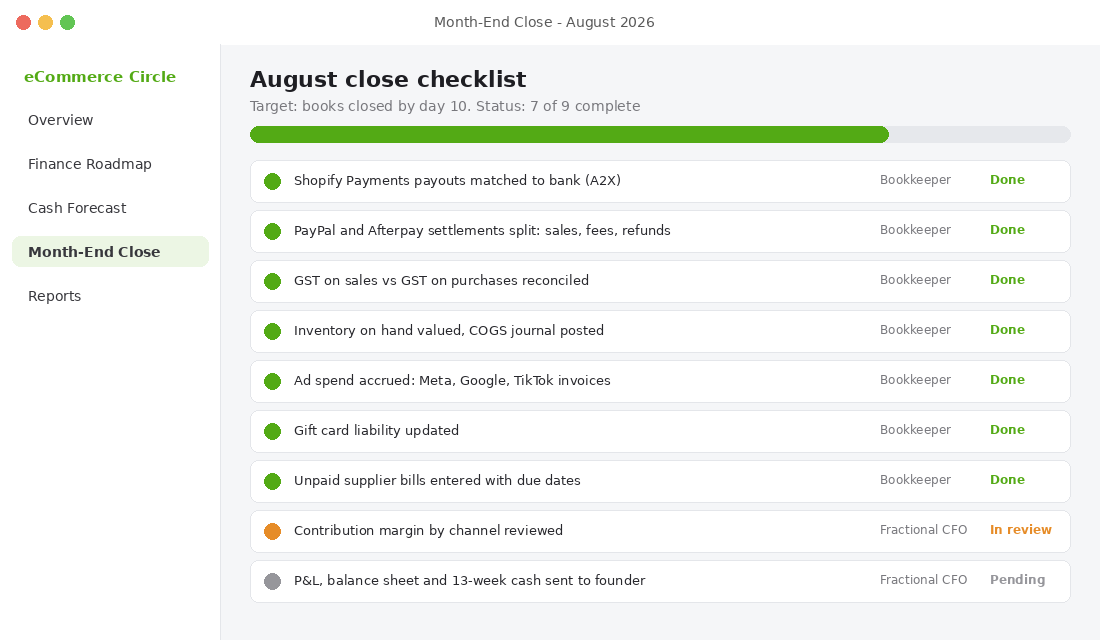
- Define the deliverable, not the hours. Books reconciled weekly. P&L and balance sheet delivered by the 10th of the following month. Gift card liability, GST liability and unpaid supplier bills all current. Write that into the engagement letter.
- Insist on a chart of accounts built for a store. Sales split by channel (online, wholesale, marketplace). Merchant fees as their own line. Ad spend split by platform. Shipping revenue and shipping cost as separate lines so you can see your true shipping margin. This is a two-hour setup that makes every future report useful.
- Move BAS to the bookkeeper if they are a registered BAS agent. Many are. It removes the quarterly handover and means the person who understands your payouts is the person lodging your GST.
A good ecommerce bookkeeper at this stage is the highest-return hire in the business relative to cost. For under $1,500 a month you get a P&L you trust, which is the prerequisite for every pricing, ad spend and inventory decision you will make for the next two years. If you have not already, read our month-end close playbook and hand it to them on day one.
Stage 3: 150k to 400k a Month (Add a Fractional CFO Before You Think You Need One)
The five signals it is time
Most of the guides written by fractional CFO firms say to hire one at $5m to $10m in annual revenue. That is roughly $400k to $800k a month, and in our experience with hundreds of Aussie Shopify founders it is too late. The decisions that make or break a brand between $2m and $5m a year are finance decisions dressed up as operations decisions: how much inventory to order, whether to take Shopify Capital or a bank facility, whether wholesale is actually profitable, when to raise prices.
Bring a fractional CFO in when you hit any two of these five signals:
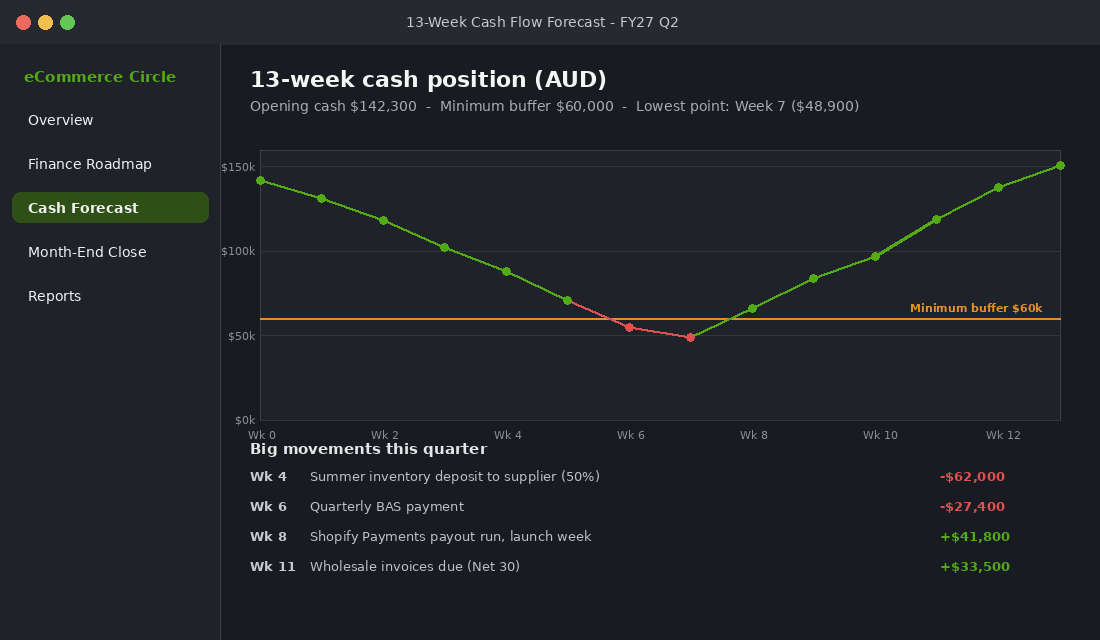
- Inventory orders above 15% of monthly revenue. A $60k deposit on a $200k month is a cash event that needs modelling, not a gut call.
- Two or more sales channels. Once wholesale, Amazon or a second Shopify market is live, you need margin by channel, and most bookkeepers will not build it.
- You are considering debt or investment. A lender will ask for a 12-month forecast and a balance sheet that reconciles. Nothing burns credibility faster than turning up without one.
- Profit is growing slower than revenue. If revenue is up 40% and net profit is up 5%, something structural is wrong and nobody on the team currently has the job of finding it.
- You have had a cash scare. One near miss on payroll or a BAS payment is your business telling you the forecast does not exist.
Australian ecommerce fractional CFO engagements run $3k to $8k a month at this stage, usually one or two days a week. Compare that to a full-time CFO, where the all-in cost in Australia sits at $250k a year minimum and more commonly $420k plus for someone with real ecommerce experience. Under $30m in annual revenue, full-time rarely makes sense.
What the first 90 days should deliver
Eightx, a Sydney-based fractional CFO firm, published a case on a Brisbane surf and lifestyle brand doing $3.6m across Shopify, Amazon Australia and wholesale. The founders were running finance on Xero and a BAS agent. In 90 days the fractional CFO restructured Amazon pricing to lift channel margin to 12%, cut margin-negative wholesale accounts, built a 13-week cash model tied to seasonal inventory buys, and found $28k in unclaimed R&D Tax Incentive credits. The stated result was $168k in annualised profit improvement, which is 4.7% of revenue, on a fee well under $100k a year.
That is the shape of a good engagement. Use it as your scorecard. By day 90 you should have:
- A 13-week rolling cash forecast updated weekly, with a minimum cash buffer set (we recommend 6 weeks of fixed costs) and every inventory deposit and BAS payment plotted. Our rolling forecast guide is the starting template.
- Contribution margin by channel and by top 20 SKUs, after fees, shipping, returns and ad spend. This is where the “wholesale is great for volume” story usually dies.
- An inventory funding plan: how the next two seasonal buys will be paid for, and at what cost of capital.
- A one-page monthly pack you can read in 10 minutes: P&L vs budget, cash position, margin trend, three decisions needed.
If you are 90 days in and you have a beautifully formatted P&L but none of the above, you have hired an expensive bookkeeper.
Stage 4: Past 400k a Month (Finance Manager In-House, CFO Still Fractional)
Past $5m a year the volume of finance work justifies someone in the building. That is usually a finance manager or head of finance at $130k to $180k plus super, not a CFO. They own the close, manage the bookkeeper (or absorb the role), run payroll and supplier payments, and handle the lender and the auditor day to day.
Keep the CFO fractional. A finance manager plus a senior fractional CFO at $6k to $12k a month covers the same ground as a $420k full-timer for less than half the cost, and the fractional CFO brings pattern recognition from 10 other brands your full-timer will never have. The exception is a defined transaction in the next 12 months, a capital raise or a sale, where a full-time CFO’s availability starts to earn its salary.
The cautionary tale every Aussie founder should keep in mind is Booktopia. A $200m plus online retailer, ASX listed, and it still collapsed into voluntary administration in July 2024 with cash flow and inventory problems at the centre of the story. Revenue does not protect you from the numbers. The systems do.
How to Split the Work So Nobody Is Overpaid or Underused
The most expensive mistake at Stage 3 and 4 is scope creep in the wrong direction. The fractional CFO ends up fixing payout reconciliations because the bookkeeper is not ecommerce literate, and you are paying $250 an hour for $60 an hour work. Set the split explicitly and put it in both engagement letters.
- Bookkeeper owns: weekly reconciliation, payout splitting, bills and payroll, COGS journal, GST, the month-end close by day 10, BAS lodgement if registered.
- Tax accountant owns: annual financials and tax return, structure advice, ATO correspondence, R&D Tax Incentive and other claims, Division 7A and director loan issues.
- Fractional CFO owns: the 13-week cash forecast, budget and reforecast, margin by channel and SKU, inventory funding, pricing decisions, lender and investor relationships, the monthly one-page pack.
- Founder owns: reading the pack, making the three decisions, and not touching Xero.
One more rule: the bookkeeper reports to the CFO on quality, not to you. If the CFO cannot trust the close, the forecast is fiction. Give them the authority to set the standard.
Vetting a Fractional CFO: Seven Questions That Expose the Pretenders
The fractional CFO market in Australia has grown fast, and plenty of people offering the service are accountants who added “CFO” to their LinkedIn. Ecommerce finance is specific: gateway timing, inventory as the biggest line on the balance sheet, ad spend as a variable cost, marketplaces with their own fee structures. Ask these before signing anything.
- “How many Shopify brands do you currently work with, and at what revenue?” You want at least three at or above your stage. Generalist SME CFOs will learn ecommerce on your dollar.
- “Show me a 13-week cash forecast you built for a client.” Redacted is fine. If they cannot produce one in the first meeting, they do not build them routinely.
- “How do you treat inventory in the forecast?” The right answer talks about deposits, balance on shipping, landed cost including duty and freight, and sell-through assumptions. The wrong answer treats stock purchases like any other expense.
- “What is a healthy contribution margin after ad spend for a brand like mine?” They should have a number and a reason. For most Aussie DTC brands the answer sits between 15% and 30% depending on AOV and category, and they should know why yours would land where it does.
- “Which connector do you prefer for Shopify to Xero, and why?” Anyone who has done this has an opinion on A2X versus Link My Books. Anyone who has not will say “the native integration”.
- “What does the monthly deliverable look like?” Ask to see a real (redacted) monthly pack. You are buying decisions, not spreadsheets.
- “What is the exit if it is not working?” 30 days notice, no lock-in. A confident operator does not need a 12-month contract.
Pricing sanity check: at 0.5% to 2% of revenue, a brand doing $3m a year should expect $1,250 to $5,000 a month, and a brand at $6m should expect $2,500 to $10,000. Quotes far outside that range in either direction deserve a harder look.
The Compound Effect: Why the Order of Hires Matters More Than the Hires
Every stage in this roadmap makes the next one cheaper. Clean A2X setup at Stage 1 means the Stage 2 bookkeeper starts producing a real P&L in week two instead of month six. A real P&L with channel splits means the Stage 3 fractional CFO spends their first month building the forecast instead of rebuilding the chart of accounts. A working forecast and monthly pack means the Stage 4 finance manager inherits a system rather than a rescue.
Do it in the wrong order and the costs compound the other way. We regularly meet founders at $250k a month paying a fractional CFO $8k a month, and the CFO is spending half their hours cleaning up three years of gateway misclassification because the founder skipped Stage 1 and hired a generalist at Stage 2. That is $4k a month of senior time spent on work that should have cost $600.
There is a bigger payoff too. When a buyer or a lender eventually looks at the business, the thing that moves valuation is not revenue, it is the quality and trustworthiness of the numbers. Three years of clean, reconciled books with a forecast track record is worth a full turn of multiple. Our exit readiness playbook goes deeper on that, but the short version is: the finance function you build at $100k a month is the one that gets you paid at $1m a month.
Your Finance Function Checklist
Print this, tick what you have, and the gaps tell you your next hire.
- Foundations: A2X or Link My Books posting every payout by gateway. Separate clearing accounts for Shopify Payments, PayPal, Afterpay and Zip. Chart of accounts split by channel with merchant fees, shipping revenue and shipping cost as their own lines.
- Bookkeeping: Weekly reconciliation. Monthly COGS journal from a stocktake or inventory system. P&L and balance sheet by the 10th. Gift card, GST and supplier liabilities current.
- Compliance: Registered BAS agent lodging quarterly. Tax accountant reviewing structure annually and checking R&D Tax Incentive eligibility.
- Strategy: 13-week cash forecast updated weekly with a minimum buffer of 6 weeks of fixed costs. Contribution margin by channel and top 20 SKUs. Inventory funding plan for the next two buys. One-page monthly pack with three decisions.
- Governance: Written scope for each role. Bookkeeper quality owned by the CFO. Founder reads, decides, and stays out of Xero.
If you ticked the first two groups and nothing in Strategy, you are the founder at Stage 3 running on gut feeling. That is the most common place we find $2m to $5m brands, and it is the most expensive place to stay.
Inside eCommerce Circle, building the right People around the numbers is one of the core pillars we work on with every member. If you want a second opinion on where your finance function should be at your stage, let’s talk.