Most “Shopify review” articles you will find are written by someone with an affiliate link and a free trial to sell. They say it is easy, it is powerful, and you should start today. None of them tell you what a $30,000 a month Australian store actually pays, where the platform costs you more than you expect, or the handful of cases where you should pick something else.
What’s in This Article
So here is the review a coach gives a founder across the table. Shopify is the right platform for most Australian ecommerce brands, and I will show you the numbers behind that. I will also show you the fees, the app creep and the limits that catch people out, plus a fit check you can run in two minutes before you spend another dollar.
Everything below uses Australian dollars and current Australian pricing, checked on 9 October 2026. Prices and promotions change, so confirm them in your own admin before you decide.
Shopify Review Australia: The Short Verdict
Shopify is worth it if you sell physical products to Australian customers and you want to spend your time on marketing and margin, not on servers and plugins. It is not worth it if your business is mainly content with a few products attached, or if you need deep custom logic that only a bespoke build can give you.
The market backs the first half of that verdict. Australians spent A$82.6 billion online in 2025, up 14% on the year, and online now makes up 24% of total retail, according to Australia Post’s 2026 eCommerce Report. More buyers are shopping online every year, and a platform that lets you take their money reliably on a phone is a good place to be standing.
Shopify is where most Aussie brands have landed. Store Leads counted about 152,000 active Australian Shopify stores in May 2026, against roughly 84,000 on WooCommerce. That is close to two Shopify stores for every WooCommerce store, which means the apps, themes, agencies and freelancers you need are plentiful and competitive on price.
Here is the scorecard I give founders who ask me for a quick answer:
- Setup speed: excellent. A competent founder can have a store taking orders in a weekend.
- Checkout and conversion: strong. Shop Pay, Apple Pay and Google Pay come built in.
- Running cost: fair, but the headline plan price is the smallest part of the bill.
- Flexibility: good for 90% of stores, restrictive on checkout and data if you are not on Plus.
- Blogging and content: adequate, not a strength.
What Shopify Really Costs in Australia (the Plans)
Shopify lists four main plans for Australian merchants. These are the figures from Shopify’s Australian pricing page, in AUD and before GST.
| Plan | Monthly billing | Annual (per month) | Online card rate | Third-party gateway fee |
|---|---|---|---|---|
| Basic | $56 | $42 | 1.70% + 30c | 2% |
| Grow | $149 | $114 | 1.55% + 30c | 1% |
| Advanced | $575 | $431 | 1.35% + 30c | 0.6% |
| Plus | From $3,700 | Not listed | 1.15% + 30c | 0.2% |
Two things to know before you read that table. First, Shopify’s own page shows the Grow plan at $114 on the plan card and $149 in the comparison table. The $114 is the annual price and $149 is month to month, so always check which one you are looking at. Second, the card rates move around. One third-party summary I checked listed slightly higher rates than Shopify’s own page, so treat the page in your admin as the source of truth.
The offer most people start with is a 3-day free trial, then $1 a month for the first 3 months. That is a good way to build and test, but it tells you nothing about what you will pay in month four. The plan to price is the full one.
Which plan should you pick? For most stores doing under $50,000 a month, Basic on annual billing is the cheapest total cost, and I will prove it with maths in the next section. If you want the full upgrade analysis, we built a longer version in our Shopify plan break-even breakdown.
The Fees That Catch Aussie Stores Out
The subscription is the number everyone compares. The processing fees are the number that actually hurts, because they scale with every sale.
Shopify Payments is the fee you want to pay. It charges 1.70% + 30c on Basic, 1.55% + 30c on Grow and 1.35% + 30c on Advanced for standard online cards. There is no extra Shopify transaction fee on top.
Third-party gateways add a penalty. If you use PayPal as your only processor or an outside gateway instead of Shopify Payments, Shopify adds its own fee on top of whatever the provider charges: 2% on Basic, 1% on Grow, 0.6% on Advanced. On $30,000 of monthly sales that is $600 on Basic, for the privilege of not using Shopify’s own system.
Other costs that are easy to miss:
- International and Amex cards. International cards cost around 3.5% + 30c on Basic and Amex around 2.9% + 30c, per the Australian fee schedule.
- Currency conversion. Stores that sell in other currencies can pay a 2% conversion charge. From 6 April 2026 it is calculated on the gross order amount, which is a quiet increase if you sell overseas.
- GST on fees. Shopify’s fees attract GST, so budget for 10% more than the headline number. If you are registered, you claim it back, but it still shows up in cash flow.
- Buy now pay later. Afterpay and Zip charge the merchant a percentage per order. Afterpay is installed on more than a quarter of Australian Shopify stores (26.3% per Store Leads), so your customers will expect it. Our buy now pay later guide shows how to test the margin impact.
Shop Pay Installments, powered by Affirm, launched in Australia on 27 August 2026. It is not available to every store, so check your admin before you promise anything. We covered the eligibility rules and a four-week pilot in our post on Shop Pay Installments in Australia.
The Real Monthly Maths for a Store Doing 30k a Month
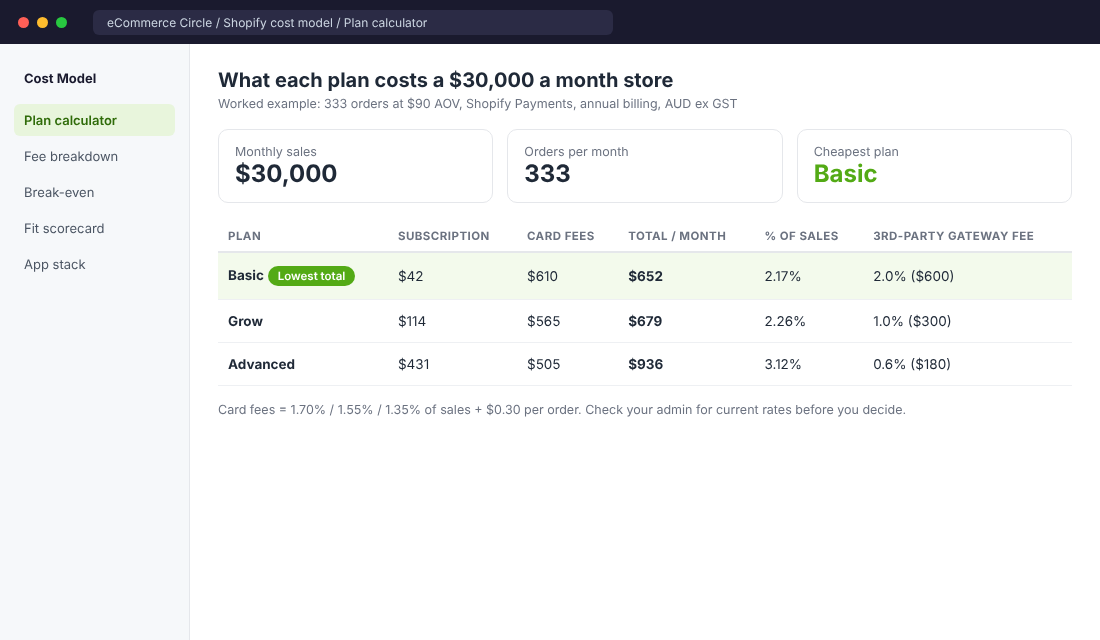
Let me make this concrete. Assume a store that sells $30,000 a month, with 333 orders at a $90 average order value. It uses Shopify Payments, pays annually and sells to Australian customers.
On Basic, the subscription is $42 and card fees come to about $610, for a total of roughly $652 a month, or 2.17% of sales. On Grow, the total is about $679. On Advanced, it is about $936.
That tells you something most reviews hide: at this size, a higher plan costs you more, not less. The lower card rate does not cover the higher subscription until your sales are much larger.
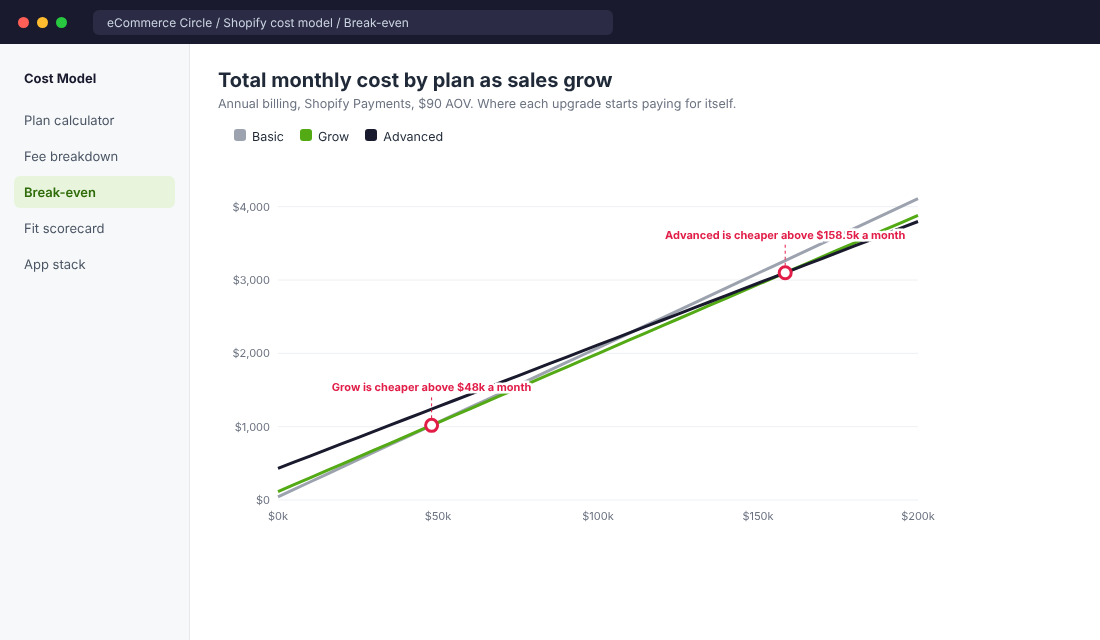
The break-even point is simple to calculate. Divide the extra subscription cost by the card rate you save. Basic to Grow on annual billing adds $72 a month ($114 minus $42) and saves 0.15 percentage points on card fees, so you need about $48,000 a month in sales before Grow is cheaper. Grow to Advanced adds $317 a month and saves 0.20 points, which puts the break-even at about $158,500 a month.
If you are on a third-party gateway the maths changes sharply, because Grow cuts the penalty from 2% to 1%. In that case Grow pays for itself above roughly $7,200 a month. That is the reason to move to Shopify Payments, or to upgrade, in the first place.
Note that these figures are Shopify’s own fees only. They exclude your theme, apps, domain, shipping and ad spend, which we get to next.
Where Shopify Wins and Where It Frustrates
A review that only says nice things is an ad. Here is the honest split.
Where Shopify wins:
- Checkout conversion. Shopify claims its checkout converts 15% better on average than competing platforms. That is a vendor claim from commissioned research, so take it as directional. It does match what I see: stores moving from clunky checkouts to Shopify often gain on conversion without changing anything else.
- Shop Pay. Shopify says Shop Pay converts up to 50% better than guest checkout, based on a 2023 study with a global consulting firm. Treat the 50% as a ceiling, not a promise. Even a 5% lift on a $30,000 store is $1,500 a month in extra sales.
- Reliability and security. Shopify lists 99.9% average uptime and handles the hosting, SSL and PCI work. You do not patch plugins at 11pm on a Sunday.
- The ecosystem. Klaviyo runs on 21.4% of Australian Shopify stores and Judge.me on 17.2%. When your tools are this common, you can hire help easily and nothing you need is unusual.
Where it frustrates:
- App creep. Every feature Shopify does not ship is a monthly subscription. Twelve apps at $20 to $40 each adds $240 to $480 a month, which can exceed the plan fee. Audit your app list twice a year.
- Checkout limits. Deep checkout customisation sits mostly with Plus, which starts at $3,700 a month. If a custom checkout is a must-have on a smaller plan, you will hit a wall.
- Blogging and content. Shopify’s blog works, but it lacks the depth of WordPress for content-led SEO. Many brands run a Shopify store with the blog elsewhere.
- Data and reporting. The built-in analytics are fine for a snapshot. For real attribution you will need GA4 and a proper dashboard.
- Platform dependence. You build on rented land. Shopify can change fees or policies, as the April 2026 currency conversion change showed.
One more point on themes, because it comes up in every Shopify review. Shopify’s newer Horizon architecture changes how themes are built, and it affects whether you should buy a theme now or wait. We covered that in our Shopify Horizon theme breakdown.
Shopify vs WooCommerce vs BigCommerce for Australian Stores
Founders usually ask me about three alternatives, so here is how I see them.
WooCommerce is the main rival, with around 84,000 Australian stores. It is free software, but you pay for hosting, security, a developer and plugin licences, and you carry the maintenance. It suits content-heavy businesses and teams with a developer on call. Shopify’s own comparison claims a 36% lower total cost of ownership versus WooCommerce. That is Shopify’s marketing figure, so I would not quote it, but the direction is right for a store without a developer.
BigCommerce has stronger built-in features for complex catalogues and B2B, and no transaction fees on third-party gateways. It has a far smaller Australian ecosystem. If you have 50,000 SKUs and strong in-house tech, it deserves a look. Otherwise the smaller pool of agencies and apps works against you.
Custom or headless builds make sense for a small number of brands with complex needs and a real budget. For everyone else they are a very expensive way to solve problems Shopify already solves.
The pattern is clear in the data. Shopify holds about 42% of online stores tracked in Australia by AfterShip and WooCommerce about 27%. Aussie brands including The Oodie, Peppermayo and Sukin, run on Shopify Plus according to Store Leads. When brands at that level choose the platform, it tells you it scales.
Who Should Not Use Shopify
I will say it plainly, because most reviews will not.
- You are a publisher first. If 80% of your revenue comes from content and affiliate links, WordPress with WooCommerce is a better base.
- You sell very complex or made-to-order products. Heavy configurators, quote workflows and unusual B2B pricing push you into custom territory.
- You cannot manage a tool stack. If nobody on your team will own the apps, themes and integrations, costs and bugs pile up quietly.
- You are a hobby seller. If you expect fewer than a few orders a month, a simple link-in-bio tool is cheaper.
For everyone else, which is most of the Australian ecommerce brands I coach, Shopify is the practical choice.
The Shopify Fit Check: A 10-Point Template
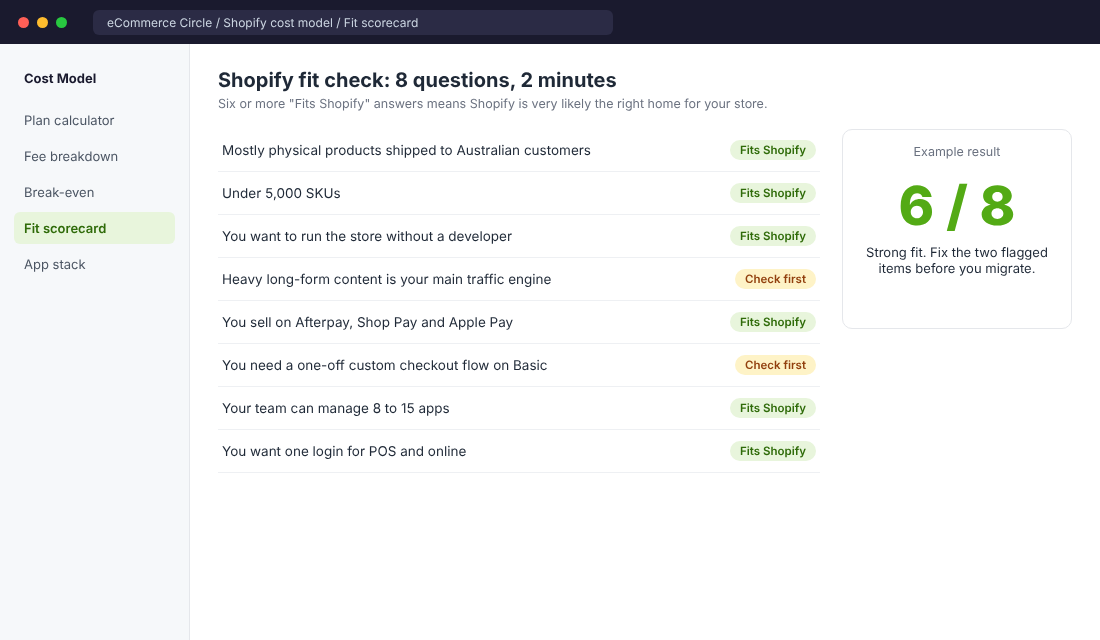
Run this check before you sign up, or before you decide to migrate away. Score one point for every “yes”.
- Do you sell physical products shipped mainly within Australia?
- Do you have fewer than 5,000 SKUs?
- Do you plan to run the store without a full-time developer?
- Is paid media or email your main traffic source, not blog SEO?
- Do your customers expect Afterpay, Apple Pay or Shop Pay?
- Can you live without a fully custom checkout on a plan under $3,700 a month?
- Will someone on your team own the app stack and review it twice a year?
- Do you want your point of sale and online store in one system?
- Are your sales under $158,500 a month, so Basic or Grow suits you?
- Can you accept a platform that updates and changes without asking you first?
8 to 10 points: Shopify is the right home. 5 to 7 points: Shopify likely works, but price the risks first. Under 5: get a second opinion before you commit.
Tool Setup: Move Your Payments Onto Shopify Payments in 10 Minutes
The single most valuable setting in the platform for a small store is also the one most founders skip. If you are paying the third-party fee, here is how to fix it.
- Open your Shopify admin and go to Settings > Payments.
- Under the Shopify Payments section, click Activate (or Complete account setup if you started before).
- Enter your ABN, business structure and bank account details. This is where Shopify checks your business, so have your ABN and ID to hand.
- Tick the wallets you want: Shop Pay, Apple Pay and Google Pay.
- Place a test order and confirm the payout schedule under Finance > Payouts.
- Once you are happy, remove any third-party gateway you no longer need, so the extra fee stops applying.
One caution. New accounts can have payouts held while Shopify verifies them, so do not switch over the week before a big sale. Do it now, test it, then run BFCM on a processor you trust.
The Compound Effect: How the Pieces Fit
A good Shopify store is not one decision. It is five small ones that stack.
The right plan keeps your fixed cost low. Shopify Payments removes the third-party fee. Shop Pay and wallets lift conversion on the same traffic. A lean app stack stops the monthly bill creeping. And a regular review of your numbers tells you when it is time to upgrade.
Take the $30,000 example. Moving off a third-party gateway removes the $600 a month Shopify penalty on Basic. A modest 5% lift from wallet checkout adds about $1,500 in sales. Trimming $200 of unused apps saves another $200. That is more than $2,000 a month of improvement, with no extra ad spend, from settings you already have.
This is the difference between brands that say Shopify is expensive and brands that say Shopify pays for itself. The platform did not change. The setup did.
Final Verdict: Is Shopify Worth It in 2026?
Yes, for most Australian product brands. It is quick to launch, converts well, is supported by a huge local ecosystem, and the cost is predictable if you pick the right plan and use Shopify Payments. Start on Basic with annual billing, move up only when the break-even maths says so, and audit your apps twice a year.
Inside eCommerce Circle, platform choice is one of the first things we work through with every member, because it quietly decides your margin for years. If you want to see exactly where your store is being capped, take the free More Orders Scorecard. It takes two minutes and shows you which of the 10 P’s to fix first.
Sources: Australia Post 2026 eCommerce Report (via Eight X), Store Leads Australia Shopify census (May 2026), AfterShip eCommerce Statistics in Australia 2026, Shopify Australia pricing and Shop Pay pages, Shopify vs WooCommerce comparison, Aspire Shopify fees Australia guide (15 Sep 2026). Prices checked 9 October 2026. Product examples are Shopify Plus stores as listed by Store Leads.