Search “ecommerce consultant Australia” and you get two kinds of results: agencies dressed up as consultants, and freelancers quoting wildly different rates with no way to tell who is worth it. Most founders pick on gut feel, a polished website or a mate’s recommendation. Then they find out three months and $12,000 later that they hired the wrong type of help for the wrong problem.
What’s in This Article
The brands that get real value from a consultant do three things differently. They define the problem in numbers before they shop. They hire the right type of consultant for that problem. And they write the scope, the success measure and the exit terms down before a cent changes hands.
This guide covers what an ecommerce consultant actually does, what they cost in Australia (with real ranges), the four types worth knowing, the break-even maths, eight vetting questions, and a 90-day structure that keeps the engagement honest. Full disclosure: eCommerce Circle is a coaching business, so we have a stake in this space. That is why we have included the questions that would make you walk away from us too.
What an Ecommerce Consultant Actually Does
A consultant is paid to diagnose a specific problem and either fix it or hand you a fix you can run. The word that matters is specific. A good consultant works on a defined constraint, such as a checkout that leaks 70% of carts, a Meta account that cannot scale past $300 a day, or margins that vanish after shipping and returns.
Shopify’s own guide to hiring consultants describes the work as audits and advice across conversion rate, digital marketing, product and pricing, and profitability, from reducing checkout friction to renegotiating supplier, shipping and software contracts. That is a wide brief, which is exactly why you need to narrow it before you hire.
Here is how a consultant differs from the other two people you will be pitched by:
- Consultant. Time-boxed and outcome-focused. You buy an audit, a rebuild of one system, or a fixed block of advice. They leave and you keep running the thing.
- Coach. Ongoing and developmental. They build your skill and keep you accountable week after week. We cover that model in our guide to what an ecommerce coach does and what it costs.
- Agency. A team that executes: ads, theme builds, email, SEO. If you want hands on keyboards every week, this is the one. Our guide on how to choose an ecommerce agency in Australia covers that decision.
Most stores past about $500K a year end up using more than one, in sequence. We break down which to hire first in why most Shopify brands need both a coach and an agency. The short version: a consultant is the right first call when you have one expensive, well-defined problem and you do not want a long contract.
What Ecommerce Consultants Cost in Australia
Pricing is where founders get burned, because the spread is enormous. Shopify’s guide, citing Clutch, puts the global range at roughly $25 to $300 an hour. That is useless as a buying guide, because the bottom end is offshore freelancers and the top end is boutique strategists.
For Australian work, Performance Marketer’s 2026 breakdown is more usable. It puts consultants and strategists at $130 to $300+ per hour, project fees at $5,000 to $50,000+ for defined deliverables, and standard monthly retainers at $1,500 to $6,000 (with some agencies below $1,000 and others above $10,000). Another Australian source, Groe, quotes marketing consultants at AU$50 to AU$250 an hour, so treat the lower end with caution and ask who does the work.
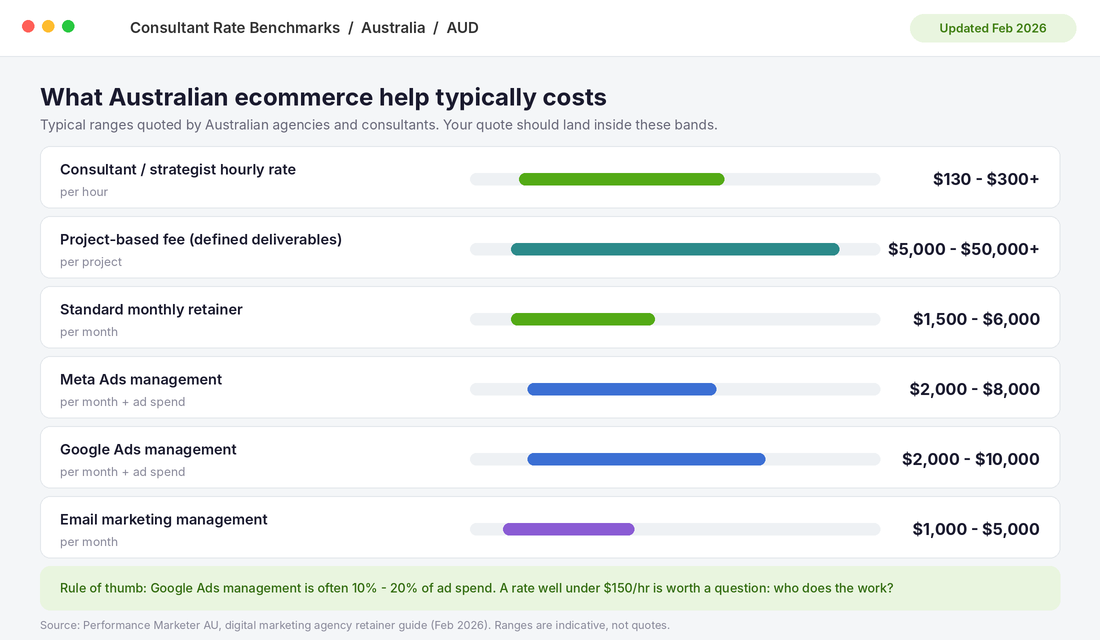
Channel-specific management is priced separately. The same source lists Meta Ads management at $2,000 to $8,000 a month plus ad spend, Google Ads management at $2,000 to $10,000 plus ad spend (often 10% to 20% of spend), and email marketing at $1,000 to $5,000 a month.
Two pricing rules save founders money:
- Pay for the deliverable, not the hour. An hourly rate rewards slow work. A fixed fee for “tracking audit, fixes implemented, dashboard handed over” rewards finishing.
- Treat anything well under $150 an hour as a question, not a bargain. The question is who actually does the work. Often it is a junior, a contractor, or software.
The Four Types of Ecommerce Consultant (And Which Problem Each Solves)
“Ecommerce consultant” covers four quite different jobs. Hiring the wrong one is the most expensive mistake on this page.
1. The channel specialist
Deep in one channel: Meta, Google, email, SEO. Hire one when your numbers say the channel itself is the constraint. For example, your blended MER is fine but your Meta account has no creative testing structure. Expect project work or a short retainer. Ask for a before-and-after on a store with a similar average order value to yours. Australia Post’s 2026 eCommerce report puts the average online order at about $96, so a consultant who only works with $300+ baskets may not transfer.
2. The Shopify and platform expert
Handles theme, speed, checkout, apps and migrations. Hire one when the problem lives inside the store: slow mobile pages, a messy app stack, a replatform. The Shopify Experts marketplace lists these people by service category, with merchant reviews you can read before you ask for a quote.
3. The strategic or growth consultant
Looks across the whole business: offer, pricing, margin, channels, team. Hire one when you are growing but profit is not following, or you have plateaued and cannot tell why. The output is a prioritised roadmap and numbers you can check, not a 60-page deck. If the deliverable cannot be summarised in one page, be suspicious.
4. The fractional operator
A part-time head of ecommerce or marketing, usually one to three days a week. Hire one when you need execution leadership but cannot yet justify a $150K+ salary. This is the closest thing to a retainer that is worth it, because they own outcomes, not just advice.
The Break-Even Maths Before You Sign Anything
A consultant fee is an investment, so test it like one. Use this formula:
Monthly revenue lift needed = (fee ÷ months to pay back) ÷ contribution margin
Here is an illustrative example. Your store does $50,000 a month with a 30% contribution margin (what is left after COGS, shipping, payment fees and ad spend). You are quoted a $9,000 fixed fee for a conversion and tracking project, and you want payback in six months.
- $9,000 ÷ 6 months = $1,500 extra contribution needed per month.
- $1,500 ÷ 0.30 = $5,000 extra monthly revenue.
- That is a 10% revenue lift. Realistic? If your conversion rate sits at 1.6% with traffic unchanged, a lift to 1.76% gets you there.
Now run it the other way. If the consultant needs a 40% lift to pay back, the engagement is either mis-scoped or mis-priced. Walk away, or shrink the scope until the maths works. This single calculation filters out more bad proposals than any reference check.
If you do not know your contribution margin, stop here and fix that first. The Profit section of the More Orders Scorecard checks exactly this, and a consultant who does not ask for your margin in the first call is selling you something else.
Write the Brief Before You Shop
Shopify’s guide recommends defining goals and budget before building a shortlist, and it is the step founders skip. A one-page brief does three jobs: it filters out consultants who do not fit, it makes quotes comparable, and it stops scope creep later.
Your brief needs six lines:
- The problem in one number. “Conversion rate is 1.6% on mobile.” Not “sales feel flat.”
- The target and deadline. “2.0% by 31 January, before the January sale.”
- What is in and out of scope. “Checkout and PDP only. No theme rebuild.”
- Access you will grant. Shopify staff account, GA4 viewer, ad account analyst access. Never share the owner login.
- Budget band. “$5,000 to $10,000 fixed.”
- Who owns the work. You do, including documentation and any accounts they create.
Send the same brief to three consultants. If one comes back with a generic proposal that ignores your number, you have learned what you needed to know.
Eight Questions That Separate Good Consultants From Good Salespeople
Shopify’s guide suggests asking about process, communication and how they measure success. We would push harder. Run every candidate through these eight, and score each from 0 to 5.
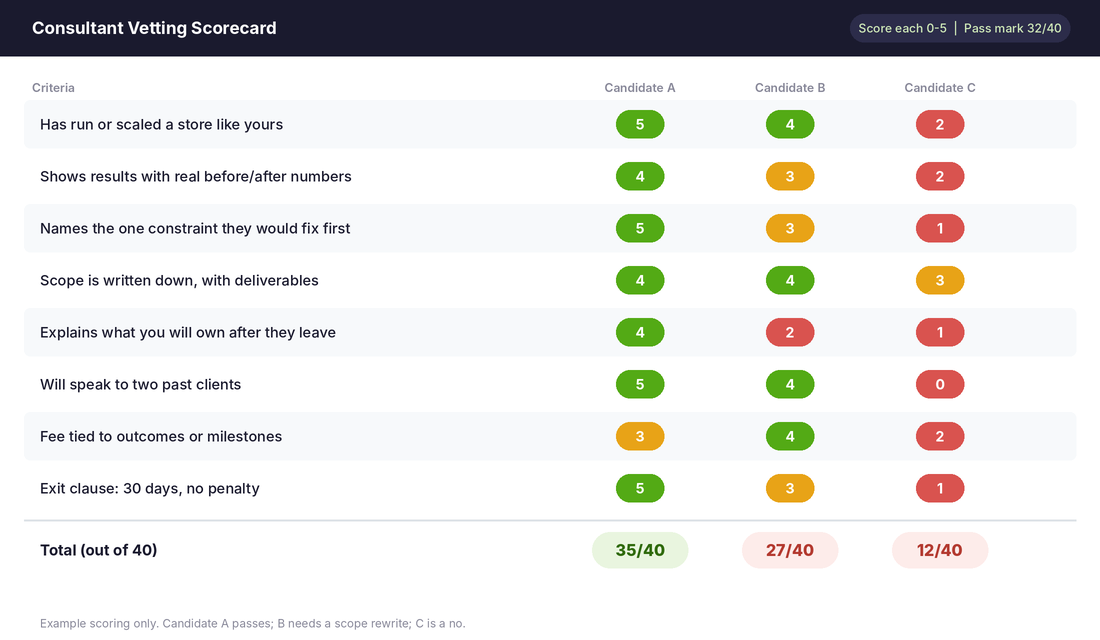
- “Have you worked on a store like mine?” Look for similar revenue, AOV, margin structure and category, not just “Shopify”.
- “Show me a before and after with real numbers.” Case studies without baselines are marketing. Be wary of percentages with no starting point.
- “What is the first constraint you would fix, and why?” A good one names it after a 20-minute look at your data. A weak one lists ten things.
- “What exactly will I receive?” Deliverables should be nouns: a tracking spec, three tested ad concepts, a margin model.
- “What will I own when you leave?” Ad accounts, flows, dashboards and documentation should all sit in your name.
- “Can I speak to two past clients?” Not testimonials on a website. Actual phone calls.
- “How is the fee structured?” Milestone-based beats open-ended hourly. Part-performance fees can work for paid media but need a clearly defined baseline.
- “What does exit look like?” Shopify’s guide specifically flags early-termination fees and unclear engagement length. Aim for 30 days’ notice, no penalty.
Red flags that should end the call
- Guaranteed revenue numbers. Nobody controls your conversion rate or your supplier costs.
- A proposal that arrives before they have seen your data.
- Any request for owner-level access to Shopify or your payment gateway.
- Case studies from a single standout client, repeated in every pitch.
- Terms in the contract that differ from the proposal. Compare the two line by line.
How to Find Candidates: A Setup Guide for the Shopify Experts Marketplace
The Shopify Experts marketplace is the fastest way to build a shortlist, because it shows merchant reviews and lets you request quotes without commitment. Shopify’s own description says matched experts reply by email and you are under no obligation to hire anyone. Here is how to run it properly:
- Open the Experts marketplace from your Shopify admin or the Shopify Experts site, and pick the service category that matches your problem (marketing and sales, development and troubleshooting, or expert guidance).
- Choose “create a job” rather than browsing profiles. Paste in your one-page brief, set your budget tier and tick that you want someone near your store if timezone matters.
- Filter responses by relevant merchant reviews. Read the three-star reviews first. They tell you more than the five-star ones.
- Shortlist three. Book 30-minute discovery calls and use the eight questions above.
- Keep payments and messages inside the platform until you are signed, since Shopify says this adds protections for you.
One caution: the marketplace shows who is listed, not who is vetted for your situation. The scoring is still your job. Also check a consultant’s own case studies against Google reviews and, where relevant, Clutch.
What Good Looks Like: Two Real Australian Examples
Koala Living (specialist support during a replatform). StudioHawk’s published case study on Koala Living reports revenue growth of 535% before the site migration and a further 39.75% afterwards, with organic traffic up 140% and then 35.65%. What matters for you is how the work was structured. The specialist matched keyword research to specific pages, coordinated with Koala’s internal project lead and external developers, and monitored rankings after launch, with instructions to correct drops. That is a narrow channel specialist working inside someone else’s project, not a vague “SEO retainer”. (The page does not state baseline numbers or dates, so treat the percentages as directional.)
Culture Kings (the cost of outsourcing the wrong thing). Shopify’s case study says Culture Kings had spent heavily on outsourced developers just to keep its website running before it moved to Shopify Plus, and reports 40% to 60% year-on-year growth since 2013, with ecommerce now about 60% of revenue. The lesson is not “move platform”. It is that the merchandising and curation work, including weekly shoots and a “Shop The Look” page, stayed with their in-house team, while the technical maintenance burden went away. Outsource the commodity. Keep the craft. (These figures are self-reported in a Shopify-published case study.)
Both examples have the same shape: a defined problem, a bounded role for the outside help, and a measurable result.
Run the Engagement in 90 Days, Not Open-Ended
Even if the consultant offers a 12-month retainer, start with 90 days and a defined handover. Here is a structure that works:
- Weeks 1 to 2: Baseline. Data audit, funnel audit, tracking checks. Agree the starting numbers in writing.
- Weeks 3 to 6: Quick wins. The two or three changes with the best effort-to-impact ratio. Ship them, measure them.
- Weeks 5 to 10: Build. The system work: flows, campaign structure, dashboards.
- Weeks 9 to 13: Document and hand over. SOPs, recorded walkthroughs, and a team session so nothing lives only in the consultant’s head.
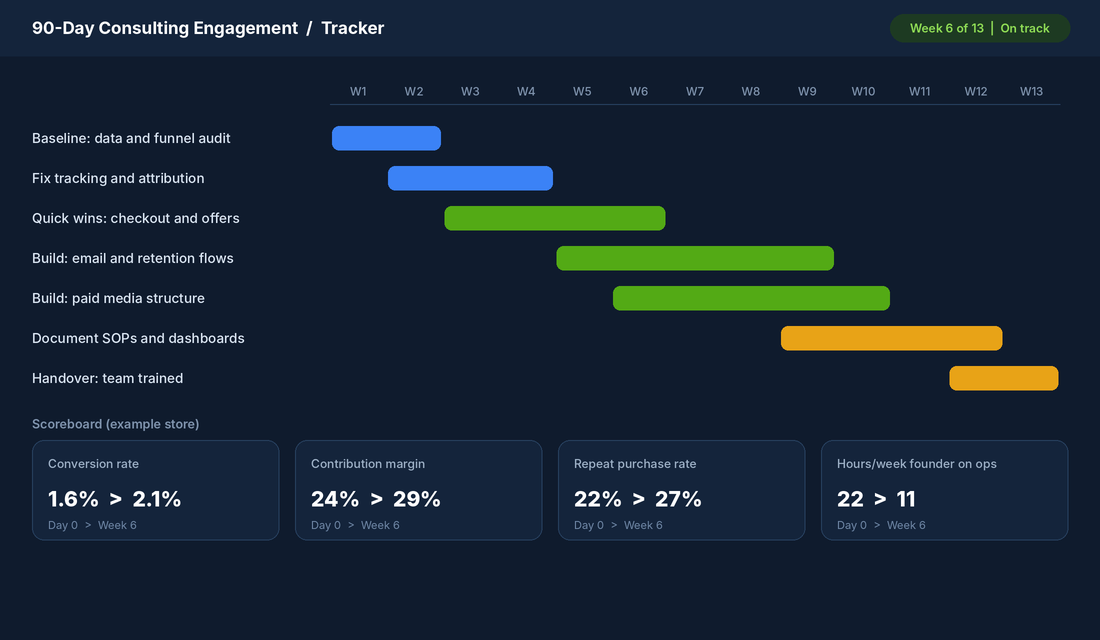
Review it weekly against four numbers: conversion rate, contribution margin, repeat purchase rate and your own hours spent on operations. If a consultant resists a scoreboard, that tells you what you need to know. For a one-page format, our monthly business review dashboard works well as the shared scoreboard.
If you are also managing an agency alongside the consultant, set the ground rules early. Our agency management guide covers the weekly rhythm that keeps everyone pointing the same way.
The Compound Effect: Why the Brief, the Maths and the Handover Work Together
Each step on its own helps a little. Together they change the outcome. The brief forces you to name a number. The break-even maths tells you whether that number justifies the spend. The scorecard filters for people who can actually deliver it. The 90-day structure keeps the work measurable. The handover means you keep the value after the invoice is paid.
Skip any one and the others weaken. A great consultant on a vague brief wastes money. A clear brief with an unvetted consultant wastes it differently. The reason so many Australian founders feel burned by consultants is rarely a bad consultant. It is a missing brief, a missing baseline, or a missing handover.
Your Consultant Hiring Checklist
Copy this into a doc and tick it off before you sign:
- The problem is stated as a number, with a baseline and a target date.
- I know my contribution margin and have run the break-even maths.
- The brief is one page and the same brief went to three candidates.
- Each candidate was scored on the eight questions.
- I spoke to two past clients on the phone.
- Deliverables are written as nouns, with milestone payments.
- Access is staff-level only. I own every account and document.
- Exit terms are 30 days with no penalty.
- The engagement is 90 days with a handover week.
- There is a weekly scoreboard with four numbers.
Quick Answers
How much does an ecommerce consultant cost in Australia? Expect roughly $130 to $300+ an hour, $5,000 to $50,000+ for a defined project, or $1,500 to $6,000 a month on a standard retainer, based on 2026 Australian agency pricing guides. Your quote should sit inside those bands and be tied to deliverables.
Should I hire a consultant or an agency? Hire a consultant when you have one defined, expensive problem and want to keep control. Hire an agency when you need ongoing execution you cannot do in-house.
When is it too early to hire one? If you have fewer than about 100 orders of data, you are better off validating product and offer first. Consulting on a store with no data is mostly guesswork.
Inside eCommerce Circle, choosing and managing outside help is one of the core pillars we work on with every member. If you want to see exactly where your store is being capped, take the free More Orders Scorecard. It takes two minutes and shows you which of the 10 P’s to fix first. And if you would rather talk it through with our team, you can get in touch here.