You transfer somewhere between four and eight thousand dollars to an agency on the first of every month. A deck lands in your inbox around the tenth. It has a lot of blue bars going up and to the right. You skim it, you say “great, thanks team” on the call, and you go back to sorting out a freight delay.
What’s in This Article
Now answer this honestly. If I asked you today what that agency delivered last month, could you list it? Not the vibe. The actual deliverables, the actual number they moved, and the actual dollars of contribution that came back after their fee.
Most founders I sit down with cannot. And the data says the relationship is already on the clock. Research on agency retention found that roughly 43% of all client churn happens within the first 90 days, and project-based agencies see 28% of departures inside six months. That is not because agencies are lazy. It is because almost nobody sets the relationship up with a scorecard, a scope and a review date. You hired a supplier and then managed them like a friend.
This playbook fixes that. It is the same seven-step structure we run with members inside eCommerce Circle who are spending real money with an external partner. It works for a media buying agency, a creative studio, a Shopify dev shop or a fractional CMO. Copy it, and you will either get dramatically more out of your current agency or find out within one quarter that you need a different one.
Why Month Four Is Where Agency Relationships Quietly Die
The pattern is almost always identical. Month one is onboarding and audit. Month two is rebuild and launch. Month three is the first real read, and it usually looks decent because low-hanging fruit exists in every account. Month four is when the easy wins run out and the honest work starts.
By month four you have stopped reading the report properly. The agency has quietly reduced the senior time on your account because the junior can keep the lights on. Nobody has said anything out loud. Six months later you are frustrated, they are defensive, and you are pricing up replacements.
What separates the good relationships from the bad ones is not talent. It is structure. Retainer-based agencies run around 18% annual churn with average client lifespans near 56 months, while project-based shops sit at 42% churn and 24-month lifespans. The retainer model wins because it forces an ongoing agreement about what gets done and what gets measured. You can build that same forcing function yourself, whatever model you are on.
The context matters too. Australians spent $82.6 billion online in 2025, up 14% year on year, with 24% of all retail spend now happening online. But the average online transaction fell to $96, roughly $10 lower than it was in 2020. More orders, smaller baskets, thinner room for error. In that market you cannot afford an agency relationship running on goodwill and monthly PDFs.
Step 1: Write the Scope Before You Argue About the Fee
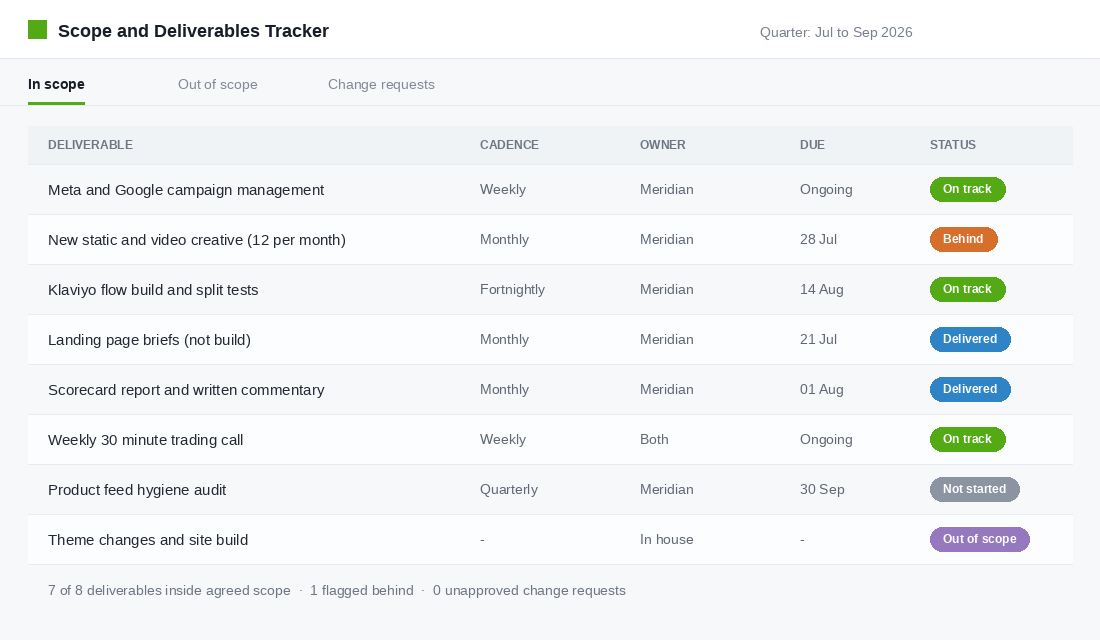
Almost every bad agency relationship starts with a proposal that lists services instead of deliverables. “Paid social management” is a service. “Twelve new static creatives and three video edits per month, briefed by the 5th, live by the 20th” is a deliverable. One can be argued about forever. The other cannot.
Before you sign anything, build a three-column document: in scope, out of scope, and change request. That third column is the one nobody writes, and it is the one that saves the relationship. It defines what happens when you ask for something extra, how it gets priced, and who signs it off.
Here is what belongs in each column for a typical Aussie Shopify brand doing $150k to $400k a month:
- In scope. Campaign management and optimisation across named platforms. A fixed monthly creative volume with a stated format mix. Audience and offer testing with a stated test count per month. A monthly written scorecard, not just a dashboard link. A weekly trading call.
- Out of scope. Theme changes and site build. Product photography shoots. Email and SMS if you have not paid for it. Anything touching your checkout. Write these down even if it seems obvious, because “can you just quickly” is how scope dies.
- Change request. A one-page form with the request, the estimated hours, the cost, and the impact on existing deliverables. Nothing starts without your written approval. This single document ends 90% of end-of-quarter invoice disputes.
On fees, know the market before you negotiate. Ecommerce agencies typically charge 10% to 20% of monthly ad spend as a management fee, with the higher percentages appearing at lower spend levels. Straight retainers for a single service commonly sit between $2,500 and $12,000 a month. If someone quotes you 25% of spend on a $60,000 a month budget, you are paying $15,000 for work that the market prices at $6,000 to $9,000. Ask them to justify the gap. A good agency will have an answer. A weak one will get uncomfortable.
One thing worth doing before you sign: build a percentage-of-spend fee into the contract with a ceiling. If your spend doubles in November, the fee should not automatically double with it. Cap it, or move to a flat retainer above a threshold you agree in advance.
Step 2: Pick the One Number Your Agency Actually Owns
This is where most founders get it wrong, and it is the most expensive mistake on the list. They make ROAS the number. Platform-reported ROAS is the easiest metric in ecommerce to make look good, because the agency can simply shift budget toward branded search and retargeting. You will see 6x in the dashboard and a flat bank balance.
Pick a number that cannot be gamed by reallocating spend to people who were going to buy anyway. In practice that means one of three:
- Marketing efficiency ratio (MER). Total store revenue divided by total ad spend. Blunt, but nearly impossible to fake. If your agency’s platform ROAS climbs while MER stays flat, they are harvesting, not growing. We break the mechanics down in the marketing efficiency ratio guide.
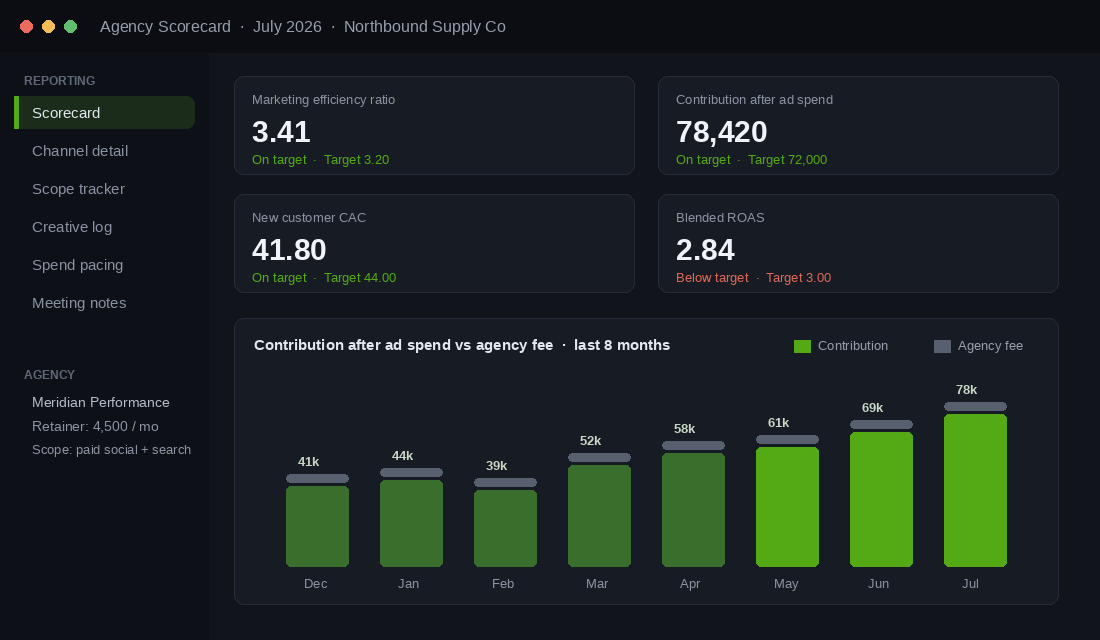
- Contribution after ad spend. Gross profit minus ad spend, in dollars. This is the number that pays your rent. It forces conversations about product mix and discounting instead of just bidding.
- New customer acquisition cost, capped. Useful when the mandate is genuinely growth. Set the cap using your real payback window, not a guess. Our contribution margin playbook walks through how to work out what you can actually afford to pay.
Whichever you choose, agree the target in writing with a date attached. “MER of 3.2 by the end of Q1, measured on the calendar month, using Shopify gross sales and total platform spend” is a target. “Improve efficiency” is a wish.
And be fair about it. Your agency does not control your product page, your delivery promise, your pricing or your stock levels. If you set them a contribution target and then run out of your hero SKU for three weeks, that is on you. The best relationships name the things outside the agency’s control up front so nobody wastes a call arguing about them later.
Step 3: Build the One-Page Agency Scorecard
The report your agency sends is their story about their work. The scorecard is your version of the truth, built from your data, in your account, that they cannot edit. You need both, and the scorecard comes first on every call.
Keep it to one page with six rows. Anything longer stops getting read within two months.
- The owned number. Actual vs target vs last month. From step 2.
- Contribution after ad spend, in dollars. With the agency fee shown as a separate line underneath so the true cost is always visible.
- New customer count and new customer CAC. Growth or harvest, in two numbers.
- Deliverables shipped vs promised. A simple 11 of 12 style count from the scope tracker.
- Tests run and what you learned. Not “we tested creative”. What was the hypothesis, what happened, what changed as a result.
- One thing they need from you. This row is non-negotiable. It stops the scorecard becoming a one-way audit and surfaces the blockers you are causing.
How to build it in Looker Studio in about 90 minutes
You do not need Triple Whale or Northbeam to start. Looker Studio is free and connects to everything you need. Here is the build:
- Create the data spine in Google Sheets. One tab, one row per month, columns for gross sales, gross profit, total ad spend by platform, agency fee, new customers, and orders. Some of this can be pulled automatically, but typing twelve numbers once a month takes four minutes and guarantees you understand them.
- Connect the live sources. In Looker Studio, add the Google Ads and GA4 connectors directly. For Meta, use a free community connector or export monthly into the same sheet. Do not chase perfect automation on day one.
- Add calculated fields. MER as gross sales divided by total spend. Contribution after ad spend as gross profit minus total spend. New customer CAC as spend divided by new customers. Keep the formulas in Looker Studio, not in the sheet, so the logic lives in one place.
- Build four scorecard tiles across the top. Use the comparison setting to show previous period change on each. Set conditional formatting to green above target and red below.
- Add one combo chart. Contribution after ad spend as bars, agency fee as a line, trailing twelve months. This single chart has ended more bad agency relationships than any deck I have seen.
- Share it with the agency as a viewer, not an editor. Then send the link in the calendar invite for every monthly review so nobody arrives unprepared.
If you would rather not build it yourself, AgencyAnalytics and Swydo both do a version of this out of the box for around $60 to $150 a month. Worth it if you are managing more than one partner.
Step 4: Run the Weekly 30 and the Monthly 60
Two meetings. Different jobs. Most brands run one meeting that tries to do both and does neither well.
The weekly 30 is a trading call. Thirty minutes, same time every week, and it never becomes a strategy session. The agenda is fixed: what happened last week against the number, what is live this week, what is blocked, and any stock or promo changes they need to know about. No deck. If you have nothing to say, cancel it, but do not let it drift into a monthly.
The monthly 60 is the scorecard review. Your dashboard on screen, not theirs. Walk the six rows in order. Then spend the back half on the next month’s plan and the change request queue. End with one written commitment from each side.
Two rules make these calls work. First, the same person from your side attends every time. Rotating attendance is how agencies learn to tell three slightly different stories. Second, someone takes notes in a shared doc that both sides can see, with actions and owners. If you are already running documented processes internally, this slots straight into your existing SOP structure.
One more thing that costs nothing: ask who is actually doing the work. Not who is on the call. Who is in the ad account on a Tuesday afternoon.
Step 5: Own Every Account, Every Time
This is the least glamorous step and the one that will save you the most money. If your agency owns an account that your business depends on, you do not have a supplier. You have a hostage situation with a monthly invoice.
The rule is simple. Your business owns the asset. The agency gets access. Never the other way around, no matter how convenient it seems during onboarding when they offer to “just set it up on our side to save you the hassle”.
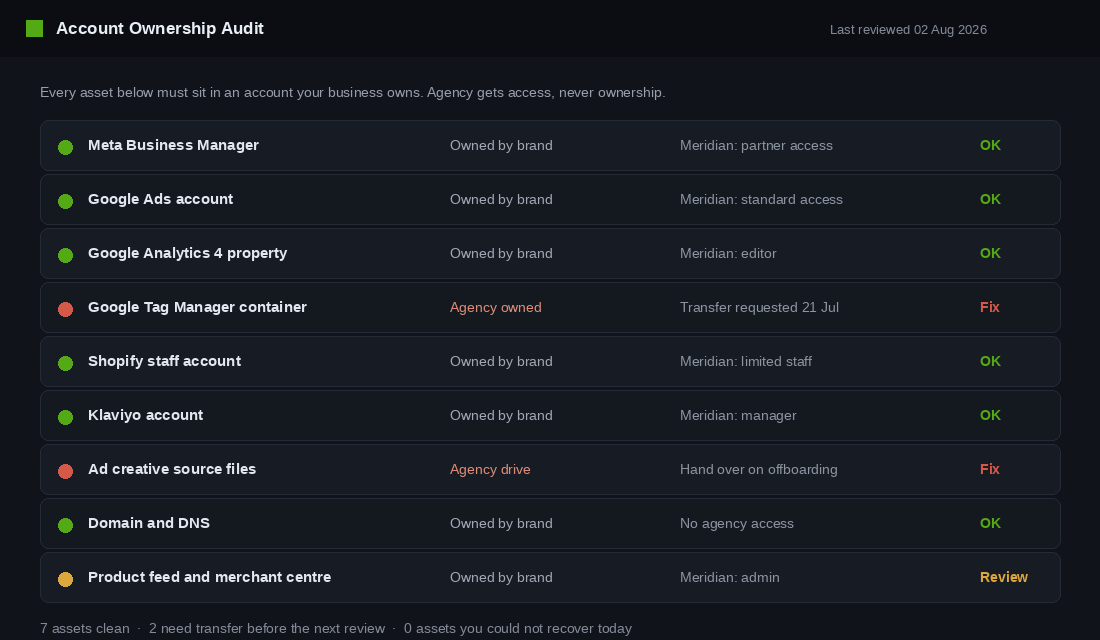
Work through this list and mark each one green, amber or red:
- Meta Business Manager. Owned by your business, agency added as a partner. If your ad account sits inside their Business Manager, you cannot take it with you.
- Google Ads and Merchant Center. Your MCC or standalone account, agency granted standard access. Check the billing profile is yours, not theirs.
- Google Analytics 4 and Tag Manager. Your property, your container. GTM is the one that gets missed most often, and losing it means rebuilding your entire tracking layer. If you are unclear on how yours is wired, the UTM tracking playbook is the place to start.
- Klaviyo, Shopify, and your review platform. Agency added as staff or manager users with the minimum permission that lets them work.
- Creative source files. Written into the contract: layered files and raw footage handed over on request and on offboarding. Not just the exported JPEGs.
- Domain, DNS and email sending domain. No agency access unless there is a specific active project. Revoke it when the project ends.
Do this audit once a quarter and it takes twenty minutes. Skip it, and the day you decide to leave becomes a six-week negotiation instead of a two-day handover.
Step 6: The 90-Day Review That Keeps the Good Ones
Here is a finding worth sitting with. The ANA and 4As 2025 tenure study found that clients running a frequent formal review cycle averaged 3.8-year agency tenures, while those without mandatory reviews averaged 8.1 years. On the surface that reads like an argument against reviewing.
It is not. It is an argument against treating a review as a pitch. Constant competitive tendering exhausts good partners and rewards whoever presents best rather than whoever performs best. The answer is a structured internal review that is honest without being a threat.
Every 90 days, sit down for an hour and score the relationship out of five on six things: results against the owned number, deliverables shipped on time, quality of thinking (are they bringing you ideas or waiting for briefs), responsiveness, seniority of the people actually working on the account, and whether the fee still matches the value.
Then share the scores with them. All of them. A strong agency will thank you for it and fix the twos before the next quarter. A weak one will get defensive, and you will have learned what you needed to know without spending a cent on a pitch process.
When a full review is genuinely warranted, run it properly. ANZ jeweller Michael Hill ran a competitive media review and appointed EssenceMediacom across Australia, New Zealand and Canada, deliberately reshaping its marketing model around media, commerce and data capability rather than just chasing a cheaper rate card. That is the point of a review. Not to squeeze the fee, but to check the shape of the partnership still matches where the business is going. Online fashion retailer Selfie Leslie did something similar in appointing Adcore to run performance media and media mix modelling across North America and Australia, buying a capability it did not have in-house rather than a lower price.
Step 7: Decide What Never Leaves the Building
The market has moved decisively on this. A WFA and Observatory International survey found 66% of brands now have in-house agency capability, a 16-point rise since 2020, with a further 21% actively considering it. That does not mean you should fire your agency. It means you need a deliberate answer to what stays inside.
Melbourne B Corp Who Gives A Crap is a good model here. They run a deliberately split roster: Hatched handles media planning and buying across all channels excluding performance, 72andSunny does creative, and Eleven runs PR and social. Performance is treated differently to brand media on purpose. The structure reflects a decision about what the business wants close to it, not an accident of who pitched well.
For an Aussie brand between $40k and $500k a month, three things should almost always stay in-house regardless of agency:
- Your customer data and your email or SMS list. This is the asset. Agencies can execute against it, but ownership, segmentation logic and consent handling stay with you.
- Your offer and pricing decisions. An agency can tell you a bundle is performing. Deciding what you sell and at what price is a business decision that touches every part of the P&L.
- At least one person who can read the ad accounts. Not necessarily build campaigns. Just someone internal who can log in and tell whether what the report says is what the account shows. If nobody can do this, hire or train for it. Our media buyer hiring playbook covers what to look for.
Everything else is genuinely a build-or-buy question, and buying is often right. Specialist creative, feed management, technical SEO and Shopify development are all areas where an outside team with a hundred accounts of pattern recognition beats your one internal person.
How the Seven Steps Compound
Each step on its own is useful. Together they change the nature of the relationship, and that is where the real return sits.
The scope document means nobody argues about what was promised. The owned number means every conversation starts from the same fact. The scorecard means you spot drift in week six rather than month six. The meeting cadence means small problems get raised while they are still small. Account ownership means you are choosing to stay, not stuck. The quarterly review means resentment never gets a chance to build. And the in-house line means you always know which capabilities you are renting.
Put another way: you stop being a client who receives reports and start being a manager who runs a supplier. Agencies respond to that. The good ones respond by putting better people on your account, because accountable clients are the ones they want to keep and the ones they put in case studies. The weak ones respond by resigning your account, which saves you the trouble.
Something else happens once the structure is in place. The conversation moves off the ad platform. When you can see contribution after ad spend next to the fee, the obvious question stops being “can we get ROAS up” and becomes “what else moves this number”. That is when your agency starts talking to you about your product page, your bundle structure, your delivery promise and your repeat rate. Which is exactly the conversation you were hoping to have when you hired them.
Your 30-Day Agency Reset Checklist
If you are already three months into a relationship that feels wobbly, do not tear up the contract. Run this instead. It takes about six hours of your time spread across a month.
- Week 1, day 1. Run the account ownership audit. Fix anything red before you do anything else, because it changes your negotiating position on everything that follows.
- Week 1, day 3. Write the scope document yourself, from what you believe you are paying for. Send it to the agency and ask them to correct it. The gaps between your version and theirs are the whole conversation.
- Week 2. Choose the owned number and set a target with a date. Get it agreed in an email, not on a call.
- Week 2. Build the Looker Studio scorecard. One page, six rows, twelve months of history so you can see the trend, not just the month.
- Week 3. Put the weekly 30 and monthly 60 in the calendar as recurring invites for the next six months. Attach the dashboard link to both.
- Week 3. Ask who is doing the work day to day and get their names. Ask what percentage of their week your account gets.
- Week 4. Run the first quarterly review scoring, share the scores, and agree three specific improvements with dates on them.
- Day 90. Re-score. If nothing moved after all of that, the problem is not communication and you have your answer.
Most founders find something uncomfortable in week one. Usually it is a Business Manager they do not own, or a scope they were never actually sold. Better to find it now than the week you decide to leave.
Managing an agency well starts with picking the right one. If you are still shortlisting, how to choose an ecommerce agency in Australia covers the pricing tiers, the red flags and the questions worth asking before you sign.
Inside eCommerce Circle, managing external partners well is one of the core pillars we work through with members, because at a certain revenue level almost everyone is paying someone. If you want a second opinion on your agency relationship before you renew, let’s talk.