Most Aussie store owners think product liability is somebody else’s problem. The factory made it, the supplier shipped it, so if a customer gets hurt, surely the maker carries the can. That belief is exactly what turns a single faulty hair dryer or a mislabelled body oil into a five-figure legal bill for the store that sold it.
What’s in This Article
Under Australian Consumer Law, the brand on the box is treated as the manufacturer. If you import the product, put your label on it, or can’t point to an Australian maker, the law treats you as the one who made it. Your Shopify store is not a neutral shop window. It is the party a lawyer will name first.
The brands that sleep well have worked this out early. They know which of their products carry real injury risk, they hold the right policy at the right limit, and they can trace a faulty batch to a list of customers in under an hour. This guide shows you how to do all three, in plain language, with the Australian rules that actually apply. (This is general information, not legal or insurance advice. Confirm your own situation with a broker.)
Why Your Online Store Counts as the “Manufacturer” Under Australian Law
Product liability sits in Part 3-5 of the Australian Consumer Law. The short version from the government’s own Product Safety Australia site: a person who suffers injury or loss because of a safety defect can claim against the manufacturer, and the definition of manufacturer is far wider than most founders expect.
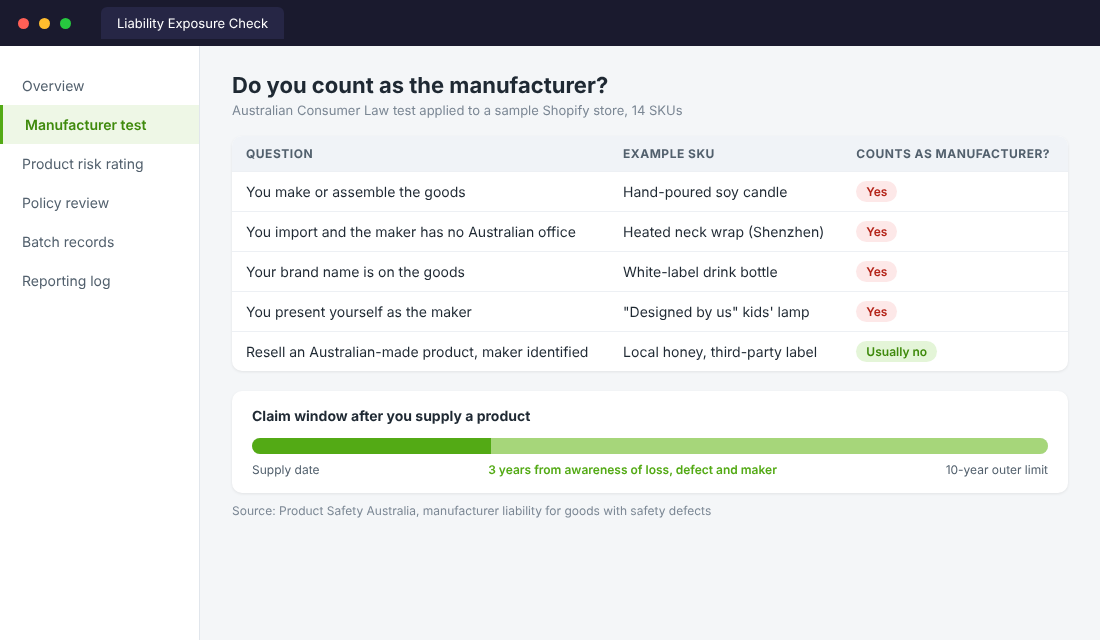
According to Product Safety Australia, you count as the manufacturer if you:
- Make or assemble the goods yourself.
- Import the goods and the maker has no office in Australia.
- Put your own brand name on goods someone else produced.
- Present yourself to the public as the manufacturer.
- Let someone else promote the goods as your product.
Read that list again as a Shopify owner. Private label? You are the manufacturer. Imported from a Shenzhen factory that has no Australian presence? You are the manufacturer. Bought white-label stock and added your logo and packaging? Manufacturer again.
The only founders who sit outside that list are pure resellers of an Australian-made product, and even they can be pulled in if they can’t identify the maker. Law firm Sprintlaw covers that scenario in its guide to product liability when the manufacturer is unknown.
The clock runs longer than you think
A consumer has 3 years from the time they became aware (or should have become aware) of the loss, the defect and who made the product. There is also a hard outer limit: any action must start within 10 years of the time the product was supplied.
That means a candle sold in October 2026 can still produce a claim in 2036. Your insurance wording needs to deal with that, which we cover in the limits section below.
What a claim can include
Claims cover personal injury, injury or death of another person, and economic loss from damage to other property such as a house, building or other goods. Dependants can claim their own losses where someone is killed or injured. Damage to commercial property and a business’s lost profits are outside this regime, so the typical claimant is a household, not a competitor.
The ordinary-store reality check
You do not need a dramatic recall to land here. The everyday triggers look like this:
- A reusable water bottle lid cracks and cuts a child’s lip.
- A phone charger overheats and scorches a bedside table.
- A face serum causes a chemical burn because the label missed a warning.
- A baby sleeper arrives without the safety instructions the standard requires.
Each one is a small order value and a large claim. That asymmetry is the whole reason this insurance exists.
What Product Liability Insurance Actually Covers (and What It Doesn’t)
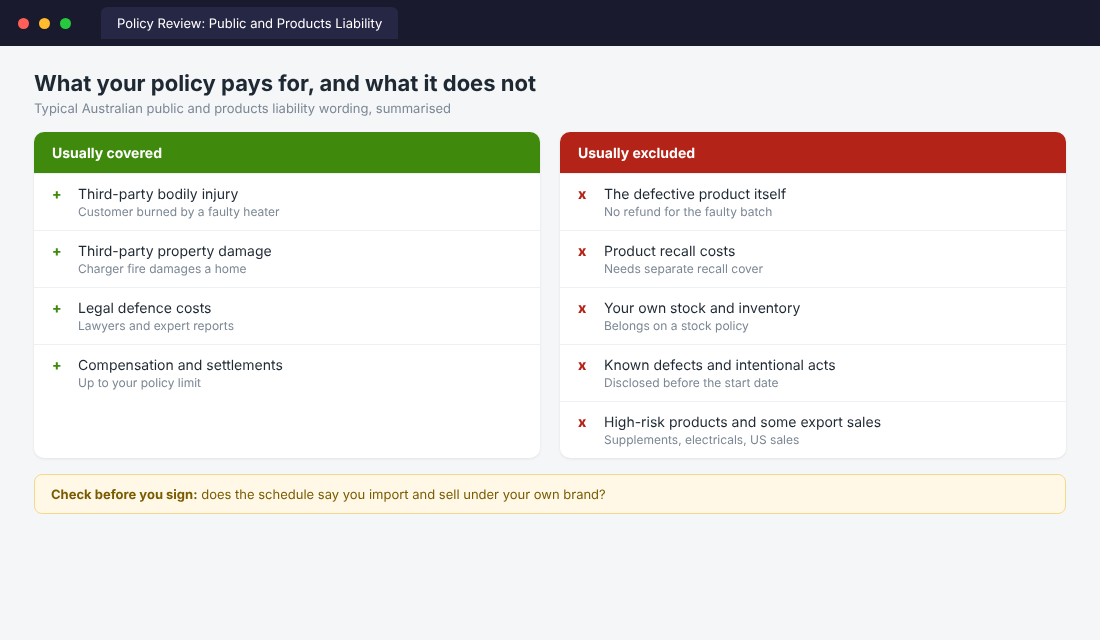
Product liability insurance pays for third-party bodily injury or property damage caused by a product you sold, supplied, made or imported, after it has left your hands. It generally also covers legal defence costs. In Australia it is almost always sold bundled with public liability as a “public and products liability” policy, which is why you rarely see it priced on its own. (If you want the pricing side, our ecommerce insurance quotes guide covers what stores pay and how to compare three quotes.)
The part most owners never read is the exclusions. Insurer Upcover’s plain-English summary lists the usual ones:
- The defective product itself. If your batch of heaters is faulty, the policy does not refund the heaters.
- Recall costs, unless you buy recall cover. More on that in a moment.
- Your own stock and inventory. That belongs on a stock or contents policy.
- Known defects that existed before the policy started.
- Intentional misconduct, such as selling something you knew was dangerous.
- Professional advice errors. Those sit under professional indemnity.
- Certain high-risk products. Some policies exclude supplements, ingestibles, children’s products or anything with electrical components.
- Some export markets. US and Canadian sales are commonly excluded or need an endorsement.
Where importers get caught
The exclusion that hurts online stores most is the one hiding in the “products” definition. A policy sold to a “retailer” can quietly assume you buy from an Australian wholesaler. If you import direct, or sell your own label, you need to tell the insurer. Otherwise the claim gets declined on the grounds that you misdescribed the business.
Say it in plain words on the proposal form: “We import and sell under our own brand.” Then ask for that to be confirmed in writing in the policy schedule.
Your supplier’s cover will not save you
Founders often tell me their Chinese or Vietnamese factory “has insurance.” Possibly. But that policy is written under another country’s law, for the factory’s customers abroad, and it almost never names you as an insured party. If a customer in Geelong is hurt, the claim lands on your door. If you want a contract-level safeguard, our supplier agreement guide shows the indemnity and insurance clauses worth getting signed before your next production run.
The Five Product Types That Change Your Risk Rating
Not every SKU carries the same exposure. An insurer prices your risk off what you sell, so it helps to know where your catalogue sits before you ask for a quote.
1. Anything ingested or applied to skin. Supplements, protein, skincare, body oils, candles with fragrance oils. Allergic reaction and contamination claims dominate here. Label accuracy matters as much as formulation.
2. Anything electrical. Chargers, heaters, hair tools, LED lights. Overheating and fire claims are expensive because they involve property damage on top of injury. Check compliance with the relevant electrical safety rules and keep the test reports.
3. Anything for children. Toys, baby bedding, nursery furniture, kids’ clothing with cords or drawstrings. The ACCC treats these as top-priority categories.
4. Anything with small, high-powered magnets. These are banned in Australia when separable or loose. Which brings us to the clearest recent example.
5. Everything else with a mechanical failure mode. Straps, clasps, wheels, hinges, ladders, bottles under pressure.
If one or two SKUs fall in the first four buckets, tell your broker which ones. Don’t hide them. A disclosed risk gets a priced answer. An undisclosed risk gets a declined claim.
What happened when four big sellers got this wrong
In June 2026 the ACCC issued takedown requests to Amazon, eBay, Kogan and Fruugo after finding “magnetic chess” and “battle chess” style toys on their sites that contained separable high-powered magnets, which sit under a permanent ban. ChannelNews reported that the four agreed to remove the listings, stop relisting and contact affected customers, with Kogan, Amazon and Fruugo providing or offering refunds. The regulator also told toy and game sellers to review products immediately and to recall anything non-compliant, and named unsafe products in digital markets a key enforcement priority for 2026-27.
The lesson is not “Kogan was careless.” It’s that the same rules apply to a three-person Shopify brand, with a fraction of the legal team. Dropshippers selling imported novelty toys are in the same position as those marketplaces, with none of the resources.
How common is this?
The Sedgwick Australian Product Safety and Recall Index counted 1,247 product safety market actions (recalls and similar) in 2025, down 3.2% from 1,288 in 2024, with the second half of the year showing an uptick tied to increased regulatory focus. A drop in volume is not the same as a drop in scrutiny. If anything, the shift is toward enforcement on online sellers.
Recall Cover Is a Different Policy (Read This Twice)
Here is the trap that surprises most founders. Product liability protects you against third-party legal claims. Product recall cover protects your own money: the cost of pulling stock, notifying customers, shipping returns and destroying product.
As AXA XL’s Rebecca Bowman put it in Insurance Business, “recall policies are there to protect their first party interests.” Founders commonly assume their liability policy pays for a recall. Usually it doesn’t. The same article notes that Chubb in Australia writes recall cover only alongside a general liability policy, not standalone, while AXA XL treats it as a distinct first-party policy.
Recall cover is built mostly around contamination. About 85% of AXA XL’s Australian recall claims involve contamination, and for contamination the cover generally responds only once the contamination is shown to cause injury, sickness or property damage. So a mould issue on a food product might not trigger cover unless it harms someone.
Do you need it?
Use this rule of thumb:
- Under 10 SKUs, no ingestibles, no electricals, no kids’ products: a recall plan matters more than a recall policy. Save the premium and write the plan.
- Food, supplements, cosmetics, kids’ products or anything electrical: price recall cover. Ask your broker whether it can be added as an extension to your liability policy.
- Selling into big retailers: check the contract. Retailers commonly demand recall cover as a condition of listing.
A 2019 Inside Retail piece quoting GS1 Australia noted that “knowledge about what to do and when is limited at best among many suppliers and smaller retailers,” and that online retailers of overseas-sourced products can be less attentive to recall notices. That is still the gap. The store with a written plan looks competent to a regulator before a single dollar is spent.
The 2-Day Rule: What You Must Report and When
Insurance pays after the event. Reporting law starts the moment you hear about one.
Under the Product Safety Australia rules, everyone in the supply chain must report a death, serious injury or serious illness associated with a consumer good they supplied. The deadline is 2 days from becoming aware, and if you’re unsure whether it counts, the guidance is to report anyway to meet the deadline. Reports go through the mandatory reporting page.
The penalties are not small. For banned goods and recall failures, the maximum for a company is the greatest of $100 million, three times the benefit from the offence, or 30% of adjusted turnover. For an individual it is $2.5 million, per the Consumer Affairs Victoria penalty table. Failing to report carries its own, smaller penalties and can be a criminal offence.
For a small brand the real exposure is rarely the headline number. It’s the combination of a missed 2-day deadline, no batch records and a policy that was never told you import. That stack is what turns a manageable claim into a business-ending one.
Your 2-day response script
Put this in your team’s shared SOP folder today:
- Hour 0: Whoever receives the complaint tags the support ticket “SAFETY” and messages the founder.
- Hour 1: Founder pulls the order, product, batch and supplier details. Photos of the product and packaging are saved.
- Hour 4: Pause the listing on the store if the complaint involves injury, fire or ingestion. You can unpause later. You can’t undo a second injury.
- Day 1: Phone your broker. Notify the insurer as soon as practicable, because late notification is a common reason for declined claims.
- Day 2: Lodge the mandatory report if it meets the threshold, or if you’re unsure.
- Day 3 onward: Request test reports from the supplier, check other orders from the same batch, and decide on a voluntary recall.
Limits, Excess and Claims-Made Wording: The Three Numbers to Check
When you get a certificate, three numbers do the heavy lifting.
The limit. This is the most the insurer will pay per claim. Many wholesale agreements and marketplace seller terms specify a minimum, so check any contract you sign before choosing a figure. Don’t pick a limit because it makes the monthly premium look small.
The excess. This is what you pay first. Our ecommerce insurance guide puts typical product liability excesses at roughly $1,000 to $5,000. A $5,000 excess on a $300 policy is a decision to self-insure the small claims. That can be sensible if you’ve got cash set aside, and reckless if you haven’t.
The trigger. Some liability policies respond to claims made during the policy period, not to events that happened during it. Given the 10-year long-stop, that matters. If you switch insurers or let the policy lapse, you may have no cover for a product sold last year. Ask your broker two questions: is this policy claims-made or occurrence-based, and is there run-off cover if we cancel?
What it costs
Upcover’s indicative ranges are about $30 to $60 a month (roughly $360 to $720 a year) for lower-risk small businesses, and about $80 to $150 or more a month (roughly $960 to $1,800 or more a year) for higher-risk products and importers. Those are indications, not quotes, and your actual premium moves with turnover, product type, limit and claims history.
Put that against a single claim. A defective-charger house fire or a serious allergic reaction can exceed that premium by orders of magnitude. The cost isn’t the problem. The disclosure is.
The Tool: Build a 10-Minute Batch Trace With Shopify Flow
The fastest way to turn a nasty situation into a manageable one is to know exactly who bought a particular batch. You can set this up in Shopify without paying for another app.
Shopify Flow is the free automation tool built into Shopify’s paid plans. Here is the setup:
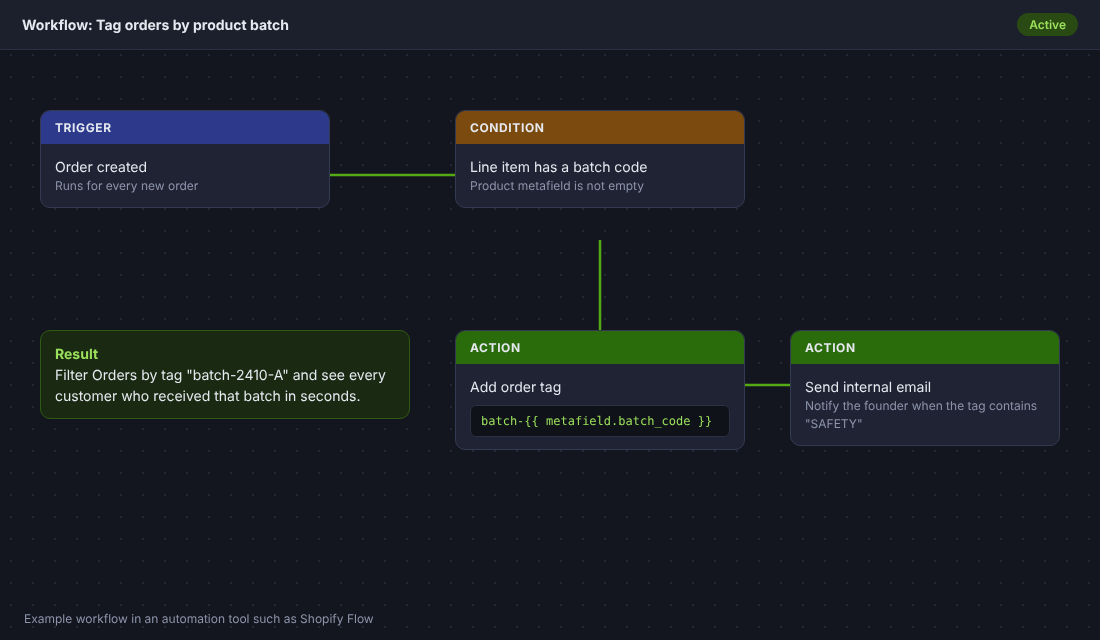
- Add the batch to the product. In Shopify admin, create a product metafield called “Batch code” and fill it in each time stock lands. If you manage stock by lot number, add the lot to the variant SKU or the metafield.
- Open Flow. Go to Apps, then Shopify Flow, then Create workflow.
- Choose the trigger. Select “Order created.”
- Add an action. Choose “Add order tag” and build the tag from the line item’s batch code, for example “batch-2410-A.”
- Test it. Place a test order, then filter your Orders page by that tag.
- Add the recall email. In Klaviyo or Shopify Email, save a template called “Safety notice” with a placeholder for the product name, the problem and the refund steps. When you need it, filter customers by the tag and send.
The result: when a complaint lands, you can pull every customer who received that batch in minutes, not days. That also supports your 2-day report and any voluntary recall.
Pair it with a free recall-watch habit. Subscribe to alerts from Product Safety Australia, then check them monthly against your supplier list. The ACCC’s recall database is public, and the Product Safety Australia alerts are the first place a regulator will expect you to have looked.
The Product Liability Readiness Checklist
Copy this into your SOP folder and tick it off once a quarter.
How It All Works Together
Each piece covers a different failure.
The legal definition tells you that you are the manufacturer. The risk-rating exercise tells you which SKUs deserve scrutiny. The policy pays third-party claims and defence costs. The recall plan (and recall cover where it makes sense) protects your own cash. The batch trace turns a mystery into a spreadsheet. The 2-day script keeps you on the right side of the regulator.
Take away one layer and the others get weaker. A policy with no batch records means slow, expensive claims handling. Batch records with no policy means you’re documenting your own exposure. A policy that never heard you import means the other layers don’t get a chance to help.
Done well, none of this slows you down. You launch new products with confidence, you answer wholesale buyers’ insurance questions in one email, and you spend ten minutes a quarter on it instead of ten weeks in a dispute.
Inside eCommerce Circle, protecting the downside is one of the core pillars we work on with every member, right alongside growth. If you want to see exactly where your store is exposed, take the free More Orders Scorecard. It takes two minutes and shows you which of the 10 P’s to fix first.