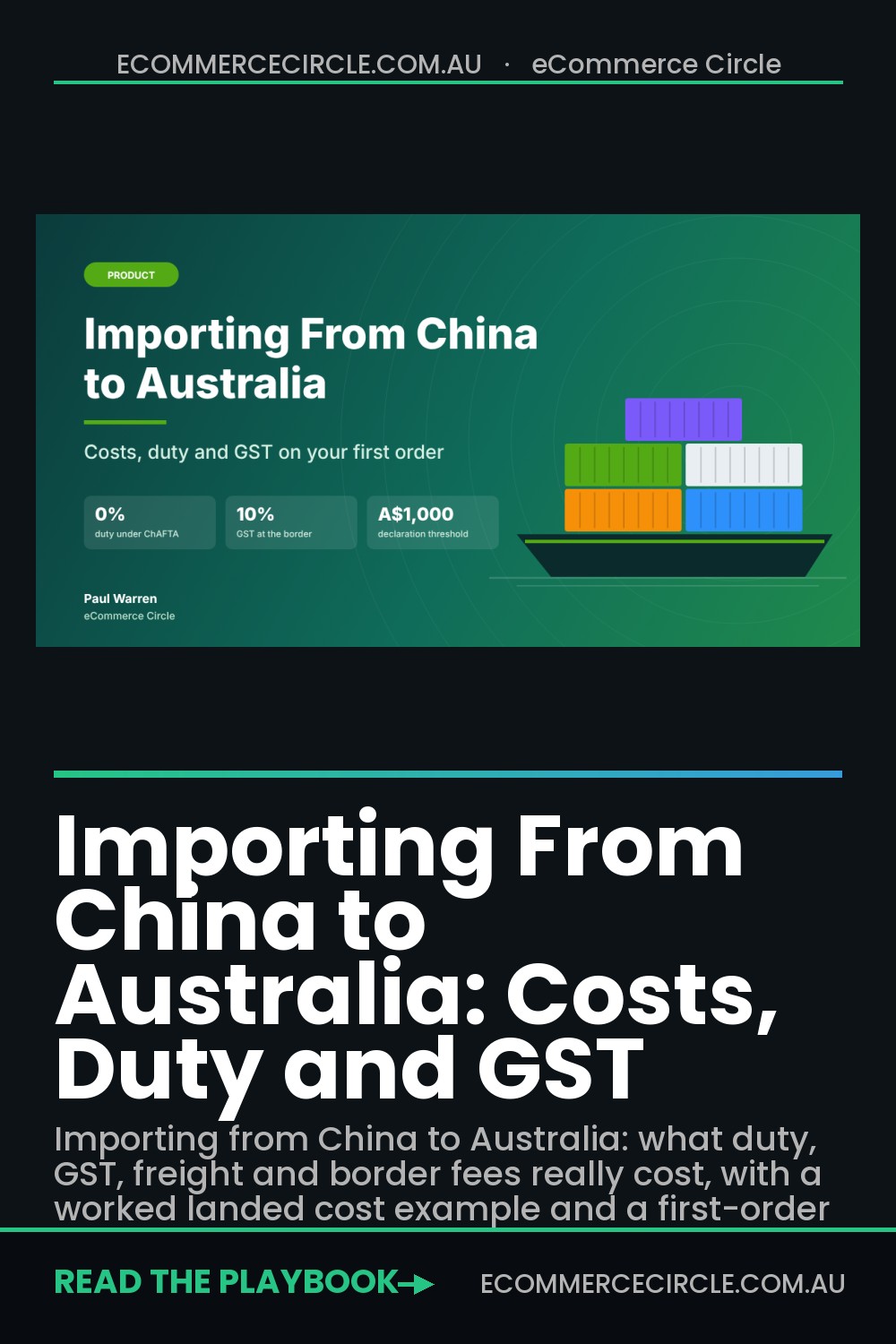
Importing from China to Australia costs more than the factory quote, but less than most first-timers fear. On a commercial order worth more than A$1,000 you will usually pay 0% customs duty (with the right certificate), 10% GST at the border, around A$120 in government charges, plus freight and a customs broker. Budget for a landed cost 15% to 30% above the supplier’s price and you will rarely be caught short.
Most store owners get this wrong in one of two ways. They take the US$4.00 unit price off an Alibaba listing, multiply by the exchange rate, and set their retail price off that number. Or they get so spooked by customs, biosecurity and paperwork that they keep buying from a local wholesaler at double the cost.
The brands that do it well treat importing as a repeatable process with five numbers and four documents. This guide walks you through the lot: what you pay, when you pay it, how to ship, who to hire, and a 12-point checklist for your first order. Government charges were checked on 15 November 2026.
What Importing From China to Australia Costs
China is Australia’s biggest supplier by a wide margin. DFAT’s 2025 trade figures put imports from China at A$130.2 billion, or 19.8% of everything Australia imported, up 12.5% on 2024. So the path is well worn, and the costs are predictable once you know the lines.
Every commercial shipment has the same seven cost lines:
- Goods. What you pay the supplier, usually quoted in US dollars.
- International freight and insurance. Sea or air, from the Chinese port to an Australian port.
- Customs duty. 0% or 5% for most consumer products.
- GST. 10%, charged on more than just the goods.
- Import processing charge. A flat fee from the Australian Border Force.
- Biosecurity charge. A flat fee collected for the Department of Agriculture.
- Local costs. Customs broker, port and unpacking fees, and delivery to your door.
Here is a worked example for 1,000 units at US$4.00 each, shipped as 2 cubic metres of sea freight. The exchange rate is A$1 = US$0.678 and the freight rate sits mid-range. The broker and port line is an allowance, so swap in your own quote.
| Cost line | How it is worked out | AUD |
|---|---|---|
| Goods | US$4,000 converted | 5,900.00 |
| Sea freight (LCL) | US$150 per cubic metre x 2 | 442.00 |
| Cargo insurance | Allowance | 40.00 |
| Customs duty | 0% with a ChAFTA certificate of origin | 0.00 |
| GST at the border | 10% of (5,900 + 0 + 442 + 40) | 638.20 |
| Import processing charge | Value between A$1,000 and A$10,000 | 50.00 |
| Biosecurity charge | Sea cargo | 71.00 |
| Broker, port and delivery | Allowance | 650.00 |
| Cash out the door | 7,791.20 | |
| Less GST credit on your BAS | If you are registered for GST | -638.20 |
| Net landed cost | A$7.15 a unit | 7,153.00 |
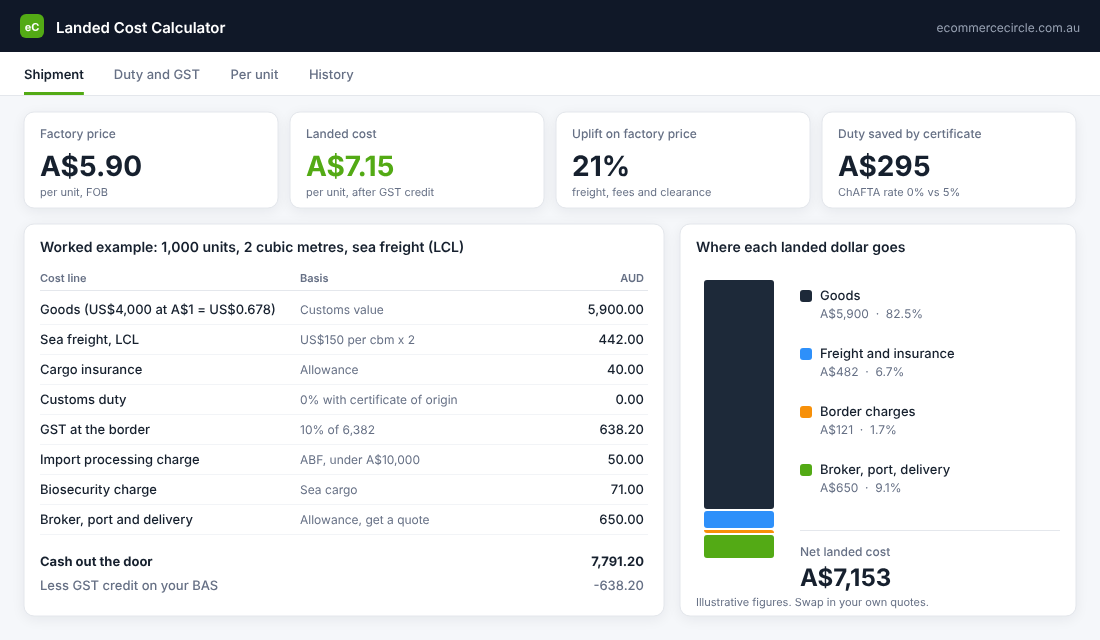
Your A$5.90 product is really a A$7.15 product. That is a 21% uplift, and it is the number your pricing has to be built on. If you want the full method for rolling this into a per-unit cost across a whole range, work through our landed cost guide next.
Notice the cash flow gap too. You pay A$7,791 before a single unit sells, and the A$638 of GST only comes back when you lodge your next BAS.
Customs Duty: Why Most Goods Land at 0%
The general rate of customs duty on consumer goods coming into Australia is 5%. For goods made in China, you can usually bring that to zero.
Under the China-Australia Free Trade Agreement (ChAFTA), Australia removed tariffs on 82% of Chinese goods when the deal started in December 2015, and DFAT confirms that reached 100% tariff elimination by 1 January 2019.
The catch is that 0% is not automatic. You have to claim it, and you need proof the goods were actually made in China.
- Ask for a ChAFTA Certificate of Origin with every order. It is issued in China by the customs service (GACC) or the China Council for the Promotion of International Trade. One certificate covers one shipment of up to 20 items.
- Put it in your purchase order. Write “Supplier to provide ChAFTA Certificate of Origin at no charge” on the PO. Factories that export to Australia weekly do this without blinking. If a supplier does not know what it is, that tells you something.
- Check the product-specific rule. Goods assembled in China from imported parts must meet a rule of origin. Your broker can confirm this from the tariff code.
- Know your fallback. DFAT says you can claim a refund for up to 12 months from the shipment date if the certificate is issued after the goods arrive.
In the example above, the certificate is worth A$295. Duty is a real cost that you never get back, unlike GST. On a A$50,000 order that one piece of paper is worth A$2,500.
Tool: check your rate on the DFAT FTA Portal
Before you ask for quotes, spend ten minutes on the free DFAT FTA Portal. Here is the setup:
- Open the portal and choose Import as your trade direction.
- Set the origin to China and the destination to Australia.
- Search your product by name, such as “stainless steel drink bottle”, and pick the closest tariff heading.
- Read off the general rate and the ChAFTA rate side by side.
- Open the rules of origin tab and save the product-specific rule as a PDF.
- Send the tariff code to your supplier and your broker so all three of you use the same one.
That tariff code (the HS code) drives your duty rate, your paperwork and any permit requirements. Getting it agreed up front saves arguments later.
GST on Imports: How the 10% Is Calculated
GST is where most first-time importers under-budget, because it is not 10% of the supplier’s invoice.
The ATO states that GST is 10% of the value of the taxable importation. That value is the customs value of the goods, plus any customs duty, plus the cost of transport to Australia, plus insurance for that transport.
So freight is taxed. Duty is taxed. In our example the GST base is A$6,382, not A$5,900.
Three things to know:
- Everyone pays it. GST applies whether or not you are registered. Home Affairs collects it before your goods are released.
- Registered businesses get it back. If you are registered for GST and the goods are for your business, you claim the full amount as a credit on your BAS for the period you paid it.
- You need the paperwork. The ATO wants a finalised import declaration in your name and the matching receipt. This is why your business, not your supplier’s agent, should be the importer on record.
If you are not registered for GST yet, the 10% is a straight cost. Our guide to ABN and GST rules for online sellers covers when registration becomes compulsory and when it pays to register early. Importers are a classic case for registering early.
The deferred GST scheme
Once you import regularly, paying GST at the wharf and waiting weeks for the credit ties up cash for no reason. The ATO’s deferred GST scheme fixes this. The GST shows up on your BAS and you claim the credit on the same BAS, so no cash leaves your account.
To qualify you need an ABN, GST registration, and you must lodge your BAS monthly and online. If you lodge quarterly now, the ATO says the switch to monthly only takes effect from the start of the next quarter, so apply before your big pre-Christmas order, not during it.
On A$200,000 of imports a year, deferral keeps roughly A$20,000 of GST moving through your own account instead of sitting with the government between payment and refund.
The 1,000 Dollar Threshold and Border Charges
Australian import rules split at A$1,000, and the two sides work very differently.
Consignments of A$1,000 or less. These clear on a self-assessed clearance declaration, and the Border Force says there is generally no duty or GST to pay at the border, with tobacco and alcohol the exceptions. Your courier usually handles it. This is how samples arrive. Be aware that large overseas platforms may add 10% GST at checkout on low-value orders, and you can generally avoid that charge by giving your ABN if you are registered for GST.
Consignments over A$1,000. You need a full import declaration, and duty, GST and charges must be paid before release. The threshold applies to the combined value of the consignment, so splitting one order across several parcels does not get you under it.
On a full declaration you pay two flat government fees:
| Charge | When it applies | Amount |
|---|---|---|
| Import processing charge | Value over A$1,000 and under A$10,000, lodged electronically | A$50 |
| Import processing charge | Value of A$10,000 or more, lodged electronically | A$152 |
| Biosecurity charge, air | Full import declaration | A$48 |
| Biosecurity charge, sea | Full import declaration | A$71 |
These come from the Border Force’s import processing charge schedule. The biosecurity charges rose from A$46 and A$68 on 1 July 2026.
Because these fees are flat, small shipments wear them hardest. A$121 on a A$1,500 order is 8%. On a A$15,000 order, A$223 is 1.5%. That is the maths behind ordering less often in bigger lots once a product is proven.
Sea or Air: Choosing How to Ship
You have four ways to move stock, and the right one depends on volume and urgency.
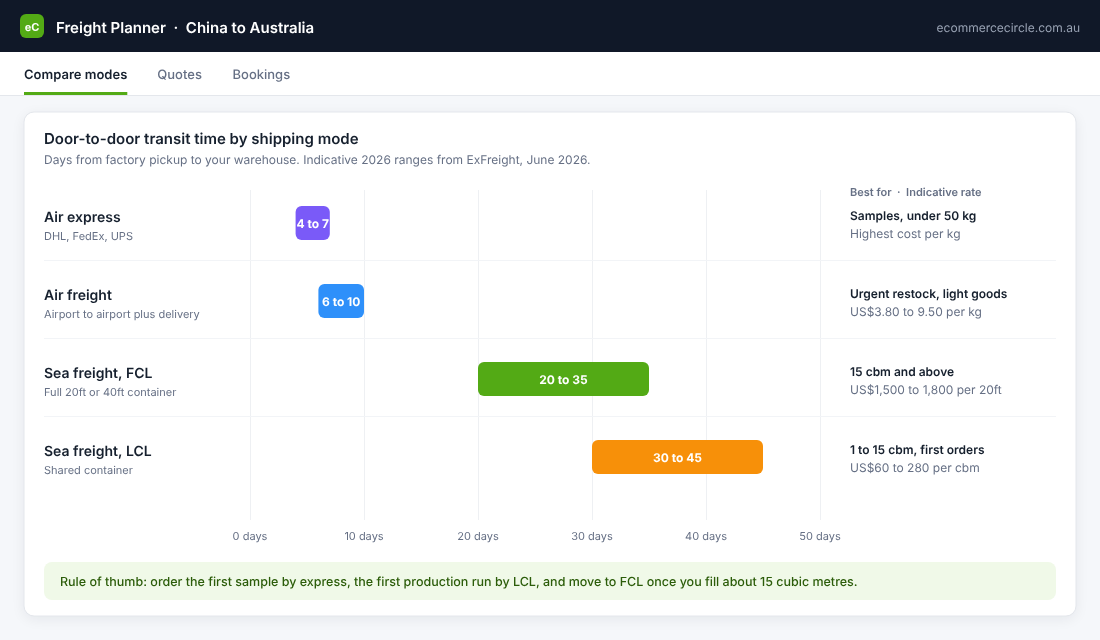
ExFreight’s 2026 guide gives these indicative ranges, and notes that a freight quote is only good for two to three weeks:
| Mode | Door to door | Indicative rate | Use it for |
|---|---|---|---|
| Air express | 4 to 7 days | Highest cost per kg | Samples and parcels under about 50 kg |
| Air freight | 6 to 10 days | US$3.80 to US$9.50 per kg | Urgent restocks of light, high-margin goods |
| Sea, full container (FCL) | 20 to 35 days | US$1,500 to US$1,800 per 20ft | About 15 cubic metres and up |
| Sea, shared container (LCL) | 30 to 45 days | US$60 to US$280 per cubic metre | Most first production orders |
A few rules that save money:
- Air freight is charged on volume as well as weight. Carriers divide cubic centimetres by 6,000 and bill whichever is higher. Bulky, light products like cushions or packaging get expensive fast.
- LCL is slower than a full container. Your cartons wait to be packed into a shared box in China and unpacked again here. Plan on six weeks door to door.
- Peak season adds time. October to December, and the weeks around Chinese New Year, stretch every estimate. If your stock has to land for a sales event, read our inbound freight guide and book early.
Buy FOB and hire your own forwarder
Suppliers quote on different shipping terms, and the term decides who controls your freight.
- EXW (ex works). You collect from the factory door. Cheapest unit price, most work for you.
- FOB (free on board). The supplier gets the goods onto the ship. You take over from there.
- DDP (delivered duty paid). The supplier delivers to your door with everything included.
For a first order, buy FOB and appoint your own Australian freight forwarder and customs broker. DDP looks easy, but the supplier’s agent is usually the importer on the paperwork, which means there may be no import declaration in your name. Without that you cannot claim the GST credit, and you have no visibility of how the goods were declared.
The Border Force itself encourages first-time and infrequent importers to use a licensed customs broker. Ask for an all-in quote that lists the port charges, unpack fees, clearance fee and delivery separately, so you can compare two brokers line by line.
Find and Vet a Supplier Without Getting Burned
The supplier decision matters more than any freight saving. A bad batch costs you the whole order, not 5% of it.
Start on Alibaba, at a trade fair like the Canton Fair in Guangzhou, or through a sourcing agent. Shortlist three to five suppliers and put the same spec sheet in front of each one. Our product sourcing guide covers the vetting questions in detail.
Tool: set up Alibaba Trade Assurance properly
Trade Assurance holds your payment through Alibaba and gives you a path to a refund if the order ships late or fails the agreed quality standard. It only works if you set it up right. Guided Imports’ 2026 breakdown lists the steps and the traps:
- Filter your search to suppliers that offer Trade Assurance.
- Check the supplier’s coverage limit. If your order is US$10,000 and the limit is US$7,500, the most you can recover is US$7,500.
- Write the ship date and the quality requirements into the order in measurable terms. “Good quality” cannot be enforced. “Wall thickness 0.5 mm, plus or minus 0.05 mm” can.
- Pay the deposit through the Alibaba order, never to a bank account sent by email.
- Book a third-party inspection before the goods leave the factory, and hold the balance until it passes.
- If something goes wrong, open a dispute straight away. The supplier gets three days to resolve it before Alibaba steps in.
A common payment structure is 30% deposit and 70% on passing inspection. If a supplier ever emails you “new bank details”, stop and phone them. Our guide to supplier payment fraud explains how that scam works.
How two Aussie brands handle it
Who Gives A Crap makes its toilet paper in China and says so openly. The Melbourne-founded brand explains that no local recycled tissue producer would partner with it, and that Chinese supply chains gave it the materials, plastic-free packaging and flexibility to scale. It keeps a full-time team in China and has every partner independently audited against the amfori BSCI code. The lesson: being upfront about where you make things builds trust, and audits are part of the cost of doing it properly.
frank green takes a split approach. Its sustainability page says products are designed in Australia and “made responsibly in Australia and China”. The lesson: you do not have to choose one country. Many brands keep design and some production local and import the rest.
Compliance: You Are the Manufacturer Now
This is the part new importers skip, and it carries the biggest downside.
Under the Australian Consumer Law, if the overseas maker has no place of business in Australia, the importer is treated as the manufacturer. Product liability and consumer guarantees land on you, not on a factory in Shenzhen.
- Check for a mandatory standard. Products such as items with button batteries, toys for young children, sunglasses and children’s nightwear have mandatory Australian safety standards. Search your product on productsafety.gov.au before you order.
- Get test reports for your batch. A certificate for a similar product from three years ago is not evidence.
- Watch natural materials. Timber, bamboo, seeds and plant fibres, including in the packaging, can trigger biosecurity inspection and treatment costs.
- Keep your records. The Border Force requires import documents to be kept for five years.
Run every new product through our product compliance checklist before you pay a deposit. It is far cheaper than a recall.
Your First Import Order Checklist
Allow about 16 weeks from first enquiry to stock on the shelf when shipping by sea.
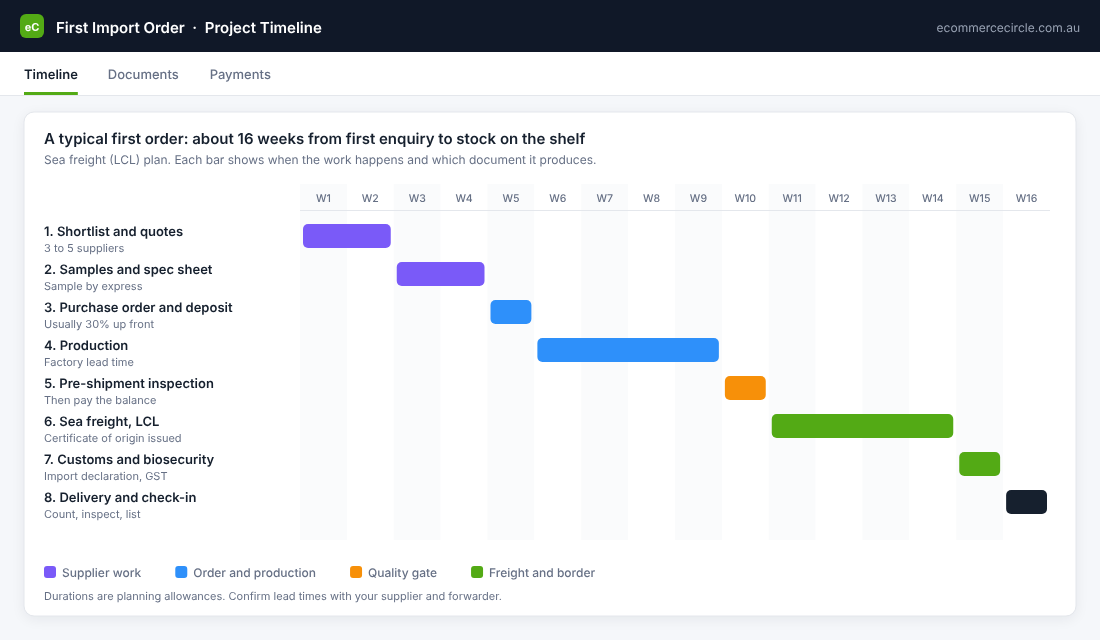
Copy this list into your project tool and tick it off in order:
- Look up the tariff code and duty rate on the DFAT FTA Portal.
- Check for mandatory safety standards and biosecurity conditions.
- Request quotes from three to five suppliers on FOB terms, using one spec sheet.
- Order samples by express and test them hard.
- Get all-in quotes from two Australian freight forwarders or customs brokers.
- Build a landed cost per unit and confirm your margin still works.
- Issue a purchase order that names the ship date, quality tolerances, packaging and the ChAFTA Certificate of Origin.
- Pay the deposit through a protected method.
- Book a pre-shipment inspection and release the balance only when it passes.
- Send your broker the commercial invoice, packing list, bill of lading and certificate of origin before the ship arrives.
- Pay GST and charges, or have them deferred, and file the import declaration with your BAS records.
- Count and inspect on arrival, then update your true unit cost in Shopify.
Frequently Asked Questions
Do I pay duty on goods from China?
Usually not. The general rate is 5%, but ChAFTA has removed tariffs on Chinese-made goods, so the rate is 0% when you hold a valid Certificate of Origin and the product meets its rule of origin.
How much GST do I pay on imports from China?
10% of the customs value plus duty, international freight and insurance. If you are registered for GST and importing for your business, you claim it back on your BAS.
Do I need a customs broker?
Not by law. You can lodge your own import declaration, but the Border Force encourages first-time importers to use a licensed broker, and for most store owners the fee is cheaper than a mistake.
What happens if my shipment is under 1,000 dollars?
There is generally no duty or GST at the border and no import processing charge. The goods clear on a self-assessed clearance declaration, which your courier normally lodges.
How long does shipping from China to Australia take?
About 4 to 7 days by express, 6 to 10 days by air freight, 20 to 35 days for a full container and 30 to 45 days for shared sea freight, door to door.
How the Pieces Fit Together
Importing looks like a pile of separate problems. It is really one chain, and each link protects the next.
The tariff code tells you the duty rate and the rules. The certificate of origin turns that rate into 0%. The FOB terms and your own broker put the import declaration in your name. That declaration gets your GST back. The inspection protects the balance payment. And the landed cost number, built from all of it, protects your margin on every sale.
Miss one link and the others weaken. No certificate, and you pay 5% you never recover. No declaration in your name, and the GST credit is gone. No landed cost, and you price off a number that was never real.
So start with the ten-minute tariff check today, then get two broker quotes this week. Once your first order has landed and you know your true unit cost, the second order is mostly a repeat of the first.
This guide is general information, not tax or legal advice. Confirm duty, GST and compliance for your product with a licensed customs broker and your accountant.
Inside eCommerce Circle, Product is the first of the 10 P’s we work through with every member, because a store cannot out-market a product that costs too much to land. If you want to see exactly where your store is being held back, take the free More Orders Scorecard. It takes two minutes and shows you which of the 10 P’s to fix first. Or if you would like help building your sourcing and pricing plan, start in Connect.