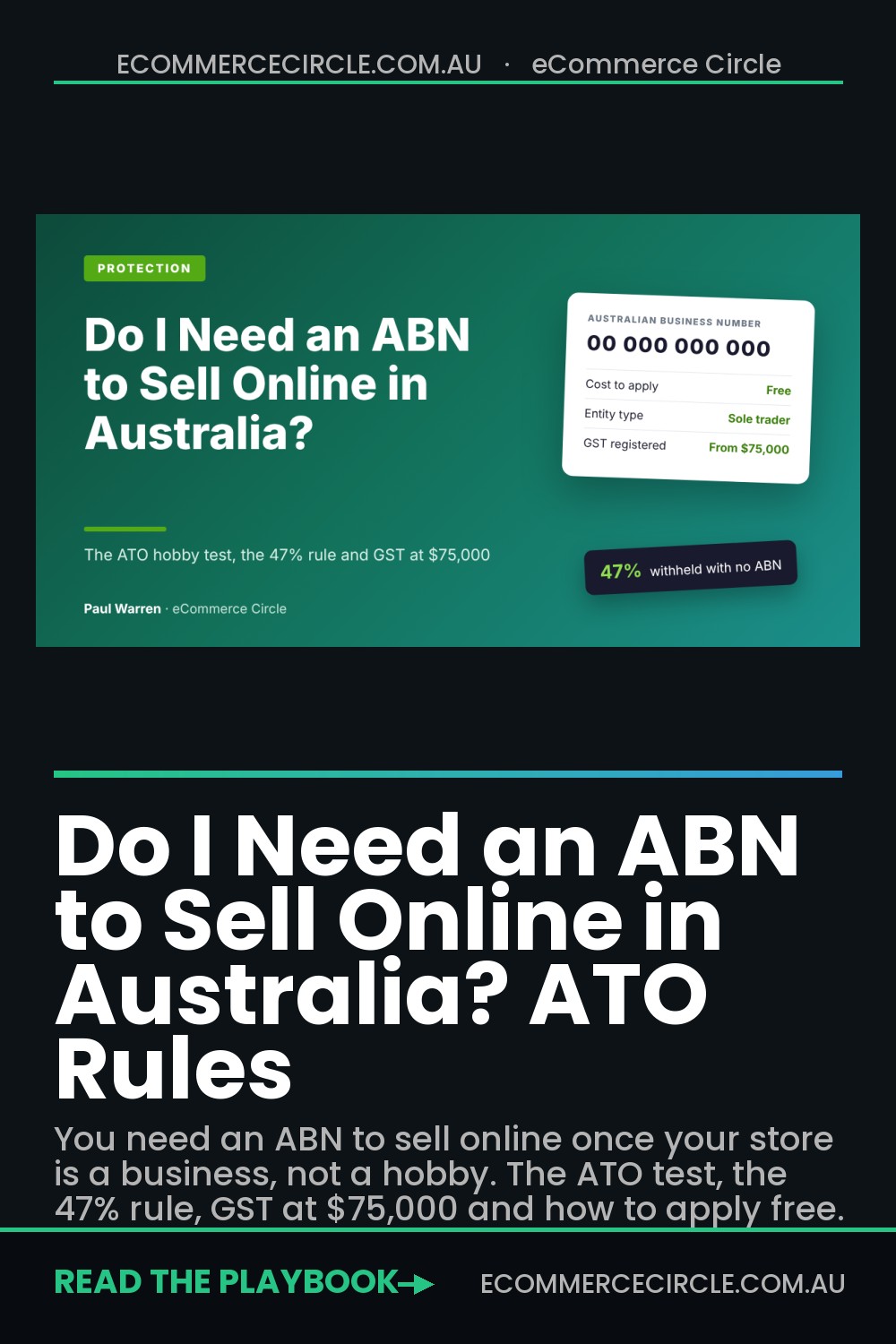
No law makes every online seller hold an ABN. But once your store is a business and not a hobby, you need one in practice: without it, other businesses must withhold 47% of what they pay you, and you cannot register for GST, which becomes compulsory at $75,000 in turnover.
Most new sellers get this wrong in one of two directions. Some grab an ABN the night they open a Shopify trial, before they have anything to sell, and tick boxes on a government form they do not understand. Others trade for two years on “it’s just a hobby” while shipping 40 orders a week, then find out the ATO already had their sales figures.
The sellers who get it right ask one question first: am I running a business? Answer that honestly and the ABN, GST and tax questions mostly answer themselves. This guide gives you the ATO’s test, what really happens without an ABN, what Shopify, eBay, Amazon and Etsy each ask for, and the exact steps to apply. It is general information, not tax advice, so check your own situation with a registered tax agent.
Do You Need an ABN to Sell Online? The Quick Answer
Here is the short version before the detail.
| Your situation | Do you need an ABN? | What to do |
|---|---|---|
| You sell your own second-hand things now and then | No. That is private selling, and a hobby is not entitled to an ABN | Keep basic records in case you are ever asked |
| You make or buy products to resell, regularly, to make a profit | Yes, in practice. You are carrying on a business | Apply free at abr.gov.au and declare the income |
| Your turnover is at or near $75,000 in any 12 months | Yes. You must register for GST, and that needs an ABN | Register within 21 days of reaching the threshold |
| You sell to other businesses (wholesale, corporate gifts) | Yes, or they must withhold 47% of payments over $75 | Put your ABN on every invoice |
| You want a .com.au domain, trade accounts or Shopify Payments as a sole trader | Yes | Get the ABN before you set these up |
An ABN is an 11-digit Australian Business Number issued by the Australian Business Register (ABR). It is free. It is also not a licence to trade and not the same thing as being registered for GST. Those are three separate ideas, and mixing them up is where most of the confusion starts.
Hobby or Business: The ATO Test That Decides It
There is no dollar figure that turns a hobby into a business. Not $1,000, not $18,200, not $75,000. The ATO and business.gov.au both say the same thing: no single factor decides it, and you have to look at the whole picture.
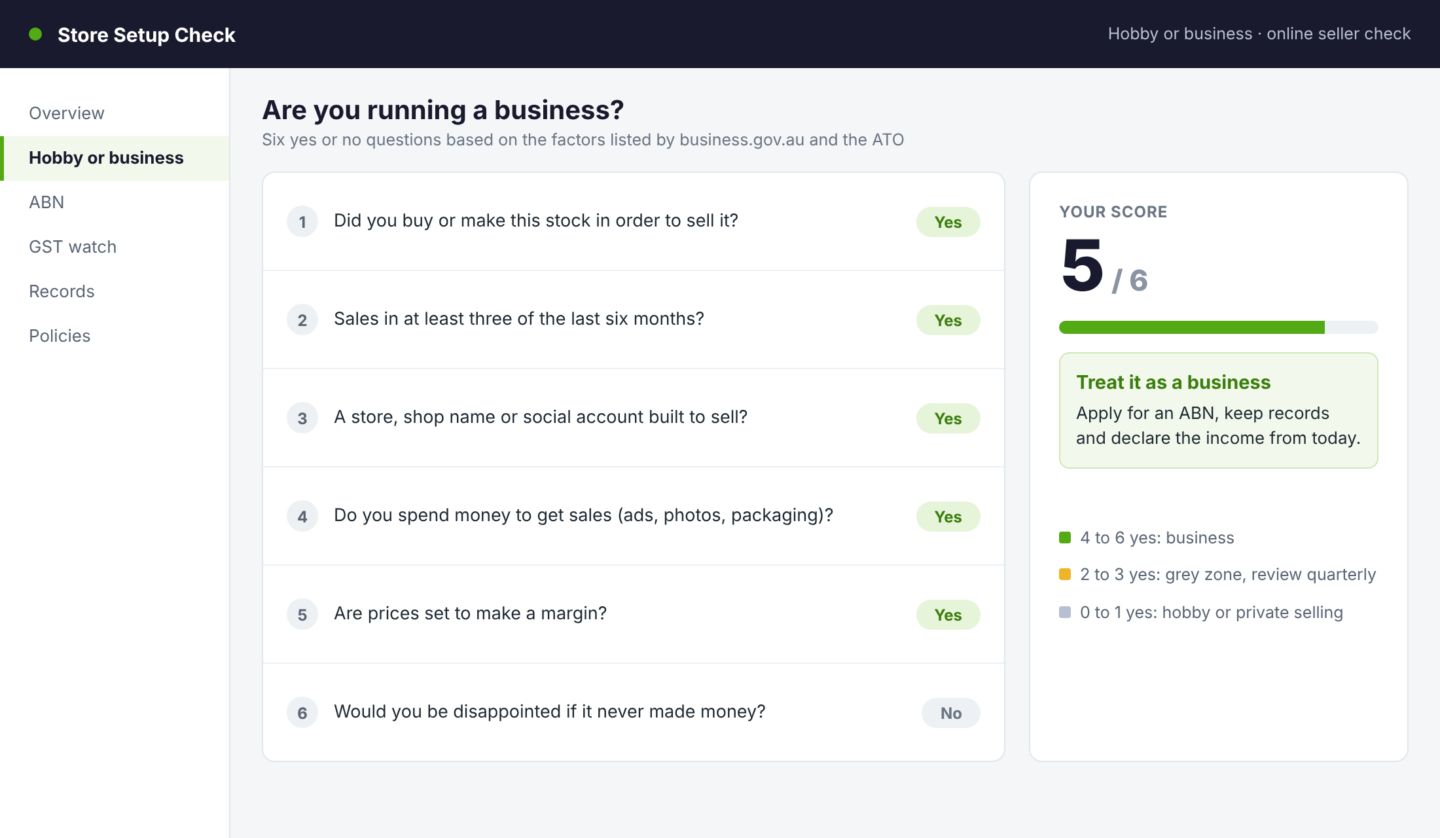
The factors the government lists are:
- Profit intent. You intend to make a profit, or really believe you will.
- A decision to start. You have decided to start a business and done something about it.
- Repetition. You repeat similar activities. Listing new stock every week counts. Clearing out the garage once does not.
- Scale. The size of what you do looks like other businesses in your industry.
- Businesslike conduct. Your activity is planned and organised. Think records, a separate bank account, a registered business name, licences.
In March 2026 the ATO put it bluntly in its small business newsroom: if you regularly earn money from a hobby or side hustle, you may be carrying on a business without realising it.
The 6-question check for online sellers
Answer yes or no to each one.
- Did you buy or make this stock in order to sell it?
- Have you made sales in at least three of the last six months?
- Do you have a store, a shop name or a social account built to sell?
- Do you spend money to get sales (ads, product photos, packaging, samples)?
- Do you set prices to make a margin, not just to get rid of things?
- Would you be disappointed if this never made money?
Four or more yeses: treat it as a business from today. Get the ABN, keep records and declare the income. Two or three: you are in the grey zone, so write down why you think it is a hobby and review it every three months. None or one: it is a hobby or private selling. This check is our own rule of thumb built on the government’s factors, not an official ATO tool.
If you opened a Shopify store, you have almost certainly answered yes to at least four. Nobody pays for a theme, a domain and a payment gateway for a pastime.
Why “it’s only a hobby” cuts both ways
Calling it a hobby feels safer, but look at what you give up. A hobby is not entitled to an ABN, hobby income is not declared, and hobby costs cannot be claimed. A business declares its income, but it also deducts stock, shipping, software, ads and a share of home office costs.
In your first year you might spend $6,000 and sell $4,000. As a hobby that $2,000 is just gone. As a business it is a loss you can usually carry forward, and in some cases offset against other income if you meet the ATO’s non-commercial loss rules. Being a business is often the better tax position for a store that is investing to grow.
What Really Happens If You Sell Without an ABN
Selling to the public without an ABN is not an offence on its own. The pain shows up in five practical places.
- The 47% rule. When a business pays you more than $75 (excluding GST) and you have not quoted an ABN, the ATO says it must withhold 47% of the total payment and send it to the tax office. Land a $2,000 wholesale order from a gift shop and you get $1,060. The other $940 sits with the ATO until you lodge your tax return.
- No GST registration. You cannot register for GST without an ABN. If you pass $75,000 and are not registered, you may owe GST on sales you never charged it on.
- No GST credits. Without registration you cannot claim back the GST on stock, packaging, freight or ad spend.
- Closed doors. Most wholesalers and trade suppliers will not open an account without one. A .com.au domain generally needs an ABN or ACN behind it under auDA’s eligibility rules. Many business bank accounts ask for it too.
- Less trust. Corporate and wholesale buyers check ABN Lookup before they pay a new supplier. No listing often means no order.
Shoppers buying a $60 candle from your site do not withhold anything. The 47% rule only bites on business-to-business payments. That is why a pure direct-to-consumer hobbyist can run for a while without noticing a problem, then hit a wall the first time a retailer wants to stock them.
The one form that helps real hobbyists
If you truly are a hobbyist and a business wants to pay you, give them the ATO’s Statement by a supplier form (NAT 3346). It tells the payer your sale is a private recreational pursuit or hobby, so they do not need to withhold. The same form covers sellers under 18 who are paid no more than $350 a week. Do not sign it if you are really running a business. It is a written statement to the tax office.
What Shopify, eBay, Amazon and Etsy Ask For
Each platform has its own sign-up rules, and none of them decides your tax position. Passing a sign-up form without an ABN does not mean the ATO agrees you are a hobby.
| Platform | Can you sell without an ABN? | What changes with an ABN |
|---|---|---|
| Shopify | Yes. Shopify Payments has an “Individual” business type for single-person sellers with no ABN | Sole trader, partnership and company types all require an ABN. Add it in billing and Shopify stops charging 10% GST on your subscription and shipping labels once you are GST registered |
| eBay Australia | Yes, as an individual seller with photo ID | Business accounts must give an ABN, ACN or ARBN plus business details |
| Amazon Australia | Amazon’s own guide says “most likely, yes” you need one to sell online | Needed for GST registration and for business selling in general |
| Etsy | Yes. Etsy does not require an ABN to open a shop | Lets you run the shop as a business and register for GST when you need to |
Shopify’s help centre is specific on this. If you do not have an ABN, you must select the Individual business type, described as single-person businesses “doing business privately”. The moment you pick sole trader, it asks for your ABN, registered business name, business phone and address.
That Individual option is a starting point, not a place to stay. If you later move from Individual to sole trader, or from sole trader to a company, Shopify Payments has to be re-verified. Our guide to choosing a business structure for a Shopify store covers when each switch makes sense and what breaks when you make it.
If you are still weighing up where to sell, our Etsy vs Shopify comparison runs the fees on both.
The ATO Can Already See Your Online Sales
The old logic was “nobody will know”. That stopped being true years ago, and it is less true every year.
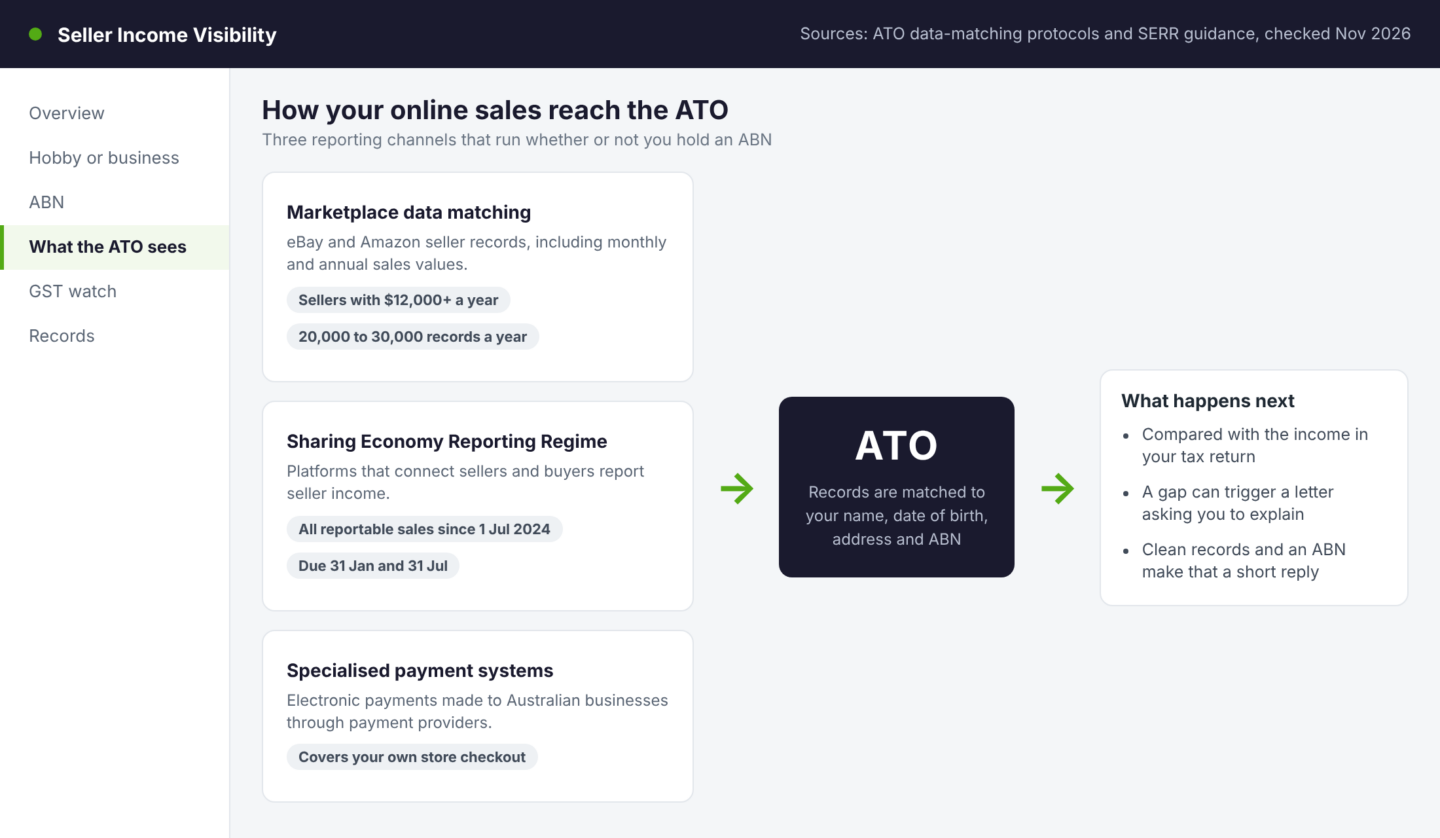
- eBay and Amazon data matching. Under its online selling data-matching program, the ATO collects records for sellers with $12,000 or more in annual sales. The program covers the 2018-19 to 2025-26 financial years and pulls about 20,000 to 30,000 account records a year. The data includes your name, date of birth, address, ABN, and monthly and annual sales counts and values.
- The Sharing Economy Reporting Regime. Since 1 July 2024, platforms that connect sellers with buyers must report seller income to the ATO twice a year: by 31 January for July to December, and by 31 July for January to June.
- Payment systems. The ATO also runs a data-matching program on electronic payments made to Australian businesses through specialised payment systems, so sales through your own checkout are not invisible either.
Crossing $12,000 on a marketplace does not make you a business by itself. It does make you far more likely to get a letter asking you to explain. A seller with an ABN, clean records and declared income answers that letter in ten minutes. A seller with none of those has a much longer month.
ABN and GST Are Two Separate Triggers
This is the mix-up we see most often. Getting an ABN does not mean you charge GST. Plenty of small stores hold an ABN for years and never register for GST.
| ABN | GST registration | |
|---|---|---|
| When | From the day you start a business | When GST turnover reaches $75,000, or earlier by choice |
| Cost | Free | Free |
| Deadline | None, but get it before you trade | Within 21 days of reaching the threshold |
| What it changes | You can quote it, invoice businesses and register for other taxes | You add 10% GST to prices, claim GST credits and lodge a BAS |
The ATO’s GST registration rules have two details that catch online stores.
It is turnover, not profit. GST turnover is your gross business income, less GST. A store with $80,000 in sales and $3,000 in profit is over the line.
It is a rolling 12 months, not a financial year. You test the current month plus the previous 11, and also the current month plus the next 11 you expect. A store averaging $6,500 a month crosses $75,000 in month 12, even though no single month looked big.
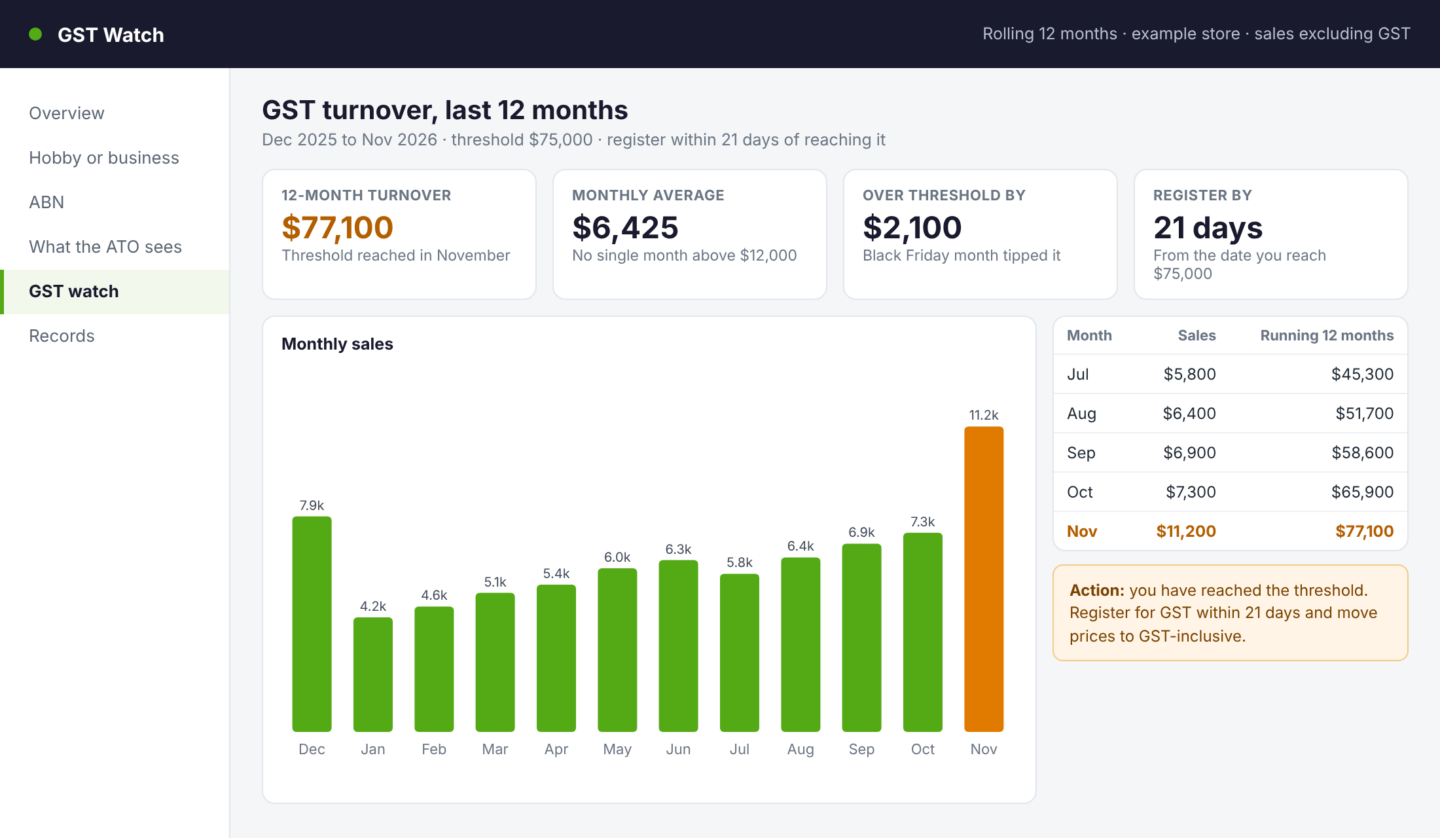
Miss it and the ATO says you may have to pay GST on sales made since the date you should have registered, even if you never added GST to your prices. That is one eleventh of every sale, straight out of your margin, plus possible penalties and interest. November and December are when most stores cross, because one good Black Friday can add two months of normal turnover in a week.
So check the number monthly. Add up the last 12 months of sales in Shopify Analytics on the first of each month. If the total is past $60,000 and climbing, start planning your GST-inclusive prices now, not in the week you cross. Our ecommerce tax guide to GST, BAS and deductions walks through what changes once you register.
How to Get an ABN: 15 Minutes and No Cost
Applying is free on the government’s site. Third-party sites that charge a fee to “lodge” it are filling in the same form for you.
- Pick your structure first. Most new stores start as a sole trader. It is free, there is no separate tax return for the business, and your ABN sits against your own tax file number. A company costs $636 to register with ASIC from 1 July 2026 and needs its own ABN.
- Gather your details. You need your tax file number, legal name, date of birth, address, the date your business started or will start, and a description of your main activity. “Online retail” plus your product type is enough.
- Apply at abr.gov.au. Go to the Australian Business Register and choose “Apply for an ABN”. The form asks questions about whether you are entitled to one, so answer for what you are doing now, not what you hope to do in three years.
- Save the confirmation. The ABR says successful applications receive the 11-digit ABN immediately. If you get a reference number instead, your application is under review, with a target of 20 business days.
- Register your business name. If you trade under anything other than your own name, register it with ASIC. From 1 July 2026 that costs $47 for one year or $108 for three.
- Check your listing. Search your number on ABN Lookup (abr.business.gov.au). This is what suppliers and wholesale buyers will see. For a sole trader it shows your legal name, state and postcode, so know that before you hand the number out.
Two warnings. Not everyone is entitled to an ABN, and the ABR says applying when you are not entitled can lead to prosecution. And an ABN is not set-and-forget: if you stop trading or change structure, update or cancel it. The ABR also cancels ABNs that show no sign of business activity.
You are not alone in doing this. Lawpath’s New Business Index, built on ABR data, counted 115,934 new ABN registrations in June 2026 alone, up 7.83% on June 2025, with sole traders the biggest driver of growth.
Add your ABN to Shopify
Once you have the number, put it to work inside your store.
- Payments. Go to Settings, then Payments, and complete or update your Shopify Payments business details as a sole trader with your ABN.
- Billing. Once you are registered for GST, go to Settings, then Billing, then Billing profile. In the Tax registration section confirm you are GST registered, enter your ABN and click Add ABN. Shopify’s help centre notes the GST exemption only applies to invoices issued after you add it, so do not leave it for later.
- Invoices and footer. Add the ABN to your invoice template, your wholesale price list and your store footer. If you are GST registered, customers can ask for a tax invoice on sales over $82.50 including GST, and it must show your ABN.
Your After-the-ABN Setup Checklist
Getting the number is step one. These seven jobs are what make you look, and run, like a business. Copy the list and tick it off this week.
- Open a separate bank account. One account for the store, nothing personal through it. It is the single easiest way to prove what is business and what is not.
- Start a bookkeeping file. Xero or a similar tool connected to Shopify, or a simple spreadsheet if you are tiny. Record every sale and every cost from day one.
- Keep records for five years. Supplier invoices, platform statements, bank statements and receipts.
- Set a GST watch. A recurring calendar entry on the first of each month: add up the last 12 months of sales and compare it to $75,000.
- Put tax aside. Move a fixed share of profit into a separate savings account every month so the tax bill is not a shock. Ask your tax agent what share suits your income.
- Update your store policies. Add your ABN and legal entity name to your terms, privacy policy and contact page.
- Book a tax agent before 30 June. One hour early in the year is cheaper than fixing two years of guesses later.
If you are starting from zero, our step-by-step guide to starting an online store in Australia puts these jobs in order alongside the product, platform and launch steps.
ABN Questions Online Sellers Ask
Do I need an ABN to sell on Shopify?
Shopify does not require one to open a store, and Shopify Payments has an Individual option with no ABN. But if your store is a business, get one. You need it for the sole trader set-up, for GST and for almost every supplier you will deal with.
Do I need an ABN for dropshipping?
The same test applies. Dropshipping is buying to resell for profit, repeatedly, through a store built for it, which makes it a business from the first order. Our dropshipping in Australia guide covers the margins and the consumer law side.
Is there an income limit before I need an ABN?
No. There is no minimum. The $75,000 figure is the GST threshold, not an ABN threshold, and the $18,200 tax-free threshold is about how much income tax you pay as an individual, not whether you are in business.
Do I pay tax if I earn under $18,200?
As a sole trader your store profit is added to your other income, such as wages. If your total taxable income for the year is under $18,200 you generally pay no income tax, but you still need to lodge a return and declare the business income.
Can I get an ABN before I make a sale?
Yes, if you have taken real steps to start, such as buying stock, building the store or registering a business name. The ABR may ask you to show those steps.
Does having an ABN mean I have to charge GST?
No. You only charge GST once you are registered for it, which is compulsory at $75,000 in GST turnover and optional before that.
How the Pieces Fit Together
Treat these as one chain and the whole topic gets simple.
The hobby or business test decides whether you need an ABN. The ABN lets businesses pay you in full, opens supplier and wholesale doors, and is the ticket to GST registration. Your rolling 12-month turnover decides when GST starts. And the records you keep from day one are what let you answer any ATO letter, claim every deduction and know your real margin.
Skip the first link and every later one gets harder. Sellers who call a real business a hobby miss deductions in the lean years, get 47% held back on their first wholesale order, and reach $75,000 with no GST built into their prices.
So do the six-question check today. If you land on four or more, apply for your ABN this week, open the separate bank account and set the monthly GST watch. It is a few hours of admin, once, and it is the difference between a store you can grow and one you have to keep quiet about.
Inside eCommerce Circle, Protection is one of the 10 P’s we work through with every member, because a store with shaky foundations cannot scale safely. If you want to see exactly where your store is being held back, take the free More Orders Scorecard. It takes two minutes and shows you which of the 10 P’s to fix first. Or if you would like help setting your store up properly, start in Connect.