Your product sells fine on your own Shopify store. Then one of three emails lands. A wholesale buyer asks for your “GTINs and carton barcodes”. Google Merchant Center flags half your catalogue with “limited performance due to missing value: GTIN”. Or Amazon rejects a listing with error 5461 because the number you typed does not match anything in the GS1 database.
What’s in This Article
Most Aussie founders handle that moment badly. They buy a $30 barcode from a reseller, or they paste a made-up 13-digit number into the Shopify barcode field just to make the warning go away. Both choices work for about six months. Then a retailer says no, a marketplace suppresses the listing, and you are reprinting packaging you already paid for.
The brands that get ranged, get listed and get scanned first time treat the barcode as a product asset, not an admin chore. They own one GS1 company prefix, they allocate one GTIN per sellable variant, and they load the same number into Shopify, Google, Amazon and their wholesale line sheet. That is the whole system. This playbook walks through the five steps, with the 2026-27 GS1 Australia prices, the Shopify settings and the 2027 change to the barcode itself that most brands have not heard about yet.
Why the Barcode Field Stopped Being Optional
A barcode is a picture of a number. The number is the Global Trade Item Number, or GTIN, and in Australia it is almost always the 13-digit EAN-13 you see on every supermarket shelf. GS1 is the not-for-profit that issues them. More than 10 billion GS1 barcodes are scanned globally every day, across more than 1 billion listed products, and GS1 Australia has connected over 71,000 Australian companies to that system since 1979.
For a DTC brand, four channels now ask for that number, and each one punishes you differently when it is missing or wrong:
- Google Shopping. Google’s own product spec says products with missing or incorrect GTINs “may have limited visibility”, and Australia is on the list of countries where the mandatory GTIN rules apply for products that have one. Free listings and Performance Max both lean on the GTIN to match your product to the right search.
- Amazon Australia. Amazon states in Seller Central that it verifies product identifiers by checking the GS1 database, and that numbers that do not match GS1’s record are treated as invalid. Brand Registry listings are checked the same way.
- Major retailers. Woolworths requires suppliers to be GS1 members and runs its supplier product data through GS1’s National Product Catalogue, which needs a GTIN on every item. Coles, IGA and Metcash accept GS1 numbers and often ask for a barcode verification report before ranging.
- Your own POS and 3PL. Shopify POS scans the barcode field to find the variant. Your 3PL scans it to pick the right SKU. A missing barcode is a manual lookup every single time, and manual lookups are where mis-picks come from.
Over 75% of GS1 Australia’s customers are small businesses. This is not a big-brand system that you graduate into later. It is the entry ticket, and it costs less than a month of your email app.
Step 1: Pick the Membership That Matches Your SKU Count
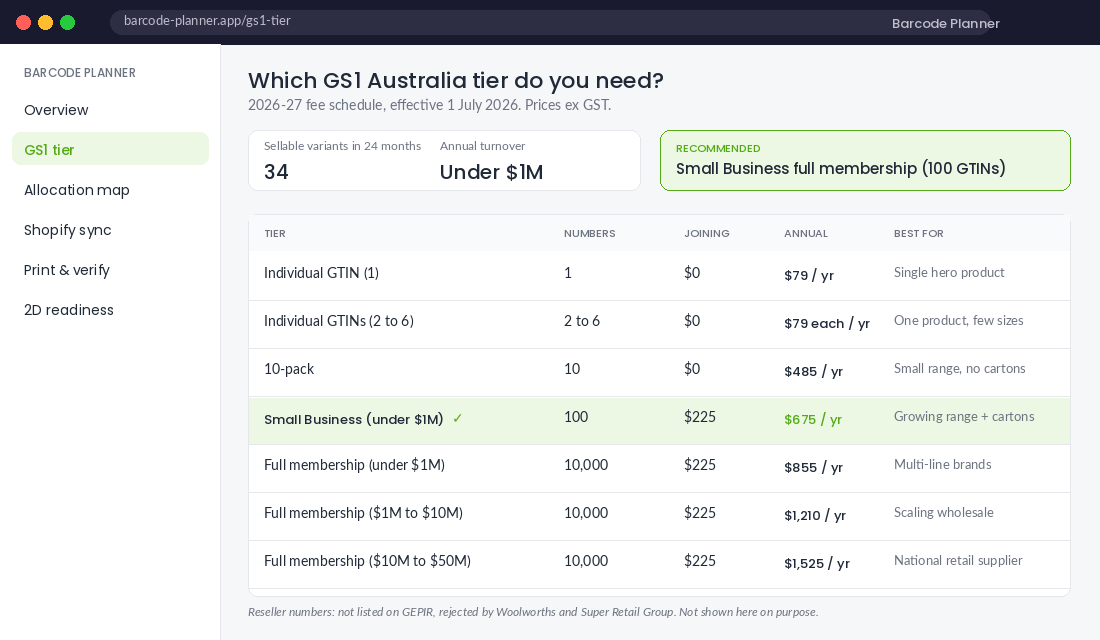
GS1 Australia’s fee schedule changed on 1 July 2026, and the numbers below are from that schedule. All prices are ex GST, and annual fees are pro-rated monthly, so joining in September costs about 83% of the July price.
- Individual barcode numbers (turnover under $1M). No joining fee. $79 per GTIN per year for one to six numbers, or $485 a year for a 10-pack. This is the right tier if you have one hero product in a couple of sizes.
- Small Business full membership (turnover under $1M, 100 numbers). $225 joining fee, then $675 a year. You get your own GS1 company prefix, which is what retailers and Amazon look up.
- Full membership, 10,000-number range. $225 joining fee, then $855 a year under $1M turnover, $1,210 for $1M to $10M, and $1,525 for $10M to $50M. Under $50M turnover you get an 8-digit company prefix with 10,000 GTINs to allocate.
Here is the decision rule we use with eCommerce Circle members. Count every sellable variant you expect to have in 24 months, not today. A skincare brand with 6 products in 2 sizes is 12 GTINs now, and probably 30 after the next two launches. That brand should skip the 10-pack and go straight to the 100-number Small Business membership, because it also needs carton-level GTINs the moment a wholesaler asks for them, and those come out of the same allocation.
Now the trap. Barcode resellers sell numbers for a one-off fee with no annual licence. They are cheap because the numbers came from prefixes issued to someone else years ago, and GS1 does not maintain the record for them. Even the resellers admit the limits: one Australian reseller’s own comparison page says Woolworths and Super Retail Group will not accept third-party numbers, that resellers cannot list you on GS1’s GEPIR database, and that this can block Amazon Brand Registry. The same page tells the story of a founder who bought reseller codes for a Woolworths launch, found out the retailer needed a GS1 certificate, and reprinted his packaging. Buy the licence. It is the cheapest insurance in your business.
Setup: joining GS1 Australia online (about 15 minutes).
- Go to gs1au.org and choose Join GS1. Have your ABN, company details and a turnover figure ready.
- Choose the tier from the list above. Pay by card to get your numbers instantly, rather than posting a form and waiting two business days.
- Log in to the MyGS1 portal. Your company prefix and your unallocated number range are sitting there.
- Download your GS1 membership certificate as a PDF. Woolworths asks new vendors for a letter confirming current membership, and buyers at other retailers will ask for the same thing.
- Diarise the renewal month. A lapsed licence is technically an unlicensed number, which is exactly what Amazon’s GEPIR check is looking for.
Step 2: Build the GTIN Allocation Map Before You Assign a Single Number
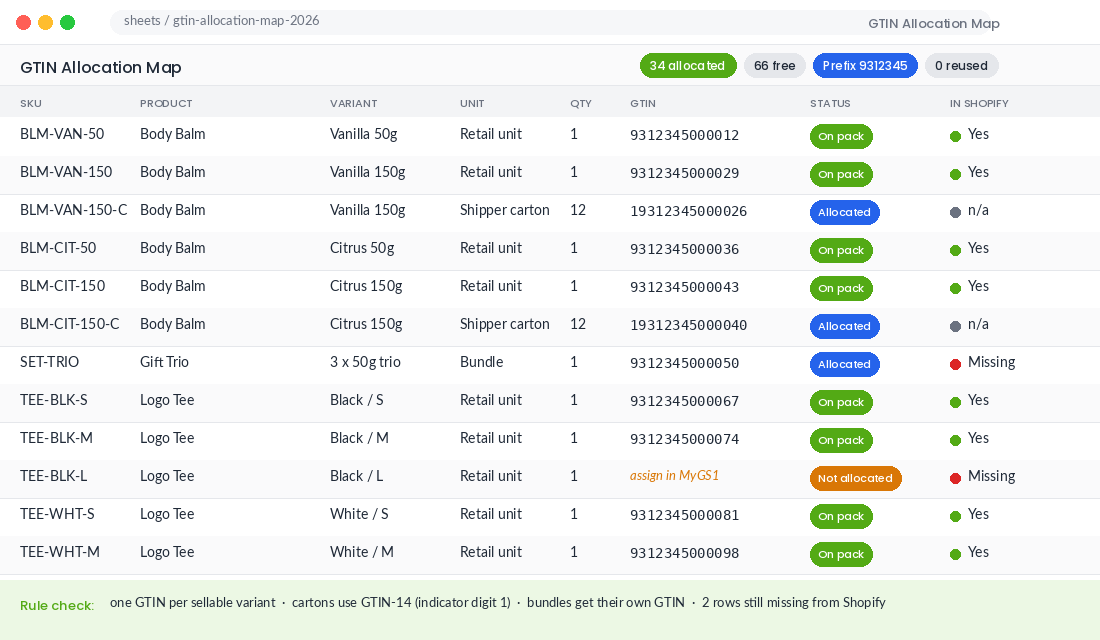
This is where most brands go wrong, and it is a spreadsheet problem, not a barcode problem. GS1’s rule is simple: every product a shopper could pick up and buy separately needs its own GTIN. Google says the same thing in its feed spec, and it names colour and size specifically. A tee in three colours and five sizes is 15 GTINs, not one. If you have already built clean variant structures, our Shopify variant architecture playbook gives you the exact SKU logic to mirror here.
Build one sheet with these columns and fill it in before you touch MyGS1: internal SKU, product name, variant (colour, size, scent), unit type (retail unit, inner pack, shipper carton), quantity per unit, GTIN, and status (allocated, on packaging, live in Shopify). The GTIN column stays empty until the rest of the row is locked.
Then apply these allocation rules, which are the ones GS1 Australia publishes in its GTIN-13 guide:
- One GTIN per sellable variant, forever. Never reuse a number for a different product, even after you discontinue the original. Retail systems remember the old item.
- A new GTIN for a meaningful change. New size, new formulation, new pack count or a new claim on the pack all need a new number. A colour tweak on the label does not.
- Cartons get their own number. If the carton itself is never sold at a checkout, assign a GTIN-14 (the 13-digit retail number with an indicator digit in front). If a retailer might sell the whole carton, it needs a full GTIN-13 of its own.
- Bundles you create need a bundle GTIN. A gift set of three existing products is a new trade item. Google’s feed spec asks for the bundle’s own GTIN, not the components.
- The check digit is calculated, not chosen. The 13th digit is derived from the first 12. MyGS1 generates it for you, and GS1’s free check digit calculator lets you verify any number you are handed by a supplier.
One useful fact for reading numbers: Australian GS1 prefixes start with 93. That first pair of digits tells you where the number was licensed, not where the product was made, which is why “made in Australia” claims have nothing to do with the barcode.
Step 3: Load Every GTIN Into Shopify the Way the Channels Expect
Shopify has exactly one place for this: the Barcode (ISBN, UPC, GTIN, etc.) field in the Inventory section of each variant. It is a variant-level field, so a product with 15 variants needs 15 entries, and the fastest way to do that is a CSV export, a VLOOKUP against your allocation sheet, and a re-import.
Two Shopify changes this year make the field worth more than it used to be. Since 1 September 2026, Shopify POS v11.14 can find a variant from any barcode associated with it, and you can now attach up to 20 barcodes to a single variant. That means the retail EAN-13, the Amazon FNSKU and a supplier’s own code can all sit on one variant, and a staff member scanning any of them at a market stall or pop-up gets the right item. Keep the GS1 GTIN as the primary barcode and treat the others as aliases.
Here is how the field flows out to each channel, and what to check:
- Google and YouTube channel. The Shopify barcode field maps to the gtin attribute in your Merchant Center feed automatically. Pair it with a brand value and, for private-label products, an MPN. If a product has no GTIN because you are the only maker, leave the field empty rather than inventing one. Google’s spec is explicit: a fake or restricted-range number gets the product flagged. Our Google Shopping feed playbook covers the rest of the feed audit.
- Amazon. The brand name on your GS1 record, your Amazon Brand Registry and your listing must match character for character. “Bondi Beach Co” versus “Bondi Beach Co Pty Ltd” is enough to throw a 5461 error. Check gepir.gs1.org before you list, because if GEPIR does not resolve your number, Amazon will not either. The Amazon Australia playbook has the listing sequence.
- Wholesale line sheet and 3PL. Export product title, SKU, GTIN, carton GTIN, units per carton and carton dimensions as one CSV. That file is what a buyer’s category team and your 3PL’s WMS both want, and it comes straight out of the allocation sheet from Step 2.
Setup: printing labels from Shopify (Retail Barcode Labels app, free). Stocky was retired on 31 August 2026, so if you were using it for labels, this is the replacement.
- Install Retail Barcode Labels from the Shopify App Store. It reads the barcode field on each variant, so finish Step 3 first.
- Create a template. The app supports Avery sheets for an office printer, and Dymo and Zebra roll printers. For a 3PL or retailer, print the GTIN in EAN-13 format with the human-readable digits underneath.
- Select products or an inventory transfer, choose the quantity per variant, and print from a desktop browser. The app cannot print from the POS app itself, and the Zebra ZD421 needs a computer connection rather than an iPad.
- Scan one label from each batch with the POS app before you apply the rest. A label that scans on the first try is the only kind worth sticking on 500 units.
Step 4: Print It, Test It and Pass the Scan Before Packaging Goes to Print
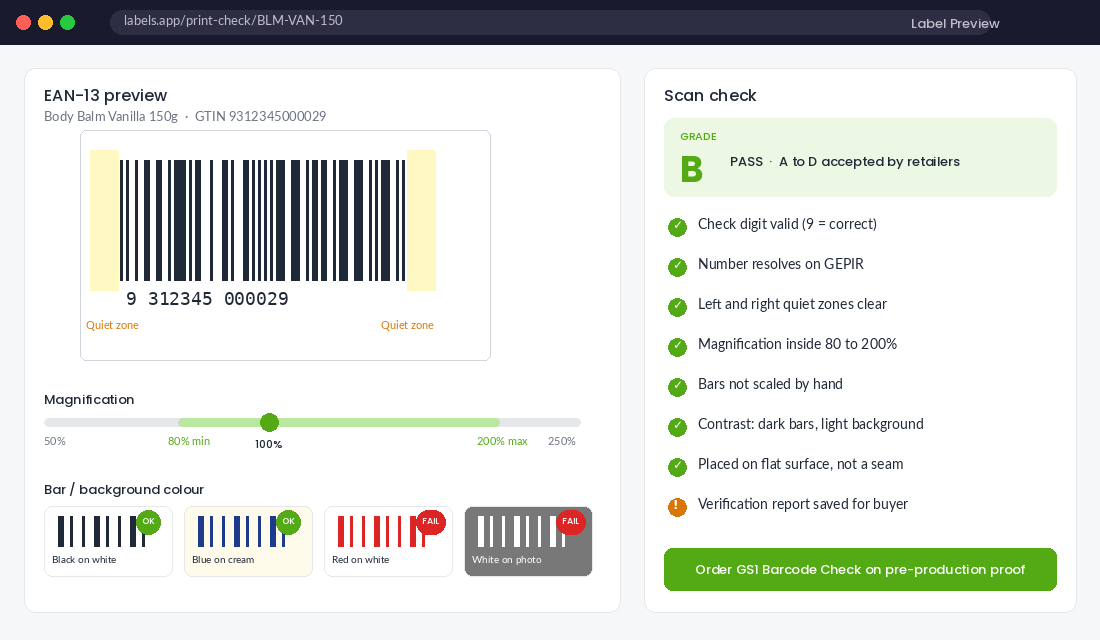
A valid number on an unreadable barcode is still a rejected product. Retailers only accept barcodes that scan first time, and the reasons a barcode fails are boringly predictable. Give your packaging designer these five rules and you will avoid nearly all of them:
- Magnification between 80% and 200%. The nominal EAN-13 is 37.29mm wide by 25.93mm high. Smoother substrates can go smaller, rough kraft and corrugated need bigger. GTIN-8 exists for tiny items like lip balm, but you have to apply for it.
- Quiet zones on both sides. The blank margin left and right of the bars is part of the symbol. Designers who crowd it with the recycling logo create a code that scans one time in three.
- Dark bars on a light background. Black on white is the safe default. Blue or dark green bars on white, cream or yellow also work. Red bars, metallic inks and bars printed over a photo do not, because retail scanners read red as white.
- Never scale the bars by hand. Stretching a barcode image in Illustrator changes the bar-to-space ratio and kills the read. Generate the image at the size you need from MyGS1 or your label software.
- Put it where the scanner can reach it. Flat surface, not across a seam, fold or curve tighter than a soft-drink can, and not on the base of a heavy item that staff will not lift.
Then get it verified. GS1 Australia’s Barcode Check service tests a physical sample of your printed packaging and grades it A to F, with A to D as a pass. You get a verification report per line. Woolworths treats Barcode Check as mandatory, and most other majors will ask for the report before they range you. Do this on the pre-production proof, not on the first pallet, because a fail on 5,000 printed cartons is a very expensive lesson.
If you are on the wholesale path, plan for GS1’s National Product Catalogue at the same time. Woolworths runs supplier item and pricing data through it, and it needs a GTIN on every product you load. The brands that treat NPC as a data-entry surprise after the buyer says yes are the ones that miss the ranging window. Read our wholesale channel playbook for how the rest of the buyer conversation runs.
Step 5: Get Ready for the 2027 Switch to 2D Barcodes
The barcode you have used your whole life is being upgraded, and the deadline is public. GS1’s Sunrise 2027 initiative sets the end of 2027 as the date by which retail point-of-sale systems worldwide aim to scan 2D barcodes, meaning QR codes and Data Matrix symbols built to the GS1 Digital Link standard. A 2D code still carries the GTIN, so the checkout works the same, but it can also carry batch, best-before, a serial number and a web link, all in one square.
This is not a distant overseas project. Woolworths started piloting 2D codes on meat, produce and ready meals in 2023, and by late 2025 meats and fresh salads were almost completely transitioned. Woolworths reports more than 10 million 2D codes scanned per week and food waste reductions of up to 40%, because the checkout can read the expiry date inside the code and block an out-of-date sale. GS1 Australia says the major supermarket groups are working toward full dual-read scanners by 2027, Coles has a pilot underway and Aldi is rolling 2D out country by country.
What should a DTC brand actually do about it this year? Three things, none of which cost extra, because GS1 Australia includes 2D codes in every membership tier:
- Dual-mark your next packaging run. Keep the EAN-13 for every scanner that exists today, and add a GS1 Digital Link QR code next to it. That is what manufacturers supplying the majors are already doing during the transition.
- Point the QR somewhere useful. A GS1 Digital Link resolves to a web page you control. Use it for care instructions, a reorder link with a returning-customer discount, a review request or a how-to video. This is the first time the barcode has been a marketing surface, and most brands will waste it on a homepage link.
- Put batch and best-before in the code if you sell consumables. Recall management gets dramatically simpler when the code on the pack identifies the batch, and Matthews Australasia notes that product fraud costs Australian industry an estimated $2 billion to $3 billion a year, which is a big part of why retailers want traceable codes.
Carrefour in Europe already prints GS1-powered QR codes on 148 million bottles of wine a year that scan at the checkout. The first small retailer in the world to go fully 2D was a deli in Brazil, and it cut waste by 50% inside two months. The technology has stopped being a big-company thing.
The Compound Effect: One Number, Every Channel
Look at what the five steps do together. Step 1 gives you a licensed prefix that Amazon’s GEPIR check and Woolworths’ vendor onboarding both recognise. Step 2 turns that prefix into a clean map where every variant, carton and bundle has exactly one number. Step 3 puts that number in the one Shopify field that feeds Google, POS, your 3PL and your line sheet. Step 4 makes sure the printed symbol scans first time so none of that data is wasted at the checkout. Step 5 future-proofs the pack for the scanners that will be in every major supermarket by 2027.
Miss one step and the others leak. A clean allocation map with reseller numbers still gets rejected at Woolworths. A licensed GTIN that never made it into the Shopify barcode field still shows as “limited performance” in Merchant Center. A perfect feed with a barcode printed in red ink still fails the scan. The system only pays when it is complete, and the whole thing costs a few hundred dollars and an afternoon.
The upside is real money. Google gets to match your listing to the exact product a shopper searched for. Amazon stops fighting you on every new ASIN. A buyer at a major retailer sees a supplier who already has verification reports and NPC-ready data, which moves you from “come back when you’re bigger” to “send me the line sheet”. And your own team stops doing manual lookups at the pick bench and the market stall.
Your Barcode Readiness Checklist
Run through this before your next packaging print run or wholesale pitch. Every line is a yes or a no.
- Licence. We hold a current GS1 Australia membership under our own company name, and the certificate PDF is saved where the whole team can find it.
- Tier. Our tier covers every variant, carton and bundle we expect to have in 24 months, with headroom.
- Allocation map. One spreadsheet lists every sellable unit with its SKU, GTIN and status, and no GTIN has ever been reused.
- Cartons and bundles. Shipper cartons carry GTIN-14s, and every gift set has its own retail GTIN.
- Shopify. Every variant’s barcode field holds its GS1 GTIN as the primary barcode, with marketplace or supplier codes added as extra barcodes.
- Channel match. The brand name on GS1, Amazon Brand Registry and the Shopify product matches exactly, and every GTIN resolves on GEPIR.
- Print spec. Packaging artwork uses 80% to 200% magnification, protected quiet zones and dark bars on a light background, generated at size rather than scaled.
- Verified. Each new line has a GS1 Barcode Check report graded A to D from the pre-production proof.
- Retail data. If we are pitching a major, our National Product Catalogue data is loaded and matches the physical pack.
- 2027. The next packaging run carries a GS1 Digital Link QR alongside the EAN-13, and the link resolves to a page we control.
Inside eCommerce Circle, getting the product itself ready to travel beyond your own store is one of the core pillars we work on with every member, and the barcode is the least glamorous part of it. If you want to see exactly where your store is being capped, take the free More Orders Scorecard. It takes two minutes and shows you which of the 10 P’s to fix first.