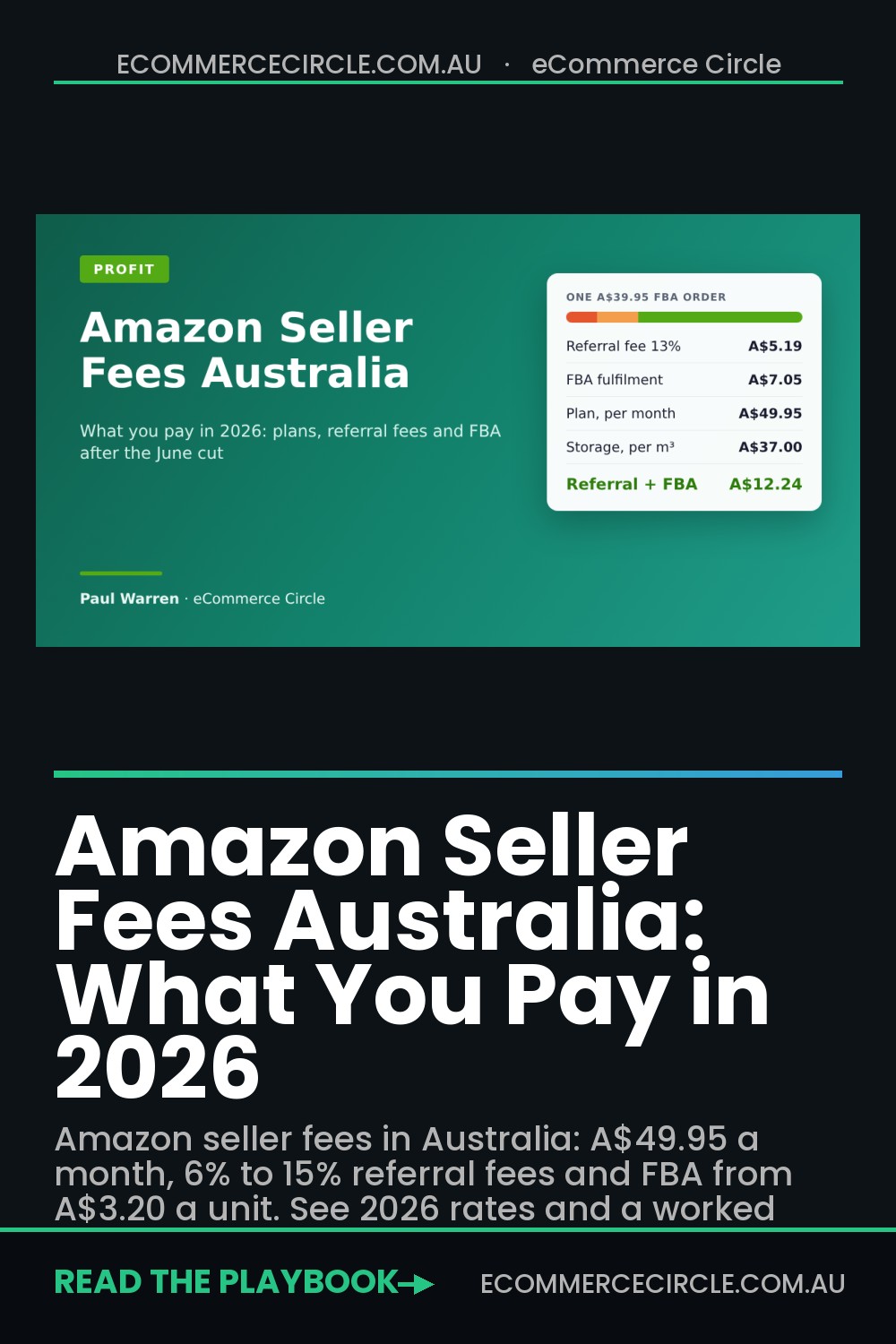
Amazon seller fees in Australia come in three layers: a selling plan (A$0.99 an item or A$49.95 a month), a referral fee of 6% to 15% of each sale, and a fulfilment fee if Amazon ships for you, which starts at A$3.20 a unit. On a typical A$39.95 product sent through Fulfilment by Amazon (FBA), that comes to A$12.24 an order before ads, or about 31% of what the buyer pays.
Most store owners carry one number in their head: “Amazon takes 15%”. That number is wrong for most categories, and it leaves out the bigger fee. On a product under A$50, the FBA fulfilment fee is usually larger than the referral fee. And since 10 June 2026, that fulfilment fee changes with your selling price, so a 5 cent price move can cost you more than a dollar a unit.
The brands that make Amazon pay treat it like any other channel with a known cost. They work out the fee stack for each product before they send a single carton, and they price around the fee bands. This guide gives you every current rate, a worked order, the two price cliffs to avoid and a 20-minute audit. All rates were checked against Amazon Australia’s pricing page and Seller Central help pages on 17 November 2026. Amazon quotes its fees excluding GST, and so does this guide.
Amazon Seller Fees in Australia: The Short Answer
These figures come from Amazon Australia’s seller pricing page and the Seller Central help articles linked through this guide.
| Fee | What you pay | When it is charged |
|---|---|---|
| Individual selling plan | A$0.99 per item sold | On each sale |
| Professional selling plan | A$49.95 a month | Monthly, while you have active listings |
| Referral fee | 6% to 15% for most categories, on the total the buyer pays including delivery | On each sale |
| Closing fee on media | A$1.00 per book, DVD, music, software or video game item | On each media sale |
| FBA fulfilment fee | From A$3.20 a unit. A$7.05 for a 251 to 500 g parcel priced at A$20 or more | On each unit Amazon ships |
| FBA storage | A$37.00 per cubic metre a month from January to September, A$51.80 from October to December (standard size) | Monthly |
| Aged inventory surcharge | From A$155 per cubic metre once stock has sat for 271 days | 15th of each month |
| Amazon Easy Ship (you pack, Amazon’s carrier delivers) | From A$3.81 a package | On each shipment |
| Advertising | Optional. You set the budget | As clicks happen |
Three points catch people out straight away.
- Every fee is quoted before GST. Add 10% to see what leaves your account. The Professional plan is A$54.95 a month with GST on top. If you are registered for GST you can generally claim that back, so check the treatment with your accountant.
- The referral fee is charged on the total sale. Amazon applies the percentage to everything the buyer pays, including delivery and gift wrap. There is no minimum and no maximum.
- The FBA fee now depends on your price. Since 10 June 2026 there are three price bands (under A$13, A$13 to A$19.99, and A$20 or more) and some categories get a discount in the lower two.
Why bother with any of this? Because the shoppers are there. Roy Morgan reported in November 2026 that 9.5 million Australians bought from Amazon in the 12 months to June 2026, up 728,000 on the year before, and that they bought about six times each. eBay had 5.9 million shoppers over the same period, down 389,000. Amazon says more than 60% of sales in its store come from independent sellers, and that Australian sellers sold more than 33 million products through its stores in 2024.
Selling Plans: Individual or Professional
You pick one of two plans when you register, and you can switch at any time.
- Individual: A$0.99 per item sold. No monthly fee. Amazon suggests it for sellers moving fewer than 50 items a month.
- Professional: A$49.95 a month. No per-item fee. Charged in any month you have active listings on Amazon.com.au.
The break-even is simple. A$49.95 divided by A$0.99 is 50.5, so from your 51st sale in a month the Professional plan is cheaper.
For a Shopify brand the per-item maths is the smaller issue. Amazon’s plan comparison shows the Individual plan cannot run on-site advertising, cannot qualify for top placement on product detail pages, cannot use bulk listing tools, feeds or API integrations, and cannot sell in restricted categories. If you want to connect Shopify to Amazon or run Sponsored Products, you need Professional from day one.
What to do: if you are testing one or two products by hand, start on Individual and upgrade the month you expect to pass 50 units or want to advertise. If you are launching a brand, go straight to Professional and count A$49.95 a month as a fixed channel cost.
Referral Fees by Category: 6% to 15%
The referral fee is Amazon’s commission. Every seller pays it on every sale, whichever plan they are on. These are the rates on Amazon.com.au for the categories Shopify brands sell in most, taken from Amazon’s referral fee table.
| Category | Referral fee | Fee on an A$39.95 sale |
|---|---|---|
| Beauty, Health and Personal Care | 8% at A$20 or less, 13% above A$20 | A$5.19 |
| Clothing and Accessories | 10% at A$20 or less, 13% above A$20 | A$5.19 |
| Pet Products | 10% at A$20 or less, 13% above A$20 | A$5.19 |
| Home and Kitchen | 13% | A$5.19 |
| Sports and Outdoors | 13% on the first A$200, 12% above that | A$5.19 |
| Toys and Games | 12% | A$4.79 |
| Baby Products | 8% at A$20 or less, 11% above A$20 | A$4.39 |
| Grocery and Gourmet | 8% at A$20 or less, 10% above A$20 | A$4.00 |
| Shoes, Handbags and Sunglasses | 14% on the first A$50, 10% above that | A$5.59 |
| Everything else | 15% | A$5.99 |
Two details in that table are worth money.
The A$20 line. In Beauty, Clothing, Pet, Baby, Grocery and Tools, the lower rate applies to the whole sale when the total is A$20 or less. Go one cent over and the higher rate applies to the whole sale, not just the extra cent. A A$20.00 beauty product pays A$1.60. The same product at A$20.01 pays A$2.60.
The GST base. The percentage is applied to the GST-inclusive price the buyer pays. A 13% fee on a A$44.00 sale is A$5.72. Your revenue after GST on that sale is A$40.00, so the fee is really 14.3% of the money you keep. Build your margin model on the ex-GST figure or you will overstate profit on every unit.
What to do: look up your exact fee category in Seller Central before you price. Do not guess. A product that Amazon files under “Everything else” pays 15%, and the 2 points between 13% and 15% is A$0.80 a unit on a A$39.95 item.
FBA Fulfilment Fees After the June 2026 Cut
The FBA fulfilment fee is a flat charge per unit for picking, packing, delivery, customer service and returns handling. It is set by the size and weight of the packaged product and, since June, by the price.
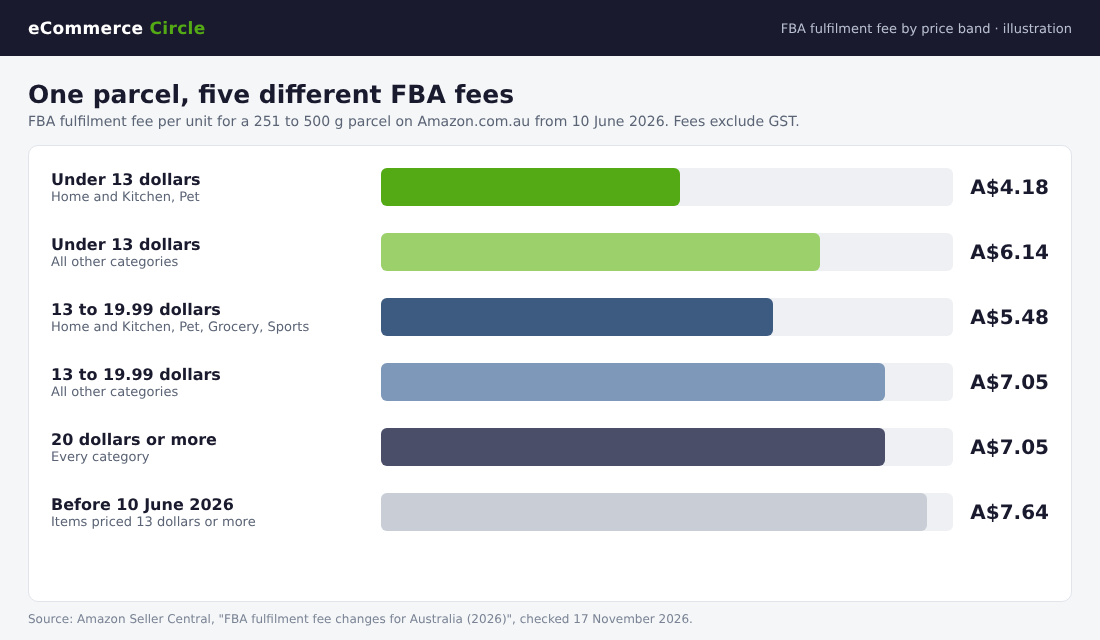
On 10 June 2026 Amazon Australia made what it called one of its largest-ever fee reductions. The old schedule had two price bands, with items under A$13 paying A$0.91 less. The new schedule has three bands, and products in a handful of categories pay less again in the two lower bands.
| Size and weight | Priced under A$13 | Priced A$13 to A$19.99 | Priced A$20 or more | Before 10 June (A$13 or more) |
|---|---|---|---|---|
| Small envelope, up to 75 g | A$3.20 discounted, A$3.64 other | A$4.55 | A$4.55 | A$4.55 |
| Standard envelope, 76 to 225 g | A$3.44 discounted, A$4.35 other | A$4.60 discounted, A$5.26 other | A$5.26 | A$5.26 |
| Large envelope, 476 to 975 g | A$3.98 discounted, A$6.33 other | A$5.06 discounted, A$7.24 other | A$7.24 | A$8.29 |
| Parcel, up to 250 g | A$3.98 discounted, A$6.14 other | A$5.48 discounted, A$7.05 other | A$7.05 | A$7.34 |
| Parcel, 251 to 500 g | A$4.18 discounted, A$6.14 other | A$5.48 discounted, A$7.05 other | A$7.05 | A$7.64 |
| Parcel, 501 g to 1 kg | A$4.36 discounted, A$6.33 other | A$5.48 discounted, A$7.24 other | A$7.24 | A$9.22 |
| Parcel, 1,001 g to 1.5 kg | A$6.19 discounted, A$7.97 other | A$6.19 discounted, A$8.88 other | A$8.88 | A$9.68 |
| Parcel, 1,501 g to 2 kg | A$6.64 discounted, A$8.90 other | A$6.64 discounted, A$9.81 other | A$9.81 | A$9.81 |
“Discounted” means Home and Kitchen and Pet Products for items under A$13. For items priced A$13 to A$19.99 it means Home and Kitchen, Pet Products, Grocery and Gourmet, and Sports and Outdoors. Every other category pays the “other” rate.
What changed in plain terms:
- Light parcels got cheaper for everyone. A 501 g to 1 kg parcel priced at A$20 or more dropped from A$9.22 to A$7.24, a cut of 21%.
- Cheap items in four categories got much cheaper. A pet product under A$13 in the same weight band went from A$8.31 to A$4.36, close to half.
- Parcels over 2 kg did not move. A 2 to 3 kg parcel is still A$9.86, or A$8.95 under A$13.
Two things to check on your own products.
Dimensional weight. For parcels and oversize items Amazon bills on the greater of actual weight and dimensional weight, which is length x width x height in centimetres divided by 4,000. Amazon’s own example is an iron in a 32 x 17 x 14 cm box. It weighs 1,360 g but bills at 1,904 g. A box with air in it costs you a weight band.
Which page you are reading. On 17 November 2026 the fee tables on Amazon’s public pricing page still showed the old two-band layout, while the Seller Central help article had the June rates. Use the help article or the Revenue Calculator, covered below, for a current number.
The 13 and 20 Dollar Price Cliffs
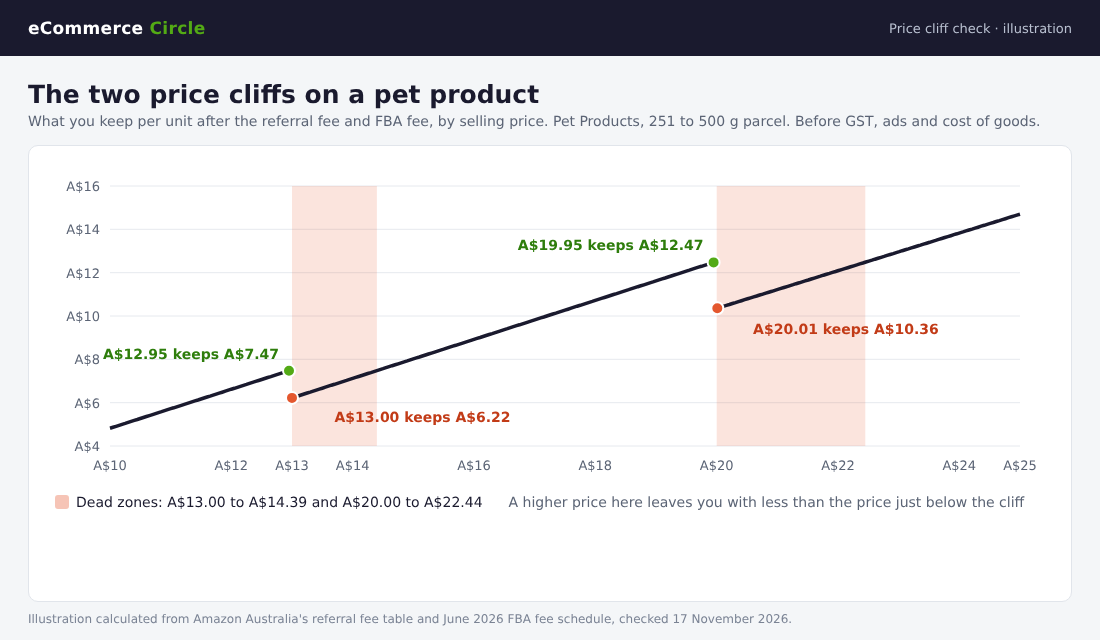
Put the referral table and the FBA table side by side and you find two prices where charging more leaves you with less.
Take a pet product in a 251 to 500 g parcel. Here is what you keep per unit after the referral fee and the FBA fee, before GST, ads and cost of goods.
| Selling price | Referral fee | FBA fee | You keep |
|---|---|---|---|
| A$12.95 | A$1.30 (10%) | A$4.18 | A$7.47 |
| A$13.00 | A$1.30 (10%) | A$5.48 | A$6.22 |
| A$19.95 | A$2.00 (10%) | A$5.48 | A$12.47 |
| A$20.01 | A$2.60 (13%) | A$7.05 | A$10.36 |
| A$22.45 | A$2.92 (13%) | A$7.05 | A$12.48 |
Moving from A$12.95 to A$13.00 costs you A$1.25 a unit. Moving from A$19.95 to A$20.01 costs you A$2.11, because the referral rate and the FBA fee both step up at once.
That creates two dead zones for this product. Any price from A$13.00 to A$14.39 leaves you with no more than A$12.95 does. Any price from A$20.00 to A$22.44 leaves you with no more than A$19.95 does. These figures are an illustration calculated from Amazon’s published rates, and the exact zones shift with your category and weight band.
What to do:
- List every Amazon product priced between A$12 and A$15, and between A$19 and A$23.
- For each one, calculate what you keep at the current price and at A$12.95 or A$19.95.
- If the lower price keeps more, drop to it. You earn more per unit and you look cheaper in search results.
- If you want to sit above a cliff, clear the dead zone completely. For the pet example that means A$14.40 or more, or A$22.45 or more.
- Remember the FBA band uses the item price after coupons and deal discounts. A A$21.95 product with a 10% coupon is a A$19.76 product for fee purposes.
Storage, Aged Stock and Removal Fees
Storage is billed on the average daily volume your stock takes up in Amazon’s fulfilment centres. Standard-size stock costs A$37.00 per cubic metre a month from January to September and A$51.80 from October to December. Oversize stock is A$34.20 and A$48.00.
Those rates went up on 1 August 2025. The standard rate was A$30.80, so the off-peak increase was 20%.
Per unit it looks tiny. A product that takes up one litre of space costs about 3.7 cents a month to store, or 5.2 cents in the Christmas quarter. The damage comes from slow stock.
- Aged inventory surcharge. Stock that has been in the network for 271 to 300 days pays an extra A$155 per cubic metre, assessed on the 15th of each month. That rises to A$175 at 301 days and A$185 at 331 days. After 366 days it is A$370 per cubic metre or A$0.12 a unit, whichever is greater. All of this sits on top of the monthly storage fee.
- Removal fees. Getting stock sent back to you costs A$0.65 a unit for standard-size items up to 500 g and A$0.84 up to 1 kg. Disposal is A$0.21 to A$0.53 a unit across the same weights.
What to do: as a rule of thumb, send six to eight weeks of cover and top up, instead of sending six months of stock to save on freight. Set a calendar reminder for any batch at 240 days, so you can run a deal or pull it before the first surcharge at 271.
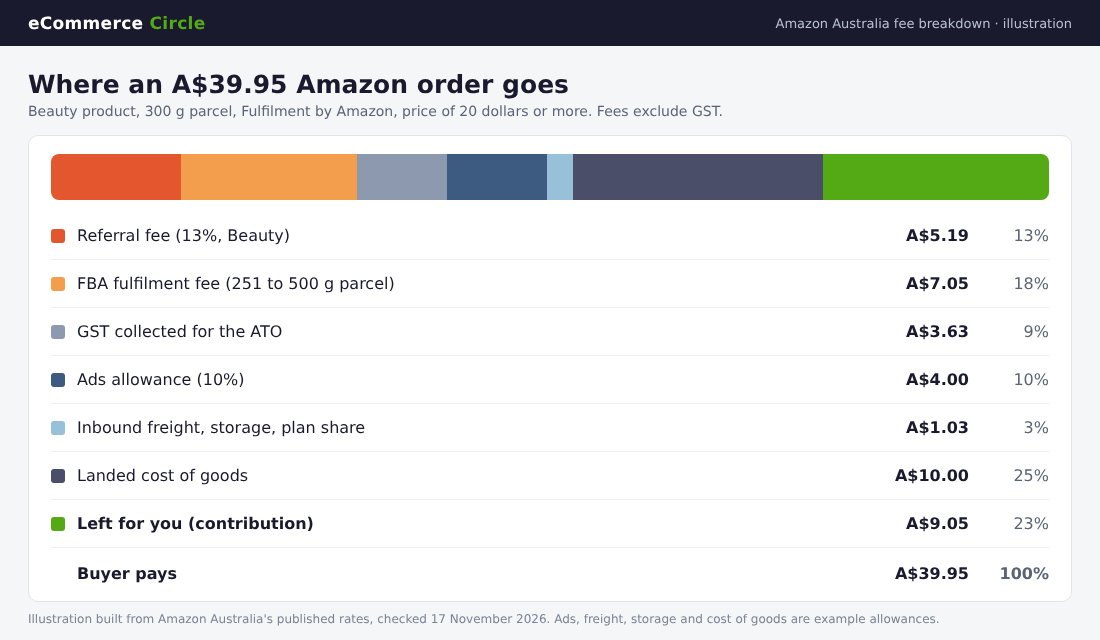
What Amazon Takes From a Real 39.95 Dollar Order
Here is the full stack for one unit. This is an illustration, not a client result. The product is a beauty item in a 300 g parcel, sold at A$39.95 through FBA, with 150 units a month on the Professional plan. The Amazon fees are the published rates. The ad, freight, storage and product cost lines are example allowances, so swap in your own.
| Line | Per unit | Share of revenue after GST |
|---|---|---|
| Price the buyer pays | A$39.95 | |
| Less GST | A$3.63 | |
| Revenue after GST | A$36.32 | 100% |
| Referral fee (13% of A$39.95) | A$5.19 | 14.3% |
| FBA fulfilment fee | A$7.05 | 19.4% |
| Storage allowance (about two months) | A$0.10 | 0.3% |
| Professional plan (A$49.95 over 150 units) | A$0.33 | 0.9% |
| Freight into Amazon (allowance) | A$0.60 | 1.7% |
| Ads (allowance of 10% of price) | A$4.00 | 11.0% |
| Landed cost of goods (example) | A$10.00 | 27.5% |
| Contribution per unit | A$9.05 | 24.9% |
Read the middle of that table again. The referral fee and the FBA fee together are A$12.24, a third of your revenue after GST. Add storage, the plan, freight in and ads, and the channel costs A$17.27 a unit, or 47.5% of revenue, before you have paid for the product.
A A$9.05 contribution at 24.9% is a workable channel. Run the same sums with a landed cost of A$16 and you are left with A$3.05, which one bad month of ads will erase. If you have not built this view for your own store yet, start with our guide to contribution margin for ecommerce and make sure your cost of goods is a true landed cost.
Selling From Shopify: Easy Ship, MCF and the Tools
You do not have to use FBA. A Shopify brand has three ways to get an Amazon order out the door, and one way to use Amazon’s warehouses for Shopify orders.
- Ship it yourself. You pay the plan, the referral fee and your own postage. Good for bulky, slow or made-to-order products.
- Amazon Easy Ship. You pack the order and Amazon’s carrier collects and delivers it. Rates start at A$3.81 a package for up to 500 g within the same metro area and A$4.85 for up to 3 kg. Amazon lists those rates as accurate at 1 August 2025, and the service only covers eligible postcodes.
- FBA. You send stock in and Amazon does the rest. Your products become Prime eligible and Amazon handles customer service and returns.
- Multi-Channel Fulfilment (MCF). Amazon ships your Shopify orders from your FBA stock. Since 10 June 2026 a 251 to 500 g parcel on standard delivery costs A$9.52 for a one-unit order, A$7.14 a unit on a two-unit order and A$5.24 a unit on orders of three or more. Parcels to Tasmania and the Northern Territory carry a A$5.45 surcharge.
Tool 1: Amazon’s Revenue Calculator (free). This is the fastest way to get a fee for a specific product. You do not need a seller account for a basic estimate.
- Open the public Revenue Calculator on Seller Central Australia.
- Search the Amazon catalogue for a product like yours, or choose “Define product” and enter your packaged dimensions, weight, category and price.
- Add your cost of goods and what it costs you to get one unit to Amazon.
- Add your own postage and packing cost so the calculator can compare FBA with shipping it yourself.
- Copy the referral fee, fulfilment fee and storage estimate into your margin sheet, then repeat at A$12.95, A$19.95 and your planned price.
Tool 2: Shopify Marketplace Connect. Shopify’s own app syncs your products, stock and orders with Amazon so both channels draw on one inventory count. Its App Store listing shows the first 50 marketplace-synced orders a month free, then 1% per synced order, capped at US$99 a month.
Tool 3: A2X. Amazon pays you a net amount with the fees already taken out. A2X splits each payout back into sales, fees and refunds in Xero or QuickBooks, from US$29 a month for up to 200 orders.
If Amazon is one of several marketplaces you are weighing up, compare the fee stack with our breakdowns of eBay fees in Australia and Shopify Payments fees. For the channel strategy itself (what to list, how to protect your brand and how to stop Amazon eating your own store’s sales) read our guide to selling on Amazon Australia from Shopify.
Three Australian Brands Selling on Amazon
These are Amazon’s own seller spotlights, so they are written to show the channel at its best and none of them publishes its fee bill. They are still useful for what the brands chose to do.
- Bondi Boost. The Australian haircare brand launched on Amazon Australia in 2022 and uses FBA. Amazon’s case study says the brand doubled its Amazon sales in 2023 by taking part in deal events such as Prime Day. A deal discount can move a product across a fee band, so re-run the pricing check before each event.
- Koala. The furniture brand launched on Amazon in 2020. Its VP of New Ventures, Mark Mitchinson, told Amazon the three things to put time into are Sponsored Ads, coupons and promotional periods, continuous learning, and watching ad spend against return. Koala paid a third-party contractor to manage pay-per-click at the start, a cost that sits outside Amazon’s fee table.
- Dog Friendly Co. The harness and lead brand launched on Amazon in 2022 and now has a team of twenty, according to its seller story. Pet Products is one of the two categories with the deepest FBA discount under A$13.
None of these brands treats Amazon as free traffic. Ads, deals and outside help belong in your per-unit sums next to the referral fee.
How the Fees Compound, and How to Make That Work for You
No single Amazon fee looks frightening. Thirteen percent here, seven dollars there, a few cents of storage. The problem is that they stack on the same unit, and each one is set by a different thing.
- Your category sets the referral rate.
- Your box sets the size tier and weight band.
- Your price sets the FBA band and, in six categories, the referral tier.
- Your stock cover sets storage and whether you ever meet the aged surcharge.
- Your ad discipline sets the biggest variable line of all.
That is also the good news, because every one of those is a decision you control. Trim a box by a centimetre and you can drop a weight band. Price at A$19.95 and you can save A$2.11 a unit. Send eight weeks of stock and storage stays under 1% of revenue. Get the first three right before launch, because they are the cheapest to fix.
The 20-Minute Amazon Fee Audit
Copy this checklist and run it for your top five products before you list, and again every quarter.
- Plan. Count last month’s Amazon units. Over 50, or running ads? You should be on Professional.
- Category. Confirm the fee category for each product in Seller Central and write the referral rate next to it.
- Box. Measure the packaged product. Calculate length x width x height divided by 4,000 and compare it with the actual weight. Note the size tier and weight band.
- Price band. Mark which FBA band each product sits in: under A$13, A$13 to A$19.99, or A$20 or more. Flag anything within A$2.50 above a cliff.
- GST. Divide the price by 1.1 and use that as revenue. Take the referral fee from the full price.
- Fee stack. Add referral fee, FBA fee, storage, plan share and freight in. Write it as a percentage of revenue after GST.
- Ad cap. Decide the most you will spend on ads per unit and still clear your target contribution. Put that number in your campaign settings.
- Stock age. Open FBA Inventory and filter by age. Anything past 240 days gets a deal or a removal order this week.
If a product cannot clear 20% contribution after all of that, it does not go on Amazon. Keep it for your own store, where you own the customer. That 20% line is our working threshold, so set your own if your overheads call for a different one.
Amazon Seller Fees Australia: FAQ
How much does Amazon take per sale in Australia?
A referral fee of 6% to 15% of the total sale, depending on category, plus A$0.99 an item if you are on the Individual plan. If you use FBA, add a fulfilment fee from A$3.20 a unit. On a A$39.95 beauty product in a small parcel, the referral fee and FBA fee come to A$12.24.
Do Amazon seller fees include GST?
No. Amazon Australia quotes its seller fees excluding GST. GST-registered businesses can generally claim the GST on fees as a credit. Confirm the treatment with your accountant.
Is the Amazon Professional plan worth it?
Yes once you sell 51 or more items a month, and from the start if you want to advertise, use bulk tools or connect Shopify. The Individual plan cannot do those things.
Did Amazon cut FBA fees in Australia in 2026?
Yes. From 10 June 2026 Amazon reduced selected FBA fulfilment fees and moved to three price bands. Light parcels and low-priced items in Home and Kitchen, Pet Products, Grocery and Sports saw the biggest cuts. Parcels over 2 kg did not change.
Can Amazon ship my Shopify orders?
Yes, through Multi-Channel Fulfilment. A 251 to 500 g parcel on standard delivery costs A$9.52 for a single-unit order, with lower per-unit rates on orders of two or more units.
Inside eCommerce Circle, Profit is one of the 10 P’s we work through with every member, and marketplace fees are one of the first places we find margin that nobody was watching. If you want to see exactly where your store is being held back, take the free More Orders Scorecard. It takes two minutes and shows you which of the 10 P’s to fix first. Or if you would like help working through your numbers, start in Connect.