For most Shopify brands doing under 500 orders a month, Cin7 Core and Unleashed cost almost exactly the same: about A$520 a month plus GST. The gap opens as you grow, because Unleashed prices in Australian dollars and sells extra orders in bundles, while Cin7 Core bills in US dollars and packs more orders and users into each tier.
That is the short answer. The longer answer matters more, because the subscription is usually the smallest cheque you will write. The setup, the data clean-up and the months your team spends learning a new system cost far more than the plan, and they are where most brands get burned.
Here is the pattern we see with founders. They outgrow spreadsheets and Shopify’s built-in stock tools, book two demos in one week, and pick whichever sales rep was more convincing. Six months later they are paying a consultant to rebuild the setup. The brands that get it right do the opposite: they work out their order volume, their channels and their must-have workflows first, then let the numbers pick the system.
This guide gives you those numbers. Every price below was checked on 22 November 2026 on each vendor’s own pricing page.
Cin7 vs Unleashed at a Glance
Both systems were born on this side of the world. Unleashed started in New Zealand and has been part of the UK’s Access Group since 2020. Cin7 Core is the product that used to be called DEAR Inventory, and it now sits alongside Cin7 Omni, a quote-only version for larger operations. Both connect to Shopify and Xero, both handle purchasing, stock and light manufacturing, and both offer a 14-day free trial.
Where they differ is how they charge and who they were built for.
| Unleashed | Cin7 Core | |
|---|---|---|
| Entry plan | Core, A$449 a month | Standard, US$349 a month (about A$526) |
| Next plan | Pro, A$819 a month | Pro, US$599 (about A$903) |
| Top published plan | None above Pro | Advanced, US$1,199 (about A$1,807) |
| Currency | Australian dollars, excluding GST | US dollars, excluding taxes |
| Users included | 3 on Core, 5 on Pro | 5, 10 and 15 |
| Sales orders included | 100 a month, bundles extra | 6,000, 24,000 and 120,000 a year |
| Ecommerce integrations included | 3 on Core, 5 on Pro | 2, 4 and 6 |
| Point of sale | Through partners such as Lightspeed | Add-on |
| Shopify App Store rating | 2.7 from 25 reviews | 4.4 from 65 reviews |
| Annual billing discount | Up to 10% | One month free (per implementation partner Waypoint) |
The App Store ratings are worth a second look before you read too much into them. Twenty-five reviews is a small sample, and many reviews on both listings are about support experiences rather than the software itself. Use them as a prompt for questions in your demo, not as a verdict.
What Each Plan Really Costs in Australian Dollars
Unleashed publishes its prices in AUD. Its pricing page says all prices exclude applicable taxes, so add 10% GST to every figure below.
- Core: A$449 a month. 3 users, 100 sales orders a month, 3 basic integrations, 250,000 API calls.
- Pro: A$819 a month. 5 users, 100 sales orders a month, 5 integrations, 500,000 API calls, plus Advanced Inventory Manager (forecasting and MRP) and the Production module included free.
- Extra users: A$69 a month each on Core, A$79 on Pro.
- Extra orders: up to 500 a month for A$70, up to 1,500 for A$200, up to 3,000 for A$320, unlimited for A$490.
- Extra integrations: A$29 a month each.
- Optional modules on Core: Advanced Inventory Manager A$129, Production A$69, Warehouse Management and Multi-Bin A$149, B2B eCommerce Store from A$119.
Cin7 Core publishes its prices in USD only. At the 22 November 2026 rate of US$1 = A$1.507, the three tiers work out like this:
- Standard: US$349, about A$526 a month. 5 users, 2 ecommerce or app integrations, 6,000 sales orders a year, unlimited locations.
- Pro: US$599, about A$903 a month. 10 users, 4 integrations, 24,000 orders a year, material requirements planning included.
- Advanced: US$1,199, about A$1,807 a month. 15 users, 6 integrations, 120,000 orders a year, advanced warehouse management included. This tier was US$999 until recently, according to Australian review site SoftwareHQ’s price history.
Two things catch Australian buyers out with Cin7. First, your bill moves with the exchange rate, so if the Aussie dollar falls 5 US cents, a Pro plan costs about A$70 a month more. Second, the useful extras are add-ons. Waypoint, a Cin7 implementation partner, lists Automation at US$79 a month, a B2B portal at US$119, Advanced WMS on Pro at US$149, extra integrations at US$99 each and extra users at US$99 per group of three.
Timing tip: Unleashed is running a Black Friday offer of 90% off the first three months of Core or Pro for new customers who subscribe by 30 November 2026. The terms say it is an initial three-month contract that then rolls monthly, and it does not apply to optional modules or sales order bundles. Useful if you plan to switch anyway. Not a reason to switch on its own.
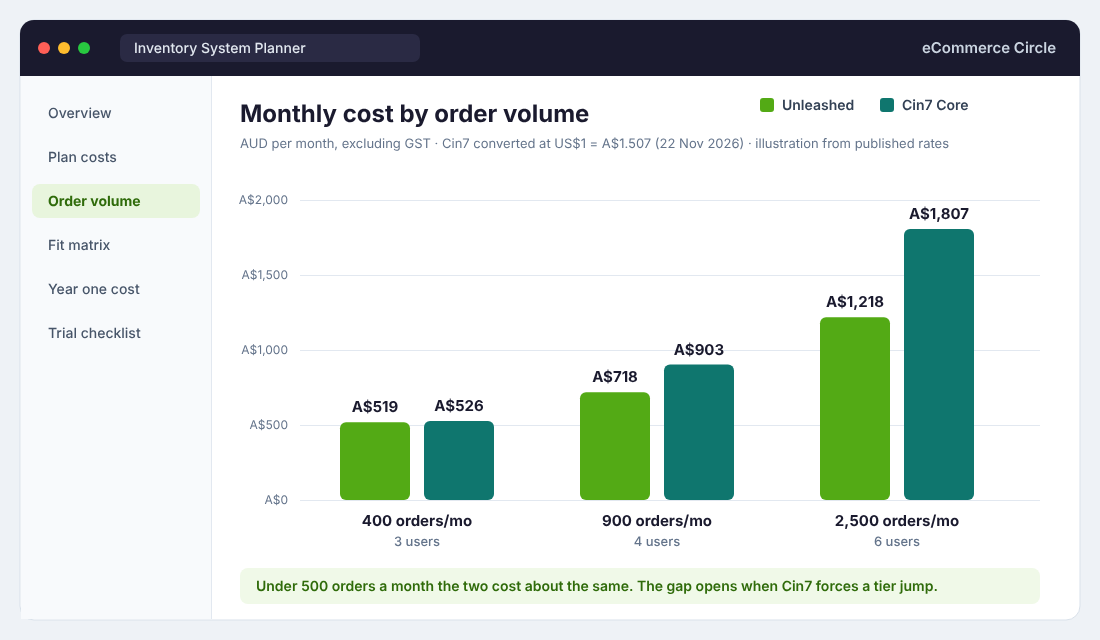
The Real Monthly Bill at Three Order Volumes
List prices only make sense once you plug in your own order count. Here is what a typical Shopify brand would pay at three sizes. These are illustrations built from the published rates above, excluding GST, onboarding and optional modules, and assuming Shopify, Xero and one shipping app are your only connections.
| Store size | Unleashed | Cin7 Core |
|---|---|---|
| 400 orders a month, 3 users | Core A$449 + 500-order bundle A$70 = A$519 | Standard, about A$526 |
| 900 orders a month, 4 users | Core A$449 + 1,500-order bundle A$200 + 1 user A$69 = A$718 | Pro (Standard caps at 6,000 a year), about A$903 |
| 2,500 orders a month, 6 users | Pro A$819 + 3,000-order bundle A$320 + 1 user A$79 = A$1,218 | Advanced (Pro caps at 24,000 a year), about A$1,807, unless Cin7 quotes you extra orders on Pro |
The pattern is clear. At small volumes it is a coin toss on price. In the middle, Unleashed is usually cheaper on paper. Cin7 claws some of that back if you need its extra users, integrations or warehouse tools, because those come bundled in its higher tiers.
Do this maths with your own numbers before your first demo. Pull your last 12 months of orders from Shopify, find your busiest month (it is usually November), and price both systems for that month, not your average. An order allowance that fits in July can blow out in Black Friday week, and Unleashed’s pricing FAQ says that going over your allocation in any month applies a larger allocation to your account in the months that follow.
How Each One Syncs With Your Shopify Store
Both systems pull Shopify orders in, push stock levels back out and send the accounting to Xero. The detail is in how much control you get.
Unleashed connects through its eCommerce Hub. You can link up to five Shopify stores by default, and choose whether orders import when they are paid, authorised or fulfilled. You can create a customer record for every Shopify buyer or roll them all into one “Shopify” customer, which keeps your customer list clean if you sell mostly direct to consumer. Its help centre says the Shopify connection needs the eCommerce Hub Shopify module in your bundle, and its pricing page asks Shopify sellers to book a chat to scope it, so confirm that line item in writing.
Cin7 Core leans harder into multichannel. Its Shopify App Store listing pitches stock, orders and product data kept in sync across Amazon, wholesale, retail POS and multiple warehouses, and Cin7 says it integrates with more than 700 platforms. If you run Shopify plus a marketplace plus a retail counter, that breadth is the main reason to pay more.
Whichever you choose, check the shipping link too. Most Aussie brands push orders from the inventory system to Shippit or Starshipit for labels, and our Shippit vs Starshipit comparison covers how those two handle the hand-off.
Where Unleashed Wins and Where Cin7 Core Wins
After the price, this is the question that actually decides it. Each system has a home turf.
Unleashed is the stronger pick when
- You sell under about 1,500 orders a month. Its AUD pricing and order bundles keep the bill predictable.
- You make or assemble your own product. Bills of materials, assemblies and batch tracking are core to how it was built, and Pro throws in forecasting and production at no extra cost.
- You want to budget in Australian dollars. No exchange rate surprises on your software line.
- You want cheap, structured onboarding. Its packages run A$449 for self-service, A$789 for standard onboarding and A$7,999 for full consultative onboarding, all one-off.
Cin7 Core is the stronger pick when
- You sell across many channels. Shopify plus Amazon plus wholesale plus a shopfront is exactly what its higher tiers are built around.
- You need point of sale or a B2B portal from the same vendor. Both are add-ons, but they live inside one system.
- You need lots of users. Ten users on Pro and fifteen on Advanced are included, while Unleashed charges A$69 to A$79 for each user past three or five.
- You run high volumes. 120,000 orders a year on Advanced is a lot of headroom without bolting on bundles.
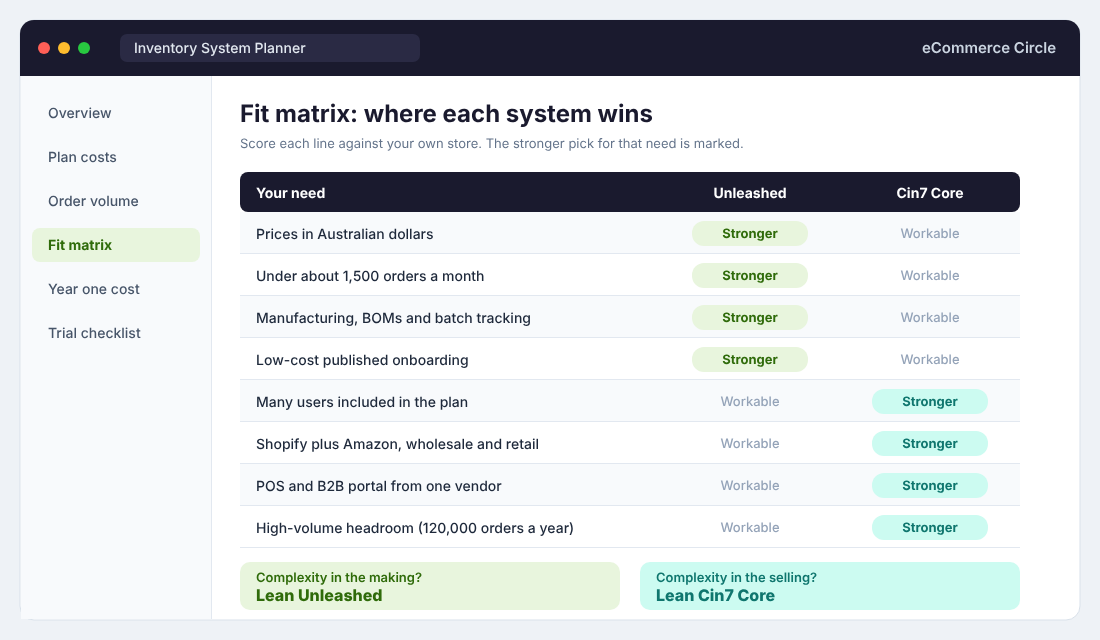
A simple rule of thumb from what we see in coaching: if your complexity is in the making, lean Unleashed. If your complexity is in the selling, lean Cin7. A skincare brand that mixes batches in a Brisbane unit and sells mostly through Shopify has a production problem. A homewares brand that buys finished stock and sells through its site, Amazon, two stockists and a pop-up has a channel problem.
The Setup Costs Nobody Quotes You Upfront
This is where the real money goes, and where most comparison pages go quiet.
Unleashed’s onboarding is cheap and published. Self-service is A$449, standard onboarding A$789 and full onboarding A$7,999. Support plans are separate: Standard at A$79 a month or Premier, with a dedicated success manager, at A$229 a month.
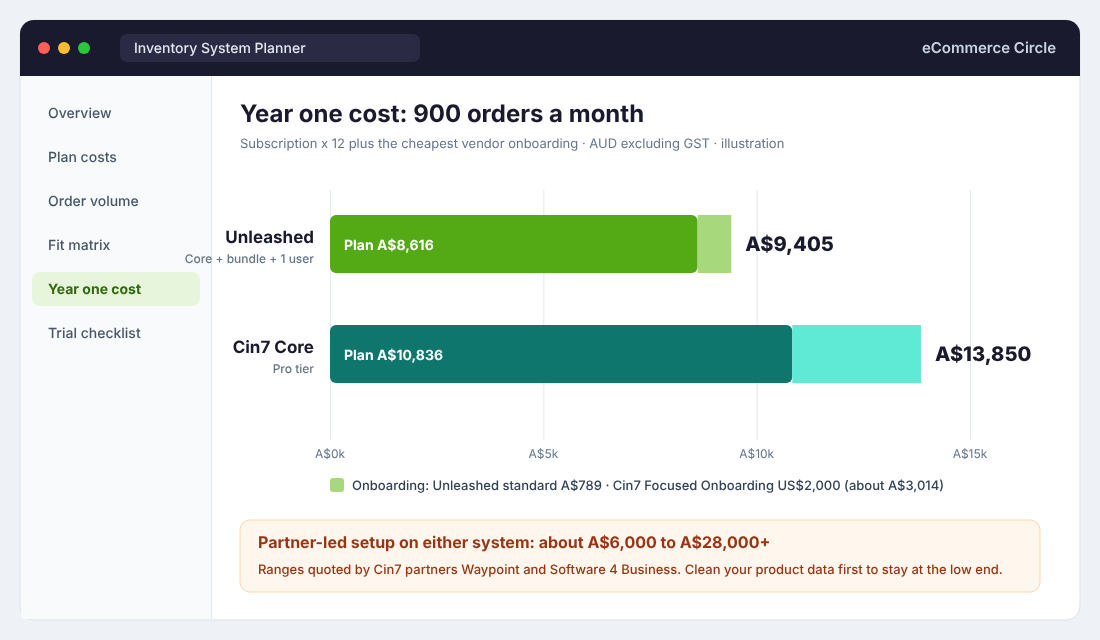
Cin7’s own onboarding costs more. Waypoint says Cin7’s Focused Onboarding package is US$2,000 (about A$3,014) and runs over 8 to 10 weeks, with one or two live sessions a week. Your team still prepares the data and does most of the configuration.
Partner-led implementations cost the most, on either system. Waypoint quotes A$7,000 to A$28,000+ for Cin7 Core projects, with most established businesses landing between A$18,000 and A$25,000. Australian consultancy Software 4 Business puts typical Cin7 Core projects for Australian SMEs at A$6,000 to A$25,000 ex GST over 3 to 12 weeks. Unleashed partners charge in similar ranges for complex builds, because the work (mapping processes, cleaning product data, testing integrations) is the same.
Here is what year one looks like for the 900-order store from the table above, using the cheapest vendor onboarding on each side:
- Unleashed: A$718 x 12 = A$8,616, plus A$789 standard onboarding = A$9,405 ex GST.
- Cin7 Core: about A$903 x 12 = A$10,836, plus about A$3,014 Focused Onboarding = A$13,850 ex GST.
That is roughly a A$4,400 gap in year one. It is real money, but it is smaller than one bad implementation. Picking the system that fits your workflows, then paying for proper onboarding, beats saving A$4,000 and spending the next year working around it.
The biggest single cost driver is your data. If your SKUs, barcodes, supplier codes and cost prices are a mess, every partner will bill you to clean them. Spend two weekends tidying your product data before you sign anything. If you are not sure your landed costs are right, fix that first using our landed cost guide, because both systems will faithfully report whatever wrong numbers you feed them.
Two Brands Selling in Australia, Two Different Choices
Vendor case studies are marketing, so read them as stories about fit, not proof one system is better. These two are useful because they show the trade-offs in practice.
Changing Habits moved from Unleashed to Cin7 Core. The Australian organic health food brand, founded by nutritionist Cyndi O’Meara in 1998, was running Unleashed with WooCommerce, a setup built for manufacturing and wholesale rather than online retail. According to Cin7’s case study, the team averaged over 1,000 transactions a month with peaks of 100 to 200 orders a day, their stock valuations were off and their accountant did not trust the numbers flowing to Xero. With implementation partner Integration Kings, they moved to Cin7 Core and Shopify over about six months from April 2025. Their team now saves five to six hours a week on stock management and has added Amazon FBA. Keep in mind this is Cin7 telling the story of a customer it won from Unleashed.
Almighty runs its Shopify stores on Unleashed. The organic juice and sparkling water brand started in Wellington in 2015 and now sells across New Zealand and Australia. According to Unleashed’s case study, Almighty plugged its Australian business into Unleashed through the Shopify integration, and its annual stock take dropped from a week to 20 minutes once its stock numbers finally matched its 3PL’s. Batch tracking, which matters a lot for food and drink, was the biggest win.
Notice the theme. Changing Habits had a retail and multichannel problem and moved to the system built for channels. Almighty had a batch and stock accuracy problem and stayed with the system built around production and traceability. Neither story says one tool is better. They say each brand matched the tool to its problem.
How to Connect Shopify to Unleashed During Your Trial
The best way to compare is to run both trials on your real store data. Here is the Unleashed setup, taken from its help centre (updated June 2026). Do it in a quiet week, not the week before Christmas.
- Check your bundle. In Unleashed, go to Settings, then Billing, and confirm the eCommerce Hub Shopify module is included. Only an Account Owner can add it.
- Log in to Shopify with an account that has admin rights, in the same browser.
- Install the shop. In Unleashed go to eCommerce Hub, then Shopify, then the Overview tab, and click Install. You will be sent to the Shopify app listing.
- Approve access. Click Install in Shopify, sign in and approve the data access. You will land back in Unleashed. Refresh the page.
- Configure the shop. Under Your Shops, click Configure. Choose whether each Shopify order creates its own customer or uses one shared customer, and pick the Shopify status that triggers an import (for example Paid).
- Set the import status and date range. Choose whether orders arrive in Unleashed as Parked, Placed or Completed, and how far back to import (the default is one month).
- Map products and warehouses, then check the Connection Log to confirm orders, products and customers are syncing.
Run the same week of orders through Cin7 Core’s trial. Then compare three things side by side: how long a typical order takes to process, whether stock levels in Shopify updated correctly, and whether the journals in Xero match what your bookkeeper expects. Our Shopify and Xero reconciliation guide shows what a clean month should look like.
The 10-Question Inventory System Scorecard
Copy this into a doc and score each system from 0 to 2 on every line during your demos. The higher total wins, unless it fails a question you marked as a must-have.
- Order volume. What does my busiest month cost on each plan, including order bundles or tier jumps?
- Users. How many people need a login in 12 months, and what does each extra seat cost?
- Channels. Which channels do I sell through today and next year (Shopify, Amazon, wholesale, POS), and is each one included or an add-on?
- Production. Do I need bills of materials, batch or expiry tracking, and is it included in the plan I am pricing?
- Forecasting. Is demand forecasting included, or a paid module?
- Accounting. Does the Xero or MYOB sync post the journals my accountant wants, and who will test it?
- 3PL. Does it connect to my 3PL, or will I be emailing CSVs?
- Currency. Am I happy carrying exchange rate risk on a software bill?
- Onboarding. What will setup really cost, and who does the data clean-up?
- Exit. What is the notice period? (Unleashed asks for 30 days on monthly plans.) Can I export all my data if I leave?
If you want a deeper base before you start, our Shopify inventory management guide covers the reorder points and stock rules you should have nailed before buying any software.
Why the Right System Pays for Itself
Bad inventory data is expensive at every scale. IHL Group’s 2025 research puts the global cost of out-of-stocks and overstocks at US$1.73 trillion a year, or 6.5% of global retail sales, and Asia-Pacific carries the largest share at US$642 billion. For a small Shopify brand, that shows up as a sold-out hero product in November and A$30,000 of slow stock sitting in a 3PL in February.
Here is how the pieces fit together. Price the system on your busiest month, not your average. Match it to where your complexity lives, making or selling. Budget for onboarding and clean your data before you start. Then test both trials on a real week of orders and score them. Do those four things and the choice between Cin7 and Unleashed usually makes itself, and you avoid the most expensive outcome of all: paying for an implementation twice.
Cin7 vs Unleashed FAQs
Is Cin7 or Unleashed cheaper in Australia?
At around 400 orders a month they are nearly identical, about A$519 for Unleashed and A$526 for Cin7 Core before GST. In the middle range Unleashed is usually cheaper on paper. Cin7 can work out better value if you need many users, integrations or its warehouse tools, because those are bundled into its higher tiers.
Does Cin7 charge in Australian dollars?
No. Cin7’s pricing page lists Core prices in US dollars, excluding taxes, so your monthly cost changes with the exchange rate.
Do both work with Shopify and Xero?
Yes. Both sync orders and stock with Shopify and post to Xero. Unleashed also lists QuickBooks Online, and Cin7 lists QuickBooks as well.
Can I try both before I commit?
Yes. Both offer a 14-day free trial. Unleashed says its trial needs no credit card and has all features enabled.
Inside eCommerce Circle, choosing and setting up the systems behind your store is one of the core things we work through with every member, because the wrong stack quietly caps how far you can grow. If you want to see exactly where your store is being capped right now, take the free More Orders Scorecard. It takes two minutes and shows you which of the 10 P’s to fix first.