Most Aussie store owners choose shipping software the way they choose a phone plan. They look at the monthly fee, pick the cheaper one, and never look at the bill again.
That is the wrong number to stare at. On a store sending 1,000 parcels a month, the gap between Shippit and Starshipit subscriptions is a few hundred dollars. The gap in what you pay carriers, the hours your team spends at the packing bench and the customers you lose to a late parcel is far bigger.
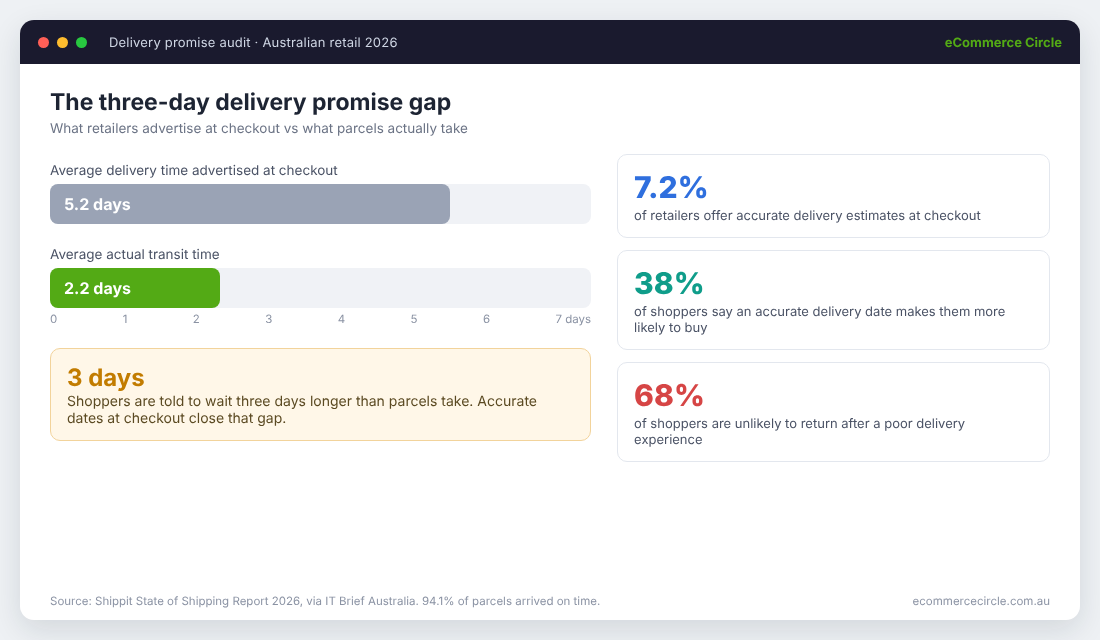
Shippit’s State of Shipping Report 2026 found 68% of shoppers are unlikely to return to a retailer after a poor delivery experience, up from 64% a year earlier. Your shipping app is not admin software. It decides how fast parcels leave, which carrier takes them and what your customer sees while they wait.
This guide compares Shippit and Starshipit on the things that change your margin: real 2026 pricing at four order volumes, carrier access, automation, tracking and support. You will finish with a five-question scorecard and a 30-day trial plan you can run before peak.
Shippit vs Starshipit: the short answer
If you want the verdict before the detail, here it is.
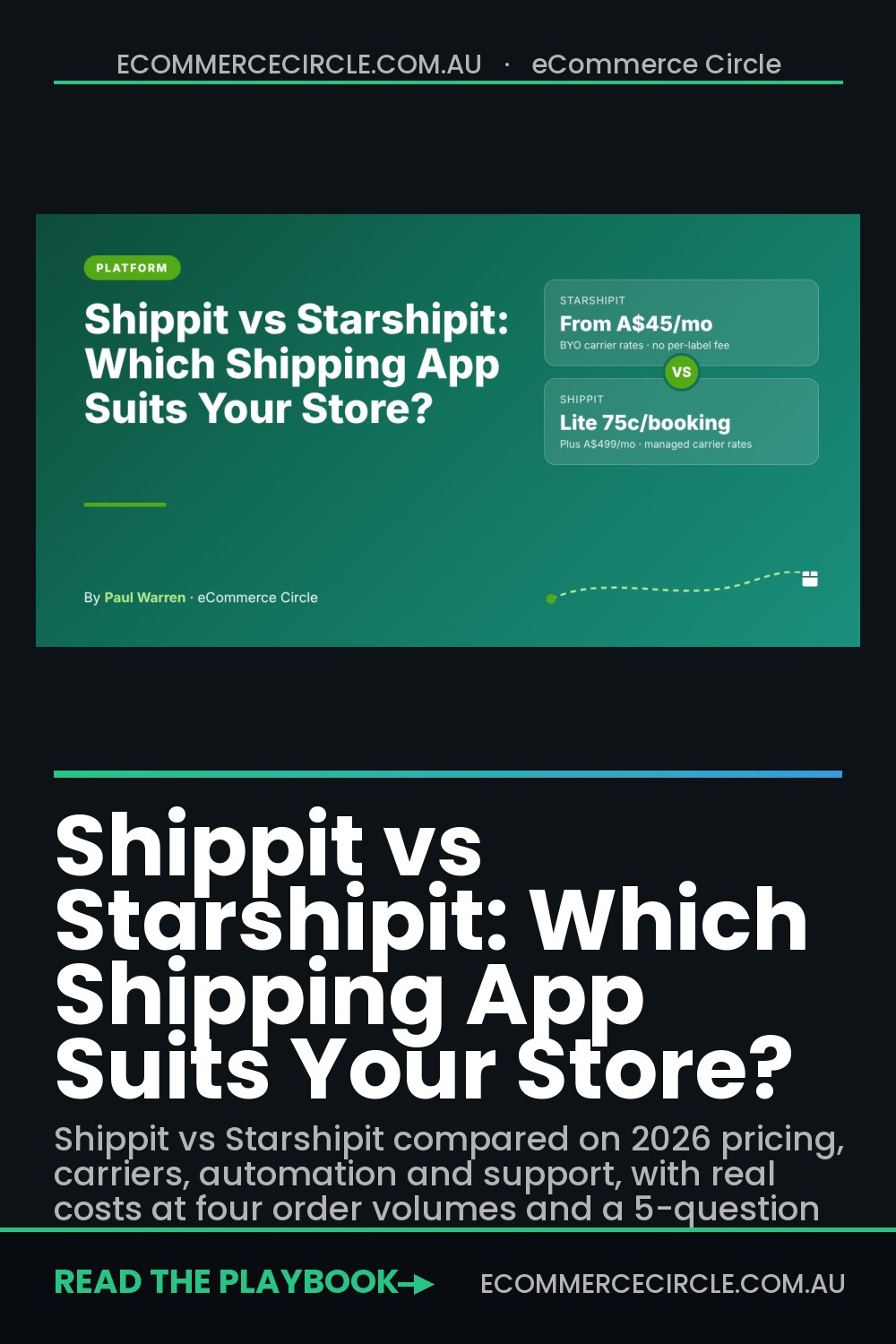
- Choose Starshipit if you ship between 50 and 5,000 parcels a month, already have (or plan to get) your own carrier accounts, and want multi-carrier rules, branded tracking and phone support without paying per label. Its plans start at A$45 a month on annual billing.
- Choose Shippit if you ship several thousand parcels a month, want access to Shippit’s negotiated carrier rates and on-demand or same-day options, or run multiple warehouses and stores. Its Plus plan is A$499 a month plus GST, so it earns its keep at volume.
- Shippit Lite suits a very small Shopify store with one carrier account that wants free software and is happy paying 75 cents a booking.
Both are built in Australia and New Zealand for local carriers, both connect to Shopify, and both are used by brands you know. The right choice depends on your volume, your carrier setup and how much of your delivery experience you want to control.
Who Shippit and Starshipit are built for
Starshipit started in New Zealand and now says it serves more than 30,000 retailers globally. It is shipping automation software first: it pulls orders from Shopify, applies your rules, prints labels through your carrier accounts and writes tracking back to the order. Its pitch is simple: bring your own carrier rates and it will never charge you a per-label fee on top.
Shippit is Sydney based and positions itself as a delivery platform, not just label software. It offers more than 100 carriers through one integration, its own negotiated rates on managed carriers, on-demand and same-day delivery, and a fleet management product called NowGo used by businesses like Reece. Its customer list leans larger: Harvey Norman, Baby Bunting, Petbarn and Decjuba all appear in its case studies.
That difference in DNA shows up everywhere. Starshipit is built to make a two-person dispatch team fast. Shippit is built to make a multi-site retailer’s delivery network cheaper and more predictable.
Neither is wrong. The mistake is choosing the enterprise tool when you ship 300 parcels a month, or staying on a starter tool when you are running three warehouses and a store network.
Shippit vs Starshipit pricing in 2026
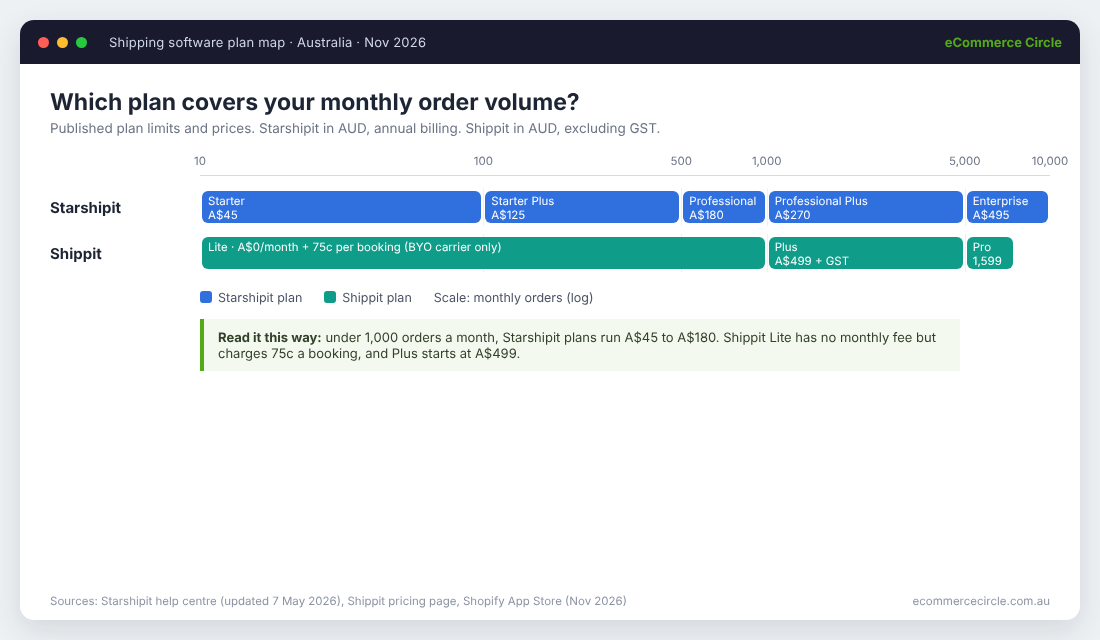
Here is what each platform publishes as of November 2026. Starshipit’s prices come from its help centre guide (updated 7 May 2026), which states all prices in Australian dollars. Shippit’s prices come from its pricing page, which says all prices exclude GST.
| Plan | Monthly orders | Price |
|---|---|---|
| Starshipit Starter | Up to 100 | A$45/month annual, A$50 month to month |
| Starshipit Starter Plus | Up to 500 | A$125/month annual, A$140 month to month |
| Starshipit Professional | Up to 1,000 | A$180/month annual, A$200 month to month |
| Starshipit Professional Plus | Up to 5,000 | A$270/month annual, A$300 month to month |
| Starshipit Enterprise | Up to 10,000 | A$495/month annual, A$550 month to month |
| Shippit Lite | Up to 1,000 bookings | Free plan, A$0.75 per booking |
| Shippit Plus | Up to 5,000 bookings | A$499/month plus GST |
| Shippit Pro | Up to 7,500 bookings | A$1,599/month plus GST |
Two things in that table catch store owners out.
First, Shippit Lite is not free once you ship. The plan has no monthly fee, but Shippit’s Shopify App Store listing says you book up to 1,000 orders at 75 cents a booking. At 300 orders a month that is A$225, which is more than Starshipit’s Starter Plus plan.
Second, Starshipit’s add-ons matter. Live rates at checkout (A$30 a month on Starter and Professional plans), a branded returns portal (A$20) and multi-location accounts (A$25) are extras below Enterprise. Shippit sells its own add-on packs (Experience, Returns, Advanced Insights and Premium Support) on Plus and Pro, priced on application.
Starshipit also offers a 30-day free trial with no credit card. Shippit Lite lets you sign up online, while Plus and Pro start with a demo call.
What you really pay at 80, 300, 800 and 3,000 orders a month
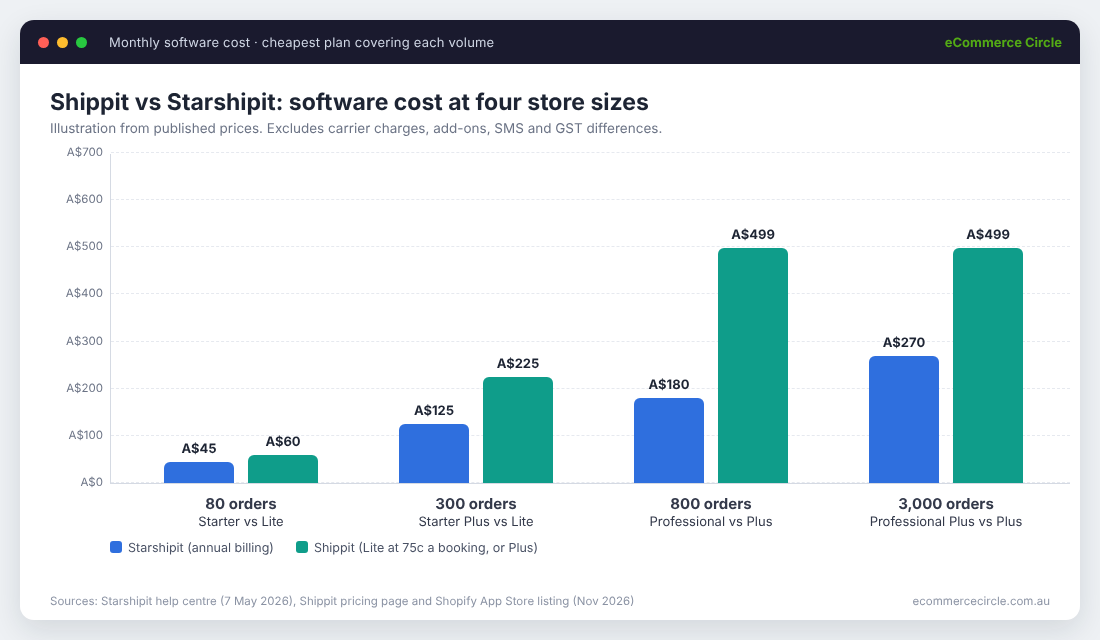
Subscription fees only make sense against your volume. Here is a side-by-side at four common store sizes, using annual Starshipit pricing and the cheapest Shippit plan that covers the volume.
| Monthly orders | Starshipit | Shippit | Gap |
|---|---|---|---|
| 80 | Starter, A$45 | Lite, A$60 (80 x 75c) | Starshipit A$15 cheaper |
| 300 | Starter Plus, A$125 | Lite, A$225 | Starshipit A$100 cheaper |
| 800 | Professional, A$180 | Plus, A$499 + GST (Lite would be A$600) | Starshipit about A$370 cheaper |
| 3,000 | Professional Plus, A$270 | Plus, A$499 + GST | Starshipit about A$280 cheaper |
These figures are an illustration built from each vendor’s published prices. They exclude carrier charges, add-ons, SMS and GST differences, and assume one store location.
On software alone, Starshipit wins at every volume up to 5,000. But software is the small line on your shipping P&L. Now look at freight.
Shippit’s 2026 report puts the average standard delivery fee charged by Australian retailers at A$11.30, up 8.7% on the year. Say your true carrier cost averages A$11 a parcel at 3,000 parcels a month. That is A$33,000 a month in freight. A 1% improvement in your blended rate is worth A$330 a month, which is more than the entire subscription gap.
So the real question is not “which app is cheaper?” It is “which app gets me the lowest total cost per parcel delivered on time?” If you already hold strong Australia Post, Aramex or CouriersPlease rates, Starshipit lets you use them with no per-label fee. If you do not have the volume to negotiate those rates, Shippit’s managed carrier rates may beat what you could get alone. Get a quote from Shippit with your real parcel profile before you assume either way.
If you are still working out which couriers to use, start with our breakdown of Australia Post alternatives and what each courier costs.
Carriers and rates: bring your own vs managed
This is the biggest structural difference between the two platforms, so it is worth getting right.
Starshipit is a bring-your-own-rates platform. You connect your own carrier accounts and Starshipit charges nothing per label for using them. Its plans cap how many couriers you can connect: two on Starter, four on Professional and unlimited on Enterprise. If you are a new business without an account, Starshipit points you to plug-and-play carrier options that charge your credit card, so you can still ship on day one.
Shippit runs both models. You can bring your own carrier contracts, use Shippit’s ready-to-use discounted rates, or mix the two. Shippit handles carrier account setup, billing and invoice reconciliation for its managed carriers, and monitors pickups and deliveries. Plus includes multi-carrier quoting with up to five carriers. Pro adds unlimited carrier access. Lite is limited to bringing your own carrier.
Shippit also offers delivery types most small stores never touch: scheduled delivery, on-demand delivery, after-hours and weekend delivery, bulky and white glove delivery, and palletised freight. If you sell furniture, ship B2B pallets or want two-hour metro delivery, that matters. Shippit says Petbarn customers who chose on-demand delivery spent 3.5 times more, though that is a vendor case study about a national retailer, not a small Shopify store.
The practical test: pull your last 90 days of orders and split them by weight band and destination zone. If more than 80% are satchels to metro postcodes, you do not need Shippit’s specialist delivery types, and a lean two-carrier setup on Starshipit will cover you. If you ship heavy, bulky, regional or time-critical parcels, Shippit’s carrier depth becomes worth paying for.
If you are weighing whether to outsource fulfilment entirely instead, read our guide to 3PL costs in Australia first. Many 3PLs bring their own shipping software, which changes this decision.
Automation and dispatch speed
Shipping software earns its fee by taking decisions off your packing bench. Both platforms automate the basics: they import Shopify orders, print labels in bulk, generate packing slips and manifests, and write tracking numbers back to Shopify.
The differences sit in the rules engine and the fulfilment tools.
- Automation rules. Starshipit Starter and Starter Plus allow up to three rules, Professional plans allow five, and Enterprise is unlimited. Shippit describes AI-powered carrier allocation and shipping rules on Plus, with advanced fit-based package allocation on Pro.
- Packing tools. Starshipit’s Professional plans add a product catalogue, packing validation (scan the item to confirm it belongs in the order) and recommended packaging. Shippit includes pick lists, pack slips, a Pick and Pack app and barcode scanning in its fulfilment automation group, with only part of that group on Lite.
- Order handling. Starshipit lists merge and split orders. Shippit lists order consolidation and an order modifications API, and supports multi-warehouse routing and ship-from-store.
How much time does this save? Starshipit’s own savings calculator assumes 10 minutes a parcel handled manually, 50% of that time saved and an Australian warehouse labour benchmark of A$32 an hour. On those assumptions, 500 orders a month frees about 42 hours. Treat that as the vendor’s estimate, then test it against your own stopwatch.
Hello Molly, the Sydney fashion label, is a useful Starshipit example. Before automation, its team printed invoices and labels separately and paper-clipped them together. After integrating Starshipit with its PeopleVox warehouse system, orders route automatically by destination and parcel weight, and the system picks the cheapest carrier where several offer the same service level. Its Supply Chain Director says dispatch headcount fell by around 15% to 20% in the first year at the same output.
Hunter Candles, a Sydney maker of hand-poured soy candles, shows the Shippit side. It moved from Squarespace to Shopify and ships more than 9,000 orders a year across DTC and wholesale on a six-carrier mix through Shippit, defaulting to the best price. Shippit’s case study says the brand cut labour on shipping processing and reporting by 50%. Glass, weight and occasional dangerous goods rules make carrier choice matter for a candle brand, and Shippit flags documentation needs when an order is created.
Both are vendor-published results, so read them as what is possible, not what is promised.
Tracking, delivery promises and WISMO
This is where shipping software starts making you money rather than saving you time.
Shippit’s 2026 report found Australian parcels took an average of 2.2 days in transit, with 94.1% arriving on time. Yet retailers advertised an average of 5.2 days at checkout. That is a three-day gap between what stores promise and what carriers deliver. Two in three shoppers said an accurate delivery date before purchase is essential or very important, and 38% said it makes them more likely to buy. Only 7.2% of retailers offer one.
If you are quoting “5 to 7 business days” on a parcel that arrives in two, you are leaving conversions on the table.
Here is how the two platforms help:
- Starshipit includes basic branded tracking and notifications on every plan, with advanced branded tracking pages on Professional and above. Live rates and delivery estimates at checkout are a paid add-on below Enterprise.
- Shippit includes tracking, notifications and managed SMS (8 cents an SMS on Plus, 5 cents on Pro). Estimated delivery dates at checkout, branded tracking and Apple Wallet order tracking sit in its Experience add-on pack. Lite has no customer tracking or notification features.
Whichever you pick, turn on proactive notifications on day one. Every “where is my order?” email you prevent is five minutes your team gets back. Our Shopify order tracking page playbook shows how to build the page those notifications link to.
Support, reliability and reviews
When labels stop printing on Cyber Monday, support quality is the only feature that matters.
Starshipit says every customer gets unlimited support from local shipping experts by live chat, phone and email, plus free video onboarding. Shippit includes only part of its support features on Lite, fuller support on Plus and Pro, and 24/7 priority access with a dedicated technical account manager in its Premium Support pack. Shippit reports 99.9% uptime for 2025 and fallback quoting during carrier API outages. Starshipit quotes 99.98% uptime.
The Shopify App Store gives you a rough read on small-merchant sentiment. In November 2026, Starshipit rated 3.9 stars from 211 reviews and Shippit rated 2.9 stars from 88 reviews. Read the recent one-star reviews for both before you commit. One recent Shippit review, for example, complains of charges continuing after the app was uninstalled. Small-store reviews also skew toward Shippit Lite, which has the lightest support, so the gap partly reflects plan mix.
The five-question shipping app scorecard
Run your store through these five questions. Score one point to the platform that wins each one for your business.
- What is your monthly parcel volume today and in 12 months? Under 1,000 parcels, point to Starshipit. Above 5,000 with growth planned, point to Shippit.
- Do you hold negotiated carrier rates? If yes, point to Starshipit (no per-label fee). If no and you lack the volume to negotiate, point to Shippit (managed rates).
- Do you need specialist delivery? On-demand, same-day, bulky, pallets or ship-from-store all point to Shippit. Standard satchels point to Starshipit.
- How many locations do you ship from? One warehouse or a home garage points to Starshipit. Multiple warehouses or a store network points to Shippit.
- Who handles shipping problems? A founder or small team that wants phone support points to Starshipit. An operations manager who wants a dedicated account manager and enterprise data points to Shippit.
Four or five points to one platform is a clear answer. A 3 to 2 split means you should trial both with real orders.
How to set up Starshipit on Shopify (the 30-day trial plan)
Because Starshipit offers a 30-day free trial with no credit card, it is the easier platform to test first. Here is the order we recommend.
- Install the Starshipit app from the Shopify App Store and approve the connection. Your unfulfilled orders import automatically.
- Connect your carriers. Add your Australia Post MyPost Business or eParcel account and one second carrier, such as Aramex or CouriersPlease. Starter supports two couriers, which is enough for a fair test.
- Enter your package sizes and set default weights for your top products so labels are right the first time.
- Build your three rules. For example: satchels under 500g to the cheapest metro carrier, parcels to regional postcodes to Australia Post, and anything over 5kg to your heavy-freight carrier.
- Turn on tracking write-back and notifications, then add your logo and brand colours to the tracking page.
- Run a parallel week. Ship every order through Starshipit and record minutes per order, label errors and cost per parcel against your previous week.
- Decide by day 25. Pick a plan based on your trial volume (Starshipit sets your plan from it) or cancel before the trial ends.
To test Shippit fairly, book a demo, send them the same 90-day parcel profile, and ask for a written quote showing their managed rates against your current carrier rates. Compare total cost per parcel, not subscription price. And if you are close to peak, do not migrate in the middle of it. Our Christmas cut-off playbook explains why December is the worst time to change your shipping stack.
The compound effect: why the right shipping app pays twice
Pick the right platform and the wins stack.
Automation cuts minutes from every parcel, so your dispatch team handles growth without new hires. Smarter carrier rules lower your blended freight rate, and at Australian delivery costs a few cents a parcel adds up to thousands a year. Accurate delivery dates at checkout lift conversion, because shoppers buy when they know when it will arrive. Proactive tracking cuts “where is my order?” tickets, which frees your support time for sales. And on-time parcels bring customers back, which matters when 68% of shoppers will not return after a bad delivery.
That is five separate gains from one decision. Most stores only ever measure the first.
Shippit vs Starshipit: quick answers
Is Shippit free?
Shippit Lite has no monthly fee but charges 75 cents a booking for up to 1,000 bookings a month, and only supports bringing your own carrier. Plus is A$499 a month plus GST.
Does Starshipit charge per label?
No. Starshipit charges a monthly plan fee and does not add a per-label fee when you use your own carrier rates. Carrier charges are billed by your carrier.
Which is better for a small Shopify store?
For most stores under 1,000 parcels a month, Starshipit is cheaper and includes multi-carrier rules, notifications and phone support from the Starter plan. Shippit makes more sense as volume, carrier complexity and locations grow.
Can I switch later?
Yes. Both platforms connect to Shopify through an app, and both offer migration help. Plan any switch for a quiet month, run the new platform in parallel for a week, and never change platforms during BFCM or the Christmas rush.
Your next step
Pull your last 90 days of orders, run the five-question scorecard, and price both platforms against your real parcel profile. The answer is usually obvious within an hour, and it is rarely the one the monthly fee suggests.
Inside eCommerce Circle, your platform and fulfilment stack is one of the core pillars we work on with every member. If you want to see exactly where your store is being capped, take the free More Orders Scorecard. It takes two minutes and shows you which of the 10 P’s to fix first.
Sources: Starshipit, Compare Starshipit pricing plans (help centre, updated 7 May 2026); Starshipit pricing page and Starshipit vs Shippit page (November 2026); Shippit pricing page and Shippit subscription plans help article (November 2026); Shopify App Store listings for Starshipit and Shippit (November 2026); Shippit State of Shipping Report 2026, as reported by IT Brief Australia; Starshipit Hello Molly case study; Shippit Hunter Candles case study. Prices change often. Confirm current pricing with each vendor before you decide.