You have decided you need a VA. Good. Now comes the question that paralyses most Aussie Shopify founders: where do you actually go to find one?
What’s in This Article
OnlineJobs.ph has 2 million applicants and a $69 a month subscription. Hire with Jarvis will hand you a vetted Filipino VA but charges three times more.
Upwork is everywhere but the quality is a coin flip. And then there is the local Aussie contractor route, which costs five times the offshore option.
Pick the wrong platform for the wrong role and you will burn between $1,500 and $5,000 figuring it out. Pick the right one and your first VA pays for themselves inside the first month. Research shows 67% of ecommerce entrepreneurs are working 60+ hours a week without any team support, and 53% of founders reported experiencing burnout in the last year.
The bottleneck is rarely “I cannot afford to hire”. The bottleneck is “I do not know which platform to start with for which role”.
This article is the comparison and screening playbook we walk Circle members through when they hire their first VA. Where to look. How to filter.
What to pay. How to onboard so the hire actually sticks. No fluff.
No “seven tips” padding. Just the platforms, the screening funnel, the 30-day onboarding arc, and the mistakes to avoid.
The $5K Mistake Most Founders Make on Their First Hire
The most common way Aussie founders burn money on a first VA is not paying too much. It is hiring a “generalist” to “help with the store” and then wondering three months later why nothing got easier.
Here is what happens in that scenario. You hire someone for $600 AUD a month through Upwork or a referral. You spend the first week showing them Shopify.
They do a bit of product uploading. A bit of customer service. A bit of social media.
After 90 days you have paid them roughly $1,800, you are still in the back-end every night, and the VA has not taken a single recurring task fully off your plate. You quietly let them go and tell yourself VAs do not work.
The problem was never the VA. The problem was that you hired a person before you defined a role. Great hires start with a narrow, measurable job description tied to one outcome.
“Own all customer email replies within 4 business hours” is a role. “Help with the store” is a wish.
In the More Orders Operating System, People is one of the 10 P’s for a reason. The team you build is the use that makes the other nine P’s work. And your first VA is where that team begins. Get this one right and every future hire gets easier.
Step 1: Audit Your Week With the 3-Column Task Sort
Before you write a job ad, you need to know what you are actually offloading. For the next seven days, keep a simple running log of every task you touch in the business. Use the Notes app on your phone if you have to.
Be honest. Include the 10-minute stuff.
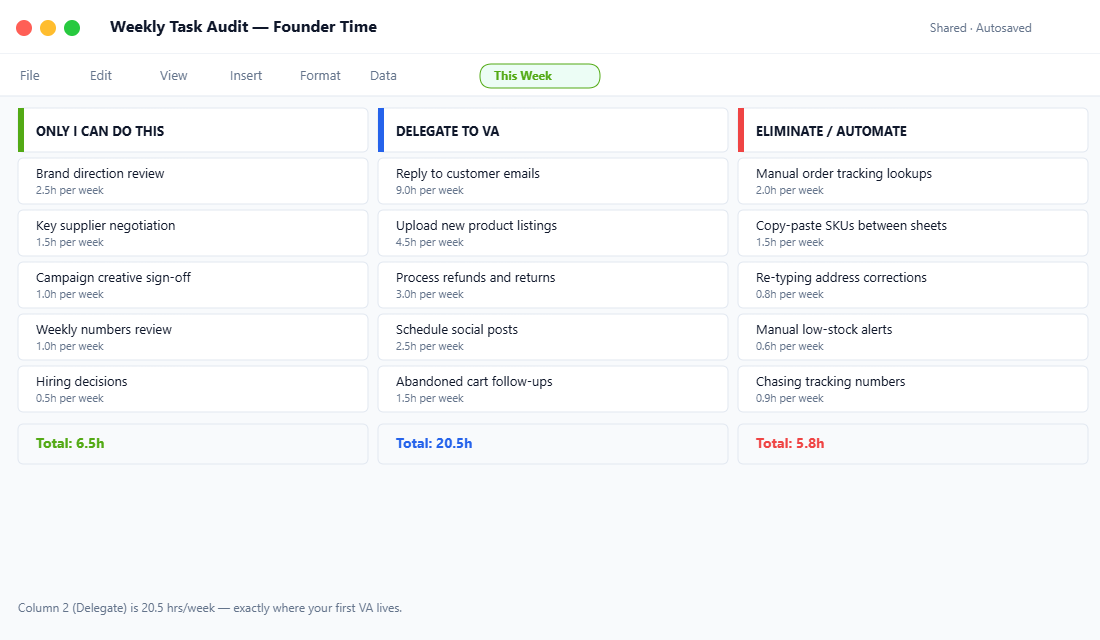
At the end of the week, open a spreadsheet and sort every task into three columns.
- Column 1: Only I can do this. Strategy, key supplier calls, creative direction, anything that needs your taste or your signature. This is usually about 20% of your week.
- Column 2: Someone else could do this if I documented it. Customer service replies, order issue resolution, product uploads, inventory adjustments, basic email campaigns, social post scheduling, abandoned cart follow-ups. This is usually 50 to 60% of your week.
- Column 3: Nobody should be doing this. Manual work that an app or automation should handle. Triaging duplicate emails. Copy-pasting order numbers between systems. Kill these before you delegate them.
Your first VA lives in Column 2. The first hire should eat a contiguous chunk of that column, not a sampler platter across five categories. If customer service is the biggest slice, hire a Customer Service VA.
If product and catalogue work eats your weekends, hire a Product Ops VA. Pick the single role that, if it disappeared from your calendar, would free the most high-value time.
Step 2: Define the Role Before You Hunt the Person
Once you know the role, write a one-page scorecard before you post a single job ad. This is not a generic job description copied from Seek. It is the internal document that keeps you honest when you are tempted to hire someone who “seems nice” but does not fit the brief.
A proper VA scorecard has five parts.
- Mission. One sentence that explains why this role exists. Example: “Own customer experience end to end so every buyer feels looked after and founder time is freed to work on growth.”
- Outcomes. Three to five measurable results the person must deliver in the first 90 days. Example outcomes for a Customer Service VA: 100% of customer emails answered within 4 business hours, refund rate kept under 2.5%, weekly VoC summary delivered every Friday, Trustpilot response rate above 85%.
- Competencies. The skills and traits required to hit the outcomes. Written English at a native or near-native level, Shopify admin familiarity, calm under pressure, proactive communicator.
- Tools. The exact stack they will work in. Shopify, Gorgias or Zendesk, Klaviyo, Slack, Loom, Notion.
- Logistics. Hours per week, time zone overlap, pay band, start date.
Write this in a Google Doc in plain language. If you cannot write the outcomes as numbers, you do not know the role well enough yet. Go back to Step 1 and look at your logs again.
Step 3: Where to Actually Find Good Ecommerce VAs in 2026
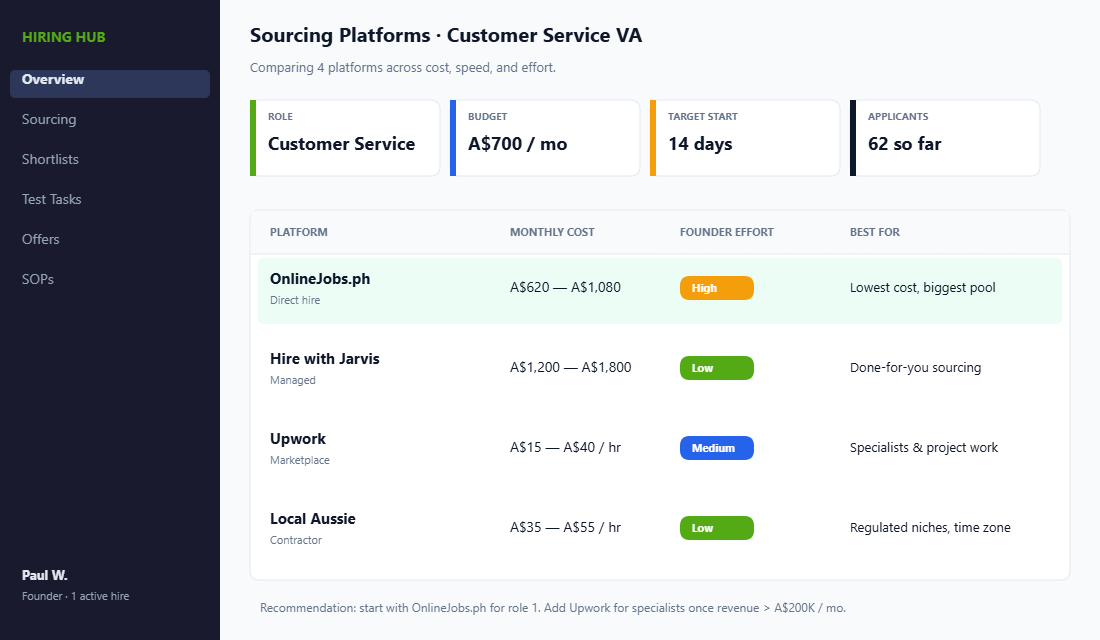
There is no single best platform. There are good platforms for different stages and budgets. Here are the four we see working for Aussie Shopify brands right now.
- OnlineJobs.ph. Direct access to Filipino talent, no middleman agency cut. A full-time ecommerce VA typically costs $400 to $700 USD a month ($620 to $1,080 AUD). You pay a $69 USD monthly platform fee while you recruit, then cancel once you have hired. Expect to review a lot of applicants. Reward: the lowest long-term cost per hour and a huge talent pool of English-fluent operators.
- Hire with Jarvis. Australian-run placement service that screens and matches Filipino VAs to Shopify brands. Higher per-hour cost than OnlineJobs.ph, lower effort on your end. Good if you do not have time to run a 100-application shortlist yourself.
- Upwork. Best for specific project work and for hiring more senior, specialised operators (Klaviyo specialists, Shopify developers, ads managers). Expect $15 to $40 AUD an hour for experienced ecommerce talent. Not the cheapest, but fast.
- Local Aussie contractors. A good option for sensitive customer service in regulated niches (health, pets, baby) where time zone overlap really matters. Expect $35 to $55 AUD an hour. Most Circle members start overseas and add a local hire for senior ops once they are past $200K a month in revenue.
One Australian cotton brand worth studying here is Goondiwindi Cotton. When retail wholesale orders dried up in 2020, they leaned into ecommerce and scaled 210% in three months by outsourcing Shopify operations to a specialist team instead of trying to hire a full in-house crew. You do not need an agency to get that same effect. You need your first VA, a tight role, and a clear set of SOPs.
Step 4: The 3-Stage Screening Process That Weeds Out 90% of Bad Hires
The biggest reason first hires fail is not interviewing. It is interviewing too shallowly. A resume and a 15-minute Zoom chat tell you almost nothing. Use a three-stage funnel instead.
Stage 1: The application gate. Your job ad should ask for three things: a one-minute Loom introducing themselves, their expected salary in AUD, and the answer to a specific question like “What is the first thing you would check in Shopify if a customer says their order never arrived?” Any applicant who skips one of the three is out. This single rule removes roughly 60% of applicants who are not paying attention.
Stage 2: The paid test task. Shortlist the top 5 to 8 from Stage 1 and pay them for a small, realistic task. For a Customer Service VA, give them five fake customer emails and ask for draft replies plus a quick summary of what the customer actually needs. Pay $20 to $40 AUD regardless of outcome.
You are not testing whether they will work for free. You are testing judgement, written English, and turnaround speed.
Most founders are shocked at how differently people respond to the same five emails. The right hire is usually obvious by email number three.
Stage 3: The culture and context interview. Only now do you get on a 30-minute Zoom. Skip the “where do you see yourself in five years” theatre. Ask three things instead: talk me through the paid task and how you made each decision; what is one time you handled an angry customer; what questions do you have for me about how we run things.
You are looking for self-awareness, ownership, and curiosity. You are not looking for a sales performance.
If you run all three stages properly, you will end up hiring the right person first time about 80% of the time. Skip them and it drops to a coin flip.
Step 5: The First 30 Days (Onboarding That Actually Works)
A good VA can take two to four weeks to hit full productivity. In ecommerce specifically, benchmarks suggest most VAs reach 70 to 80% of target productivity by day 30 if they have clear SOPs. The founders who complain that “their VA did not work out” almost always missed the first 30 days.
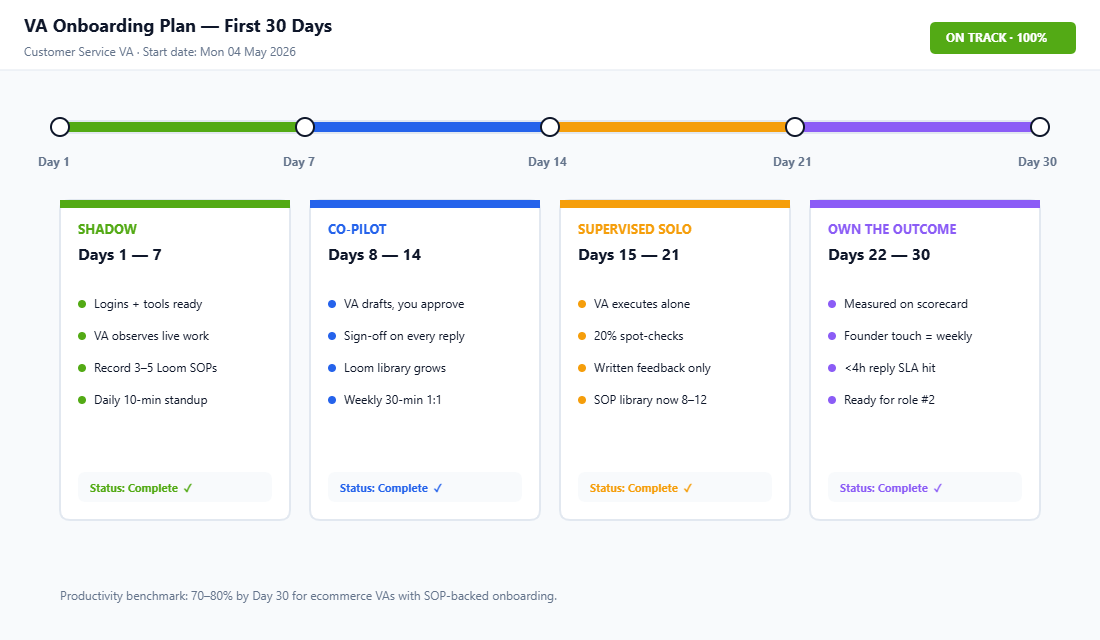
Here is the 30-day structure we use inside Circle.
- Day minus 3 (before they start). Set up all logins. Shopify staff account with the right permissions, Gmail or help-desk access, Slack, Loom, Notion or ClickUp. Create a single onboarding page with their scorecard, links to every tool, and the first two SOPs they will need. Expect to spend 2 to 3 hours here. It saves 20+ hours of chaos later.
- Days 1 to 7: Shadow and read. They observe you handling live work. Every time you do a recurring task, you screen-record it with Loom and drop the link into the SOP doc. By the end of week one you should have 3 to 5 Loom-backed SOPs. Daily 10-minute standup to unblock them.
- Days 8 to 14: Co-pilot. They draft, you approve. Every customer reply, every product update, every campaign starts in draft form and you sign off. This is where most real training happens. Keep the standup to 10 minutes. Save longer questions for a weekly 30-minute 1:1.
- Days 15 to 21: Supervised solo. They execute without pre-approval. You spot-check 20% of their work. Feedback is written, not verbal (so it sticks).
- Days 22 to 30: Own the outcome. They are now measured on the scorecard outcomes, not on activity. By day 30, the SOP library should have 8 to 12 documents, and your involvement in the role should be down to a weekly 1:1 and a monthly review.
Write the dates on your calendar. If day 30 arrives and you are still approving every reply, the issue is almost never the VA. It is that you have not let go. That is a skill too, and it takes practice.
Step 6: The Delegation Stack (Tools That Make Remote Work, Work)
Do not overthink your tool stack. You need four things, and you probably already pay for three of them.
- Async video: Loom. Record every recurring task the first time you do it in front of your VA. Loom turns your working-out-loud into a searchable SOP library. Free plan is fine to start.
- Knowledge base: Notion or Google Docs. One parent page titled “Playbook”, with sub-pages per role. Every Loom link goes here next to a one-paragraph text summary. Notion has better search; Google Docs is quicker to stand up.
- Work management: ClickUp, Trello, or Asana. One board per role, columns for Backlog, This Week, In Progress, Waiting on Founder, Done. Keep it simple. Resist the urge to build a 17-column workflow you will never maintain.
- Communication: Slack. Create two channels: one for the VA’s role (everything about the job) and one for company-wide. Email is where tasks go to die. Slack plus a weekly 1:1 is plenty for a first hire.
The whole stack costs well under $100 AUD a month at a one-person-plus-VA scale. If you find yourself shopping for a sixth tool in the first 90 days, stop. The problem is not your tooling. It is the SOPs.
Step 7: What to Pay, When to Raise, and When to Promote
Pay ranges for ecommerce VAs in 2026 are reasonably settled. Here is what we see Circle members actually paying for full-time Filipino VAs working a 40-hour week.
- Entry-level ecommerce VA (0 to 1 year experience): $500 to $700 AUD a month.
- Intermediate (1 to 3 years, owns a clear role): $800 to $1,200 AUD a month.
- Senior (3+ years, managing other VAs, owning a function): $1,400 to $2,200 AUD a month.
Two rules that will save you a lot of pain. First, honour the 13th month bonus at the end of December. It is legally expected in the Philippines and is effectively one extra month of salary.
Budget for it from day one. Second, review pay every 6 months, not every 12.
A good VA will be a very different operator at month 7 than they were at month 1. Lock them in with small, predictable raises before the market poaches them.
Promotion works the same way. When your first VA is running their role at 90%+ of scorecard every month, that is your signal to either expand their role (they now own the next function too) or have them help you hire and train VA number two. Either path builds the muscle you need to go from one hire to a team.
The Compound Effect: From First Hire to Full Team
Here is what founders miss when they look at a $700 a month VA and say “that is expensive”. Run the maths properly.
A well-onboarded first VA takes 15 to 20 hours a week off your plate. If your own time is worth even a conservative $100 AUD an hour at founder level, that is $1,500 to $2,000 a week of capacity returned to the business. Against a $700 monthly cost, you are looking at roughly 10x ROI before you even factor in what you do with the reclaimed hours. Most Circle members use that time to work on promotion, product, and platform work that compounds.
There is a second, quieter compounder. The SOPs you built to onboard VA number one make VA number two take half as long to get productive. By the time you hire your fourth operator, onboarding is a repeatable system, not a 30-day founder-intensive project.
That is the real prize. Your business stops depending on your personal throughput and starts running as a set of roles.
That is why People is one of the 10 P’s of the More Orders Operating System. The first hire is not just a cost. It is the hinge moment where your business stops being a job and starts being a business.
Your First VA Checklist
Print this, screenshot it, or save it. If you work through these 10 items in order, you will hire your first VA without wasting months or thousands of dollars on the wrong person.
- Run a 7-day task audit and sort every task into 3 columns.
- Pick the single biggest “delegate” chunk as the role for VA number one.
- Write a one-page scorecard with mission, outcomes, competencies, tools, and logistics.
- Pick a platform based on budget and your available hiring time (OnlineJobs.ph, Hire with Jarvis, Upwork, or local).
- Post a job ad with a three-part application gate (Loom, salary, screening question).
- Shortlist 5 to 8 and run a paid test task ($20 to $40 AUD).
- Run a 30-minute context interview with your top 2.
- Make the offer in writing with clear start date and 90-day outcomes.
- Set up logins, Loom, Notion, and Slack before day 1.
- Run the 30-day onboarding arc: shadow, co-pilot, supervised solo, own the outcome.
Do the work once, build the SOPs while you do it, and you will never hire a VA the hard way again.
What a Shopify VA Should Actually Cost You in 2026
Before you compare platforms, anchor on what the role costs end-to-end. Most founders underestimate the all-in cost by 40-60% because they only count the hourly rate. Here are realistic 2026 ranges for Aussie brands hiring full-time, English-fluent, ecommerce-specialised VAs.
- Junior Shopify VA (Philippines, full-time, 40 hours/week): $800-$1,200 AUD/month. Best for product uploads, basic Klaviyo support, customer service tier-1.
- Mid-level Shopify VA / specialist: $1,400-$2,200 AUD/month. Klaviyo flows, Shopify theme edits, Meta Ads support, GA4 reporting.
- Senior ecommerce manager (Philippines): $2,400-$3,800 AUD/month. Full ad management, project leadership, can run your daily operations.
- Upwork hourly (mixed quality): $8-$40 AUD/hour depending on country and skill level.
- Hire with Jarvis (managed): Typically $1,800-$2,800 AUD/month all-in with screening, replacements, and support included.
Add 10-15% for software (Time Doctor or Hubstaff, Loom Pro, password manager, Slack), 5-8% for occasional bonuses, and 2-3 weeks of paid onboarding time before they are productive. The true all-in cost of a mid-level VA is usually $2,000-$2,800 AUD/month in year one and $1,600-$2,400 AUD/month in year two onwards.
The Shopify Tasks Worth Outsourcing First (and the Ones to Keep)
The biggest mistake Aussie founders make is hiring a VA before deciding what they will actually own. The result is a $2,000-a-month employee who does a bit of everything and masters nothing. Use this priority list to scope the first hire and the second.
- Outsource first (highest ROI, lowest risk): Product uploads and metafield updates, customer service tier-1 via Gorgias or Zendesk, Klaviyo campaign building (not strategy), order tagging and 3PL liaison, daily inventory and stock alerts, reporting pulls from Shopify and GA4.
- Outsource second (after the first VA proves out): Email and SMS flow building, Meta and Google Ads day-to-day execution (under your strategy), basic Shopify theme tweaks, blog publishing and image optimisation, returns processing.
- Keep in-house (founder or senior local team): Brand and creative direction, supplier and 3PL relationships, financials and net profit accountability, hiring and firing, big strategic bets.
If you want the structured way to ramp a new VA without losing six weeks of productivity, our 30/60/90 onboarding framework shows you exactly what each week should look like.
The Tools That Make a Remote VA Actually Work
- Loom Pro: The single best tool for training a remote VA. A 5-minute Loom replaces a 45-minute call. Build a Loom library before they start.
- Time Doctor or Hubstaff: Honest tracking for hourly arrangements. Not for surveillance, for trust. Aussie hours vs. Manila hours need a shared source of truth.
- 1Password or Bitwarden: Never share Shopify, Klaviyo, or Meta passwords directly. Use a vault with role-based access.
- Slack with a single #daily-standup channel: One async standup post per day beats a daily Zoom for time-zone-mismatched teams.
- Notion or ClickUp: One source of truth for SOPs, tasks, and weekly reviews. Whichever the VA is faster in.
- Two-factor on every account: Use Authy or 1Password so you can rotate access cleanly if a VA moves on.
Red Flags to Watch For (and Avoid)
- No portfolio or proof-of-work from a real Shopify store: If they cannot show you a store they have actively managed, you are paying for their learning curve.
- Asking for full payment upfront before week one: A small deposit is reasonable. A month upfront is a scam pattern.
- Vague time-zone overlap: “I can work any hours” usually means “I have two other clients during the day”. Insist on a 3-4 hour Aussie business hours overlap minimum.
- Cannot describe a basic Klaviyo flow or Shopify metafield in their own words: Their resume is fiction.
- Disappears for 48 hours without notice in week one: Cut the cord. The behaviour does not improve.
Aussie Time Zone Strategy: Making Filipino VA Hours Work for You
The Philippines is 2-3 hours behind AEST. That sounds inconvenient. It is actually a hidden advantage if you set the rhythm right.
Imagine you run a Melbourne homewares store. Your day starts at 8am AEST. Your VA in Manila starts at 6am their time (8am AEST sharp).
You have a 30-minute Loom or async stand-up at 8:15am AEST, you record the brief, they catch it the moment they sit down. By 11am AEST, the VA has cleared the inbox, fulfilled overnight orders, and pushed the day’s Instagram post live. You spend the rest of your morning on growth work instead of operations.
Better still: schedule deep work or “no-meeting” tasks for the VA between 3pm and 6pm AEST. They work into their evening (5pm-8pm Manila) without disruption, and you wake up to completed work the next morning. Aussie founders who use this pattern routinely get 10-12 productive hours of VA output for 8 hours of pay, simply because the work flows asynchronously instead of needing constant supervision.
For roles that need real-time customer service or live ad management, hire a VA willing to work AEST hours (8am-5pm AEST = 6am-3pm Manila). Expect to pay 15-25% more for the time-zone shift, typically $7-9 USD/hour instead of $5-7. Worth every cent for a Shopify support VA handling live chat.
The 2026 Aussie VA Pay Bands (What’s Actually Working)
Salary expectations in the Philippines have climbed 15-20% since 2024 as good Shopify VAs get poached repeatedly. Here are the bands we see in our member base for 2026:
- General admin VA (1-2 years experience): $4-6 USD/hour or $700-1,100 USD/month full-time. Suitable for inbox, basic product uploads, scheduling.
- Shopify-specialist VA (2-4 years experience): $6-9 USD/hour or $1,100-1,600 USD/month full-time. Confident with Shopify admin, Klaviyo edits, basic Liquid tweaks, returns processing.
- Senior ecommerce VA / VA team lead (4+ years): $9-14 USD/hour or $1,600-2,400 USD/month. Can manage other VAs, run Klaviyo campaigns end-to-end, edit themes, manage Meta and Google Ads at a tactical level.
- Filipino-based marketing or design specialist: $12-20 USD/hour for Klaviyo email designers, Canva specialists, or junior Shopify devs. Often equal-quality work to Aussie freelancers at a third of the rate.
Pay monthly via Wise or Deel to avoid bank-fee leakage (Wise transfers run about 0.4-0.6% all-in versus 4-6% via traditional bank wires). Build in a 13th-month bonus equal to one month’s salary, paid in December, it is a cultural standard in the Philippines and skipping it telegraphs that you do not understand the labour market. Top performers should get 10-15% raises after 12 months. That is still cheap by Aussie standards and it dramatically reduces churn.
The True Landed Cost of a VA (Not Just the Hourly Rate)
Platform comparisons focus on hourly rates, which is the smallest part of the picture. The rate is what you pay. The landed cost is what the hire actually costs you before it starts returning anything.
- The rate itself. A capable Philippines-based ecommerce VA generally runs somewhere around AUD $8 to $15 per hour depending on specialisation, with Shopify-specific and paid media skills sitting at the upper end. Eastern European and Latin American talent typically lands higher again.
- Platform or agency margin. Direct-hire boards charge a flat monthly posting fee. Managed services bundle sourcing, payroll and cover, which usually adds 30 to 50% on top of the raw rate. That premium is worth paying on your first hire and rarely worth it by your third.
- Your own time in the first month. Budget 20 to 30 hours of your own time across onboarding, documentation and review. At a founder opportunity cost of $150 an hour, that is $3,000 to $4,500 in real cost before the VA is productive.
- Tooling and access. An extra Shopify staff seat, a password manager seat, project management, Loom and a time tracker. Figure on $50 to $120 per month per person.
- Ramp time. Most VAs reach genuine autonomy on a defined task set somewhere between weeks 4 and 8. Anyone promising productivity in week one is selling you something.
Add it up and a $12 an hour VA working 30 hours a week costs closer to $2,500 a month all-in for the first quarter, settling to around $1,700 after that. Still excellent value against an Australian hire, but plan the cash for it rather than being surprised by it.
The First 30 Days: The Onboarding System That Decides Whether the Hire Sticks
Nearly every failed VA relationship traces back to the same root cause, and it is almost never the VA. It is a founder who hired someone to take work away, then had no documented way to hand that work over. Run these four weeks deliberately.
- Week 1: One task, documented end to end. Pick your most repetitive task, record yourself doing it once in Loom, write the steps underneath, and have the VA do it while you watch. Resist the urge to hand over five things at once.
- Week 2: The VA writes the SOP. Have them document the task back to you in their own words. This is the single highest-return habit in the whole relationship, because it proves comprehension and builds your process library at the same time. Over six months this quietly becomes your operations manual.
- Week 3: Add task two, keep task one unsupervised. Introduce a daily written check-in covering what was done, what is blocked and what is next. Five lines, same time every day. It replaces most meetings.
- Week 4: Review against defined outcomes. Not hours worked. Orders processed, tickets resolved, listings updated, response time. Agree the numbers up front so the review is a conversation about results rather than effort.
Time zones are your friend here rather than an obstacle. A Manila-based VA working their morning covers your overnight, which means support tickets that arrived at 11pm are answered before you open your laptop. Aussie stores that get this right often see first-response times drop from 12 hours to under 2.
Once the first hire is stable, the constraint shifts from finding people to having systems worth handing them. The SOP library gives you the documentation backbone, the delegation playbook covers what to hand over and in what order, and the 30/60/90 day onboarding playbook extends this structure past the first month.
For more founder-level playbooks, see our companion guide on the 30-60-90 day onboarding framework for the next stage after hiring, or browse the full Insights library. If you are also weighing agency support alongside VA hiring, our guide to choosing an ecommerce agency in Australia is a useful read.
The Friday VA Scorecard: 5 Numbers That Tell You If the Hire Is Working
Most VA hires fail slowly. Nobody makes a decision because nobody is measuring anything, and six months later you realise you are still doing half the work yourself. A one-page scorecard reviewed every Friday fixes that.
Pick five numbers that match the role, track them in a shared Google Sheet, and spend 15 minutes on a call walking through them. Here is a starting set for a general Shopify operations VA:
- Customer service first response time. Target under 4 business hours in Gorgias or Zendesk. Under 2 hours is excellent.
- Tickets resolved without escalation. Aim for 80% or more by week eight. If you are still answering half the tickets, the SOPs are the gap, not the person.
- Orders fulfilled or flagged same day. 95% or higher. Late flags on out-of-stocks are the most common early miss.
- SOPs written or updated. One a week for the first 12 weeks. This builds the library that lets you hire the second VA in half the time.
- Founder hours saved. Track your own hours on the tasks you handed over. The goal is 10 hours a week by day 60 and 15-20 by day 90.
Use traffic lights, not paragraphs. Green means on target, amber means within 20% of it, red means below that. Two reds in a row triggers a coaching conversation. Three reds in a row across two numbers means you revisit the role, the SOPs or the hire.
A Worked Example: The First 90 Days at a 60K-a-Month Store
Imagine you run a Brisbane homewares brand doing $60K a month. You are working 55 hours a week and spending 18 of them on customer service, order issues and product uploads. You hire a mid-level Filipino VA through OnlineJobs.ph at $1,600 AUD a month, plus about $150 a month in tools (Gorgias seat, Loom, Google Workspace).
By day 30, your VA is handling tier-1 tickets with a response time of 5 hours and you have saved 6 hours a week. By day 60, response time is down to 3 hours, 11 SOPs exist, and you are saving 12 hours. By day 90, your VA owns product uploads, stock alerts and the returns queue, and you are back to 40 hours a week.
The maths: $1,750 a month all in, for 15 hours a week of founder time returned. That is roughly $27 an hour. If you spend even half of those hours on work that grows revenue, such as supplier negotiations, new product development or partnerships, the hire pays for itself many times over.
For the full framework on what to hand over first, read our delegation playbook. If you want a structured way to assess candidates before you hire, the hiring scorecard playbook gives you the interview rubric to pair with this weekly scorecard.
Let’s Talk About Your First (or Next) VA Hire
The right VA buys you back 15-25 hours a week. The wrong one costs you that plus a margin hit and a confidence dent. If you would like a second opinion on the role, the platform, or the onboarding plan, that is what we do inside eCommerce Circle.
Inside the eCommerce Circle, People is one of the core pillars we work on with every member. Most Aussie Shopify founders in the $30K to $400K a month range are one or two smart VA hires away from getting their weeks back. We have helped hundreds of brands do exactly this, including the hiring ads, the SOP libraries, the test tasks, and the first 30-day plan. If you want to stop being the bottleneck in your own business, the fastest path is a conversation.