Your first Shopify sale almost never comes from ads or SEO. It comes from 20 to 50 people you can contact directly, shown one clear offer, inside your first 14 days.
Most new store owners do the opposite. They spend a month on the logo and theme, load $300 into Meta Ads, then watch strangers land on a store with no reviews, no brand recognition and no reason to trust it. Nothing happens. They decide ecommerce is broken and start tweaking fonts.
The founders who get orders fast treat the first sale as a trust problem, not a traffic problem. They go to the people who already trust them (or can be reached in a single message), they make one irresistible offer, and they track every conversation in a simple sheet. This guide gives you that exact 14-day sprint, with scripts, a tracker and the tool setup. Start the clock today and you can have a real order before the end of November.
Why Your First Sale Feels So Hard (and Why Traffic Is Not the Fix)
Demand is not the issue. Australia Post reports Australians spent a record $82.6 billion online in 2025, around 24% of all retail spending, with 9.8 million households (82%) buying online. People are shopping. They are just not shopping from a store they have never heard of.
Then there is conversion. Andava puts the Australia-wide ecommerce conversion rate at about 1.78% for 2026, and Dynamic Yield puts APAC at 1.7%. At 1.78%, you need roughly 56 visitors for every order. That is for established stores with reviews, repeat customers and brand search. A store with zero proof will convert below that average, so a $300 ad budget buying 150 clicks is statistically likely to return two orders at best, and often none.
Compare that with a message to a friend who already trusts you. Nielsen research, widely cited, found 92% of consumers trust recommendations from people they know, and that people are around four times more likely to buy when a friend refers them. Warm traffic is not a nice-to-have. It is the fastest, cheapest way to prove your store works.
The goal of the first 14 days is not scale. It is proof: one order, one review, one photo of a happy customer, and one data point on what you said that made them buy. Everything after that gets easier.
Step 1: Make Your Store Sale-Ready in 90 Minutes (Not 3 Weeks)
A store does not need to be pretty to make a first sale. It needs to be trustworthy and clear. Spend 90 minutes on this checklist before you message a single person, because sending a friend to a broken checkout burns your best shot.
- One product, one hero page. A clear title, 5 to 7 photos (include one in someone’s hand or in use), a price in AUD including GST, and a 3-sentence benefit description. Link to your own product description playbook if you are stuck on copy.
- Shipping stated in plain words. “Ships from Brisbane in 1 to 2 business days. Free over $80” beats a vague “fast shipping”. Aussies check delivery time before they check anything else.
- Returns and contact info visible. A short returns policy, a real email address and a real name on the About page. Faceless stores do not get first orders.
- Payments that match how Aussies pay. Shop Pay, Apple Pay and Google Pay on, plus Afterpay or Zip if your average order is over about $80.
- A real test order. Create a 100% discount code, place an order from your phone, and check the confirmation email, the order in Shopify and the mobile checkout. Fix anything that feels clunky.
- Pricing that survives a sale. Know your gross margin before you offer anything. If you have not done the maths, our guide to starting an online store in Australia covers the real costs.
On cost: Shopify’s Australian pricing page currently shows a 3-day free trial, then $1 a month for your first 3 months on most plans. After that, the Basic plan is $42 a month billed yearly or $56 month to month (excluding GST). So the barrier to testing is tiny. Do not wait for a perfect store to start selling.
If you want to go deeper after your first sale, the Shopify CRO audit checklist is the next step. For now, clear and trustworthy is enough.
Step 2: Pick One Offer and One Buyer (The Prospects Rule)
The biggest early mistake is describing your store to everyone. “We sell lovely things for the home” gives people nothing to say yes to. A first-sale offer has three parts: a specific buyer, a specific problem and a specific product that solves it.
Use this sentence to test yours: “I sell [product] to [specific person] who is struggling with [specific problem], so they can [outcome].” If you cannot say it in one breath, narrow it. A dog owner whose kelpie keeps destroying standard toys is a buyer. “Pet lovers” is not.
Then choose your launch offer. For a first sale I favour a risk reducer over a discount: free shipping on the first order, a free sample add-on, or a clear satisfaction guarantee. A blanket 20% off teaches your first customers that your price is negotiable, and it hurts margin you need on the first 20 orders. If you do use a discount, keep it small, time-limited (7 days), and tied to a reason such as “founding customer”.
Write the offer down. You will use the exact same wording in every message, post and email for the next 14 days. Consistency lets you see what is working.
Step 3: The Warm Outreach Method (Where Most First Sales Actually Come From)
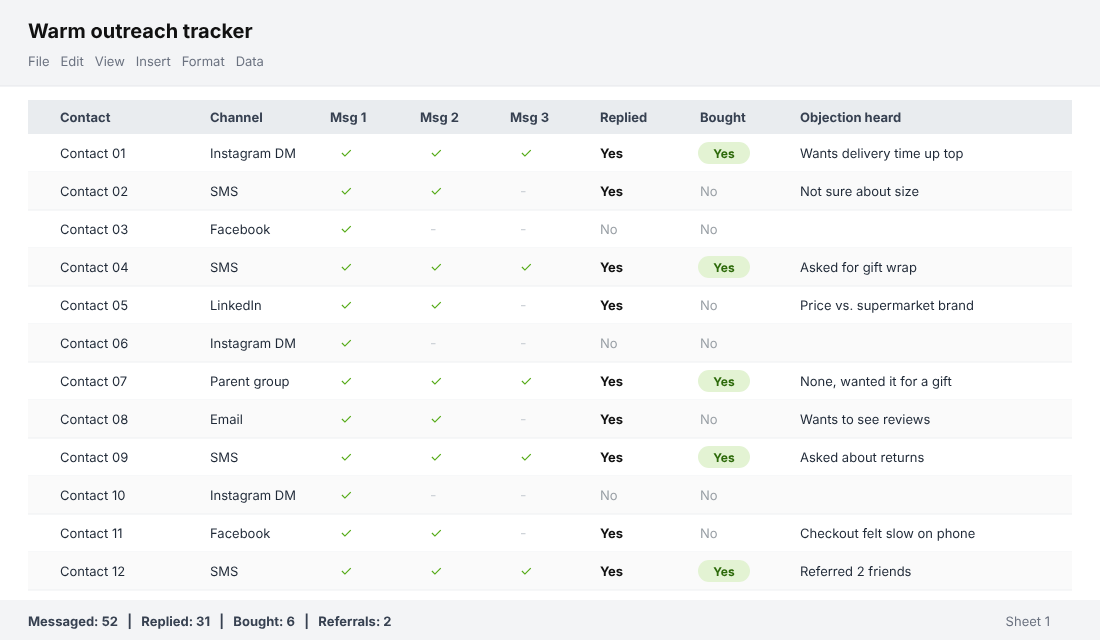
Open your phone. Scroll your contacts, Instagram followers, Facebook friends, old workplaces, school and sports groups, parent chats and LinkedIn. Pull out 50 names who either fit your buyer or know someone who does. Put them in a sheet with these columns: name, channel, date messaged, replied, bought, referred someone.
This is the part founders dodge because it feels awkward. It is also the part that works. Ann-Maree Awad, founder of Australian candle and diffuser brand Amaree Collection, started with friends and family, never ran paid ads, and grew to around $200,000 in annual revenue through repeat customers and referrals, now stocked in more than 80 Australian stores. Teatox Australia made its first sale within days of sharing its new Shopify store link on Instagram. Neither started with a media budget. Both started with people.
The 3-message script
Do not copy and paste one broadcast. Send individual messages, and keep them short. Here is the structure that gets replies:
- Message 1, the ask for help (not a pitch): “Hey Sarah, I’ve just launched [brand], a [one-line offer]. Could I send you the link and get your honest thoughts? Five minutes max.”
- Message 2, the link and one question: “Here’s the store: [link]. What’s the first thing that stops you from buying?” That answer is gold, because it tells you what to fix.
- Message 3, the soft offer, 2 days later: “Thanks for the feedback, I’ve fixed [thing]. I’m giving my first 20 customers [offer]. Want me to hold one for you?”
Aim for 10 messages a day over five days. As a rough guide, expect close contacts to reply far more often than looser ones. If you message 50 people and 3 to 5 buy, that is a healthy start. Even more valuable: ask each buyer “Who do you know who’d love this?”. Our Shopify referral program guide shows how to formalise that once you have a handful of orders.
A note on the law: personal one-to-one messages are fine, but if you plan to add people to a marketing email list, Australia’s Spam Act 2003 requires consent and a working unsubscribe. Ask first, then add them.
Step 4: Seed Product to 10 Small Creators (The Gymshark Move, Scaled Down)
Warm outreach gets you the first handful of orders. Creator seeding gets you in front of cold-but-qualified people who already trust someone else. Gymshark’s story is the famous example: in 2013, with no ad budget, the founders gave free product to popular fitness YouTubers at a bodybuilding expo, and when those creators wore the gear on their channels, Forbes reported daily sales jumped from about $450 to $45,000.
Do not expect that result. Gymshark is an outlier, and your first seeding round will be small. But the mechanism is real and cheap: you trade one unit of stock for attention from an audience that already matches your buyer.
- Go small, not big. Target creators with 2,000 to 20,000 followers whose audience is exactly your buyer. They reply, they care, and they are far cheaper than anyone with a talent manager.
- Send 10 products, not 100 DMs. Message first: “I’d love to send you [product] free, no strings. Would you like it?” Only ship to those who say yes.
- Make it easy to buy. Give each creator a trackable link and a unique code (for example EMMA10) so you can see which creator drives orders.
- Ask for permission to reuse content. Their photos become your first product page proof and your first ad creative.
- Budget it. Ten creators at $25 cost of goods each plus $9 postage is under $350 total, and you get content as well as clicks.
If you want a deeper system for ongoing outreach, see our 3-hour weekly founder-led marketing plan.
Step 5: Capture Everyone You Reach (Free Klaviyo Setup, Step by Step)
Here is where most new stores lose sales without noticing: someone visits, likes it, gets distracted and never comes back. Your fix is to capture an email address before they leave and follow up like a human. You do not need to pay for this on day one.
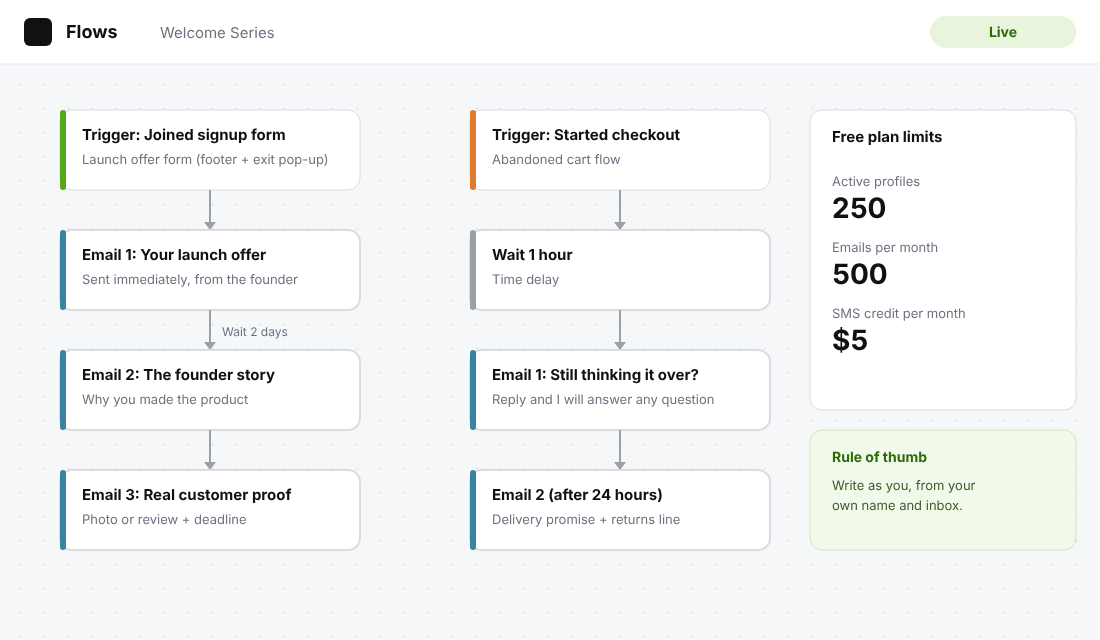
Klaviyo’s free plan currently covers up to 250 active profiles and 500 emails a month, plus $5 of SMS credit each month (per Klaviyo’s pricing page). That is more than enough for a first-sale sprint. Here is the setup:
- Install Klaviyo from the Shopify App Store and connect it to your store (about 5 minutes).
- Create a single signup form (embedded in your footer and as a pop-up on exit intent). Offer something specific, such as “Get a heads up when we restock” or your free-shipping launch offer, rather than a generic “Join our newsletter”.
- Turn on the Welcome Series flow with three emails: email 1 delivers the offer, email 2 tells the founder story and why you made the product, email 3 shows a customer photo or review (even a creator’s post) and repeats the deadline.
- Turn on the Abandoned Cart flow with 2 emails, one sent 1 hour after abandonment and one at 24 hours. Keep the tone helpful: “Still thinking it over? Reply to this email and I’ll answer any question.”
- Import only people who have said yes (friends who asked to hear updates, customers, creators who accepted product). Never upload a bought list.
Write the emails as you, from your name and email address. At this stage, a founder with a face and a reply button beats any template. If you later want a full flow architecture, see our guide to the 9 Klaviyo flows every store needs.
Step 6: Remove the Three Doubts That Stop First Orders
Every first-time buyer has the same silent questions: Is this store real? Will it arrive? What if it is wrong? If your page does not answer them in about five seconds, they leave. You do not need 200 reviews to answer them. You need three things.
1. Visible proof
Show something real above or just below the add to cart button. Before you have reviews, use a creator’s photo, a screenshot of a friend’s message (with permission), a founder note, or a testing result such as “tested by 12 customers for 30 days”. After your first three orders, send a review request within 7 days of delivery.
2. A delivery promise you can keep
Put the dispatch time and expected delivery window on the product page and in the cart. Promise a bit longer than you need. Beating a promise earns trust, while missing one costs you a review.
3. A risk reducer
A simple “30-day happy or return it” line near the buy button tends to lift first-time conversion. Keep your actual returns policy short and in plain English. It also protects you legally as a seller under Australian Consumer Law.
Before you add anything else, spend 30 minutes on your mobile experience. Open your store on your own phone, find the product, add it to cart and check out. Most first-time buyers will be on mobile, so any friction there costs real orders.
The 14-Day First Sale Sprint (Copy This Calendar)
This is the takeaway. Print it, paste it into Notion or a Google Sheet, and work down the list. The aim is not perfection. It is 14 days of consistent contact with real people.
- Day 1: Complete the sale-ready checklist. Place a real test order.
- Day 2: Write your one-line offer. Build your 50-name warm list.
- Day 3: Install Klaviyo. Set up the signup form and 3-email welcome flow.
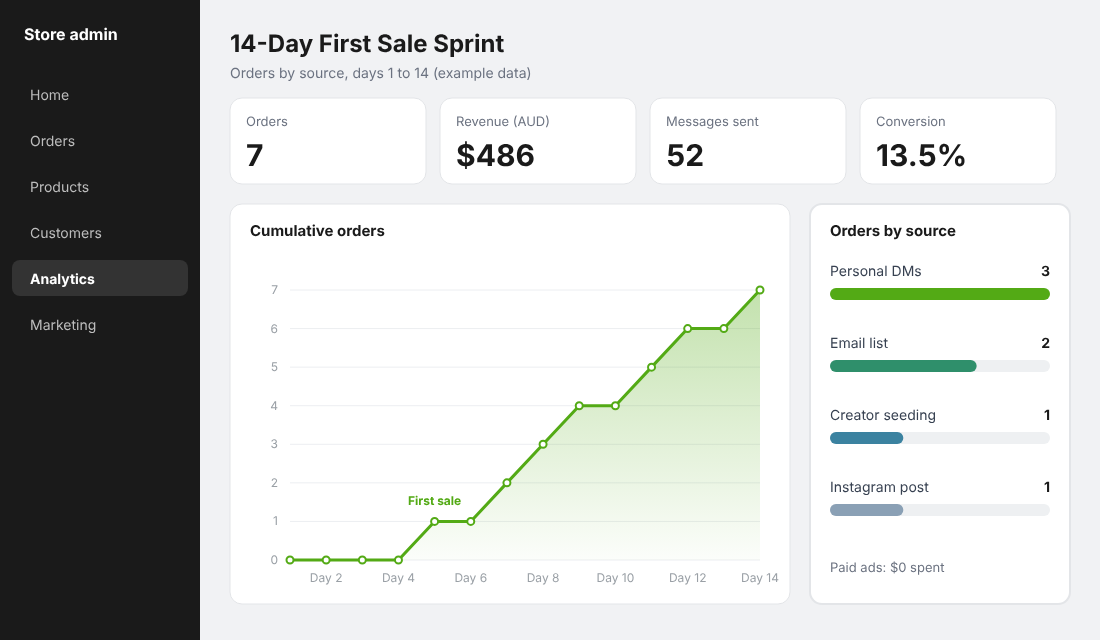
- Days 4 to 8: Send 10 personal messages a day (message 1, then 2). Log every reply in your tracker.
- Day 6: Choose 10 small creators. Send the permission message.
- Days 8 to 10: Send message 3 with your launch offer. Ship creator product within 48 hours of a yes.
- Day 10: Ask every buyer for a photo and one sentence of feedback. Ask who else would love it.
- Day 12: Review the tracker. What objection came up most? Fix it on the page.
- Day 14: Post your first customer result to your own social account. Count orders, replies and creator clicks. Decide the next 14 days.
What If You Get to Day 14 With Zero Orders?
It happens, and it is useful. Use this rule to diagnose it.
- Fewer than 40 people messaged: You have not tested the offer yet. You tested your comfort zone. Send 40 more messages.
- 40 or more messaged, lots of interest, no purchases: The store has a trust or checkout problem. Ask the next 10 people to screen-share or describe where they got stuck.
- 40 or more messaged, little interest: The offer is wrong. Change the buyer, the problem or the product angle, then repeat for another 7 days before spending anything on ads.
- Orders but low repeat interest: Check your margin and product quality before you scale. A low-margin first sale is a warning, not a win.
Do not move to paid ads until you have around 5 orders and a clear idea why people bought. Ads amplify a message that already works. They cannot repair one that does not.
The Compound Effect: From One Order to a Repeatable Engine
The point of the first sale is not the $60 in revenue. It is what it unlocks. Look at how the pieces connect:
- The warm outreach gives you your first orders and your first honest objections.
- Those objections fix your product page, which lifts conversion for every later visitor.
- The first orders become reviews and photos, which become your trust layer on the page and in ads.
- The creators you seeded give you content and a few trackable sales, and tell you which audience responds.
- The email list means every visitor you pay for later has a second chance to buy.
- Each happy buyer becomes a referral source, so customer two and three cost almost nothing.
By day 30, you are not hoping for sales. You know who buys, what to say to them and where to find more of them. That is the point where Meta Ads, SEO and wider outreach start to make economic sense. It is also why we put trust and proof ahead of traffic in the More Orders Operating System.
Inside eCommerce Circle, building the first 100 orders on a repeatable system is one of the core pillars we work on with every member. If you want to see exactly where your store is being capped, take the free More Orders Scorecard. It takes two minutes and shows you which of the 10 P’s to fix first.