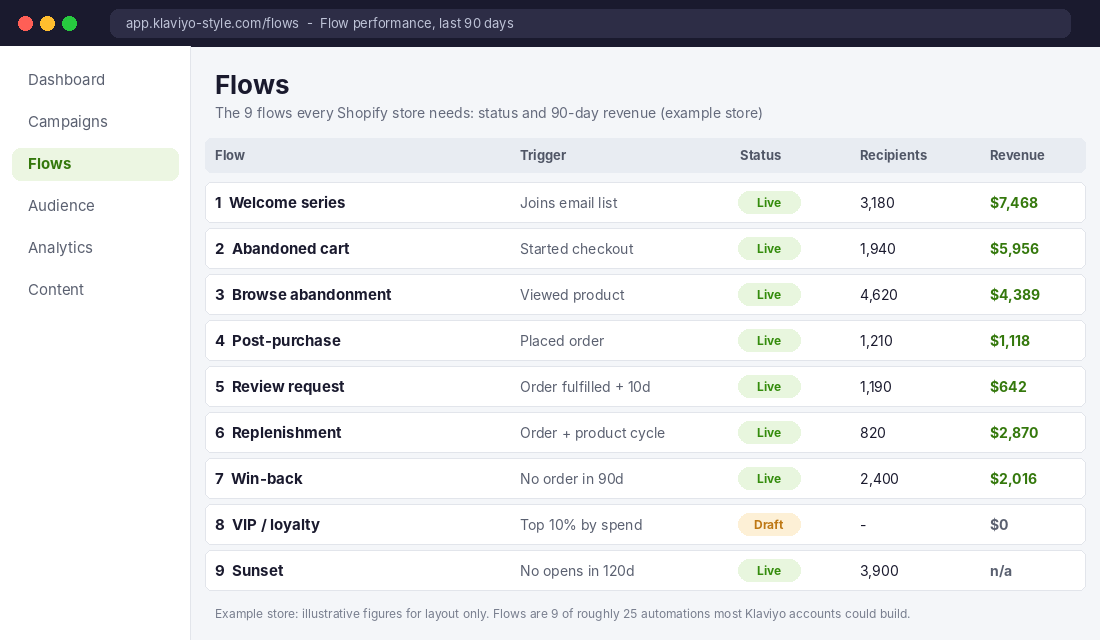
Klaviyo flows are the automated email sequences that send themselves when a shopper does something: joins your list, starts checkout, views a product, buys. Every Shopify store needs nine of them, and most stores we audit have three. Klaviyo’s own benchmark data shows why that gap is expensive: flows make up about 5.3% of sends but generate nearly 41% of email revenue.
What’s in This Article
Here is the part most founders get wrong. They treat email as a weekly newsletter, spend Sunday night writing a campaign, and wonder why revenue per send keeps sliding. Meanwhile the shopper who abandoned a $180 cart on Tuesday got nothing, the customer who bought a 60-day product has not heard from you since day one, and 3,000 dead addresses are quietly dragging your inbox placement down.
This guide lists the nine flows in the order we build them with stores inside eCommerce Circle, what each one should do, what to measure, and what a healthy number looks like. You will also get a coverage scorecard and a 30-day build plan at the end, so you can finish this article with a to-do list instead of a head full of ideas.
Why Flows Beat Campaigns (The Numbers)
A campaign goes to a list. A flow goes to one person at the moment they are most likely to act. That difference shows up in every benchmark we have seen.
Klaviyo’s 2026 benchmark page, drawn from over 183,000 Klaviyo customers, reports that flows earn nearly 18 times the revenue per recipient of campaigns, with a click rate of 5.58% against 1.69%. Flows also have a placed order rate about 13 times higher. And here is the number that matters for growth: about 48% of flow-driven email revenue comes from new buyers, against 16% for campaigns. Flows are not just a retention tool. They convert people who have not bought yet.
Australian brands are seeing the same pattern. In sponsored Klaviyo content published by SmartCompany, Hismile reported 43% year-on-year revenue growth from flows on its flagship Australian account, and esmi Skin Minerals said 80 to 85% of its revenue comes from repeat customers, helped by replenishment flows. Treat vendor-reported numbers with care, but the direction is consistent with the independent benchmarks.
Koala Eco is a useful example of the build-first approach. Before moving to Klaviyo it ran only a few flows on Mailchimp. After launching what Klaviyo’s case study calls net-new abandonment flows, it reported 62% year-on-year growth in Klaviyo-attributed revenue in the US over the last 90 days, plus a 20% increase for Australia. The flows did not need clever copy. They needed to exist.
Before You Build: The Klaviyo Setup Checklist
Every flow below depends on clean data. If the Shopify connection is half-finished, your triggers fire late or not at all. Spend 30 minutes on this first.
- Connect Shopify properly. In Klaviyo, go to Integrations, add the Shopify integration and let the historical sync finish before you build anything. Check that order, product and customer data all appear on a test profile.
- Turn on onsite tracking. Browse abandonment and the abandoned cart (before checkout) rely on Klaviyo’s onsite tracking script being active in your theme. Enable the Klaviyo app embed in your Shopify theme editor, then view a product on your own store and confirm a Viewed Product event shows on your profile.
- Set your sender identity. Authenticate your sending domain (SPF, DKIM, DMARC) and use a branded from-address, not a free webmail one. Our email deliverability guide covers the DNS records step by step.
- Check consent. Under Australia’s Spam Act 2003, commercial emails need the recipient’s consent and a working unsubscribe. Flows triggered by a purchase are transactional-adjacent, but your welcome series depends on a clear opt-in. Keep your sign-up form wording plain.
- Know what it costs. At the time of writing, Klaviyo’s free plan covers up to 250 active profiles and 500 email sends a month. The Email plan starts at about US$20 a month for 500 active profiles and roughly US$150 at 10,000 profiles, according to MoEngage’s 2026 pricing guide, which bases its numbers on Klaviyo’s list pricing. Prices are in USD and change, so confirm on Klaviyo’s Australian pricing page before you budget.
If you are still deciding between platforms, our Klaviyo vs Omnisend comparison lays out where each one wins. Everything below also works in Omnisend, but the flow names and triggers differ slightly.
Flow 1: Welcome Series (Turn Subscribers Into First Buyers)
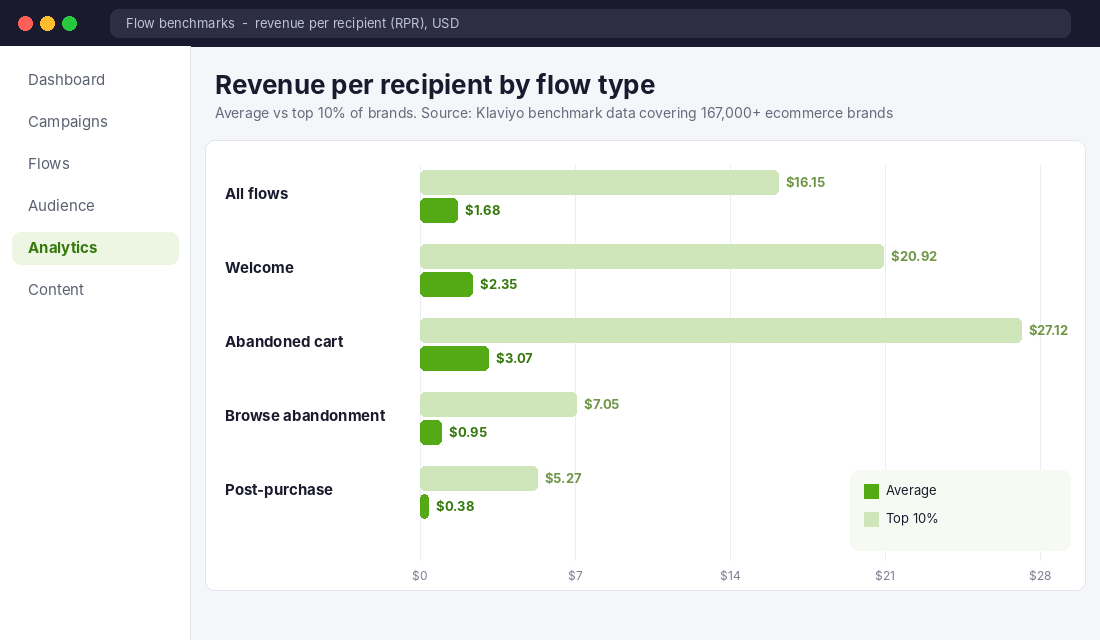
The welcome series fires when someone joins your list. It is the first impression you control, and for most stores it is the best-performing flow after abandoned cart. Klaviyo’s benchmark data across 167,000-plus brands puts average welcome flow revenue per recipient at $2.35, while the top 10% of brands earn $20.92. That is nearly a ninefold gap from the same flow type.
What separates the two groups is rarely design. It is sequence logic. Top stores send three to five emails across about a week: who you are, your best-seller with proof, your guarantee and shipping, then a reason to buy now. They split the flow by sign-up source so a competition entrant does not get the same email as someone who joined from a product page.
- Trigger: Added to list (or Subscribed to email marketing).
- Core build: 4 emails over 7 days. Email 1 within five minutes of sign-up.
- Metric to watch: revenue per recipient. Below $1.00 means the offer or the copy needs work.
- Common mistake: sending 10% off in email 1 to everyone. Test a no-discount version first; it protects margin.
Our full five-email welcome sequence has the email-by-email structure and subject lines.
Flow 2: Abandoned Cart (The Easiest Money You Will Ever Recover)
Baymard Institute’s analysis of 50 studies puts the average documented cart abandonment rate at 70.22%. Seven in ten people who put something in a cart leave. Klaviyo’s average abandoned cart flow earns $3.07 per recipient, and top performers reach $27.12.
Baymard’s list of reasons tells you what your emails should answer. Extra costs such as shipping and fees are the top reason at 40%. Slow delivery is 20%, distrust of the site with card details is 19%, a required account is 18%, and a long checkout is 17%. Your three emails should map to those: show the all-in price and delivery date, show proof you are legitimate, then remove friction.
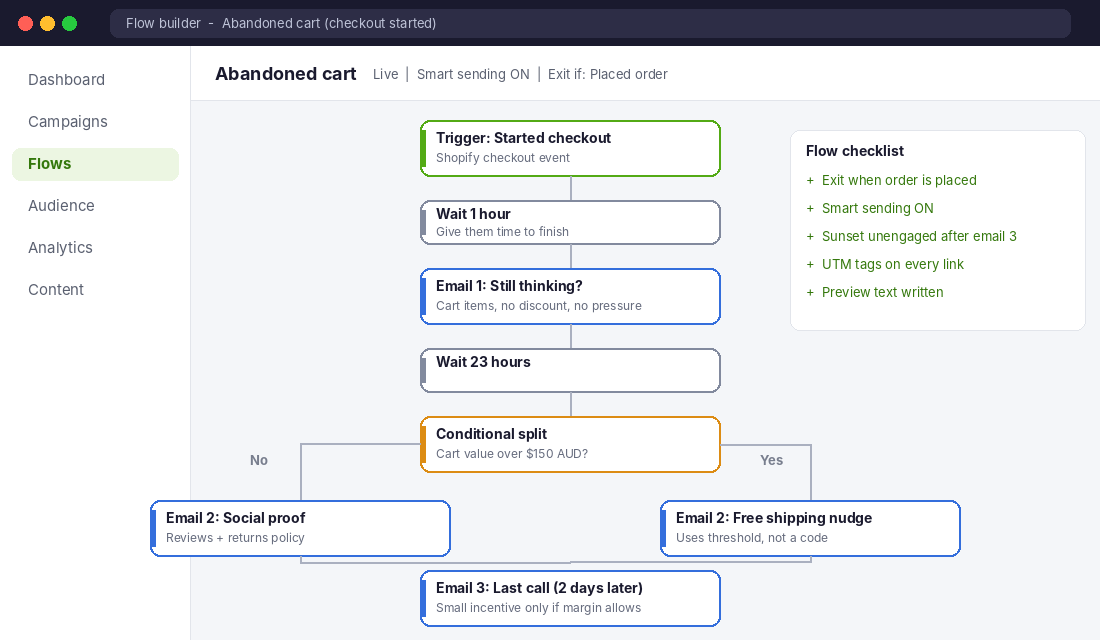
- Email 1, about 1 hour after checkout starts: a plain reminder with cart contents. No discount.
- Email 2, 24 hours later: split by cart value. Carts above your free-shipping threshold get the shipping message; others get reviews and your returns policy.
- Email 3, 2 to 3 days later: last call. Only here, and only if your margin allows, test a small incentive.
The conditional split is where most stores leave money behind. The full flow architecture, including SMS and exit conditions, is in our abandoned cart recovery guide.
Flow 3: Browse Abandonment (The Quiet Second Chance)
Browse abandonment fires when someone views a product but never adds it to cart. The intent is lower, so the numbers are lower: Klaviyo’s average is $0.95 per recipient, with the top 10% at $7.05. That is still real revenue on traffic you already paid for.
Keep it light. One email, maybe two, sent 2 to 4 hours after the browse session. Show the product they viewed, two related items and a trust element such as reviews or free returns. Add a frequency cap so a heavy browser does not get an email every day. Browse flows are the easiest of the nine to overdo, so build in a filter that excludes anyone who has already received a flow email in the last 48 hours.
Flow 4: Post-Purchase (Where Retention Starts)
Most stores send an order confirmation and then go silent. The average post-purchase flow earns only $0.38 per recipient in Klaviyo’s data, and the top 10% reach $5.27. The gap is huge because few stores build it properly.
The goal is not an immediate upsell. It is a better second order. Send a thank-you with real usage guidance, then a care or how-to email timed to delivery, then a cross-sell that fits what they bought. Time everything from the fulfilment event, not the order date, because Australian delivery times vary by state and a how-to email that lands before the parcel does is just noise.
- Trigger: Fulfilled order.
- Core build: thank-you at fulfilment, how-to at delivery plus 1 day, cross-sell at day 14 to 21.
- Exclusion: anyone who has already placed a second order.
If you want to see how big the prize is, work out your repeat customer rate first. A store at 15% has more to gain from this one flow than from another ad campaign.
Flow 5: Review Request (Social Proof on Autopilot)
Reviews feed your abandoned cart email, your product pages and your ads, so this flow pays off in three places. Trigger it 10 to 14 days after fulfilment for most products, and longer for anything that takes time to show results, such as skincare or supplements.
Ask one question only: the star rating, directly in the email. Then route the follow-up. A 5-star rating gets a request for a written review and a photo; a 1 to 3-star rating goes to your support inbox, not to a public page. That small routing step prevents most review-site complaints before they happen. Most review apps (Judge.me, Okendo, Yotpo) can feed this into Klaviyo through their integration.
Flow 6: Replenishment (For Anything That Runs Out)
If you sell consumables, this is your highest-leverage flow after abandoned cart. esmi Skin Minerals reported using advanced replenishment flows that adapt to each customer’s journey and attributes 80 to 85% of revenue to repeat customers, although the figure is vendor-reported with no stated timeframe.
The build is simple. Work out the median days between first and second order for each hero product. Then send a reorder email about 10 days before that point, with a one-click path to the product they bought. If you sell something that does not run out, such as furniture, skip this flow and build a cross-sell instead.
Flow 7: Win-Back (Re-Engage Lapsed Customers)
The win-back flow fires when a customer has not bought for longer than your normal reorder window. Pick the window from your own data. For many Australian stores it falls between 90 and 180 days.
Use two or three emails: a “we noticed you have been away” message with new arrivals, a social proof email, and a final offer. Test the offer last. It is cheaper to win someone back at full price than to pay a discount to someone who would have returned anyway. Our win-back flow guide has the timing and offer tests.
Flow 8: VIP and Loyalty (Protect Your Best Customers)
Your top 10% of customers by spend often account for a disproportionate share of revenue. A VIP flow recognises them with early access, a thank-you and perhaps a gift, and it keeps them out of your blanket discount sends. This is the flow founders most often leave in draft, and it is the one that protects margin.
Build a segment of customers above a spend or order-count threshold, then trigger the flow when someone joins that segment. Send a congratulations email, an early-access announcement before each sale, and a birthday or anniversary message if you collect the date. Read our Klaviyo segmentation guide to build the VIP segment correctly.
Flow 9: Sunset (Clean the List So Every Other Flow Works)
A sunset flow is the one that makes money indirectly. It targets subscribers who have not opened or clicked in a long time (many stores use 120 to 180 days), asks if they still want to hear from you, then suppresses the ones who do not respond.
Why it matters: mailbox providers judge your sender reputation partly on engagement. Thousands of unengaged addresses drag down inbox placement for your best flows. Cleaning them often improves deliverability within a few weeks, and it can lower your Klaviyo bill because you pay by active profile count. Run it quarterly and check your numbers using the email metrics audit.
The Flow Coverage Scorecard (Score Your Store in 10 Minutes)
Score each flow: 0 if it does not exist, 1 if it is live but you have not reviewed it in six months, 2 if it is live and reviewed this quarter with a revenue-per-recipient number you can state.
| Flow | Trigger | Healthy signal | Your score (0-2) |
|---|---|---|---|
| Welcome series | Added to list | RPR above $1.00 | __ |
| Abandoned cart | Started checkout | 3 emails, cart-value split | __ |
| Browse abandonment | Viewed product | 1-2 emails, frequency cap | __ |
| Post-purchase | Fulfilled order | Timed from delivery | __ |
| Review request | Fulfilled + 10-14 days | Routes low ratings to support | __ |
| Replenishment | Order + reorder window | Sent before the run-out date | __ |
| Win-back | No order in your window | Final offer tested last | __ |
| VIP | Joins top-10% segment | Excluded from blanket discounts | __ |
| Sunset | No engagement 120-180 days | Run quarterly | __ |
A score of 0 to 6 means you are leaving the most predictable money on the table. 7 to 12 means you have the basics but are not tuning them. 13 to 18 means you are running a proper flow programme, and the next gains come from testing offers and splits.
Your 30-Day Build Plan
Do not build all nine in one weekend. Build them in order of revenue impact, and give each one a week of data before you touch it.
- Days 1 to 3: finish the setup checklist above, then build or fix abandoned cart and welcome.
- Days 4 to 10: browse abandonment and post-purchase. Add the exclusion filters so no one gets two flows at once.
- Days 11 to 17: review request and replenishment, using your own reorder data.
- Days 18 to 24: win-back and VIP. Write the VIP segment definition on paper before you build it.
- Days 25 to 30: sunset, then a full review: revenue per recipient per flow, deleted weak emails, and a list of three tests for next month.
How the Nine Flows Compound
Each flow is useful alone. Together they form a loop. The welcome series and browse flow turn visitors into first buyers. Abandoned cart recovers the ones who hesitate. Post-purchase, review request and replenishment turn buyers into repeat buyers. VIP protects your best customers. Win-back catches the ones who drift. Sunset keeps the whole system deliverable.
That is why flows account for about 41% of email revenue from a small slice of sends. They sit at every decision point in the customer journey, and they never sleep. Once the loop is running, your campaigns stop carrying the whole load, which means you can send fewer promotional emails, discount less, and still grow.
What to Do Next
Pick the single flow with the lowest score on your scorecard and fix that this week. Inside eCommerce Circle, retention and email are core pillars we work on with every member, and they sit in the Patrons section of the More Orders Operating System. If you want to see exactly where your store is being capped, take the free More Orders Scorecard. It takes two minutes and shows you which of the 10 P’s to fix first.