Every dollar you put into Meta this month is a bet. You pay up front, you wait, and if the creative misses, the money is gone. Most Aussie founders accept that as the cost of growth because they have never built the one channel that flips the deal: you pay only after the sale lands in your Shopify admin.
What’s in This Article
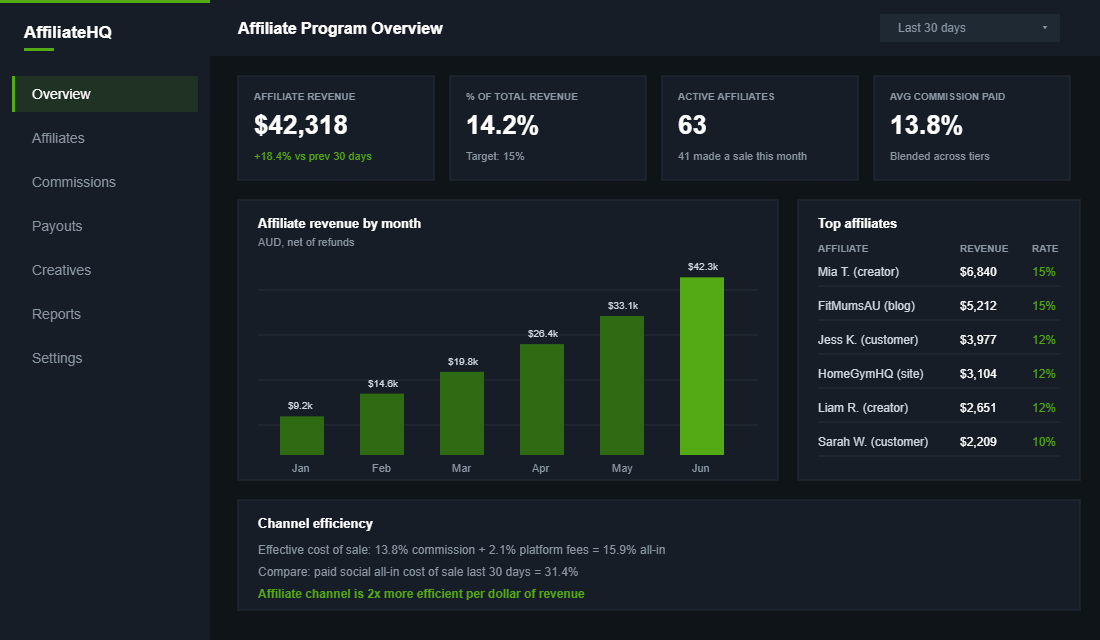
That channel is an affiliate program. Globally, affiliate marketing was worth $17.6 billion in 2025 and is tipped to pass $20 billion in 2026, driving roughly 16% of all ecommerce transactions. Brands running it well pull back around $15 in revenue for every $1 spent on the channel. And 57% of Australian advertisers increased their affiliate and partnership spend over the past year, so your competitors are already moving.
Here is the part most founders get wrong: they treat affiliate as a “set up the app and wait” channel. They install a plugin, bury a signup link in the footer, and six months later declare affiliate marketing dead because it produced four sales. The brands pulling 10 to 20% of revenue from affiliates run it like a sales team: recruited deliberately, paid properly, activated fast, and audited hard. This playbook gives you the five steps to build exactly that.
Affiliate vs Influencer: Get the Distinction Right Before You Build
Founders constantly blur these two channels, and the confusion costs them money in both. Influencer marketing is a media buy: you pay a creator up front (cash or product) for content and reach, and you carry the risk that the content converts. We covered that whole system in the Shopify Influencer Marketing Playbook.
Affiliate is a commission-only sales channel. Your partners (customers, niche content sites, micro-creators, email list owners) earn a percentage of each sale they generate, tracked through a unique link or discount code. No sale, no cost. The risk sits with the affiliate, which is exactly why the channel scales so cleanly on a tight budget.
The two channels feed each other. A creator who smashed a paid collaboration is your best affiliate recruit, because they have already proven they can sell your product. But the economics, the contracts, and the management cadence are different. Build affiliate as its own channel with its own P&L line, not as a discount-code afterthought bolted onto your influencer spreadsheet.
Step 1: Lock Your Commission Economics Before You Recruit Anyone
The fastest way to kill an affiliate program is to guess the commission. Set it too low and serious affiliates ignore you. Set it too high and every affiliate sale erodes the margin you were trying to protect. The number comes from your unit economics, not from what feels fair.
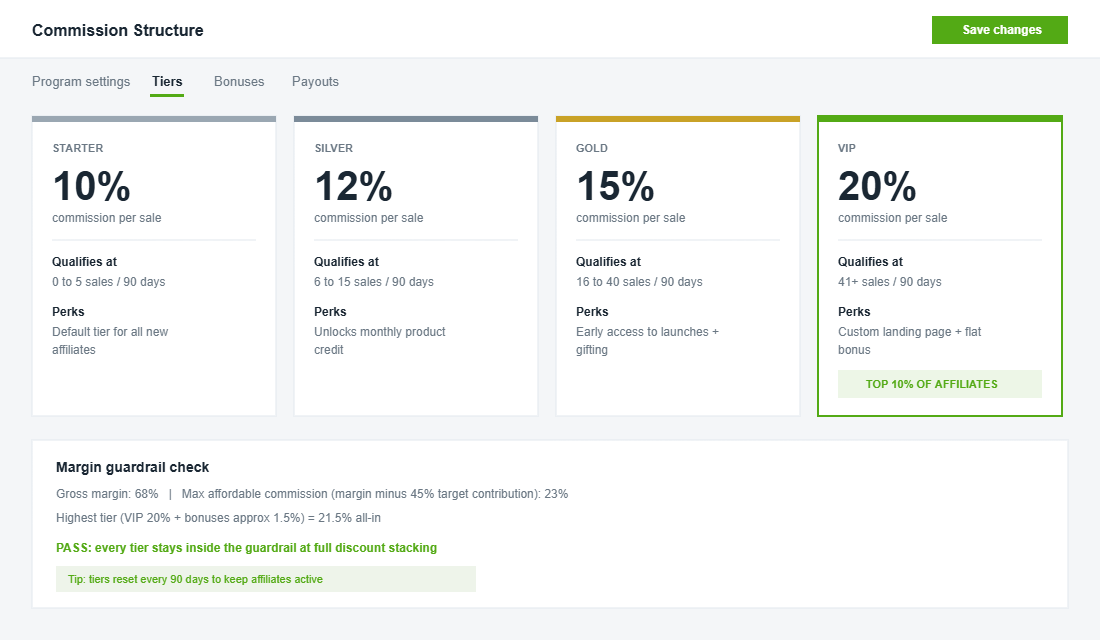
Start with gross margin. If you sit at 65 to 70% gross margin (typical for a healthy DTC brand), and you want each order to keep at least 45% contribution before fixed costs, your ceiling for commission plus stacked discounts is roughly 20 to 25%. That is your guardrail. Every tier, bonus, and discount code must stay inside it.
Then sanity-check against your category. Current benchmarks for Shopify brands: fashion pays 10 to 20%, beauty 15 to 25%, supplements 20 to 40%, and electronics just 3 to 8% because the margins are thinner. The baseline that recruited solid affiliates two years ago (10%) now sits closer to 12 to 15% in most DTC categories. If your offer is below the going rate, your recruitment emails will go unanswered.
Structure it as tiers, not a flat rate. Tiers turn your commission table into a retention tool:
- Starter (10 to 12%). Every approved affiliate lands here. Low risk for you, instant earning for them.
- Mid tiers (12 to 15%). Unlock at meaningful sales volume over a rolling 90 days. Add perks that cost you little: product credit, early access to drops.
- VIP (18 to 20%). Reserved for the top handful of performers. This is where you add gifting, a custom landing page, and a direct line to you. Your top 10% of affiliates will usually drive 60%+ of channel revenue, so treat them like key accounts.
Make tiers reset on a rolling window rather than lifetime totals. An affiliate who sold hard in 2024 and nothing since should not occupy your top rate forever.
Step 2: Choose Your Tracking Stack (and Set It Up in an Afternoon)
Affiliate tracking is the plumbing of the whole channel. If affiliates do not trust that every sale is counted, they stop promoting. You have three realistic options as an Aussie Shopify brand, and they map to three stages of maturity.
- UpPromote (start here). The most-installed affiliate app on Shopify. Free to install with paid plans from about US$29 per month. Link and coupon tracking, tiered commissions, auto-generated affiliate portals, and PayPal payouts out of the box.
- Social Snowball (scale here). Built for DTC brands that want every customer to become an affiliate automatically at the thank-you page. Pricing starts around US$199 per month plus a small revenue share, so it makes sense once the channel is producing. Brands like US supplement label Cowboy Colostrum run six figures a month in affiliate revenue through it.
- Commission Factory (network reach). The Sydney-based affiliate network used by hundreds of Australian retailers, including Bared Footwear. A network gives you instant access to established publishers, cashback and content sites, in exchange for network fees on top of commissions. Best added once your in-house program is humming.
The afternoon setup, using UpPromote as the example:
- Install the app from the Shopify App Store and connect your store.
- Create your program with the tier structure from Step 1. Set cookie length to 30 days minimum (60 is more competitive).
- Turn on coupon-code tracking as well as link tracking. In a world of iOS privacy limits, codes catch the sales links miss.
- Build the affiliate registration page and link it in your footer and your post-purchase email.
- Set payout terms: monthly, with a 30-day holding window so refunds and returns wash out before commissions are paid.
- Load 5 to 10 ready-made creatives and swipe copy into the portal before you invite anyone.
One non-negotiable: pay on time, every time. Word travels fast in affiliate communities, and a brand with a reputation for slow payouts cannot recruit.
Step 3: Recruit Your First 50 Affiliates From People Who Already Love You
Cold-recruiting strangers is the slowest possible way to launch. Your first 50 affiliates are already in your orbit, and they convert at a fraction of the effort.
- Repeat customers first. Pull everyone with 3+ orders or a high review score from Shopify and invite them personally. They already sell you to their mates for free; now you are paying them for it.
- Your email list. One dedicated send announcing the program will typically recruit more affiliates than a month of cold outreach.
- Past influencer collaborators. Anyone whose content converted in a paid deal gets a standing affiliate offer. It extends the relationship with zero up-front cost.
- Niche content sites and communities. The Aussie blogs, buying guides, and Facebook groups your customers actually read. Smaller audiences, far higher intent.
Look at how the best Australian brands structure this. Princess Polly runs a tiered ambassador program where everyday creators start on standard affiliate commissions and graduate to VIP status with monthly gifting and collaboration perks, alongside a publisher program managed through an affiliate network. LSKD bundles its affiliate offer inside a broader brand partner program that includes product supply, event activations, and early access to drops. Both brands treat affiliates as a community to be developed, not a list of links to be handed out.
Vet everyone. A simple application asking where they will promote and what their audience looks like filters out the coupon-site bottom feeders that exist purely to intercept your checkout traffic. More on that in Step 5.

Step 4: Activate Them Fast (an Affiliate Who Has Not Sold in 30 Days Probably Never Will)
Here is the dirty secret of the channel: in most programs, the majority of approved affiliates never generate a single sale. They sign up, poke around the portal, and drift off. Recruitment gets all the attention, but activation is where the revenue actually lives.
Run a 48-hour onboarding sequence the moment someone is approved:
- Immediately: welcome email with their link, their code, and one specific suggestion for their first post (not a generic “share with your audience”).
- Day 1: the swipe file. Three caption templates, product photography, a short video they can repost, and your three best-converting talking points.
- Day 2: a first-sale incentive. A bonus or a tier jump for any sale inside 14 days gives them a reason to move now rather than someday.
Then keep a monthly rhythm: a short newsletter with what is converting, upcoming launches, and a leaderboard. Public recognition costs nothing and reliably lifts output from mid-tier affiliates. Watch your activation funnel monthly and fix the biggest leak first. Usually it is the gap between “signed up” and “shared a link”, and the swipe file is the cure.
Affiliate traffic converts at 1 to 3% on average, but affiliates promoting through email lists convert around 6.5%, the highest of any affiliate traffic source. So when you spot an affiliate with a newsletter, move them up your priority list and give them exclusive offers to send.
Step 5: Defend the Margin Against Leakage, Self-Referrals and Fake Incrementality
An unaudited affiliate program quietly pays commissions on sales you would have made anyway. Three leaks to plug from day one:
- Coupon-site interception. A shopper reaches your checkout, googles “your brand discount code”, lands on a coupon site, and that site takes commission on a sale it did nothing to create. Fix: reject pure coupon sites at application, and never publish working codes to them.
- Self-referral. Affiliates buying through their own link to claw back a discount. Most platforms can block it; turn the setting on.
- Brand-search poaching. Affiliates bidding on your brand name in Google Ads and skimming traffic that was already yours. Ban it in your terms and spot-check by searching your own brand monthly.
Then measure the channel honestly. Last-click attribution flatters affiliates the same way it flatters branded search. Watch your blended numbers with the Marketing Efficiency Ratio as the channel scales, and add a “how did you hear about us” question using the post-purchase survey system to see how much affiliate revenue is genuinely incremental. If MER holds or improves as affiliate revenue grows, the channel is adding sales rather than re-labelling them.
How the Five Steps Compound Into a Channel
None of these steps is impressive on its own. Together they build a flywheel that gets cheaper as it spins.
Sound economics (Step 1) make your offer attractive enough to recruit real sellers. Reliable tracking and on-time payouts (Step 2) build the reputation that makes the next 50 recruits easier than the first. Recruiting from your own customers and collaborators (Step 3) means your affiliates actually use the product, which makes their content convert. Fast activation (Step 4) turns signups into sellers while the enthusiasm is fresh. And auditing (Step 5) means the revenue you are paying for is real, so you can keep raising commissions for your best people without sweating the margin.
Run properly, the numbers stack up like this: top brands derive 5 to 25% of online sales through affiliate channels, and every one of those sales arrives with the commission already priced in. While your competitors pray this quarter’s Meta creative lands, a slice of your revenue walks in the door pre-sold by people you only pay on results.
The Affiliate Program Launch Checklist
Work through this top to bottom and you will launch ahead of 90% of programs:
- Economics: gross margin calculated, commission ceiling set, 3 to 4 tiers defined on a rolling 90-day window.
- Stack: app installed, link and coupon tracking on, 30 to 60 day cookie, payouts monthly with a 30-day hold.
- Portal: registration page live, application questions set, swipe file loaded before the first invite.
- Recruitment: repeat customers invited, email list announcement sent, past collaborators offered a standing deal.
- Activation: 48-hour onboarding sequence built, first-sale incentive live, monthly leaderboard scheduled.
- Defence: self-referrals blocked, coupon sites rejected, brand bidding banned in terms, MER baseline recorded.
Give the program 90 days of honest effort before you judge it. The first month is plumbing, the second is recruitment, and the third is when the activation work starts showing up as orders.
Inside eCommerce Circle, building out owned and earned channels like affiliate is one of the core pillars we work on with every member. If you want a second opinion on yours, let’s talk.
Related reading: the TikTok Shop Australia playbook.