Every dollar you spend on Meta Ads or Google Ads is rented attention. The moment you stop paying, the traffic stops. SEO is different — it is traffic you own. Once your product pages rank on Google, those visitors keep coming for months and years without you paying a cent for each click.
What’s in This Article
Yet most Shopify store owners treat SEO as an afterthought. They build their store, install a few apps, run some ads, and never think about organic search. Meanwhile, their competitors are quietly building an organic traffic engine that compounds month after month.
The good news is that Shopify SEO is not rocket science. Most of the high-impact wins are straightforward changes you can make this week. Here is exactly what to do.
Why Shopify Product Pages Struggle to Rank (And How to Fix It)
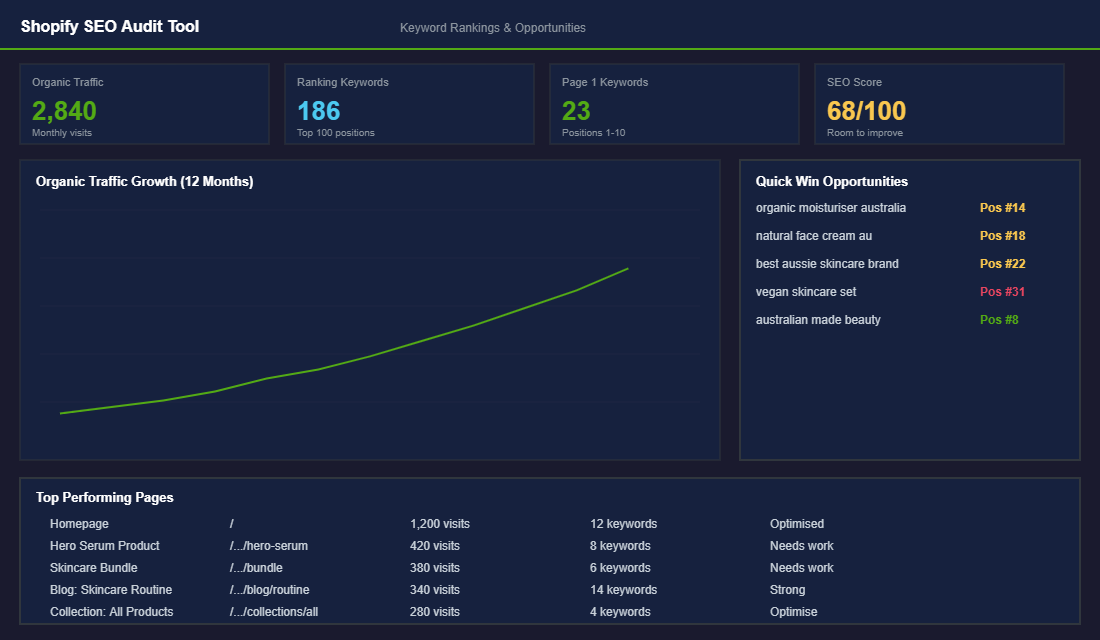
Shopify has some well-known SEO limitations out of the box. The URL structure is rigid, duplicate content issues are common with variants, and most themes generate thin product pages that Google does not value. But none of these are deal-breakers — they just mean you need to be deliberate about optimisation.
The biggest issue is thin content. The average Shopify product page has 50-100 words of description. Google sees that as a low-value page with nothing worth ranking. Compare that to the product pages ranking on page 1 for competitive terms — they typically have 300-800 words of unique, benefit-rich content. For a detailed framework on writing descriptions that convert, see our guide on product page copywriting that doubles conversion rates.
You do not need to write essays. But every product page should have:
- A unique product description of at least 300 words. Not manufacturer copy. Not the same description as every other retailer. Your own words explaining what this product does, who it is for, and why it is worth buying. Pages with 300+ words of unique copy rank on average 2.5x higher than pages with under 100 words.
- A keyword-optimised title tag. Include your primary keyword naturally. “Organic Face Moisturiser for Sensitive Skin | Australian Made” is better than “Face Cream – My Brand Name.” Keep it under 60 characters so Google does not truncate it in search results.
- A compelling meta description. This is your ad copy for Google search results. 150-160 characters that make searchers want to click. Include your key selling point and a call to action. Pages with custom meta descriptions see 5-10% higher click-through rates than those relying on Google’s auto-generated snippets.
- Alt text on every image. Describe what is in the image using natural language that includes relevant keywords. “Woman applying organic face moisturiser” not “IMG_4521.” Beyond SEO value, alt text is essential for accessibility — and Google Image Search drives approximately 22% of all web searches.
The Keyword Strategy That Actually Works for Product Pages
Here is a mistake we see constantly: Shopify store owners trying to rank their product pages for broad, high-competition keywords like “skincare” or “protein powder.” That is a battle you will not win against Amazon, Chemist Warehouse, and major brands with massive domain authority.
Instead, focus on long-tail, buyer-intent keywords. These are the specific phrases people type when they are ready to buy:
- “organic face moisturiser for sensitive skin australia” — low competition, high purchase intent
- “best australian made skincare set under $100” — comparison shopping, ready to buy
- “natural anti-aging serum with vitamin C” — specific ingredient search, informed buyer
Use tools like Ubersuggest, Ahrefs, or Google Keyword Planner to find these terms. Look for keywords with 100-1,000 monthly searches in Australia and low to medium competition. These are your sweet spot — achievable rankings that drive actual buyers, not just browsers. Long-tail keywords convert at 2-3x the rate of broad head terms because the searcher already knows exactly what they want.
Map one primary keyword to each product page. Create a simple spreadsheet listing every product, its target keyword, current ranking (if any), and monthly search volume. This keyword map prevents cannibalisation — where two of your own pages compete against each other for the same term — and ensures you are covering the full range of searches your customers are making. Review and update this map quarterly as search trends shift.
Collection Pages: The SEO Goldmine Most Stores Ignore

Here is a secret most Shopify SEO guides miss: your collection pages often have more ranking potential than your individual product pages. Why? Because collection pages target broader category-level keywords that get more search volume, and they naturally have more content (multiple products, descriptions, and internal links). For more on optimising these pages specifically, check out our collection page design guide.
Optimise your collection pages by:
- Adding 200-400 words of unique content above or below the product grid. Explain what the collection is, who it is for, and why these products were curated together. This gives Google context and keyword relevance. Place the bulk of the text below the product grid so it does not push products below the fold on mobile.
- Using keyword-rich collection titles and URLs. “Australian Organic Skincare” is better than “Our Products.” Make sure the URL slug matches: /collections/australian-organic-skincare.
- Linking between related collections. If you have a “Face Care” collection and a “Body Care” collection, link between them. This helps Google understand your site structure and passes authority between pages.
- Adding FAQ sections. A 5-6 question FAQ at the bottom of a collection page targets question-based searches and can earn featured snippets. Use questions real customers ask about the product category. Tools like AlsoAsked and AnswerThePublic are brilliant for finding exactly what Australians are searching for in your niche.
Technical SEO Fixes That Take 30 Minutes
You do not need to be a developer to fix the technical SEO issues that hold most Shopify stores back. Here are the quick wins:
- Submit your sitemap to Google Search Console. Go to Search Console, add your property, and submit your sitemap (yourstore.com/sitemap.xml). This tells Google about every page on your site. Verify that all your product and collection pages are being indexed — it is common for Shopify stores to have 30-40% of their pages not indexed due to thin content or crawl issues.
- Fix broken links. Use a free tool like Screaming Frog (free for up to 500 URLs) or Broken Link Checker to find and fix 404 errors. Broken links waste the authority your pages have built and frustrate visitors who land on dead ends.
- Compress your images. Large images slow your site down, and page speed is a ranking factor. Use apps like TinyIMG or Crush.pics to compress without visible quality loss. Target under 200KB per product image. Most unoptimised Shopify stores have images averaging 500KB-1.5MB — reducing these can shave 2-4 seconds off page load time.
- Install Rank Math or a dedicated SEO app. These Shopify apps give you control over title tags, meta descriptions, and structured data that help Google understand your pages better. The free tier of Rank Math covers everything most stores need.
- Add schema markup. Product schema tells Google your price, availability, and review rating — which can earn you rich snippets in search results. Rich snippets increase click-through rates by 20-30% on average. Rank Math handles product schema automatically, but verify it is working using Google’s Rich Results Test tool.
Internal Linking: The Free Authority Builder
Internal links are one of the most underused SEO tactics for Shopify stores. Every link from one page on your site to another passes authority and helps Google understand the relationship between your pages. Yet most Shopify stores have almost zero strategic internal links beyond the navigation menu.
Link from blog posts to product and collection pages. If you write a blog post about choosing the right moisturiser, link directly to your moisturiser collection page and your top-selling product pages. This passes the authority your blog content builds directly to the pages that make you money.
Link between related products. In your product descriptions, mention complementary products with links: “Pair this with our [Hydrating Toner] for best results.” This keeps visitors on your site longer (which Google notices) and naturally builds internal link authority.
Use descriptive anchor text. “Click here” tells Google nothing. “Our organic face moisturiser for sensitive skin” tells Google exactly what the linked page is about. Use your target keyword as anchor text where it reads naturally — but vary it so it does not look manipulative. For a deeper look at building organic traffic through content, our content marketing strategy guide covers the full playbook.
The Compound Effect: How SEO Becomes Your Best Channel
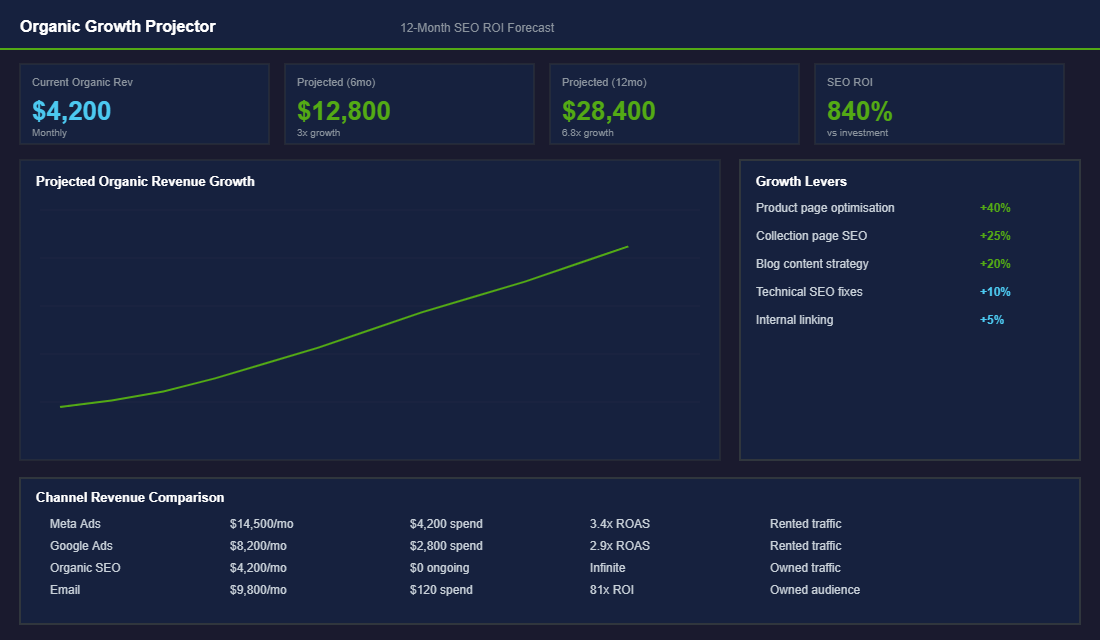
SEO is a slow burn. You will not see results in week one or even month one. But the compounding effect is extraordinary. A product page that starts ranking in month 3 keeps generating traffic in month 6, month 12, and month 24. Every new page you optimise adds to your total organic traffic, and the authority your domain builds makes future pages rank faster.
Brands inside eCommerce Circle that commit to SEO typically see organic traffic become their second-highest revenue channel within 6-8 months. And because there is no per-click cost, the ROI is essentially infinite once you are ranking. One member went from $0 organic revenue to $12,000/month in organic sales within 8 months, and that number keeps growing without any additional spend.
The key is consistency. Commit to optimising 5-10 product pages per week, publish one piece of keyword-targeted blog content weekly, and build internal links as you go. Within 90 days, you will start seeing pages climb in rankings. Within 6 months, organic will be a channel you can rely on — not just hope for.
Want to Build Your Organic Engine?
Inside the eCommerce Circle, SEO is a key component of the Promotion pillar in our More Orders Operating System. We help every member build a sustainable organic traffic strategy alongside their paid channels, so they are not entirely dependent on ad spend for revenue. If you want help getting your Shopify store ranking, reach out and let us map out your SEO opportunity.