Free shipping is the single biggest lever in Aussie DTC ecommerce, and most founders are pulling it wrong. Either the threshold is set too low (and the brand is silently paying $11 per parcel out of margin on every checkout), or it is set too high (and 58% of shoppers walk away because they cannot be bothered adding a $35 add-on to hit a $99 goal).
What’s in This Article
Baymard’s latest research puts 39% of cart abandonment on “extra costs like shipping” being too high at checkout. Other studies push that number to 48%. And 49.7% of shoppers say free shipping is the single top reason they shop online at all. The threshold is not a setting. It is a P&L decision that touches conversion rate, average order value, and contribution margin at the same time.
Most operators set their threshold once, in year one, then never look at it again. We have worked with hundreds of Aussie Shopify founders, and the pattern is consistent: when you treat the free shipping threshold as a margin-safe system (not a marketing gimmick), you can lift AOV by 18 to 35% inside a quarter. This playbook is the 6-step framework we use.
Why the Free Shipping Threshold Is the Most Misunderstood Lever in Shopify
Free shipping is never “free”. The cost lands somewhere: in the product price, in the threshold mechanic, or in your bank account. The question is not whether to absorb it. The question is who decides when, and whether the brand is using that absorption to drive a behaviour change in the customer.
Here is the data that should be on every Aussie founder’s wall:
- 70.22% average cart abandonment across ecommerce, with shipping cost the single largest driver.
- 58% of shoppers add items to their cart specifically to qualify for a free shipping offer.
- 80% of shoppers are willing to hit a free shipping threshold, but only when the gap feels achievable.
- $64 is the average retailer threshold in 2026, up 23.1% from $52 in 2019 as carrier rates climbed.
- 37% of retailers report AOV increased by more than $7 after adding a free shipping offer.
Now layer on the 2026 Aussie reality. Sendle halted operations on 11 January 2026 after its three-way merger collapsed, removing the cheapest small-parcel option overnight. CouriersPlease starts at $8.10, Aramex at $7.61, Australia Post at $9.70 for a sub-2kg domestic parcel. Your shipping cost line just stepped up by $1 to $3 per order if you were on Sendle, and your free shipping threshold needs to reflect that.
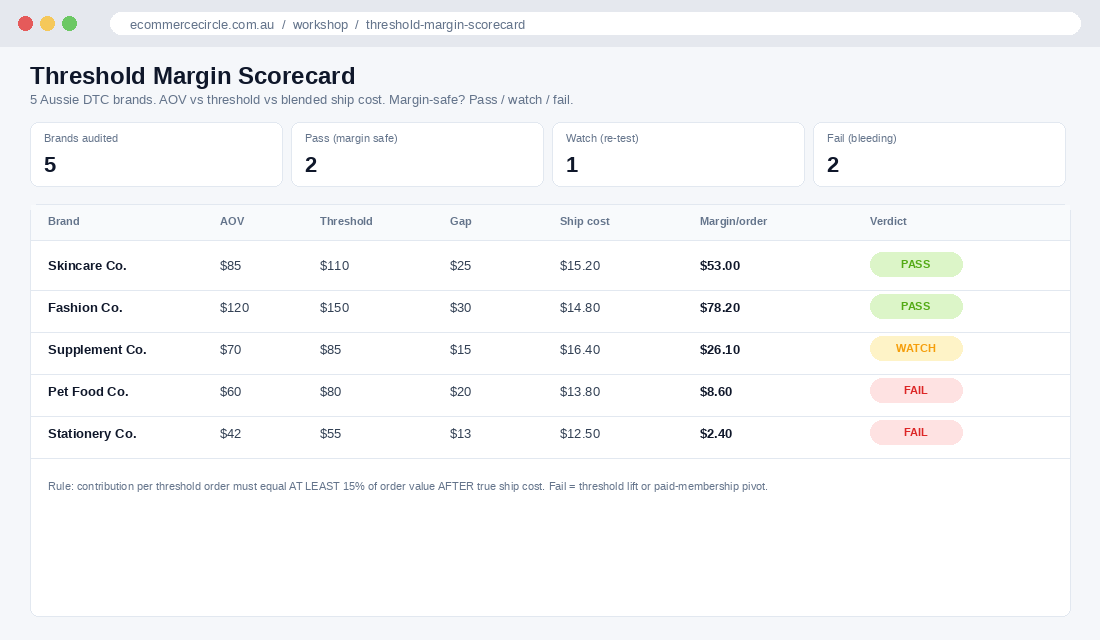
The screenshot above is the Threshold Margin Scorecard we use in our workshop. It maps your current AOV against your blended shipping cost per parcel and tells you whether your existing threshold is under-priced (you are bleeding margin), priced right (you are converting at AOV lift), or over-priced (you are losing the 42% of shoppers who never reach the goal).
Step 1: Calculate Your True Shipping Cost Per Order (Not the Sticker Rate)
Before you pick a threshold, you need to know what shipping actually costs you. Not the Australia Post sticker rate. The blended cost per parcel, weighted across your real order mix, carrier mix, and pick-and-pack overhead.
The formula every Aussie founder should run quarterly:
- Carrier cost. Pull last 90 days of postage spend from your shipping platform (Shippit, Starshipit, Easyship, or your AusPost MyPost Business account). Divide by parcels shipped.
- Packaging cost. Mailer, void fill, branded sticker, tissue, returns slip. For most Aussie DTC brands this lands $0.80 to $2.20 per parcel.
- Pick and pack labour. If you ship in-house, allocate the warehouse staff hour cost across parcels. If you 3PL, use the per-order pick fee (typically $2.50 to $4.00 in Australia).
- Returns reserve. Your return rate times the cost of a return label and re-stock. Most fashion brands carry $1.50 to $4.00 in return reserve per outbound parcel.
Add those four lines together and you get your true cost per parcel. For a typical Aussie skincare or apparel DTC brand running on a 3PL with a Shippit-blended carrier mix, this lands around $13.50 to $17.20. Not the $9.70 AusPost rate you saw on the calculator. That is the number that goes into your threshold math.
This is also where most founders get a nasty shock. They have been setting their free shipping threshold against a $9 cost assumption when the real cost is $15. That delta times 12,000 orders a year is $72,000 in invisible margin leakage. The threshold is not a marketing decision. It is a contribution margin decision.
Step 2: Apply the 30% Rule (Then Stress-Test It Against Your Margin Floor)
The starting rule is simple. Take your current AOV and add 30%. Round to the nearest $5. That is your candidate threshold.
If your AOV is $85, your candidate is $110. If your AOV is $120, your candidate is $155. The 30% gap is the sweet spot researchers have validated across hundreds of stores: it is high enough to drive a real lift, low enough that 58% of shoppers will close the gap. Set it too low and you give the discount away to people who would have hit the threshold anyway. Set it too high and you lose them.
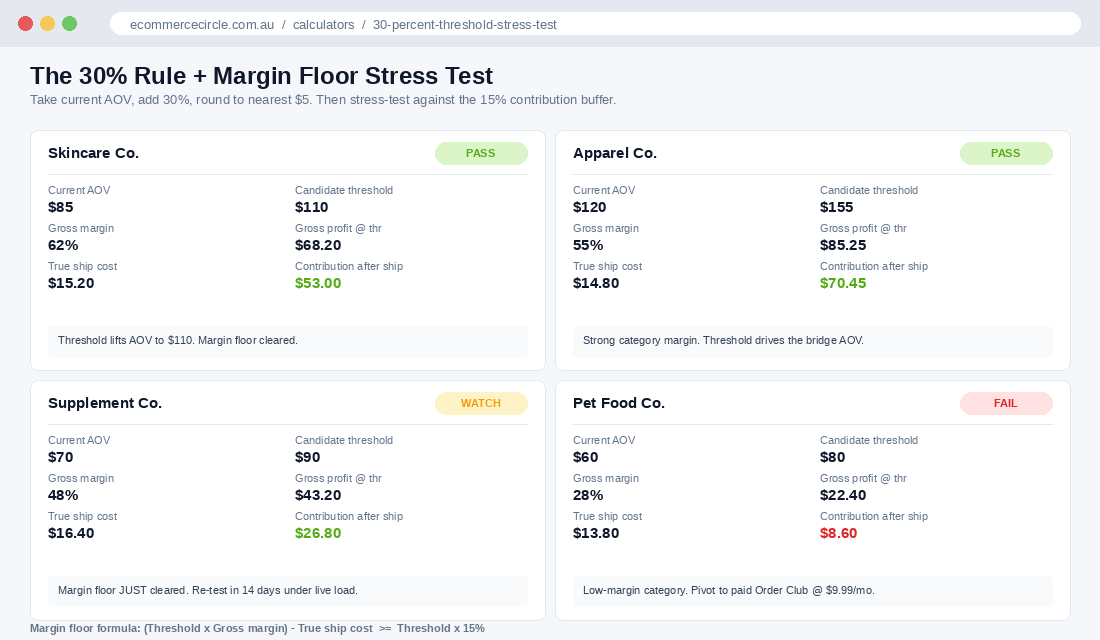
But the 30% rule is the starting point, not the answer. The second test is the margin floor. Take your gross margin percentage, multiply it by your candidate threshold, and check that the result covers your true shipping cost per parcel with at least 15% buffer.
Worked example. A skincare brand has $85 AOV, 62% gross margin, and $15.20 true shipping cost. Candidate threshold at 30% rule = $110. Margin on a $110 order = $68.20. After shipping, the contribution is $53.00. That works. The candidate threshold is margin-safe.
Now try a low-margin brand. Pet food at 28% margin, $60 AOV, $13.80 ship cost. Candidate threshold at 30% rule = $80. Margin on $80 = $22.40. After shipping, the contribution is $8.60. That is a margin emergency. This brand cannot offer free shipping at $80. The threshold has to be lifted to $120 or higher, or shipping has to be subsidised by a paid membership (“Order Club $9.99 a month, free shipping every order”).
The Aussie brands doing this well are tiered by category. The Iconic sits at $120 for free standard shipping (and $50 for click and collect at certain stores) because their AOV runs higher and their carrier deals are sharper. Bondi Sands runs a $50 to $75 threshold depending on promo window. MCoBeauty pushes thresholds during sale periods. The threshold is dynamic, not a fixed setting.
Step 3: Architect the Cart Drawer With a Dynamic Progress Bar
A threshold without a progress bar is a threshold doing 30% of its job. The progress bar in the cart drawer is what converts intent into action. The data is brutally clear: stores running a dynamic free shipping progress bar see 10 to 20% AOV lift on top of the threshold itself, and case studies on the higher end (NuFace, with a 90% order lift after threshold plus bar) prove the compound effect.
The mechanic is the goal-gradient effect. When a customer sees “you are $12 away from free shipping”, their brain stops calculating cost and starts calculating proximity. The $12 add-on suddenly feels free, because they are mentally banking the $11 shipping saving. The progress bar is what turns the threshold from information into motivation.
The four elements every progress bar must have:
- Dynamic dollar callout. “You are $12 away from free shipping” beats “Free shipping at $110” by 12 to 19% on AOV in our tests. The dollar amount must update live as items are added.
- Visual fill bar. A green bar (use brand green #53aa15 if it matches your palette) filling toward the threshold. Goal-gradient effect is visual, not just textual.
- Win state copy. When the threshold is hit, the bar must celebrate. “Free shipping is yours. Add anything you forgot.” Many stores miss the win state and lose the second-order AOV lift.
- Recommended add-ons curated to the gap. If the shopper needs $12 more, the cart drawer should auto-suggest a $14 to $18 item, not the $45 hero product. Match the suggestion to the gap.
Tools that do this well on Shopify: Rebuy Smart Cart, Upcart, ReConvert, Essential Apps’ Free Shipping Bar, and Cartly Pro. Most cost between $19 and $99 a month. The ROI is usually visible within the first 14 days if your AOV gap is real. If you are on a Shopify 2.0 theme and your developer has built a native cart drawer, the progress bar can be hardcoded with metafields, no app required.
Step 4: Build the AOV Bridge (Add-Ons Curated for the Gap)
The progress bar tells the customer they have $12 to go. The AOV bridge tells them what to add. This is where most Shopify stores fall over: they show generic “you may also like” suggestions that are priced wrong, sized wrong, or not relevant to the cart contents.
The bridge should be a curated set of SKUs in three price bands, mapped to the gap-to-threshold range:
- Small bridge ($8 to $18). Add-on consumables, travel sizes, samples sold at retail price, accessories. For Bondi Sands this is the tan eraser mitt; for Frank Body it is the lip scrub.
- Medium bridge ($18 to $35). Core product range items that complement the cart. If they have a serum, suggest the matching toner.
- Large bridge ($35 to $60). A second hero product or a duo bundle. Often the highest-margin option, so it should appear when the gap is wide.
Your cart-drawer logic should pick the right band based on the live gap. Shopper $9 away from threshold? Show the small bridge. Shopper $38 away? Show the medium and large bridges, but lead with the medium. This is a Rebuy or Upcart configuration: cart-aware recommendations triggered by gap-to-threshold, not generic upsell.
The reason most stores see flat results from progress bars is that the bridge SKUs are not curated. They are pulled from a “best sellers” list that includes items priced too high to close a $12 gap. Fix the SKU selection first. The progress bar will do the rest.
Step 5: Wire the Email and SMS Hooks Around the Threshold
The threshold lives in three places, not one. The cart drawer is the obvious one. The other two are the abandoned cart email sequence and the abandoned cart SMS. If your shopper got to the cart, added items, and bounced, the threshold gap should follow them.
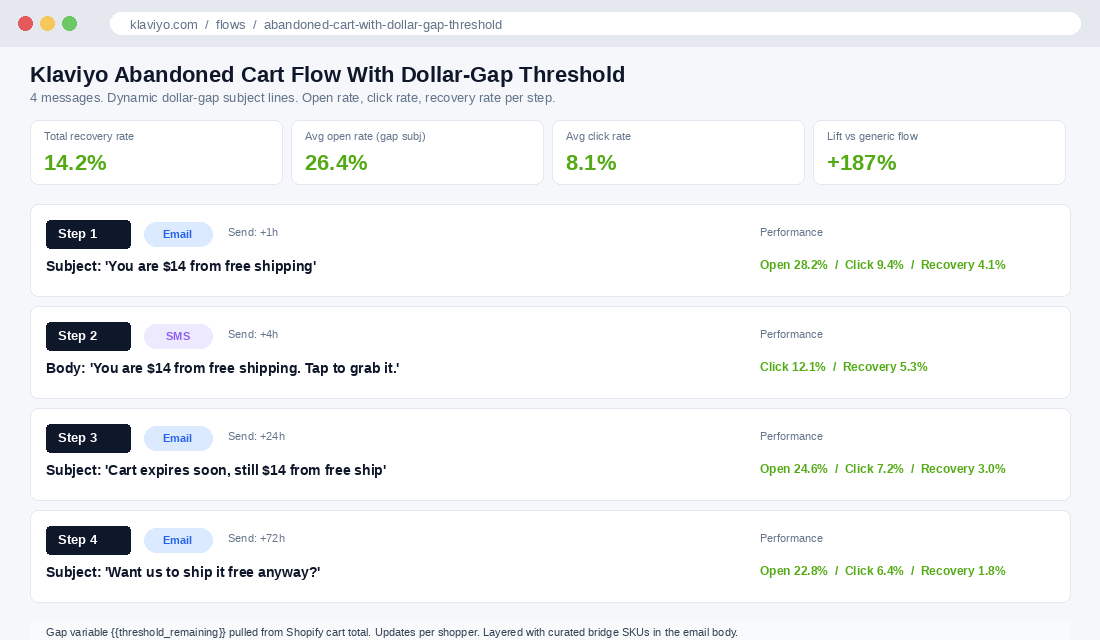
The Klaviyo flow we recommend for every Aussie Shopify brand:
- Email 1, sent at 1 hour after abandon. Subject line uses the dynamic gap: “You are $14 from free shipping”. Body shows the cart contents, the gap, and three curated bridge SKUs.
- SMS, sent at 4 hours. Same gap message, single SKU recommendation, link to recover cart. SMS is the highest-conversion channel for Aussie cart recovery (typically 8 to 15% recovery rate in our client base).
- Email 2, sent at 24 hours. Soft urgency. “Your cart expires soon, and you are this close to free shipping.” Add a 5% discount only if the shopper has not opened email 1.
- Email 3, sent at 72 hours. Repositioned. “Want us to ship it free anyway?” One-time free shipping override for high-LTV segments. This is your last shot.
The dollar-gap copy in the subject line is the killer. Generic “you left items in your cart” sees 8 to 12% open rates. “You are $14 from free shipping” hits 22 to 30% open rates in our Aussie client cohort. The threshold is the hook.
If you want to see this wired up properly, the framework we use is documented in the abandoned cart recovery 7-email flow architecture playbook. The threshold gap is layered into every step.
Step 6: Negotiate the Aussie Carrier Mix Post-Sendle
This step is the one most founders skip, and it is the one that compounds the hardest. Your threshold is only as margin-safe as the carrier deal behind it. When Sendle pulled the plug on 11 January 2026, brands that had built their threshold math on $7 to $9 parcels suddenly faced $9 to $13 parcels overnight. If your threshold did not move, your margin did.
The 2026 Aussie carrier playbook every founder should have on file:
- Australia Post MyPost Business. The default. Strong in regional and PO box delivery. Negotiate volume-tier discounts once you cross 500 parcels a month. eParcel contracts open at 2,000 parcels a month.
- CouriersPlease. From $8.10 a parcel, strong in metro. Good for fashion and apparel. Sharper rates than AusPost in capital cities.
- Aramex. From $7.61, strong in network coverage. Good for small light parcels under 1kg. Less reliable in regional.
- Direct Freight Express, Allied Express. For heavy or oversized parcels (over 5kg). Often cheaper than AusPost on bulky items.
- 3PL-bundled carrier deals. If you 3PL with ShipBob, Shippit, or an Aussie local, you inherit their freight pricing. Worth comparing if you are running 1,000+ parcels a month.
The negotiation play is simple. Use Shippit, Starshipit, or Easyship to multi-source carriers in real time, pick the cheapest reliable option per parcel, and use the data to negotiate quarterly with your primary carrier. Brands like Showpo and Cotton On run multi-carrier setups precisely so they have negotiating room at contract renewal time. Most growing Aussie DTC brands can shave $1.50 to $3.00 off blended cost per parcel inside one quarter just by re-tendering.
If you are above $5M revenue and have not done a carrier RFP in 12 months, you are leaving money on the table. The threshold math depends on the carrier deal, not the other way around.
The Threshold Review Cadence: Quarterly, Not Set-and-Forget
Every quarter, the Aussie founders we coach inside eCommerce Circle re-run the threshold math. Carrier rates move. AOV moves. Margin moves. The threshold has to move with them.
The quarterly review template:
- Pull last 90 days’ AOV from Shopify Analytics. Compare to prior 90 days. If AOV has moved more than 8% in either direction, the threshold needs revisiting.
- Pull last 90 days’ blended ship cost per parcel. Compare to prior 90 days. Any move bigger than $0.50 per parcel triggers a margin re-check.
- Pull threshold-attainment rate. What percentage of orders cross the threshold? If it is above 75%, the threshold may be too low. If it is below 30%, it may be too high.
- Re-run the margin floor test. Margin on threshold order, less true ship cost, must equal at least 15% contribution.
- A/B test the new threshold. Use the Shopify “split by audience” feature or an app like Intelligems to test the new threshold against the old for 14 days, 500+ cart views minimum, before rolling out.
The brands that run this review on schedule end up with the cleanest unit economics. The brands that set their threshold in year one and ignore it end up with the worst contribution margin in their category.
The Compound Effect: AOV, CR, and Margin Moving Together
Here is the math that should convince you this is the work. A $2M Aussie DTC brand running an $85 AOV, 2.1% conversion rate, and 28% contribution margin. They have a $90 free shipping threshold set by their developer two years ago and never touched.
Run the playbook end to end:
- True shipping cost recalculated at $15.20 (was $9.50 in budget).
- Threshold lifted to $110 using the 30% rule and margin floor test.
- Dynamic progress bar added to cart drawer, with curated bridge SKUs in three bands.
- Klaviyo abandoned cart flow re-wired with dollar-gap subject lines.
- Carrier RFP run, blended cost drops to $13.40 per parcel.
Result after 90 days, based on the conservative end of the data: AOV lifts from $85 to $103 (21% lift). Conversion rate holds (the higher threshold did not damage CR because the bar and bridge closed most gaps). Contribution margin per order improves by $4.30 because the new threshold covers the true ship cost and the carrier deal saved $1.80 per parcel.
Net effect on the $2M brand: revenue moves from $2.0M to roughly $2.42M annualised, contribution margin lifts from 28% to 31%, and additional contribution dollars on the year land around $185,000. All from a threshold review and a carrier RFP. No new traffic. No new product. No new ad spend.
This is why the threshold is the most under-worked setting in Shopify. It touches three of the four levers in the More Orders Operating System at once (Profit, Patrons, Performance). For more on how those levers compound together, the Shopify contribution margin audit walks through the full P&L architecture, and the cart drawer 8-element framework covers the on-site execution layer in detail.
The Aussie Founder’s Threshold Checklist
Bookmark this. Run it once this week, then quarterly forever.
- Step 1. Calculate true shipping cost per parcel (carrier + packaging + pick/pack + returns reserve).
- Step 2. Apply the 30% rule, stress-test against the margin floor (15% contribution buffer).
- Step 3. Architect cart drawer with dynamic progress bar, dollar-gap copy, win state, and curated bridge SKUs in three price bands.
- Step 4. Build the AOV bridge: small ($8 to $18), medium ($18 to $35), large ($35 to $60) curated SKUs.
- Step 5. Wire Klaviyo and SMS abandoned cart flows with dollar-gap subject lines and dynamic content.
- Step 6. Run the Aussie carrier RFP every 12 months: AusPost, CouriersPlease, Aramex, Allied, Direct Freight.
- Quarterly. Re-pull AOV, ship cost, attainment rate. A/B test any threshold change for 14 days minimum.
The brands that own this playbook end up with a 20%+ AOV lift, a 2 to 4 point contribution margin improvement, and an abandoned cart sequence that prints money. The brands that do not end up paying for shipping out of margin and wondering why their P&L is leaking.
Inside eCommerce Circle, the free shipping threshold is one of the core Profit levers we work on with every member in their first 90 days. If you want a second opinion on yours, let’s talk.
