Here is the pattern we see on almost every Shopify account before a brand gets serious about content. The founder books a photographer twice a year, ends up with forty polished product shots, and runs the same four ads for three months straight. Then the cost per acquisition starts creeping. Then it climbs. Then panic.
What’s in This Article
The instinct is to blame the targeting, the audience, or the agency. The real problem is upstream. You are starving the algorithm of the one thing it now feeds on: fresh creative, and a lot of it.
Nielsen has measured this across thousands of campaigns and found that creative quality drives roughly 56% of a campaign’s sales return, more than targeting and placement combined. On Meta in particular, broad targeting and Advantage+ have quietly handed the audience work to the machine. What is left for you to control is the creative. That makes hiring for content one of the highest-return people decisions an Aussie DTC founder makes, and one of the most commonly botched.
Why Creative Became the Whole Game
Two years ago a strong Meta ad could run for six weeks before it tired. Now creative fatigue hits in two to three weeks, and on higher-spend accounts much faster. One analysis of managed accounts found the median ad set throws its first fatigue signal around day 11, with frequency at 3.2 and click-through down close to 38% from launch. The auction has not changed. Your audience has simply seen the ad too many times.
That shift rewrites the maths. If every winning concept has a two to three week shelf life, you cannot win with one big shoot a quarter. You need a steady supply of new angles entering the account every single week. The strongest DTC accounts we look at are testing 15 to 20 distinct creative concepts a week as a baseline, and a useful rule of thumb is at least one new creative for every $10,000 in weekly ad spend.
Format matters as much as volume. User-generated style content, the messy, real, phone-shot stuff, regularly pulls a click-through rate three to four times higher than glossy studio ads and costs around 50% less per click. The takeaway is blunt. The job is not better art. The job is a machine that produces a high volume of customer-feeling content, tests it fast, and keeps the winners flowing. That is a content engine, and someone has to run it.
The Readiness Test: Are You Actually Ready to Hire?
Hiring for creative before you are ready just adds a salary to a problem you have not defined. Run your store through these four gates first. If you cannot clear at least three, fix the gaps before you hire.
- Spend gate. You are putting at least $8,000 to $10,000 a month into paid social. Below that, the volume need is small enough that a couple of freelance creators on retainer will do.
- Fatigue gate. You can see CPA climbing while CPM stays flat. That is the textbook sign your audience has stopped engaging, and it means you are not refreshing fast enough.
- Bottleneck gate. Creative is stuck in your inbox. You are the one filming, briefing and editing, and it only happens when everything else is done. If content lives or dies on the founder’s spare time, you have found your constraint.
- Volume gate. You genuinely need 5 to 10 new concepts a fortnight and you are nowhere near it. If two ads a quarter is fine for your stage, hold off.
Most founders hit the fatigue and bottleneck gates well before they admit it. If that is you, the next decision is not whether to invest in content. It is which model to invest in.
The 5 Sourcing Models (and What Each Costs in AUD)
There is no single right answer here, only the right answer for your spend level and stage. Most brands end up blending two or three of these. Here is how they stack up in the Australian market.
1. UGC creator network (your first move)
A roster of three to six creators who film authentic content to your brief. Australian rates sit around $150 to $400 per video depending on the creator’s track record, with the global average landing near $200 a deliverable in 2025 as the market filled up. This is the fastest, lowest-risk way to add creative volume. You are buying raw footage and finished UGC ads without carrying a salary.
2. Freelance video editor
The quiet win for most stores. One reliable editor turns a single shoot into ten cut-downs, different hooks, captions and aspect ratios. Expect roughly $40 to $80 an hour, or a retainer around $1,500 to $4,000 a month for steady output. Pair an editor with a UGC roster and you have most of an engine without a single full-time hire.
3. In-house content creator or coordinator
Once you are past roughly $10,000 a month in spend and need weekly volume, a dedicated content person earns their keep. In Australia that role runs around $65,000 to $90,000 a year. They shoot, source creators, brief edits and own the calendar. The win is speed and brand fluency. The risk is hiring a generalist who is busy but not driving CPA down, so hire for output and ad sense, not a fancy reel.
4. Performance creative agency
A specialist shop that handles strategy, production and iteration. Retainers commonly sit between $4,000 and $15,000 a month. The right one buys you senior creative strategy and volume fast. The wrong one buys you pretty ads that do not sell. Judge them on creative testing process and reporting, not their showreel.
5. The hybrid (where most scaled brands land)
A content coordinator in-house owning the system, a UGC roster feeding raw footage, and one strong editor turning it into volume. This is the model that produces 15-plus concepts a week without the cost or fragility of a full internal studio. Start with models 1 and 2, layer in 3 as spend grows, and use 4 to fill specific gaps. For the marketing leadership that sits above this, see our guide on the paid media specialist hire.
Build the Content Engine, Not a Pile of Assets
A folder full of nice videos is not an engine. An engine is a repeatable system that turns customer insight into tested ads every week, on a cadence you can predict. Four parts make it run.
- A research-fed hook bank. Your best hooks are not invented, they are mined from the exact words customers use. Pull pain language, objections and buying triggers from reviews, support tickets and social comments, and keep a running list of 20-plus angles ready to brief. This is where content quality is actually decided.
- Modular batch shooting. Stop shooting one ad at a time. Shoot in batches built around angles, capture the product from multiple distances, and film extra B-roll and hook variations so one session yields a dozen finished assets.
- An edit pipeline. A fixed weekly handoff from brief to editor to review to live. The point is rhythm, not heroics. New variants ship on a schedule whether or not inspiration showed up.
- A customer-UGC loop. Your buyers are a free creative team. Frank Body built a global beauty brand worth a reported $20 million largely on customer content, curated through its #thefrankeffect hashtag. Wire a post-purchase ask and a monthly content prize into your flow and the footage comes to you.
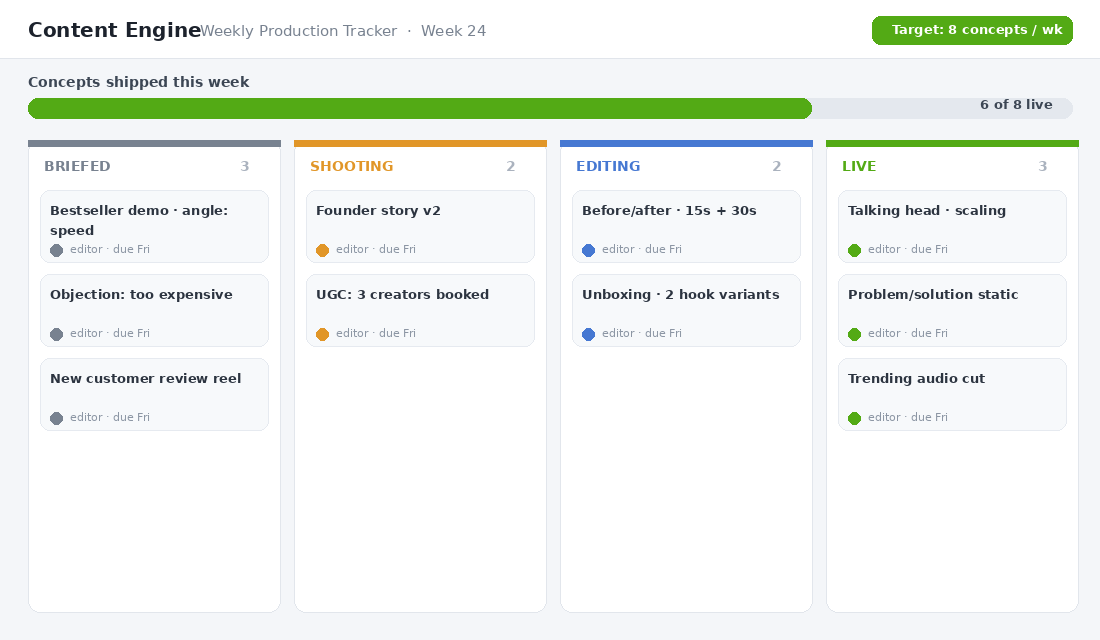
Set a weekly volume target and make it visible. A simple production tracker that shows every concept moving from briefed to shooting to editing to live keeps the engine honest and stops the whole thing collapsing back onto the founder.
The Creative Brief That Gets You Winners
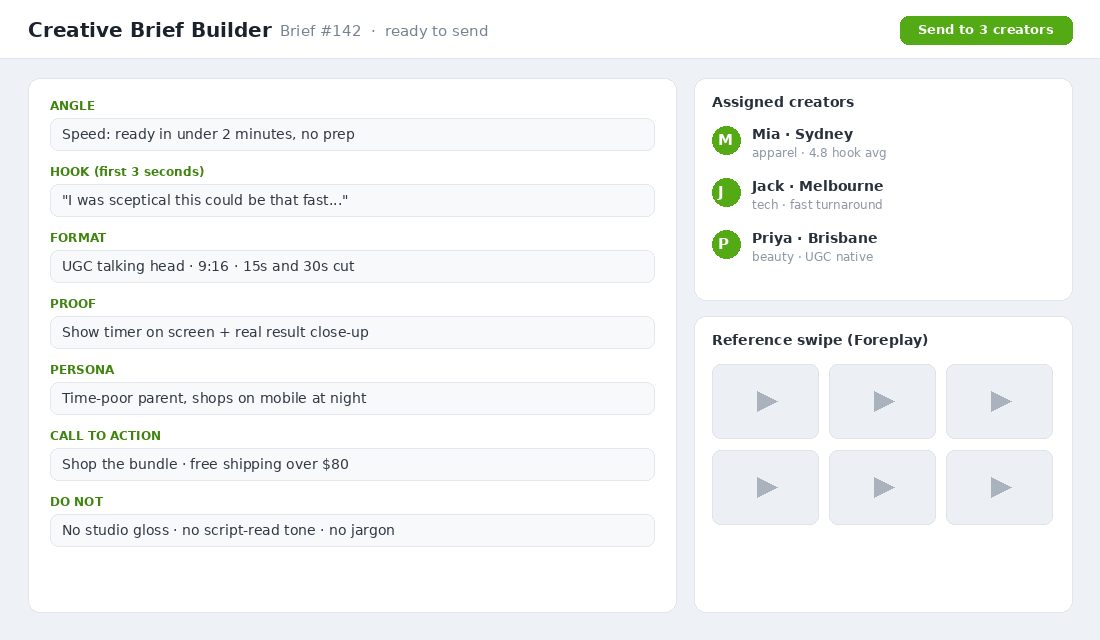
The single biggest difference between creators who deliver and creators who waste your money is the brief. A vague brief gets you a pretty video that does not convert. A sharp brief gets you a testable ad. Every brief should lock down five things.
- Angle. The one idea the ad sells. Not the product, the reason someone buys it. Speed. Confidence. Never running out.
- Hook. The exact first three seconds, scripted. This is where 80% of performance is won or lost, so do not leave it to chance.
- Format and proof. Length, aspect ratio, and the specific proof to show on screen, such as a timer, a result close-up or a real before and after.
- Persona and CTA. Who this is aimed at and the exact call to action, including any offer.
- The do-not list. Just as important. No studio gloss, no script-read tone, no jargon. Tell creators what kills the ad.
The tool that pulls this together is Foreplay. It is the standard creative-team workflow app, with an ad library of more than 10 million ads, a swipe file you build from real ads, and a briefing tool that sends one brief to multiple creators and collects their work in one place. Here is the five-step setup:
- Install the Foreplay Chrome extension and, as you scroll the Meta Ad Library and TikTok Creative Centre, save winning ads in your category to a Swipe File with one click.
- Tag saved ads by angle (problem-solution, founder story, before-after) so your swipe file becomes a searchable reference, not a junk drawer.
- Build a brief in Foreplay using the five fields above, and attach two or three reference ads from your swipe file so creators can see the standard.
- Send the brief to your assigned creators and let their drafts land back in one organised board for review.
- Approve, hand winners to your editor for cut-downs, and push the variants live. Log which angle each came from so you can tie performance back to the brief.
Measure Creative Like a Media Buyer, Not an Art Director
Once content is flowing, the temptation is to judge ads on whether you like them. Resist it. The account decides what is good, not the team. Track five numbers and let them drive the kill and scale calls.
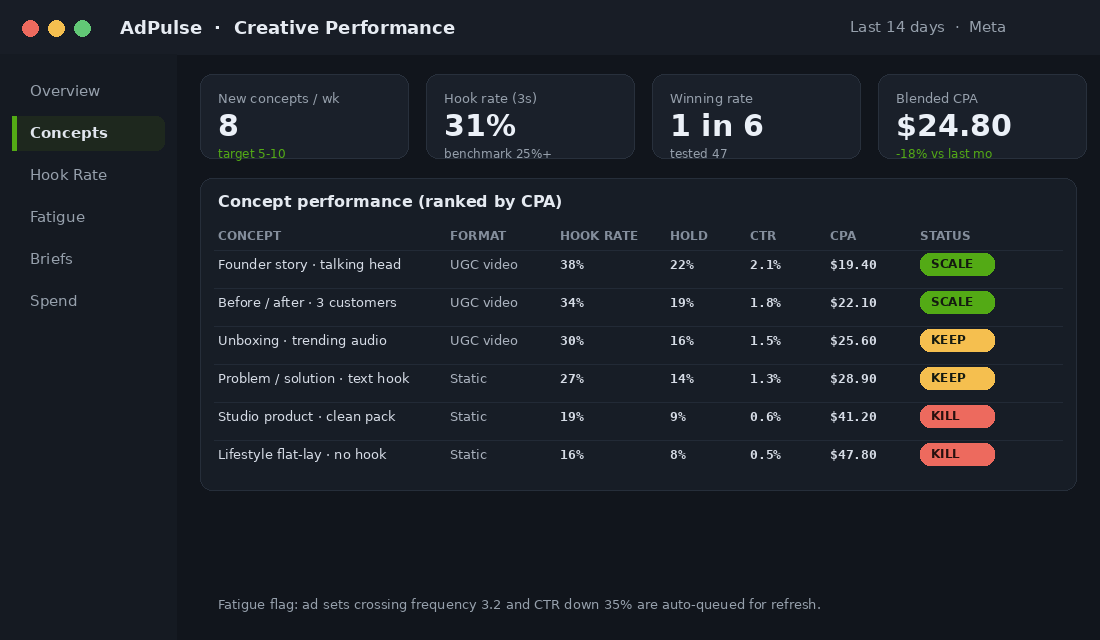
- Hook rate. The share of viewers still watching at three seconds. Aim above 25%. A weak hook rate means the opening is broken, full stop.
- Hold rate. How many reach roughly 15 seconds. This tells you if the body of the ad earns the attention the hook bought.
- Click-through rate. The bridge from interest to intent. Watch for the decline, not just the level, because a falling CTR on a flat CPM is your fatigue alarm.
- CPA by concept. Tie cost per acquisition back to the creative angle, not the campaign. This is how you learn which angles to brief more of.
- Winning rate. Of the concepts you tested this month, how many became scalable winners. One in five to one in six is healthy. It also tells you whether your volume is high enough to keep finding winners.
Set simple rules. Scale the concepts beating target CPA, keep the ones near it, kill the ones well above it without sentiment, and refresh anything crossing a frequency of around three with a falling CTR. For the testing structure that sits underneath this, work through our Meta ad creative testing framework.
The 90-Day Scorecard for Your First Creative Hire
Most creative roles fail in the first quarter because nobody defined what good looks like. The hire shoots a lot, the founder feels vaguely unsatisfied, and by month four both sides are quietly looking elsewhere. Fix it before the offer goes out by writing a 90-day scorecard with numbers the account can verify. Here is the version we use with members, adjust the volumes to your spend.
- Days 1 to 30: build the system. Hook bank of 20-plus angles live. Three UGC creators recruited and briefed. Production tracker running. Six to eight concepts shipped to the account. The number to hit is output, not performance, because nothing they made has had time to prove itself yet.
- Days 31 to 60: find the cadence. Eight to ten new concepts a fortnight, every one tagged by angle. First creative review run with the media buyer using hook rate, hold rate and CPA by concept. At least two concepts beating the account’s current best ad on CPA.
- Days 61 to 90: prove the economics. Winning rate at or above one in six. Blended CPA down at least 10% versus the 90 days before they started, on similar spend. Founder time in the creative pipeline under two hours a week. If those three land, the salary has already paid for itself.
Score it in a 30-minute review at each milestone, and share the scorecard in the interview process so candidates self-select. The people who flinch at being measured on CPA are the artists you do not want. The hiring scorecard playbook has the full template, including the reference-check questions that expose a great portfolio built by someone else’s system.
On pay, structure it so the upside is shared. A base at the market rate above plus a quarterly bonus of $1,500 to $3,000 tied to blended CPA and winning rate keeps the role pointed at the numbers, and costs you nothing in a quarter where the numbers do not move. And give the role a creator budget from day one, typically $2,000 to $5,000 a month for a store spending $30,000-plus on paid, because a content person with no budget for creators is a one-person shoot again. If you want to warm up the customer content side before the hire starts, the UGC playbook sets up the post-purchase ask and the monthly prize so footage is already flowing on their first day.
Four Ways the Creative Hire Goes Wrong
We see the same mistakes on repeat. Avoid these and you are ahead of most brands your size.
- Hiring an artist, not an operator. A beautiful portfolio is not a track record of ads that sold. Hire people who think in hooks, angles and CPA.
- Buying volume with no system. Ten creators and no brief, no hook bank and no tracker just gives you a more expensive mess. Build the engine first.
- One big shoot, no cadence. A single hero shoot feels productive and dies in three weeks. Weekly drip beats quarterly blockbuster every time.
- Judging by taste. The ad you are embarrassed by is often the one printing money. Let the five numbers, not the room, decide.
The Compound Effect
Here is why the engine is worth the effort. The parts feed each other. More volume means more tested concepts, which means more winners. More winners means a lower blended CPA, which frees up budget. More budget funds more research and more shoots, which sharpens your hooks, which produces more winners. It is a flywheel, and creative is the axle.
Put rough numbers on it. A brand spending $40,000 a month with a CPA stuck at $30, refreshing creative every quarter, is leaking money to fatigue between shoots. Stand up an engine that ships eight concepts a fortnight and lift the winning rate enough to pull blended CPA to $24. On the same spend that is around 22% more orders, with no extra ad budget, for the cost of an editor and a UGC roster. That is the difference between content as a chore and content as a channel. The same logic applies to beating creative fatigue with UGC ads at scale.
The brands that win the next two years on Meta will not be the ones with the cleverest targeting. The machine owns targeting now. They will be the ones who can reliably produce more good ideas, faster, than everyone else. Who Gives A Crap has built a brand on exactly that instinct, turning in-house wit and a strong content point of view into ads people actually want to watch. That capability is a hire and a system, not a stroke of luck.
Your 30-Day Rollout
- Week 1. Run the readiness test. Mine 20 customer-language hooks from reviews, tickets and comments into a hook bank.
- Week 2. Recruit three UGC creators and one freelance editor. Set up Foreplay and build your first swipe file.
- Week 3. Write and send your first four briefs using the five-field template. Stand up a production tracker with a weekly volume target.
- Week 4. Launch the first batch, set your kill and scale rules, and review hook rate, CTR and CPA by concept. Book next week’s briefs before this week ends.
The Creative Engine Checklist
- Paid spend is high enough that you genuinely need 5 to 10 new concepts a fortnight.
- A hook bank of 20-plus angles drawn from real customer language, kept current.
- A sourcing model chosen for your stage, usually a UGC roster plus an editor to start.
- A weekly brief cadence using a five-field template (angle, hook, format and proof, persona and CTA, do-not list).
- A swipe file and briefing workflow set up in Foreplay.
- A production tracker showing every concept from briefed to live, with a visible volume target.
- Five numbers tracked weekly: hook rate, hold rate, CTR, CPA by concept, winning rate.
- Clear scale, keep, kill and refresh rules applied without sentiment.
- A customer-UGC loop wired into your post-purchase flow.
- Performance reviewed monthly and next month’s angles briefed in advance.
Where This Fits
Building a content engine is one of the core moves we work on with members who have outgrown doing the marketing themselves. It sits right next to your hiring plan, your paid media and your customer research, and it is usually the lever that finally gets CPA moving in the right direction. If you want a second opinion on whether you are ready to make the creative hire, and which model fits your stage, let’s talk.
Related reading: our Meta ads creative testing framework.