Walk through any Aussie Shopify store and count how many product pages mention where the thing was actually made. Most founders bury it in a size chart tab, or leave it off entirely because a supplier once told them it was “complicated”. Meanwhile the brands winning on price are the ones that print it on the hero image.
What’s in This Article
Here is the number that should change how you think about this. Roy Morgan’s 2025 research for Australian Made Week found that 72% of Australians are willing to pay more for locally made goods, and half of those will pay up to 10% more. In a market where most founders are fighting for a 2% conversion lift, a 10% price premium that customers volunteer is a different kind of lever.
The catch is that origin is one of the most regulated claims you can make in Australia. Get it right and you own a premium your overseas competitors cannot copy. Get it wrong and you are exposed to the same consumer law penalties that were doubled to 100 million dollars on 28 March 2026. This playbook walks through both sides: how to earn the premium, and how to claim it without a letter from the ACCC.
Why Origin Is Worth More Than Your Next Discount Code
Most founders treat “Made in Australia” as a nice line for the About page. The data says it is a pricing instrument. When Roy Morgan asked Australians in May 2025, 84% said they would be more likely to buy a product if they knew it was Australian made, and 67% intended to buy more Australian-made products in the following 12 months.
Think about what that means for your unit economics. If your product retails at 89 dollars and origin lets you hold 95 dollars while a Chinese-made competitor drops to 79, you are not competing on the same axis anymore. You have moved from a price comparison to a values comparison, and values comparisons are where margin lives. We covered the mechanics of that in the pricing power playbook; origin is one of the cleanest sources of pricing power an Aussie brand has.
The recognition is already built. 99% of Australians recognise the green and gold kangaroo logo, and 93% are confident that products carrying it are actually Australian. Around 4,500 businesses license it, representing roughly 8 billion dollars in combined annual revenue. You do not need to educate the market. You need to show up in it.
There is also a defensive angle. Roy Morgan’s September 2025 buying-preferences study found 95% of Australians stand by Aussie-made goods while support for US products fell sharply after the 2025 tariff announcements. When global supply chains wobble, origin stops being a nice-to-have and becomes the reason a customer picks you over a marketplace listing.
So the question is not whether origin sells. It does. The question is whether you can legally say it, and whether you are saying it in the places that move conversion.
The Four Origin Claims and What Each One Legally Means
Australian Consumer Law recognises a hierarchy of origin claims, and they are not interchangeable. Using the wrong one is where most brands get into trouble, usually because a founder writes “Australian made” when they mean “Australian designed” or “Australian owned”.
- Product of Australia. The strongest claim. Every significant ingredient or component must come from Australia, and all or virtually all of the processing must happen here. This is rare for manufactured goods and common for wool, honey, wine, and skincare made from local botanicals.
- Grown in Australia. For fresh and single-ingredient products. Each significant ingredient was grown here and all or virtually all processing happened here. Not relevant to most Shopify brands unless you sell food or agricultural products.
- Made in Australia. The claim most brands want. The product must have been “substantially transformed” in Australia, meaning the last major step in production happened here and it fundamentally changed the identity, nature, or essential character of the imported inputs. Assembling, packaging, labelling, or slicing imported goods does not count.
- Australian owned or Australian designed. Not origin claims at all. These describe the business, not the product. They are legitimate and useful, but if you put “Australian” next to a product image without qualifying it, a reasonable customer may read it as “made here”, and the law judges the impression, not your intent.
The ACCC has received more than 3,000 complaints about country of origin claims in a single five-year window, spanning furniture, clothing, electrical goods, and food. That is roughly 12 complaints a week, and most of them come from competitors, not customers. If a rival knows your hoodie is cut and sewn in Vietnam and your product page says “Aussie made”, they know exactly who to email.
The practical rule: pick the strongest claim you can prove, and never a stronger one. If you cannot prove “Made in Australia”, then “Designed in Melbourne, made with our partner factory in Portugal” is a better product story than a vague “Aussie brand” line that invites a complaint.
The Safe Harbour Test: Substantial Transformation Plus the Cost Rule
The ACL gives you a “safe harbour” for “Made in” claims. If you meet the test, you have an automatic defence against an allegation that the claim is misleading. This is worth understanding properly, because it turns a legal grey area into a spreadsheet you can actually fill in.
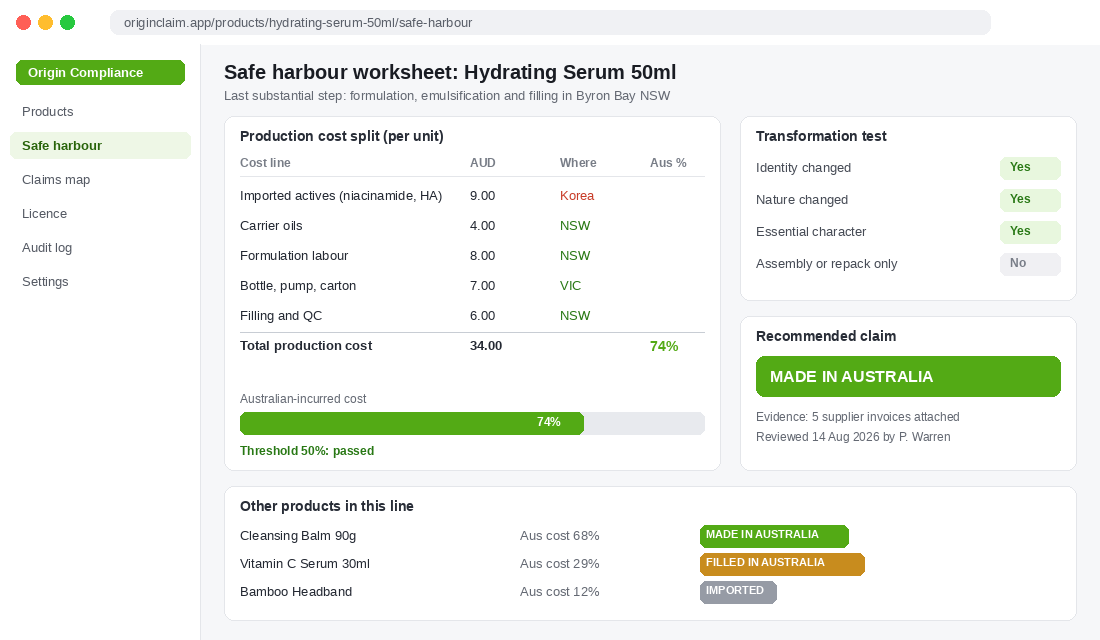
Since the February 2017 amendments, the safe harbour for a “Made in” claim rests on substantial transformation: the goods must be fundamentally different in identity, nature, or essential character from the imported inputs as a result of processing in Australia. The older version of the test also required that 50% or more of the cost to produce the goods was incurred in Australia, and while that cost threshold is no longer the formal legal gate, it remains the sanity check we run with every member, because a court deciding whether a transformation was “substantial” will look hard at where the money was spent. If most of your production cost is offshore, be very careful about claiming otherwise.
Run the transformation question against your own product, and be brutal about it:
- Passes. Imported raw leather cut, stitched, lasted, and finished into boots in Adelaide. Imported stainless steel sheet pressed, welded, and coated into a drink bottle in Melbourne. Imported oils blended, emulsified, and filled into a skincare formula in Byron Bay.
- Fails. Finished garments imported and a swing tag attached in Sydney. Imported candles re-boxed with your branding. Imported supplement capsules bottled and labelled locally. A finished mattress shipped flat-packed and “assembled” by folding it into a box.
Now do the cost maths, because it protects you even where the legal test is arguable. For a 120-dollar retail skincare product with a landed cost of 34 dollars, list every production cost: imported actives (9 dollars), local carrier oils (4), Australian formulation labour (8), local packaging (7), local filling and QC (6). Australian-incurred cost is 25 of 34, or 74%. That is a comfortable “Made in Australia”. If the same product were imported as a finished bulk formula (24 dollars) and only filled locally (10 dollars), local cost is 29% and the transformation is cosmetic. That product is “Filled in Australia from an imported formula”, and nothing stronger.
Document this calculation once per product line, date it, and keep the supplier invoices behind it. The ACCC has the power to require you to substantiate any origin representation, and “we assumed” is not a defence. If you have already built the substantiation file from the product compliance check, this is one more tab in the same workbook.
Getting the Green and Gold Kangaroo on Your Product Page
You can make a compliant “Made in Australia” claim in plain text without anyone’s permission. But the kangaroo logo is a registered certification trade mark, and you can only use it if you are licensed by Australian Made Campaign Ltd (AMCL). Given the logo carries 99% recognition and 93% trust, the licence is one of the cheapest credibility purchases available to an Aussie brand.
The fee is based on the annual sales of the products you license, not your total business turnover. The current schedule starts at 300 dollars plus GST for licensed sales up to 300,000 dollars, then steps to 400 dollars up to 500k, 600 up to 750k, 800 up to 1 million, and 1,000 dollars a year for sales between 1 and 2.5 million. A 1.8 million dollar brand pays less for the most recognised trust mark in the country than it spends on a single week of Meta ads.
The application is online at australianmade.com.au and asks for three things: the combined turnover range of the products you want to license, details of any contract manufacturer involved in production, and a declaration that the products meet the relevant origin criteria under the AMAG Code of Practice. Expect to answer follow-up questions about your supply chain; AMCL does check, which is the whole reason the logo is trusted.
Once licensed, you get more than a logo file. Licensees can list products in the Australian Made “Find Aussie Products” directory, which sends real referral traffic to your Shopify store, and you are eligible to take part in Australian Made Week each May, a national media campaign that you would otherwise pay six figures to replicate. Treat the licence as a marketing channel with a compliance benefit, not the other way round.
One rule founders miss: the logo must always appear with the correct descriptor underneath (“Australian Made”, “Australian Grown”, or “Product of Australia”), and you can only use it on the specific products you licensed. Putting it in your site footer next to products made offshore is a breach of the licence and, more importantly, a misleading representation about those other products.
Where Origin Actually Moves Conversion on a Shopify Store
Having a compliant claim and having a claim that sells are two different projects. Most brands that are legitimately Australian made mention it once, in a paragraph of description copy below the fold. Here is where it should live, in order of impact.
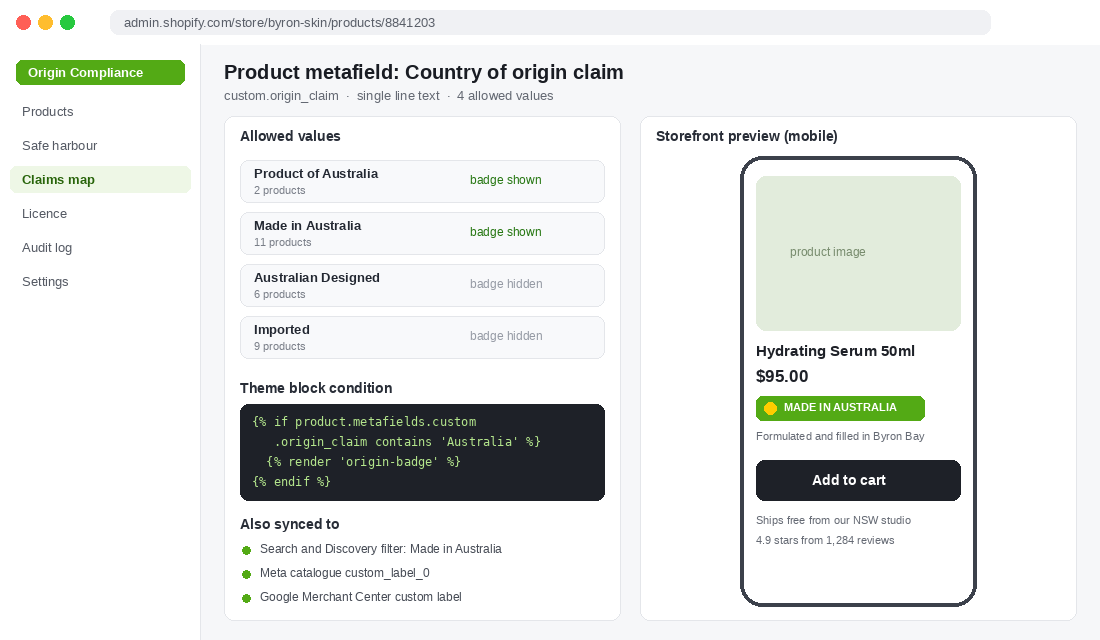
- Product page, above the add-to-cart button. A small origin badge next to price is the single highest-value placement. This is the moment the customer is comparing you to the cheaper option in another tab. Frank Green’s bottle pages lead with Melbourne manufacturing for exactly this reason.
- Collection cards. If only some of your range is Australian made, badge those products on the collection grid so the customer sees the difference before they click. It also gives you a clean upsell story from the imported entry product to the local premium one.
- Cart and checkout. A single line under the order summary (“Made in Adelaide, ships from our own workshop”) reduces the last-second bounce to a marketplace search.
- Ad creative. “Made in Australia” in the first three words of a Meta hook consistently outperforms generic quality claims for local brands, because it pre-qualifies the 72% who will pay more and repels the price-only shopper you do not want anyway.
- Post-purchase and packaging. A “Made by us in Geelong” card inside the box is a review generator. Customers photograph it.
The way to make this systematic rather than a one-off copy edit is a product metafield. Here is the setup that takes about 20 minutes on any Online Store 2.0 theme:
- Step 1. In Shopify admin, go to Settings, then Custom data, then Products, and add a definition called “Country of origin claim”. Use a single-line text type with a preset list of allowed values: Product of Australia, Made in Australia, Australian Designed, Imported.
- Step 2. Populate it per product, using the safe harbour worksheet from the previous section as your source of truth. Do not let a copywriter set this field.
- Step 3. In the theme editor, open the product template, add a text or badge block to the product information section, and connect it to the metafield using the dynamic source picker. Only render the block when the value is one of the two Australian claims.
- Step 4. Add the same metafield to Shopify Search and Discovery as a filter so customers can filter a collection to “Made in Australia”. That filter alone is worth testing in your top navigation.
- Step 5. Sync the field to your Meta and Google product feeds as a custom label so you can bid differently on locally made SKUs.
Because the claim now lives in one structured field rather than in free-text copy, when a supplier changes and a product stops qualifying, you update one value and every placement on the site changes with it. That is the difference between a brand that is compliant today and one that stays compliant.
What Getting It Wrong Actually Costs
Founders tend to assume origin enforcement is aimed at supermarkets. The case list says otherwise. The ACCC’s country of origin actions are disproportionately small and mid-sized businesses, and the products look a lot like what sells on Shopify.
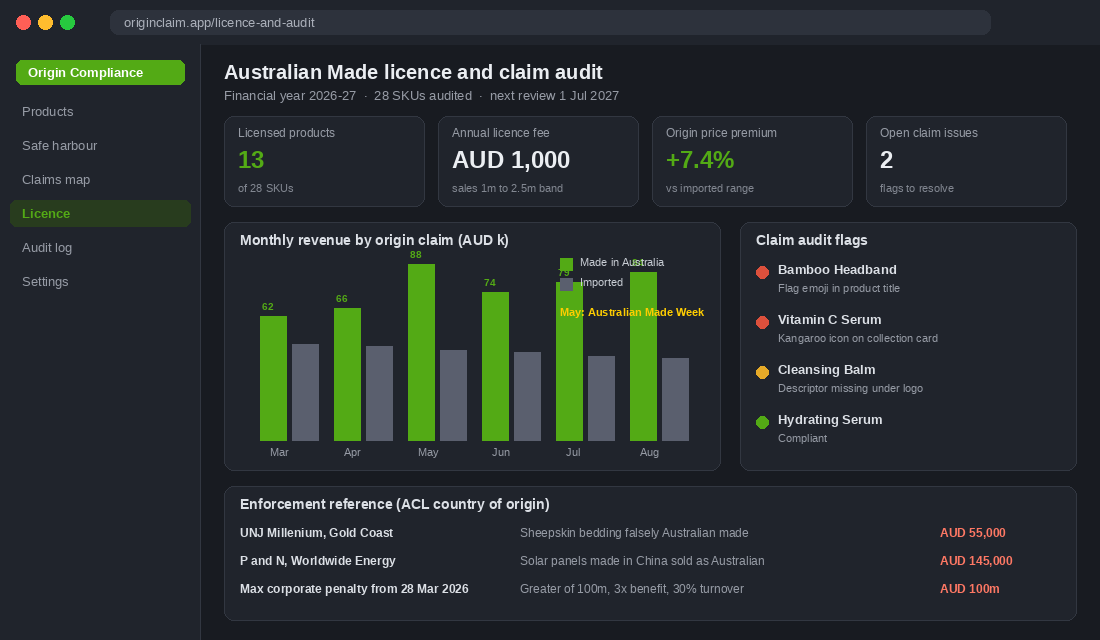
- Sheepskin and wool bedding, Gold Coast. UNJ Millenium Pty Ltd was ordered to pay a 55,000 dollar penalty, in part for falsely claiming its sheepskin and wool bedding products were made in Australia. This is a classic DTC category, and the origin claim was the whole value proposition.
- Solar panels sold as Australian made. The Federal Court ordered two related suppliers to pay a combined 145,000 dollars for representing that their panels were made in Australia when they were manufactured in China. The court also ordered corrective advertising, which means paying to tell your own customers you misled them.
- Coles fresh produce. Even the majors pay. Coles paid 61,200 dollars in infringement notices for misleading origin signage on fresh produce in five stores over a three-month window.
Those penalties were set under the old regime. From 28 March 2026, the maximum penalty for a corporation breaching the ACL is the greater of 100 million dollars, three times the benefit obtained, or 30% of adjusted turnover during the breach period. For an individual, it is 5 million dollars. Nobody expects a 1 million dollar Shopify brand to cop the ceiling, but the ceiling is what a court reasons down from, and it now starts twice as high.
The cost that hurts more than the penalty is the corrective notice. An ACCC outcome usually includes publishing a correction on your own website and social channels, and the trade press covers it. For a brand whose entire premium was built on “made here”, that is not a fine. It is the end of the pricing power, and you cannot buy it back.
The pattern across the origin cases is the same one we see in green claims enforcement: the regulator does not need to prove you lied. It needs to show a reasonable consumer would have formed a false impression. A kangaroo graphic you drew yourself, a flag emoji in a product title, or “Aussie” in the brand name next to an imported product can all create that impression.
The Australian Owned Trap (And How to Sell Without Faking Origin)
Here is the uncomfortable truth for most Aussie DTC brands: the majority of you manufacture offshore. The Oodie is one of the biggest Australian-founded apparel brands in the world and it is made in China. That is not a scandal, it is a supply chain. The problem only starts when the marketing implies something the product is not.
You can still capture a meaningful share of the local-preference premium without an origin claim, provided you are precise. “Australian owned and operated” is a true statement about your business and Roy Morgan’s data shows customers value it. “Designed in Brisbane” is a true statement about your process. “Ships from our Melbourne warehouse” is a true statement about delivery, and it answers the question customers actually care about most, which is when the parcel arrives.
The rules for the imported-product brand:
- Never put a flag, a map of Australia, or a kangaroo next to a product image unless the product qualifies for an origin claim. Those symbols are treated as origin representations in their own right.
- Qualify every “Australian” reference at the point it appears. “Australian owned” in the header is fine. “Australian” on its own in a product title is not.
- Name the real origin where a customer would expect it. A “Where it’s made” line in the product details tab that says “Cut and sewn by our partner factory in Vietnam, designed in Sydney” builds more trust than silence, and it closes the door on a complaint.
- Do not let contract manufacturers make the claim for you. If your supplier’s spec sheet says “Australian formulation” and you repeat it, you own the representation, not them.
And if you are on the fence about bringing a hero SKU onshore, run the numbers with the premium included. A product that costs 6 dollars more to make in Australia but supports a 9 dollar higher retail price and earns the kangaroo is not a cost decision. It is a positioning decision with a positive margin.
Testing the Premium: Prove Origin Lifts Conversion Before You Reprice the Range
Roy Morgan tells you 72% of Australians say they will pay more. Your customers might not be average Australians, and a survey answer is not a checkout. Before you move prices, run a four-week test and let your own data decide.
- Week 1 to 2: badge test. Using Intelligems, Shoplift or a theme A/B tool, show half your product page visitors an origin badge above the add-to-cart button (the metafield block from the previous section) and half the current page. You are measuring add-to-cart rate and conversion rate. On a store doing 8,000 product page sessions a week, two weeks gives you enough volume to trust a 10% relative difference.
- Week 3 to 4: price test. If the badge wins, hold the badge on and test a 5 to 8% price increase on the Australian-made products only. Watch conversion, AOV and, most importantly, revenue per visitor. A 6% price lift that costs you 3% of conversion is a win. One that costs you 12% is not, and you have learned something cheap.
- Read it by traffic source. Paid social visitors are more price-sensitive than branded search or email traffic. Many Aussie brands find the origin premium holds fully for returning and email customers and only partially for cold Meta traffic, which changes how you bid, not whether you reprice.
A useful benchmark from stores we have worked through this with: an origin badge next to price typically moves product page conversion by 4 to 9% for locally made SKUs, and a 5% price lift on top of it holds in most categories except commodity consumables. Your mileage will vary, which is the whole point of testing. The pricing strategy playbook covers how to structure the price test so a discount code in the wild does not contaminate the result.
Take the same claim into your ads. Test “Made in Melbourne” as the first three words of a Meta hook against your current best performer, using the same audience and budget. Origin hooks usually cost more per click and less per purchase, because they pre-qualify. The Meta creative testing engine gives you the framework for running that test cleanly.
A Worked Example: Moving a Hero SKU Onshore and Paying for It With the Premium
Say you run a Sydney bag brand with a hero tote at $149 retail, made in Vietnam at a landed cost of $31. It sells 900 units a month. A local maker in Marrickville quotes $47 a unit for the same spec at your volume, and cutting and sewing here is clearly substantial transformation, so the “Made in Australia” claim and the kangaroo licence are on the table.
The naive read is that you have just added $14,400 a month of cost. Run it properly:
- Price. Move the tote to $165, an 11% lift the badge test says the market will hold at a 5% conversion cost.
- Volume. 900 units becomes roughly 855 at the new price.
- Gross profit per unit. $118 before, $118 after ($165 minus $47). Gross profit per month: $106,200 before, $100,890 after. A $5K gap so far.
- Now the parts the naive read misses. Freight and duty on 900 units from Vietnam ran about $4.10 a unit, which disappears. Lead time drops from 11 weeks to 3, so your inventory cover drops from 14 weeks to 6, freeing about $50,000 of working capital. Origin-led ad creative lowers blended CAC by 8 to 12%. The AMCL licence costs $800 a year for this turnover band.
Net result: before the CAC saving, contribution is about $1,600 a month lower than it was. After it, roughly level. You have $50K back in the bank, a claim no offshore competitor can copy, and a premium that widens each time freight or the exchange rate moves against imports. That is the decision most founders never get to because they stopped at the unit cost. For the full cost-per-unit method behind the freight and duty figures, use the landed cost playbook.
The 5-Point Origin Claim Checklist
Run this against every product in your catalogue once a year, and every time a supplier or process changes. It takes about 15 minutes per product line and it is the whole substantiation file if the ACCC ever asks.
- 1. Map the last substantial step. Write down, in one sentence, what happens to the product in Australia. If the sentence contains only the words assemble, pack, label, bottle, or re-box, you do not have a “Made in” claim.
- 2. Run the cost split. List every production cost line and mark it Australian or imported. Record the Australian percentage and the date. Below 50%, treat any “Made in” claim as high risk regardless of the transformation argument.
- 3. Choose the strongest claim you can prove, and nothing stronger. Product of, Grown in, Made in, or a qualified statement such as “Designed in Australia, made in Portugal”. Store the choice in the product metafield, not in copy.
- 4. Audit every surface for implied claims. Product titles, badges, flags, maps, kangaroo graphics, ad creative, packaging, email headers, and marketplace listings. Every one of them either matches the metafield or gets removed.
- 5. License the logo where you qualify. Apply to AMCL for the products that pass, use the correct descriptor, and only on those products. Add the directory listing and Australian Made Week to your annual marketing calendar.
How the Pieces Compound
Done properly, origin is not a compliance task with a marketing benefit. It is a flywheel that touches four of the 10 P’s at once.
It starts in Product: a documented, provable claim stored in one structured field. That feeds Profit: the 5 to 10% premium that 72% of Australians say they will pay, held without a discount code. The premium funds Promotion: origin-led creative that pre-qualifies the right customer and lowers your blended acquisition cost because you stop paying to reach price-only shoppers. And the whole thing sits on Protection: a substantiation file, a licence, and an annual audit that mean a competitor complaint goes nowhere.
The brands that get this wrong do it in the opposite order. They start with the marketing line, discover the compliance problem when a rival reports them, and lose the premium at exactly the moment it was starting to work. Start with the worksheet, and the marketing takes care of itself.
Inside eCommerce Circle, Product positioning and Protection are two of the core pillars we work on with every member, and origin claims come up in almost every audit we run on an Australian-made brand. If you want a second opinion on yours, let’s talk.