Every December I watch the same thing happen to Aussie Shopify founders. Orders spike, the pack bench gets buried, and somewhere in week two a customer emails to say their mum opened the parcel and saw the price on the packing slip. The founder had never thought about gifting as a system. They thought about it as a cart note.
What’s in This Article
Here is why that matters. The ARA and Roy Morgan forecast Australians would spend $12 billion on Christmas gifts last year, an average of $757 per shopper, with 29% of shoppers buying earlier than the year before. A big slice of the orders hitting your store between November and the Australia Post cut-off are not for the person paying. They are gifts. And most stores treat a gift order exactly like a Tuesday reorder of the same product.
The brands that get this right do something different. They build a gifting layer into the store: a wrap option that is priced properly, a message field that actually reaches the pack bench, a packing slip that hides prices, and a wrap station that does not slow down every other order. Done well, gift options lift AOV, cut December support tickets, and turn the recipient into a future customer. This playbook walks through how to build that layer in the next six weeks, before peak hits.
Why Gift Wrapping Is an AOV Lever, Not a Nice-to-Have
Most founders price gift wrap in their head as “a few bucks of paper and ribbon” and decide it is not worth the hassle. That maths misses where the money actually is. The wrap fee itself is a small line. The behaviour change it drives is the real number.
Pitney Bowes has run consumer surveys on this for years. In their 2023 research, 71% of shoppers said they would pay someone else to wrap a gift, 35% said some gifts are simply hard to wrap, and 24% admitted they lack the skill. In an earlier BOXpoll round, two-thirds of consumers said they would pay for gift packaging if the retailer offered a preview image or a choice of options, and Gen Z shoppers valued a personalised handwritten note at over $12. That is a customer telling you, in plain numbers, that they want to hand you this job.
Where it shows up on your P&L is in the second item. When a buyer knows the order will arrive wrapped and gift-ready, a meaningful share of them add a complementary product so the gift feels complete. A candle becomes a candle plus a matchbox. A robe becomes a robe plus a body oil. Shopify’s own guidance on gift wrapping calls this the trade-up effect, and it is the same mechanism you already rely on in your gift buyer playbook: the person paying is not the person using, so they buy on presentation, not on spec.
There is also a retention angle most brands never measure. A wrapped parcel with a printed message lands in front of a recipient who has never heard of you, at the exact moment they are feeling good. Your packaging insert, your care card, and your brand are the first impression. That is a warm acquisition channel you are paying nothing extra for, which is why this sits right alongside the unboxing experience in how we coach it.
Step 1: Price the Wrap in Tiers So It Never Loses Money
The mistake I see most often is a single “Gift wrap: $5” checkbox that was priced by feel in 2023 and has never been revisited. By December it is costing more in labour than it earns, so the founder resents every wrap order and the team starts skipping them when they get busy.
Price it the way you price a product: materials plus labour plus a buffer, then a margin on top. Shopify’s published framework lands on roughly $3 for a basic tier, $4 to $5 for a standard tier, and $8 to $10 for premium, and those numbers translate cleanly to AUD once you cost your own materials.
- Basic (target A$4 to A$6). Branded tissue, a kraft wrap or gift bag, and a printed message card. Roughly 90 seconds of labour. Suits flat products: apparel, books, skincare sets.
- Standard (target A$8 to A$10). Full wrap in your branded paper, ribbon or belly band, printed card. Two to three minutes of labour. This should be your default and your most-selected tier.
- Premium (target A$15 to A$20). Rigid gift box, hand-tied ribbon, a proper card, extra care for odd shapes. Four to six minutes. Only offer this if your product and your customer justify it.
Run the costing properly. Materials at A$1.50, three minutes of labour at a fully loaded A$40 an hour is A$2, add a 10% rework buffer, and your standard wrap costs about A$3.85. At A$9 you are clearing more than 50% margin on the wrap itself before you count the second-item lift. Add a 15 to 20% peak-season labour loading in your maths because your casual packer in December is slower than your full-timer in March.
Then decide your free-wrap threshold. Set it above your current AOV, not at it. If your AOV is A$120, free standard wrap kicks in at A$150. That single rule pulls a share of single-item gift orders up to two items, which is where the whole system pays for itself.
Step 2: Build the Gift Option Into the Cart, Not the Checkout Notes
Shopify gives you three ways to do this, and the right one depends on your plan and your volume. The wrong one is the one most stores use: a bare “note to seller” box on the cart page with no label, no price, and no way for the pack bench to know it exists.
Option A: Native Shopify, no app. This works on every plan and costs nothing. Here are the setup steps:
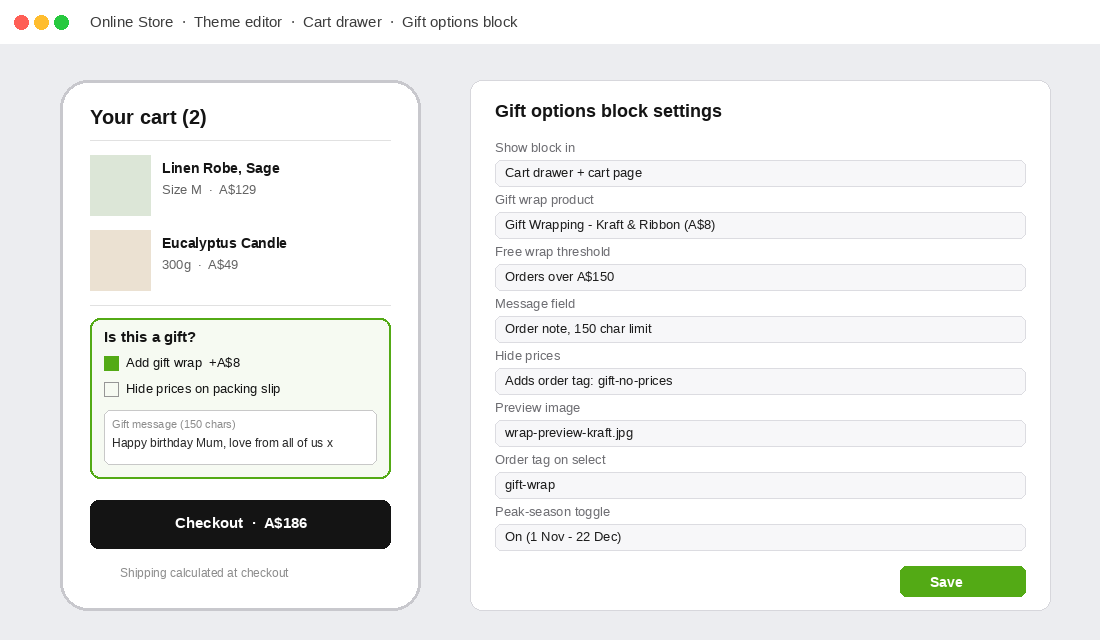
- Create a product called “Gift Wrapping” with one variant per tier (Basic, Standard, Premium). Untick “This is a physical product” so it never triggers a shipping rate on its own.
- In your theme editor, open the cart drawer or cart page and add a product block or buy button for the Gift Wrapping product. Most Online Store 2.0 themes (Dawn, Impact, Prestige) support this without code.
- Enable cart notes in theme settings and relabel the field “Add a gift message (optional, 150 characters)”. The character limit matters because your card has finite space.
- Upload a real photo of a wrapped parcel next to the option. Pitney Bowes found a preview image is the single biggest driver of a shopper choosing to pay for wrap.
- Set up a Shopify Flow that tags any order containing the Gift Wrapping product with “gift-wrap” so the pack bench can filter for it.
Option B: A gifting app. If you are doing more than a couple of hundred gift orders a season, an app earns its keep. Wrapped (Gift Wrap & Messages) starts at around US$15 a month plus 1% of gift option value and puts gift blocks on product pages, cart, and checkout. Giftnote focuses on the message side, delivering the note by email or SMS timed to the delivery. Giftship is the heavy option at around US$60 a month, and it is the only one that lets a buyer ship one cart to multiple addresses, which matters if you sell corporate gifts or hampers.
Option C: Checkout extensibility on Shopify Plus. If you are on Plus, a checkout UI extension puts the gift toggle and message field directly in checkout, where completion rates are highest. This is the cleanest experience but needs a developer, so only go here once Option A or B has proven the demand.
Whichever route you take, the rule is the same: the gift option must appear in the cart drawer, not buried on a product page or hidden behind a checkout note nobody reads. Buyers decide to gift-wrap at the moment they review the order, and that is where the option has to be.
Step 3: Fix the Packing Slip Before You Sell a Single Wrap
This is the step that generates the angry emails. A gift order goes out with a standard packing slip, the recipient sees the price, and the buyer feels exposed. Shopify’s guidance is blunt about it: shoppers expect complete price concealment on any gift order, on every printed piece.
You have two jobs here. First, edit your packing slip template so orders tagged “gift-wrap” or “gift-no-prices” print a gift receipt format: product names and quantities only, no unit prices, no totals, no discount codes. In Shopify admin go to Settings, then Shipping and delivery, then Packing slip template, and wrap the price columns in a Liquid condition that checks for the tag.
Second, make sure the gift message actually prints. The most common failure is a beautiful message typed into the cart note that never leaves Shopify admin because the packer is working from the shipping label, not the order screen. Pull the note onto the packing slip in a clearly boxed “Gift message” section, and print a separate card for premium tiers. If you use a 3PL, confirm in writing that they print order notes on the slip and that their default slip hides prices for tagged orders. Plenty of Australian 3PLs do not, and you will not find out until 14 December.
While you are in there, add a “Ship to a different address” nudge in the cart for gift orders. Pitney Bowes found the average gift shopper ships to more than five recipients over the season. Making it obvious that a buyer can send the parcel straight to the recipient is the difference between one order and five.
Step 4: Set Up a Wrap Station That Does Not Slow the Whole Bench
Here is the operational trap. Wrap orders take three to six minutes each. If they flow through the same pick and pack line as everything else, every wrapped order steals time from ten normal ones, and by the second week of December your whole dispatch is late. The fix is separation.
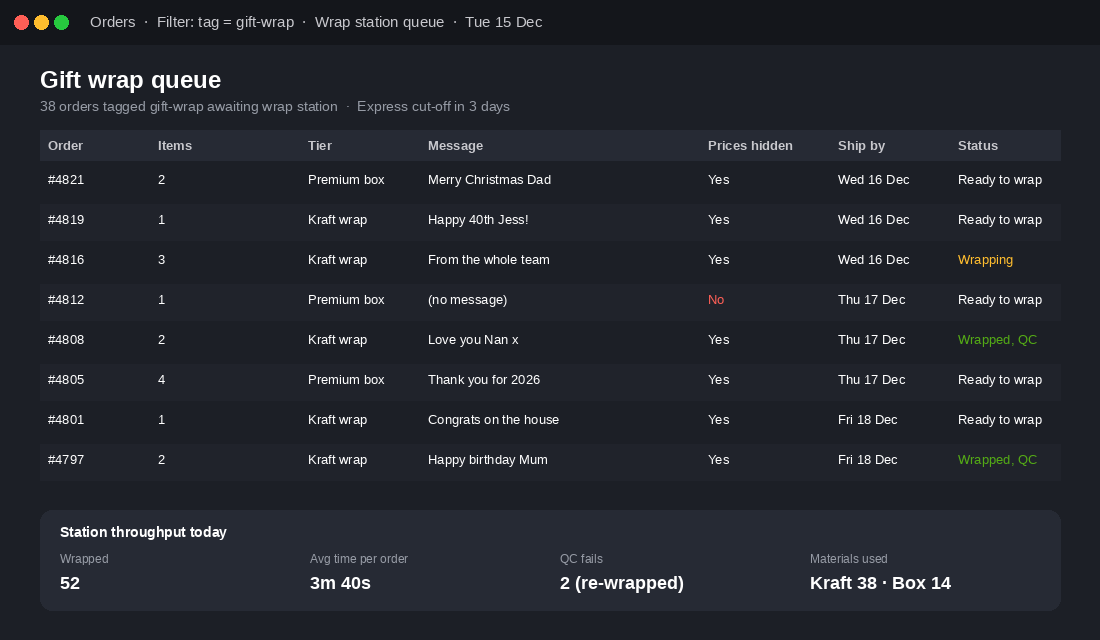
- Filter, do not hunt. Start every morning by filtering orders by the “gift-wrap” tag. Batch them into one queue. Your packers should never have to read a cart note to discover an order needs wrapping.
- Three physical zones. Pick, wrap, final pack. Wrapped and unwrapped orders must never share a bench, or you will ship a wrapped candle to the wrong buyer.
- Pre-cut and pre-bin. Pre-cut paper and ribbon for your top ten SKUs. Store each tier’s materials in a labelled bin so a casual hired on 1 December can wrap to standard by lunch.
- A one-page QC card. Paper smooth, ribbon flat, message matches order number, prices hidden, carton within your carrier’s size band. Every wrapped order gets ticked before it goes to final pack.
- Time it. Track average minutes per wrapped order per packer. If one packer is at seven minutes and another at three, that gap is your training priority, not a personality difference.
Watch the carton size too. A rigid gift box can push a parcel into the next cubic weight band with Australia Post or Aramex, and that surcharge can eat the entire wrap margin. Measure your premium box against your carrier’s cubic thresholds before you commit to it. If your wrapped parcel is 20% bigger and 40% dearer to ship, drop the box and use a belly band.
Step 5: Merchandise the Gift Option Where Buyers Are Deciding
Having a gift option and selling a gift option are different things. Once the mechanics work, you need to put it in front of people at the moments they are thinking “is this a gift?”
Aesop, still one of the best Australian-born examples of premium retail, shows gift wrapping right in the cart, with the branded cotton bag pictured, so the buyer sees exactly what the recipient will open. Bed Threads pairs its gift bundles with a gift note delivered by email or SMS and sells a reusable linen gift sack as a product in its own right, which turns the wrap into a margin line rather than a cost line. Neither brand hides the option behind a checkout note.
For your store, the placements that move the number are:
- A “Gift-ready” badge on gift-heavy collection pages from 1 November. Candles, skincare, homewares, anything under A$80 that sells more in December than in July.
- A line under the add-to-cart button: “Free gift wrap on orders over A$150” or “Add gift wrap at checkout”. One sentence, no pop-up.
- A gift guide page that filters by recipient and price, with the wrap option mentioned in the header. Tie it to the Christmas cut-off calendar so the page also shows the last order date for wrapped parcels.
- A Klaviyo segment of customers who chose gift wrap last year, and a single email in early November reminding them wrap is back and the cut-off date. This is the highest converting email most brands never send.
- A sustainability line if it is true. Shorr’s packaging research found 90% of consumers are more likely to buy from brands with sustainable packaging and 43% will pay extra for it. Kraft paper, paper ribbon, and an FSC mark are cheap credibility. Do not claim “eco-friendly” unless you can back it under Australian Consumer Law.
Step 6: Set a Wrap Cut-Off Date and Enforce It
Wrapped orders take longer to dispatch, so they need an earlier cut-off than plain orders. Last year Australia Post’s recommended final posting dates for Parcel Post were around 19 December interstate and 22 December within the same state, with Express Post a few days later. Your wrapped-order cut-off should sit two business days before your plain-order cut-off, and it should be visible on the cart, the gift guide, and the order confirmation.
After the wrap cut-off, switch the gift option off in the cart drawer with a one-line note: “Gift wrapping has closed for Christmas delivery. Gift messages are still included free.” The customer still gets the message card, your bench gets its capacity back, and nobody is promised something you cannot deliver on 23 December.
Then do the thing most founders forget: keep the gift option on all year. Birthdays, Mother’s Day, Father’s Day, and the growing corporate gifting market are not December problems. A store that only offers wrap at Christmas is retraining its customers every November. A store that offers it year-round has a steady 5 to 10% gift attach rate in quiet months and a team that already knows the SOP when peak arrives.
How the Pieces Compound
None of these steps is dramatic on its own. A tiered wrap price adds a few dollars of margin per order. A cart-drawer block lifts attach rate by a few points. A fixed packing slip removes a handful of support tickets. A separate wrap station saves a few hours a week.
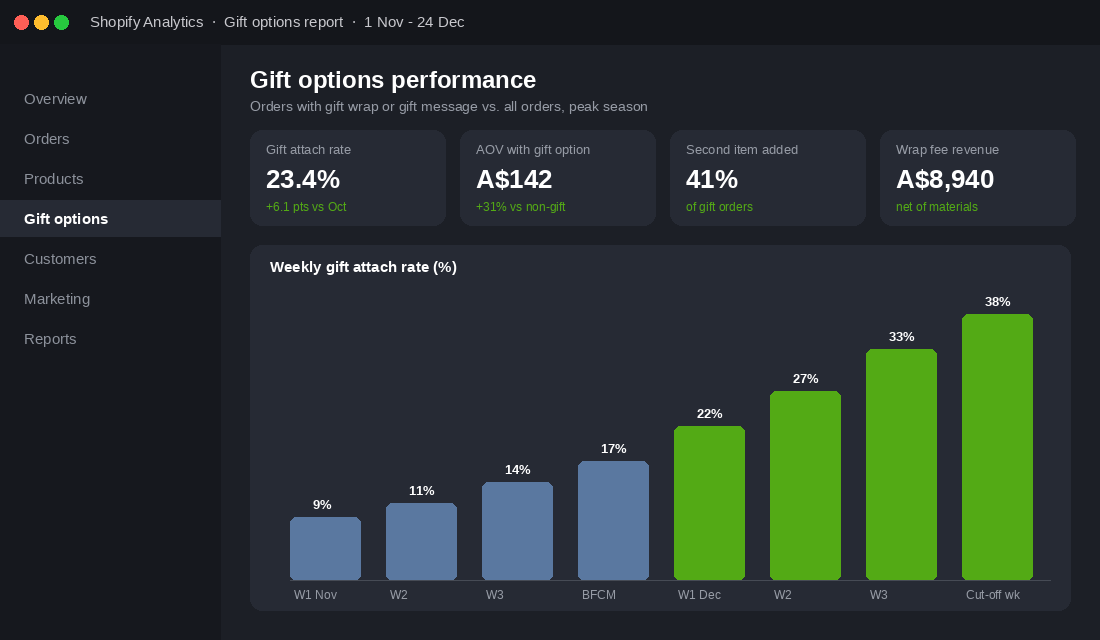
Put them together and the shape changes. Say you do 2,000 orders between November and the cut-off at an A$110 AOV. A 20% gift attach rate is 400 wrapped orders. At A$9 standard wrap with roughly A$5 margin each, that is A$2,000 of wrap margin. If 40% of those wrapped orders add a second item averaging A$35, that is another A$5,600 of revenue you did not have. And 400 recipients opened a wrapped parcel with your brand on the card, at the moment they were most likely to remember it. None of that required a dollar of ad spend.
The system also protects you. The wrap station stops December dispatch from collapsing. The packing slip fix stops the price-reveal emails. The cut-off date stops the promises you cannot keep. Gifting stops being the thing that breaks your peak and becomes the thing that pays for it.
Your Six-Week Gift Wrapping Checklist
Work through this before 1 November. Each item should take an afternoon at most.
- Week 1: Cost it. Materials plus labour plus 10% buffer for each tier. Set prices at 50% or better margin. Set the free-wrap threshold above current AOV.
- Week 2: Build it. Gift Wrapping product with tier variants, cart-drawer block, relabelled message field with a character limit, preview photo, Shopify Flow tag.
- Week 3: Fix the slip. Gift receipt format for tagged orders, gift message boxed on the slip, confirm with your 3PL in writing.
- Week 4: Set up the station. Three zones, labelled bins, pre-cut materials for top SKUs, one-page QC card, per-packer timing sheet.
- Week 5: Merchandise it. Gift-ready badges, add-to-cart line, gift guide page with cut-off dates, Klaviyo segment of last year’s gift buyers.
- Week 6: Rehearse it. Run 20 test orders through the whole flow with a casual packer. Time them. Fix whatever broke. Publish the wrap cut-off date.
Track three numbers weekly from 1 November: gift attach rate, AOV on gift orders versus plain orders, and average wrap minutes per order. If attach rate is under 10% by the end of November, the option is not visible enough. If wrap minutes are over five, the station needs work. If gift AOV is not at least 20% above plain AOV, your free-wrap threshold is set too low.
Inside eCommerce Circle, building out Product and Practice systems like this before peak is one of the core pillars we work on with every member. If you want a second opinion on your gifting setup before December, let’s talk.