Most Aussie Shopify founders treat suppliers like furniture. You set them up once, you stop noticing them, and you only think about them when something falls over. Then the email arrives. A factory shut down for Chinese New Year and forgot to tell you. A container is sitting off the coast of Yemen. Your hero product just went on a 14-week back order during your best sales month.
What’s in This Article
This is the most expensive blind spot in Australian ecommerce right now. Supply chain failures cost consumer brands more than USD 12 billion globally each year, with each individual disruption running an average of USD 680,000 in lost sales and recovery costs. Most of those brands had a single supplier doing the heavy lifting and no plan B.
The good news. Supplier risk is one of the few things in ecommerce you can almost completely engineer out of your business. Not by working harder. By building a 4-tier audit, a scorecard you run every quarter, and a simple diversification rule that the smartest brands in the country have already adopted. Here is the full playbook we run with the founders inside eCommerce Circle.
The Real Cost of Supplier Failure (And Why It Hits Aussie Brands Twice as Hard)
Australia sits at the end of one of the longest supply lines in the developed world. When something goes wrong upstream, we feel it later, longer, and more expensively than the US or Europe. The 2025 Australian Industry Group report found that 47% of local industrials are currently experiencing supply chain disruption, up from 35% a year earlier. Of those, 81% reported direct cost increases.
The numbers behind the disruption are brutal. The US tariff regime introduced in 2025 hit Aussie exporters with around AUD 1.4 billion in additional duties. Air freight rates from China to Europe spiked by 50 to 90% during the Red Sea shipping crisis, forcing brands like Shein to abandon ocean freight overnight. Australian importers who relied on the standard Asia-Europe corridor watched lead times balloon from 28 days to 42 plus days, with insurance premiums climbing in lockstep.
Here is what hurts most. 21% of business leaders currently operate without real-time visibility into disruptions affecting their suppliers, and 18% cannot identify which of their suppliers carry the highest regulatory or compliance risk. If a fire, a tariff, or a port strike took out your number one factory tomorrow, would you find out from your supplier, from your tracking software, or from a customer complaining about a missing parcel?
For a Shopify brand turning over AUD 200k a month, a six-week stockout on your hero SKU is roughly AUD 280k in lost revenue plus another AUD 60k in compounded ad spend you cannot scale. That is more than most founders pay themselves in a year. And it is fully avoidable.
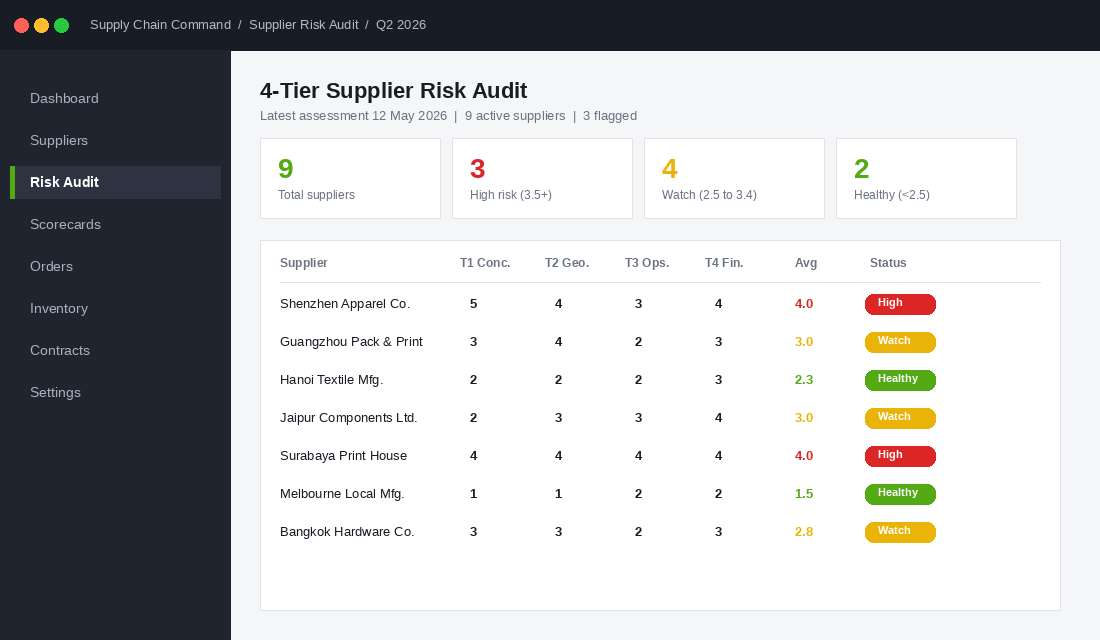
The 4-Tier Supplier Risk Audit (Run This Every Quarter)
Before you can protect your supply chain, you have to see it clearly. Most founders cannot list every supplier they depend on, let alone rate them. The 4-tier audit is the simplest way to map your exposure in a single afternoon. Pull up a spreadsheet, add columns for each supplier, then score them across all four tiers.
- Tier 1: Concentration risk. What percentage of your annual COGS sits with this one supplier? Anything over 40% with no backup is a red flag. Anything over 70% is a five-alarm fire.
- Tier 2: Geographic risk. Where are they physically located? If you have three suppliers but they are all in Guangdong Province, you have one geography of risk, not three suppliers. Floods, tariffs, port closures hit them all on the same day.
- Tier 3: Operational risk. Lead time variability, defect rate trend, response time to your last urgent email. A supplier that took 14 days to confirm an order last quarter is a slow leak you are choosing to ignore.
- Tier 4: Financial and ownership risk. Is the supplier privately owned, financially stable, and likely to be around in 24 months? In 2025 the BlackBerry research found that 74% of supply chain breaches originated from suppliers companies were not monitoring. Half of those suppliers had financial warning signs that nobody bothered to check.
Score every supplier from 1 (very low risk) to 5 (very high risk) across all four tiers. Any supplier averaging 3.5 or higher needs an active mitigation plan inside the next 90 days. This is not a paperwork exercise. This is the document you reach for when something goes sideways and you have 48 hours to decide who you call first.

The China Plus One Strategy: Why 50% of Smart Brands Are Splitting Production
The single most important supplier shift of the last 24 months is not getting out of China. It is China Plus One. The IDC projects that 50% of firms will move to balanced multi-shoring sourcing strategies, splitting orders across several regions instead of leaning on one low-cost hub. Among SMBs, 78% have already adopted some form of inventory buffering or supplier diversification.
The play is simple. Keep your primary Chinese supplier (they are still usually the cheapest and most experienced for most categories). At the same time, qualify and place small recurring orders with at least one alternate supplier in a different country. The recurring orders are the critical part. A supplier you have never placed an order with is not a backup. They are a name on a spreadsheet.
For Aussie founders, the strongest secondary regions in 2026 are Vietnam, India, and Indonesia for soft goods and apparel, Mexico and Eastern Europe for higher value or US-bound goods, and surprisingly often domestic Australian manufacturers for hero SKUs where margin allows. 35% of SMBs have already switched at least one supplier in the past 12 months, and nearly half are now sourcing from multiple regions. The pattern is consistent. Brands that diversified early are the ones now scaling through the tariff and shipping chaos. Brands that waited are paying twice.
The minimum target. Your top 3 SKUs should have at least one qualified alternate supplier in a different country, with a real purchase order placed at least every 6 months. Anything less and your top revenue earners are sitting on a single point of failure.

The Supplier Scorecard: 8 KPIs You Run Every Quarter
Suppliers respect what you measure. A vague feedback email at the end of the year gets ignored. A formal quarterly scorecard, sent every 90 days with the same KPIs, changes behaviour fast. Here is the 8-metric scorecard we use with brands inside the program.
- On-time delivery rate. Percentage of orders that arrived inside the agreed window. Target 95% or higher. Best in class brands run sub-2% late.
- Lead time variability. Difference between the fastest and slowest delivery this quarter. Tight is good. A variability above 7 days makes inventory planning impossible.
- Defect or return rate. Percentage of units that fail QC or come back from customers as faulty. Sub-1% is the benchmark for serious operations.
- Order accuracy. Percentage of orders where the right SKU, quantity, and packaging arrived. Below 98% costs you in pick errors, returns, and customer trust.
- Response time. Average hours to respond to your purchase orders and urgent emails. A supplier who takes 72 hours to confirm is a supplier you cannot scale with.
- Pricing stability. How many times prices changed this quarter, and by how much. Frequent unilateral price increases are a warning that you need a backup.
- Compliance and documentation. Are commercial invoices, certifications, and customs paperwork correct the first time? Errors here are silent killers, they cost you days in customs.
- Financial stability signals. Did they ask for unusual payment terms this quarter? Late on shipments to other clients you know of? Public credit issues? Soft signals worth tracking.
Score each KPI from 1 to 5, total the score, and email it to the supplier 5 business days before your quarterly review call. A supplier who knows the scorecard is coming will fix problems before the call. A supplier who is surprised by their score is a supplier you need to put on notice. That is the entire purpose of the scorecard, it forces the conversation that most founders avoid.
Contract Protections Most Aussie Founders Skip (And Pay For Later)
The standard supplier agreement most founders use is a quote. That is the entire contract. A PDF with a price and a delivery date. When that supplier fails, there is no contractual remedy, no exit clause, and no protection for your IP. Here are the five clauses that should appear in every supplier agreement north of AUD 20k a year.
- Quality and inspection rights. The right to inspect the factory, audit production, and reject shipments below an agreed defect threshold. Without this, “defective” is whatever the supplier says it is.
- Lead time and penalty clause. A guaranteed maximum lead time, plus a defined credit or discount if the supplier misses it. Even a token penalty (1% of order value per week late) changes behaviour.
- IP and exclusivity protection. If they manufacture your bespoke product, your designs, your moulds, and your branding cannot be sold to anyone else. This is a Pinterest-quick clause to add and a multi-year regret to skip.
- Force majeure and force majeure exclusions. Force majeure protects suppliers from unforeseeable events. The exclusions tell you what is not covered. Read this clause carefully, most founders skim it and then discover their supplier is not on the hook for shipping disruption.
- Exit and transition support. A 90-day notice period and a transition cooperation clause, including handover of tooling, samples, and technical specs to a new supplier. Without this, walking away from a bad supplier becomes its own production crisis.
You do not need a law firm to draft this. A simple bilateral supplier agreement template from an Australian commercial lawyer (one off cost AUD 1,500 to AUD 3,000) covers every supplier you will sign for the next 5 years. The cheapest insurance policy in your entire business is a properly written supplier contract.
The Safety Stock Buffer Equation
Diversification protects you from total failure. Safety stock protects you from the gap between failure and replacement. 73% of SMBs have already extended their inventory planning horizons in response to recent disruptions, which is a quiet way of saying everyone is holding more stock than they used to.
The basic safety stock formula is straightforward. Average daily sales velocity, multiplied by maximum supplier lead time in days, multiplied by 1.5 (your safety multiplier). That is the floor stock level you should never drop below for a hero SKU.
Worked example. A skincare brand sells 40 units a day of their hero serum. Their supplier in Korea has a maximum observed lead time of 56 days. Safety stock equals 40 x 56 x 1.5, which is 3,360 units. The day your inventory falls below 3,360 units of that SKU, the supplier reorder needs to be placed, no exceptions. Anything tighter and the next shipping delay puts you out of stock.
The catch. Safety stock costs cash. If you are running on tight margins, holding extra inventory is a real working capital burden that can crush your cash flow runway in a quiet month. The fix is not to skip the buffer, the fix is to fund it deliberately as part of your rolling 8-week forecast and to size the multiplier to the risk profile of the supplier, not the textbook.
The Backup Supplier Activation Protocol
The worst time to learn how a backup supplier works is the day your primary one fails. Most founders have a “backup” who has never produced a unit for them and would need 8 weeks just to qualify. That is not a backup, that is a contact in your phone.
A real backup is one you have already activated. Three steps to do it properly.
- Step 1: Qualify with a sample order. Order 50 to 200 units. Compare to your primary on quality, packaging, and accuracy. Document the differences. This becomes your QC reference for the future.
- Step 2: Place a recurring “training” order. Every 4 to 6 months, place a 5 to 10% of your normal order volume with the backup. This keeps the relationship warm, protects your pricing, and means the supplier knows your product when you actually need them.
- Step 3: Document the switchover. Write a one page activation SOP, the contact, the agreed price, the expected lead time, the inspection requirements, the shipping forwarder, and the customs broker. Store it inside your Shopify SOP library so anyone on the team can execute it in your absence.
A protocol like this turns a supplier crisis from a 3-week panic into a 5-day pivot. You also stop being held hostage by your primary supplier when they push prices up. The credible threat of moving production is the single biggest negotiation tool you have, and it only exists if you have done the work.
The Compound Effect: Why Diversification Beats Cost Cutting Every Time
Run the four pieces together and the maths is on your side. The 4-tier audit shows you exactly where the risk lives. The China Plus One strategy removes single point of failure. The quarterly scorecard improves supplier performance over time without adding cost. Safety stock and the activation protocol turn any potential crisis into a managed event.
The financial picture is striking. A founder paying 6% more for a backup supplier looks like they are wasting margin. But the same founder, when their primary supplier fails for 4 weeks, loses zero revenue and zero customer trust. Run that scenario twice over 3 years and the “expensive” diversification has paid for itself five times over. Meanwhile the cost-optimised, single-supplier founder is recovering from their second stockout and explaining to their accountant why the bank balance is sliding.
This is also why supplier diversification belongs in the same conversation as disaster recovery and business continuity. They are different facets of the same discipline, refusing to bet your business on something you cannot control. The best brands in Australia treat supply chain protection as a P&L line item, not an afterthought. It shows up in their margins, their cash flow, and the way they sleep through Chinese New Year.
The Supplier Risk Your Scorecard Will Not Catch: Payment Redirection
Your scorecard tracks on-time delivery, defect rate and lead time. None of those catch the fastest-growing supplier risk in Australia, which is someone impersonating your supplier and asking you to pay a different bank account.
Payment redirection scams cost Australians $166.8 million in 2025. The pattern is always the same. An email lands from a domain one character off your supplier’s. It references a real purchase order. It says the usual account is under audit and here are new banking details. The invoice looks perfect because in most cases it is a real invoice that was intercepted and edited.
The reason this hits growing brands hardest is timing. You are placing bigger orders, paying more suppliers, and the person approving payments is usually the founder doing it between other things. A $40,000 deposit to a new account does not look strange in a quarter where you opened two new supplier relationships.
Four controls, none of which cost anything:
- Callback verification on every bank detail change. Not to the number in the email. To the number you already had on file before the request arrived. No exceptions, including when the supplier says it is urgent, because urgency is the whole play.
- Dual approval above a threshold. Pick a number that hurts, usually $5,000 to $10,000 AUD for a brand under $5m. Two people, two devices.
- Lock supplier bank details in your accounting system. Xero and MYOB both keep contact-level bank details. If the invoice does not match the stored account, the payment stops.
- Enable DMARC, SPF and DKIM on your own domain. Most redirection attempts start with a spoofed thread. The email authentication playbook walks through the records.
Add one line to your quarterly supplier review: have this supplier’s payment details changed since the last review, and was the change verified by callback? The full attack pattern and recovery steps are in the supplier payment fraud playbook.
Who Owns the Tooling? The Question to Ask Before the Relationship Ends
Diversification only works if you can actually move production. Plenty of founders discover on the day they try that they cannot, because the thing that makes their product theirs is sitting on someone else’s factory floor.
Three things decide whether a supplier switch takes six weeks or nine months:
- Tooling and moulds. If you paid for the injection mould, you should own it, and the contract should say so in writing along with a release clause. Re-tooling a single moulded SKU typically runs $3,000 to $15,000 AUD and adds 8 to 16 weeks. Across a 12-SKU range that is a business-ending delay in the wrong quarter.
- Tech packs and specifications. Ask yourself whether a new factory could make your product from documents you hold today. If the answer is “the supplier just knows,” you do not have a spec, you have a dependency. Get the graded size chart, material composition, stitch counts, Pantone references and QC tolerances into a file you control.
- Formulations and IP. In skincare, supplements and food, the contract manufacturer often owns the formulation unless you negotiated otherwise. Check whether yours is a white-label of a house formula or genuinely yours. It changes what you can move and what you can legally claim.
The insolvency scenario is worse again. When a supplier goes under, an administrator takes control of everything on site, including moulds you paid for. Ownership documented in the contract is what gets them released; a verbal understanding gets you a place in a creditor queue.
Run this audit once, on your top three suppliers, and give yourself a score out of three per supplier: tooling ownership documented, current tech pack held locally, formulation or design IP assigned to you. Anything under three is a switching cost you have not priced.
Store all of it somewhere that survives staff turnover, alongside your process documentation rather than in a founder’s inbox. Then push for the ownership and exit terms set out in the supplier negotiation playbook at your next contract renewal.
Your 90-Day Supplier Risk Implementation Plan
If you have read this far, you do not have a supplier risk plan. Most Aussie Shopify founders do not. Here is the 90-day rollout that gets you from exposed to protected without overwhelming your week.
- Days 1 to 14. Run the 4-tier audit on every supplier. Spreadsheet, four columns, score 1 to 5. Identify your top 3 highest risk relationships.
- Days 15 to 30. Calculate safety stock for your top 5 SKUs using the formula. Adjust reorder points inside Shopify or your inventory tool today.
- Days 31 to 60. Identify and contact 2 to 3 backup suppliers for your hero products. Order samples. Begin qualification.
- Days 61 to 75. Send the quarterly scorecard to your top 3 suppliers. Hold the first formal review call.
- Days 76 to 90. Have a commercial lawyer review your supplier contracts. Place your first “training” purchase order with the qualified backup supplier.
By day 90 you have visibility, protection, and a real negotiation position. No founder ever regrets having a second supplier. Plenty regret not having one when the email arrived.
Inside eCommerce Circle, supplier risk and supply chain protection is one of the core pillars we work on with every member. If you want a second opinion on yours, let’s talk.