Most Aussie Shopify founders treat Boxing Day as a day. They pick a percentage on Christmas Eve, schedule a campaign for 6am on the 26th, watch the revenue graph spike, and then spend January wondering why the bank balance does not match the excitement.
What’s in This Article
The numbers explain why the spike is so tempting. The Australian Retailers Association and Roy Morgan forecast around 1.6 billion dollars of spend on Boxing Day alone, up 4.3 per cent year on year, with the full post-Christmas week from 25 to 31 December landing near 3.8 billion dollars. Roughly 82 per cent of Australians planning to shop those sales say they will do at least some of it online. That is the single largest concentration of ready-to-buy Australian traffic outside Black Friday.
Here is the part that gets skipped. Research published in the Journal of Marketing Research found that customers acquired with a 35 per cent discount are worth about half the long-term value of customers acquired at full price. So a Boxing Day that looks like your best trading day of the year can quietly load your database with the worst cohort you will acquire all year. The brands that win the window do not discount harder. They run it as a seven-phase campaign with a margin floor, a stock plan, a returns provision, and a segment strategy that starts the day after.
Why Boxing Day Punishes Aussie Stores Differently
Black Friday and Boxing Day are not the same event wearing different hats. Black Friday is a demand-creation moment. Shoppers are buying gifts, they are browsing widely, and a good offer can pull forward a purchase they were not planning. Boxing Day is a demand-clearing moment. The gifts are already bought. The wallets are already lighter. The shopper is either spending gift card money, replacing something that broke, or hunting a bargain on something they already wanted.
That difference shows up in the metrics. Aussie brands consistently report a higher average order value on Boxing Day than on Black Friday, but weaker cart-to-view and purchase rates. Translation: fewer people convert, but the ones who do spend more, and they are far more price-led. If you plan Boxing Day using Black Friday assumptions, you will over-forecast conversion and under-forecast discount depth.
The other Australian complication is competitive noise. On 26 December you are not competing with three other DTC brands in your niche. You are competing with Myer, Amazon Australia, The Iconic and every department store running a 50 per cent banner. Trying to out-shout them on percentage is a losing game for a brand doing 40k to 500k a month. Your advantage is precision, not volume.
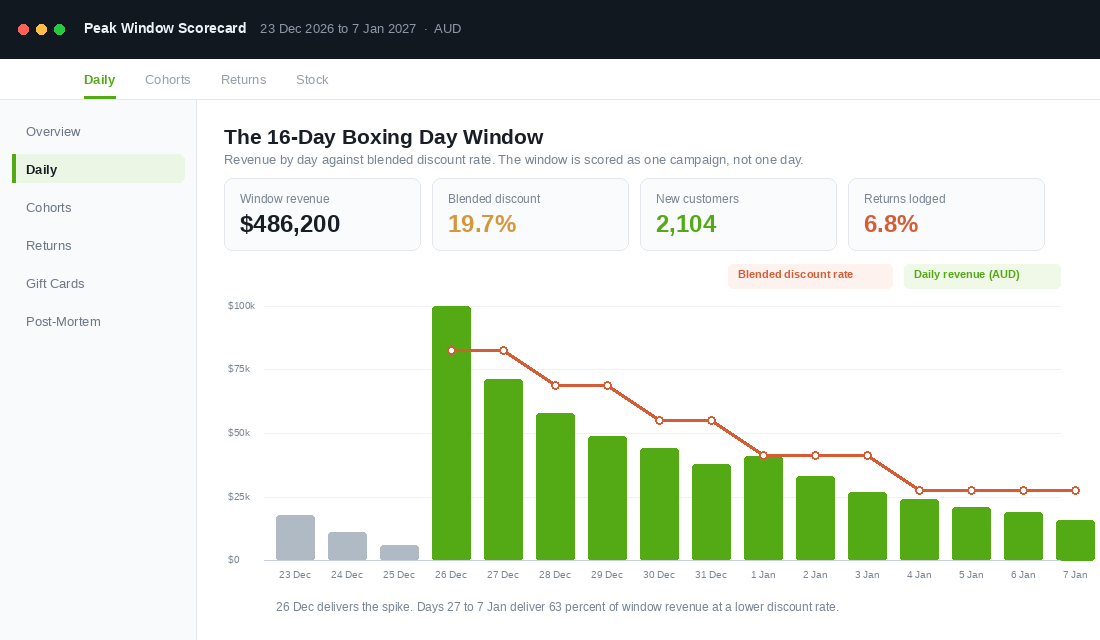
One more structural point. Boxing Day is not one day of trade. It is a 16-day window that runs roughly 23 December to 7 January, and in most Shopify accounts the days after 26 December produce more combined revenue than 26 December itself, at a lower average discount. Founders who score the whole window make better decisions than founders who screenshot one day.
Phase 1: Set the Margin Floor in September, Not on Christmas Eve
The single most expensive Boxing Day mistake is deciding the offer before knowing the floor. A margin floor is the lowest contribution margin per order you will accept on a discounted sale, after discount, freight, payment fees, pick and pack, and expected returns.
Build it like this. Take your average order at full price. Subtract landed cost of goods. Subtract outbound freight, including the portion you absorb through free shipping. Subtract payment processing, typically 1.6 to 2.2 per cent for Shopify Payments plus any buy now pay later fees, which run considerably higher. Subtract your pick and pack cost per order. What is left is your contribution margin in dollars and as a percentage.
Now set the floor. For most Aussie DTC brands, a contribution margin floor between 20 and 25 per cent is the point below which a discounted order stops paying for the business behind it. Anything below the floor is not a sale, it is inventory liquidation, and it should be treated with different rules: no paid traffic behind it, no homepage real estate, no email hero position.
- Do it in September or early October. Once your Q4 stock buy is committed, the floor tells you which SKUs can carry a deep offer and which cannot.
- Model buy now pay later separately. If 30 per cent of your Boxing Day orders come through Afterpay or Zip, the blended fee load can move your effective margin two to four points.
- Include a returns provision. Fold your historical return rate into the model before you set the floor, not after the credit notes land.
- Write the floor down and share it. If your media buyer and your ops lead do not know the number, it will get broken at 11pm on 26 December.
Phase 2: Build a Discount Ladder Instead of a Sitewide Percentage
A sitewide percentage is the laziest offer structure in ecommerce, and Boxing Day is where it does the most damage. It applies your deepest discount to the products that needed no help at all. Your hero SKU, the one that sells at full price every week of the year, gets handed 30 per cent off to a customer who was going to pay full freight in February anyway.
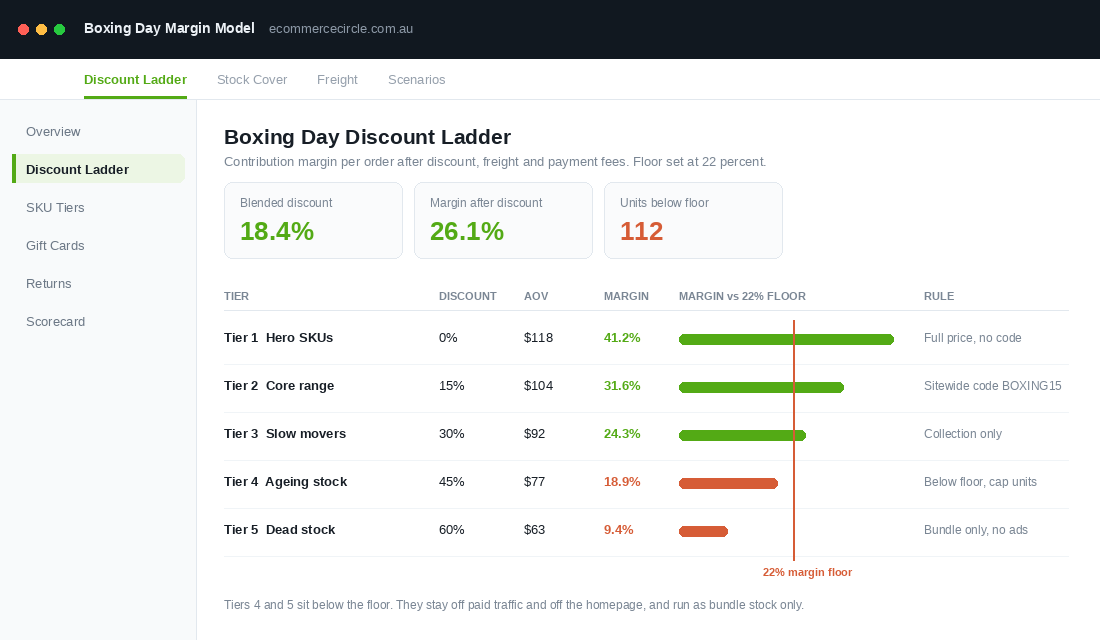
The fix is a five-tier ladder built on stock age and sell-through, not on category.
- Tier 1: Hero SKUs. Full price, no code. These sell regardless. Protect the margin and use them as the anchor that makes the rest of the sale look sharp.
- Tier 2: Core range. Modest sitewide-style discount, typically 15 per cent. This is your headline number and what the ads and emails carry.
- Tier 3: Slow movers. Around 30 per cent, but restricted to a specific collection so the depth is not visible sitewide.
- Tier 4: Ageing stock. Deeper again, usually below the floor, with a hard unit cap and no paid traffic behind it.
- Tier 5: Dead stock. Bundle only. Never sold as a standalone discount, always attached to a Tier 1 or Tier 2 product to lift the blended margin of the order.
The ladder does three things a flat percentage cannot. It keeps your blended discount well under your headline number, so a “30 per cent off” campaign might land at a blended 18 per cent. It clears the stock that is actually costing you cash to hold. And it stops training your best customers that your best product goes on sale every December.
Bundling is the underrated lever here. A Tier 5 item attached to a Tier 2 item moves dead stock at a nominal value while the order as a whole stays above the floor. It also lifts average order value, which matters more on Boxing Day than on any other day given the higher-intent, lower-frequency traffic. If you want the deeper mechanics on structuring offer depth without wrecking your P and L, our discount discipline framework walks through the full tier architecture.
Phase 3: Treat the Gift Card Wave as a Second Revenue Line
Gift card redemption is the most profitable traffic you will see in the Boxing Day window, and almost nobody plans for it. The money is already banked. The customer is spending someone else’s budget. And the redeemer is frequently a first-time visitor to your store who arrived because a family member rated you enough to buy them a card.
Industry breakage estimates in Australia sit around 6 to 7 per cent on average, with somewhere between 10 and 19 per cent of cards unredeemed at any given point in time. Two implications follow. First, a meaningful chunk of your December gift card sales is sitting as a liability that will convert in the two weeks after Christmas if you prompt it. Second, unredeemed value is not free money, it is a customer who never got to experience your product.
Run a dedicated gift card redemption sequence, separate from your Boxing Day sale campaign:
- 26 December, morning. Email every gift card recipient with a balance. Subject line references the balance, not the sale. “You have 100 dollars to spend” outperforms “Boxing Day is here” with this audience every time.
- 28 December. Send a curated edit of best sellers priced at or slightly above the common card denominations. If your cards are mostly 50, 100 and 150 dollars, merchandise to those price points.
- 4 January. A soft reminder with the balance and a link to a “shop your balance” collection.
- Late January. Final nudge. In Australia gift cards must be valid for at least three years under national consumer law, so there is no expiry urgency to lean on. Use newness instead, not false scarcity.
Critically, gift card redeemers should be excluded from your deepest discount tiers. They are already spending prepaid money. Stacking a 30 per cent code on top of a redeemed card is how a profitable order becomes an unprofitable one.
Phase 4: Sequence the Full 16-Day Window
The window has four distinct stages, and each one wants a different message. Treating them as one long sale is how brands burn their list in five days and then go quiet through the most valuable stretch.
- 23 to 25 December, the tease. Trade is thin. Use it to build the waitlist. A simple “early access opens Christmas night for subscribers” captures emails from people already on your site and gives you a segment to open to. The Iconic runs a version of this every year, opening the window early for app and member audiences before the public sale.
- 26 to 28 December, the spike. Deepest offer, heaviest ad spend, gift card sequence live. Expect this stretch to deliver your highest daily revenue and your worst blended margin.
- 29 December to 1 January, the plateau. Step the discount down. Shift the message from clearance to new year, new season. Many brands go silent here. That is a mistake, because intent is still high and competition for inbox attention has collapsed.
- 2 to 7 January, the tail. Lowest discount, highest margin. This is where you push full-price new arrivals to the customers who just bought, and where you start the retention work described in Phase 6.
Set your delivery promise honestly across the whole window. Australia Post and most carriers run reduced services between Christmas and New Year, and a customer who orders on 27 December expecting normal dispatch will lodge a support ticket on 3 January. Publish the dispatch dates on the product page and in the cart, not buried in a shipping policy nobody opens.
Phase 5: Price the Returns Before You Bank the Revenue
January is the biggest returns month of the Australian retail calendar, and Boxing Day orders return at a higher rate than the annual average. Australia Post reports that a quarter of online shoppers returned a purchase in the last 12 months, and post-Christmas is where that behaviour concentrates. Gift returns, impulse buys and size guesses all land in the same three weeks.
Three moves protect the line.
- Book the provision up front. If your baseline return rate is 8 per cent and Boxing Day historically runs at 12, model the window at 12. Reporting Boxing Day revenue gross of returns is how founders convince themselves to repeat a bad campaign.
- Default to exchange and store credit. Offer store credit at a small premium over a cash refund, for example 110 dollars of credit against a 100 dollar refund. It keeps the revenue inside the business and converts a return into a second shopping session.
- Fix the top return reason before December. Pull last January’s return reasons. If sizing dominates, ship a proper size guide and add fit feedback to the product page. This is cheaper than any discount you could run.
Extended returns windows are common over Christmas and are usually the right call for gift purchases, but extend the window deliberately and communicate the end date clearly. An open-ended policy through January turns your warehouse into a bottleneck exactly when your team is thinnest. Our returns and exchanges playbook covers the policy structure in detail.
Phase 6: Tag the Boxing Day Cohort and Treat Them Differently
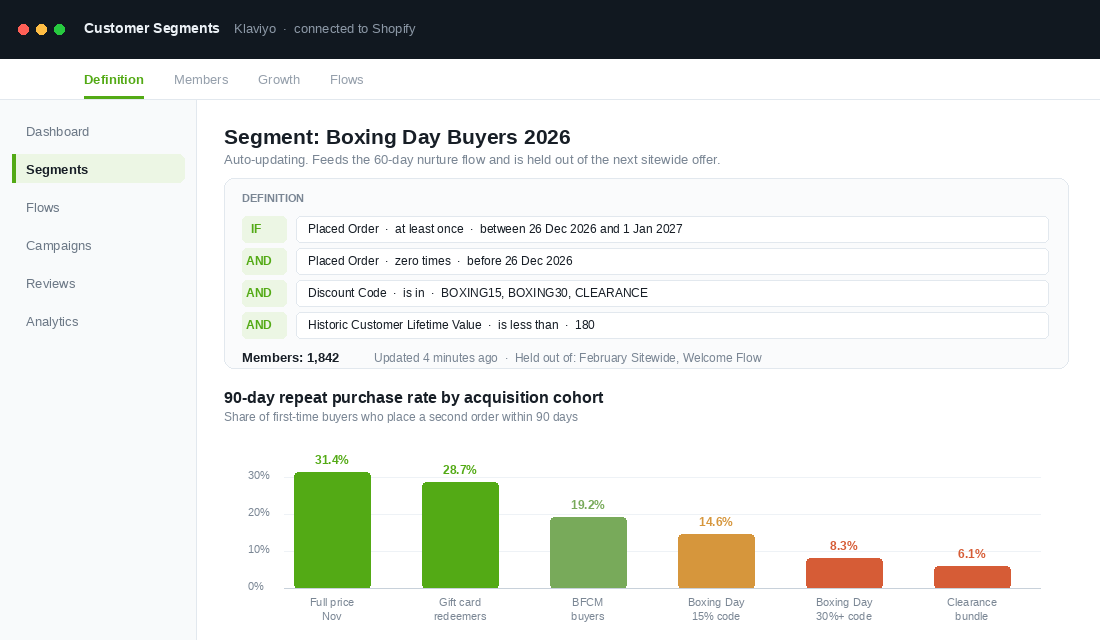
This is the phase that separates brands that grow from brands that just have a good December. A Boxing Day buyer who used a deep code is not the same asset as a full-price November buyer, and sending them into the same flows produces the same result year after year: a database that only responds to discounts.
Build the segment on 27 December while the data is clean. In Klaviyo, the setup takes about ten minutes:
- Step 1. Go to Audience, then Lists and Segments, then Create New, then Segment. Name it “Boxing Day Buyers” with the year.
- Step 2. First condition: What someone has done, Placed Order, at least once, between 26 December and 1 January. Use the date range picker rather than “in the last X days” so the segment stays accurate all year.
- Step 3. Add AND, Placed Order, zero times, before 26 December. This isolates genuinely new customers from existing customers who happened to buy in the sale. Those two groups need completely different treatment.
- Step 4. Add AND, Discount Code, is in, your Boxing Day codes. Now you can see depth of discount at the cohort level rather than guessing.
- Step 5. In Shopify Admin, mirror it under Customers, then Segments, using the filter
orders_placed_at >= 2026-12-26combined withnumber_of_orders = 1. This gives your ops and support team the same view without needing Klaviyo access. - Step 6. Suppress the segment from your next sitewide offer. If the only two emails they ever receive from you are discount campaigns, you have manufactured a discount-only customer.
Then run a 60-day nurture built on product education, not promotion. Care instructions. How to get the most out of what they bought. The founder story. A review request timed to arrival plus seven days. The goal is a second order at full price, because the second order is where the relationship actually starts.
Not every brand needs to play this game at all. July, the Australian luggage brand, has built its position by almost never discounting, leaning on monogramming and product design instead of percentage off. If your product carries that kind of pricing power, sitting Boxing Day out and running a value-add offer instead is a completely valid strategy, and often the more profitable one.
Phase 7: Run the Post-Mortem on 14 January, Not in October
Most founders review Boxing Day nine months later, when they are planning the next one and can no longer remember why anything happened. Book two hours in the diary for 14 January. By then returns have largely landed, the tail has finished, and the numbers are real.
Answer six questions in writing:
- What was the blended discount across the full 16-day window, and how far was it from the headline number you advertised?
- What was contribution margin after returns for the window, compared with a normal trading fortnight?
- How many new customers did you acquire, at what effective cost, and what share used a Tier 3 code or deeper?
- Which SKUs cleared and which ageing stock is still sitting there in January despite the deepest discount you have ever run on it?
- What did the gift card line contribute, and what percentage of December cards are still unredeemed?
- What broke operationally, and what would you freeze, staff or automate differently next time?
Add one forward-looking measurement to the calendar: check the 90-day repeat rate of the Boxing Day cohort in late March. That single number tells you whether this year’s window built a customer base or just rented one.
How the Seven Phases Compound
Run any one of these phases and you will get a modest improvement. Run all seven and something different happens, because each phase makes the next one cheaper.
The margin floor set in September determines the ladder, so the ladder is built on real numbers instead of nerves. The ladder keeps your blended discount low, which means the gift card sequence is not competing against your own deepest code. Sequencing the full window shifts revenue out of the 30 per cent days and into the 10 per cent days, which lifts blended margin again without touching the headline offer. The returns provision means the revenue you report in January is the revenue you actually keep. The cohort segment turns your worst-value acquisition group into a nurture project instead of a permanent discount audience. And the post-mortem in January means next year’s floor is set from evidence rather than memory.
The compounding is visible in one metric: blended contribution margin across the window. A brand running a flat 30 per cent sitewide with no returns provision and no cohort work will typically end the window in the low teens. The same brand running the seven phases lands in the mid twenties on similar top-line revenue. On a 500k window that difference is worth more than most brands make from the entire month of February.
It also changes what happens in Q1. Instead of starting January with dead stock, a bloated returns queue and a list trained to wait for the next sale, you start it with cleared inventory, a documented floor, and a tagged cohort in a nurture flow. That is the difference between a good day and a good quarter. The same logic applies to the November peak, which we broke down in the November double peak playbook.
Your Boxing Day Window Scorecard
Copy this into a Google Sheet and fill it in as you go. Seven rows, one owner each, one date each. If a row has no owner, it will not happen.
- Margin floor set. Due end of September. Output: a single contribution margin percentage, written down and shared with whoever can approve a discount.
- Discount ladder built. Due end of October. Output: every SKU assigned to one of five tiers, with unit caps on Tiers 4 and 5.
- Gift card sequence live. Due 20 December. Output: four emails scheduled for 26 December, 28 December, 4 January and late January, targeting balance holders only.
- Window calendar published. Due 15 December. Output: a day-by-day plan from 23 December to 7 January covering offer depth, message, channel and dispatch cut-offs.
- Returns provision booked. Due 15 December. Output: an expected return rate for the window, a store credit incentive, and a stated end date for the extended policy.
- Cohort segment created. Due 27 December. Output: a live Klaviyo segment plus a mirrored Shopify customer segment, suppressed from the next sitewide offer.
- Post-mortem completed. Due 14 January. Output: six questions answered in writing, plus a diary reminder in late March to check the cohort’s 90-day repeat rate.
Print it. Stick it on the wall. Boxing Day is four months out, which is exactly the right amount of time to get Phase 1 and Phase 2 done properly rather than in a panic on 23 December.
Inside eCommerce Circle, peak season planning is one of the core pillars we work on with every member, and the margin floor is almost always the first thing we build together. If you want a second opinion on yours before the Q4 stock buy is locked in, let’s talk.