Most Aussie Shopify founders pick their business structure in about four minutes. They need an ABN to open a Shopify Payments account, the ABR form asks “sole trader or company?”, and sole trader is the free option. Done. Three years later that same founder is turning over 1.2 million dollars, holding 180,000 dollars of stock, employing two people and running Meta ads in their own name, and the structure has never been looked at again.
What’s in This Article
That is the wrong way round. A structure is not a registration detail. It is the thing that decides who gets sued when a product injures someone, how much of your profit the ATO takes, whether you can ever sell the business, and whether a bad quarter can reach your family home.
The founders who get this right do not obsess over it on day one. They set five clear triggers, and the moment one fires, they move. This playbook gives you those five triggers, the real 2026-27 numbers behind them, and the 12-step migration sequence that moves a Shopify store from sole trader to a Pty Ltd company without breaking Shopify Payments, losing your trademark or handing the ATO a capital gains bill.
One thing before we start: this is a coaching framework, not legal or tax advice. Every number here is public and current as at September 2026, but your accountant needs to sign off on your specific situation before you lodge anything.
Why the Default Structure Quietly Caps Your Store
Australia has 3.79 million registered companies as at August 2026, and the ASIC register grew by more than 185,000 in the twelve months to that point. June and July 2026 were the two biggest months for new company registrations ASIC has ever recorded, at 43,393 and 44,040 respectively. A lot of those are founders doing exactly what this article describes: getting to the end of a financial year, looking at their profit, and finally restructuring.
Here is the problem. As a sole trader, there is no legal difference between you and the store. Every supplier invoice, every product liability claim, every ATO debt and every unpaid Meta ads bill is a personal debt. Your car, your savings and your share of the family home sit behind it. And every dollar of profit is taxed at your personal marginal rate, which in 2026-27 hits 37 percent above 135,000 dollars and 45 percent above 190,000 dollars, plus the 2 percent Medicare levy.
A Pty Ltd company changes both of those things at once. Liability stops at the company’s assets (unless you sign a personal guarantee, which we will cover), and a base rate entity pays a flat 25 percent on profit it keeps in the business. For a store that is reinvesting profit into stock every quarter, that gap compounds fast.
The trap is that the company structure costs money and admin every year: 636 dollars to register from 1 July 2026, a 342 dollar ASIC annual review fee, a separate company tax return, director duties under the Corporations Act, and Division 7A rules that bite if you treat the company bank account like your own. Move too early and you are paying for protection you do not need yet. Move too late and you have been personally exposed for years. The five triggers below tell you exactly where the line is.
Trigger 1: Retained Profit Crosses the 30 Percent Bracket
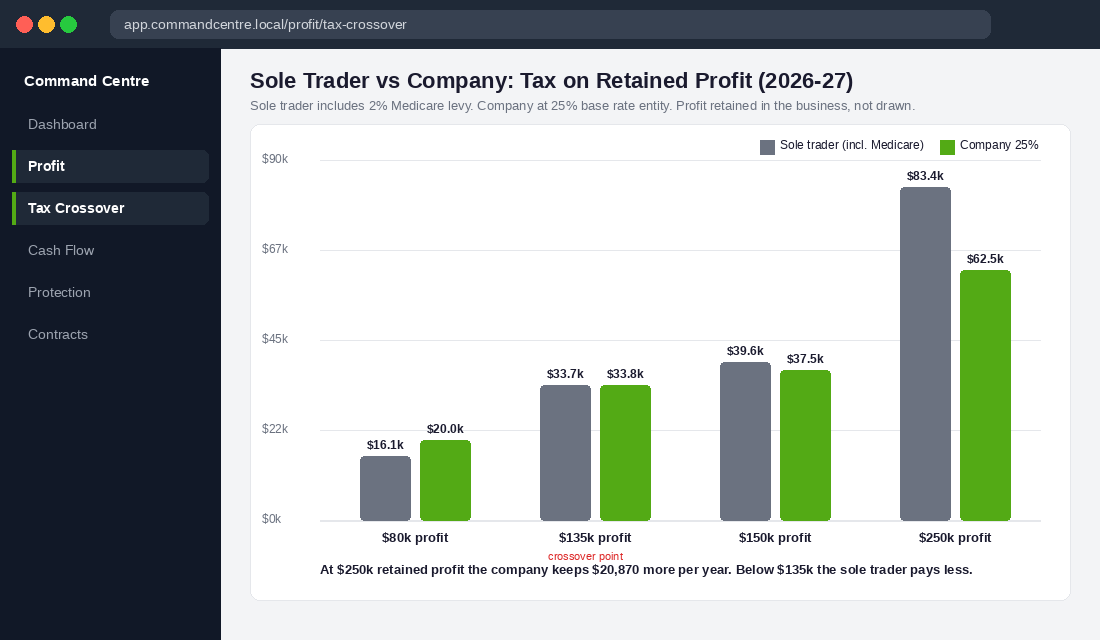
Everyone quotes the “25 percent company rate versus up to 45 percent personal” line, and it is misleading. If you pull every dollar of profit out of the company as salary or dividends, you pay personal tax on it anyway (dividends come with franking credits for the 25 percent already paid, so you top up to your marginal rate). The company rate only wins on money that stays in the business.
So the real question is: how much profit are you leaving in the store each year to buy stock, fund ads and build a cash buffer? That is the number to compare. Here is the 2026-27 maths for a sole trader, including the Medicare levy, against a company keeping the same profit:
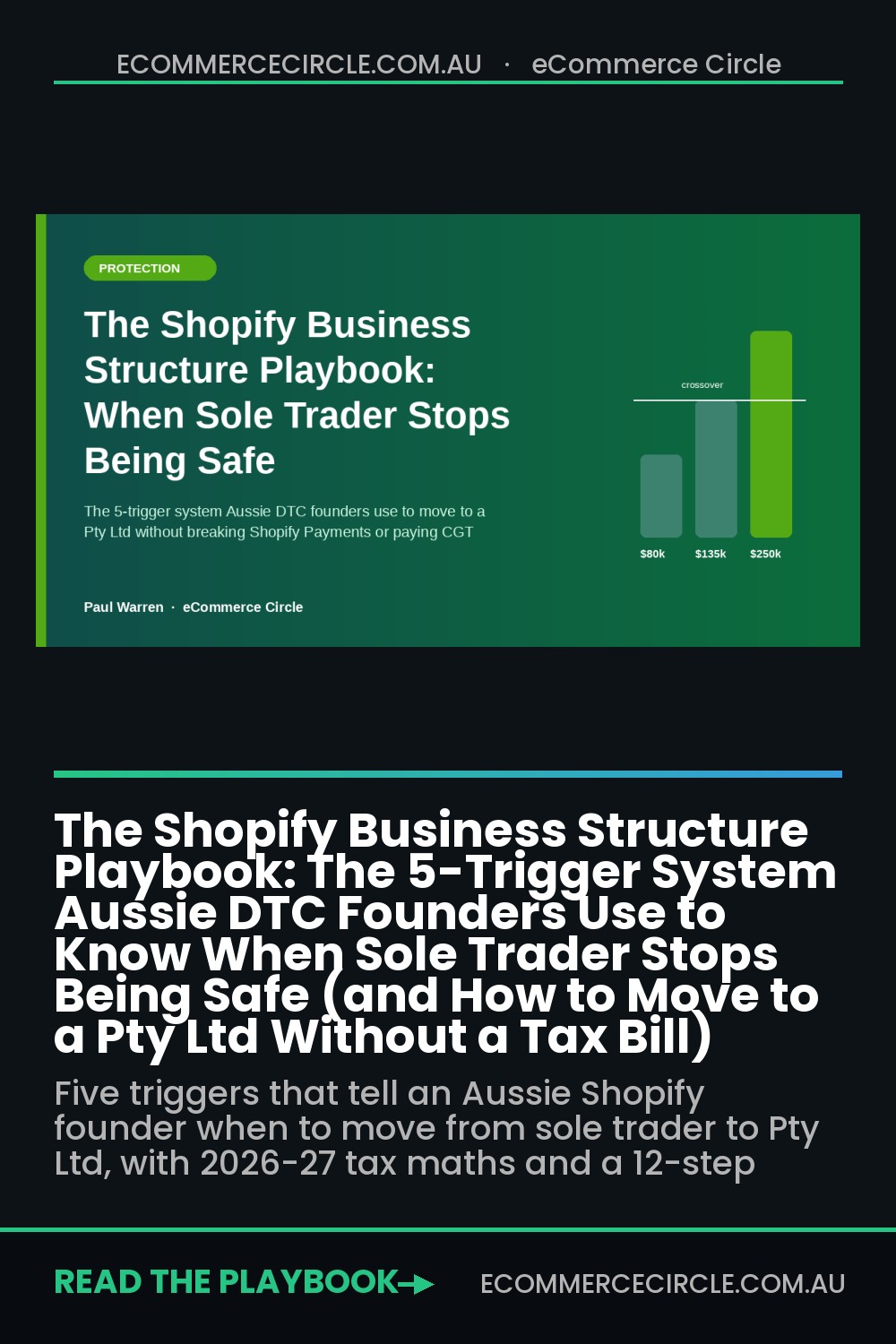
- 80,000 dollars profit. Sole trader pays about 16,100 dollars (20 percent effective). Company pays 20,000 dollars. The sole trader wins by almost 4,000 dollars.
- 135,000 dollars profit. Sole trader pays about 33,700 dollars (25 percent effective). Company pays 33,750 dollars. This is the crossover, and it sits almost exactly at the top of the 30 percent bracket.
- 150,000 dollars profit. Sole trader pays about 39,600 dollars (26.4 percent). Company pays 37,500 dollars. The company is now 2,000 dollars ahead.
- 250,000 dollars profit. Sole trader pays about 83,400 dollars (33.3 percent). Company pays 62,500 dollars. That is 20,900 dollars a year staying in the business instead of going to the ATO, which at a 45 percent gross margin is roughly 46,000 dollars of extra stock you can buy.
The rule we coach inside eCommerce Circle is simple: when your retained profit (profit after you have paid yourself a fair wage) is on track to pass 135,000 dollars for the year, Trigger 1 has fired. Below that, the tax argument for a company is weak and you should only move for one of the other four reasons.
Trigger 2: You Sell Anything That Can Hurt Someone
This is the trigger that fires before the tax one for most product brands, and it is the one founders ignore longest. If you sell skincare, supplements, candles, kids’ products, anything electrical, anything ingestible, anything with a battery, or anything a customer could plausibly injure themselves with, you are carrying product liability risk in your own name.
Under the Australian Consumer Law, a manufacturer (which includes an importer of goods made overseas, so most Shopify brands) is liable for injury caused by a safety defect. A sole trader has no wall between that claim and their personal assets. Insurance is your first line of defence, and if you do not have product liability cover yet, read our guide to ecommerce insurance in Australia before you finish this article. But insurance has exclusions, limits and excesses. The company is the second wall.
The same logic applies to regulatory penalties. When the ACCC issued six infringement notices in July 2024 over 2,460 Kids Beach Oodies sold without the mandatory fire-danger warning label, the 101,280 dollars in penalties was paid by Davie Clothing Pty Ltd, the company behind the brand, not by its founder personally. Since 28 March 2026 the maximum ACL penalty for a company has doubled to 100 million dollars, and the ACCC has been very public about pursuing ecommerce brands for fake urgency, greenwashing and misleading discounts. You do not want that exposure sitting on your personal tax file number.
The honest test: if a single customer claim, recall or ACCC letter could cost more than you have in personal savings, Trigger 2 has fired, regardless of your profit. Skincare and supplement founders should move to a company in year one.
Trigger 3: Someone Else Needs a Piece of the Business
A sole trader cannot have a co-founder, an investor or an employee with equity. The structure literally has no shares to give. The moment a second person needs ownership, you need a company, and ideally a shareholders’ agreement that sets out what happens when one of you wants out.
This trigger also covers the exit. Every meaningful Australian DTC acquisition of the last five years was a share sale of a Pty Ltd. When Kao bought Bondi Sands in 2023 for a reported 450 million dollars, it acquired the shares of Bondi Sands Australia Pty Ltd and its related companies. When a.k.a. Brands bought a 55 percent stake in Culture Kings in 2021 at a 600 million dollar valuation, it did so under a share sale agreement with founders Simon and Tah-nee Beard. Neither deal is possible for a sole trader, because there is nothing to buy except a pile of individual assets and contracts that each need to be assigned one by one.
You are almost certainly not selling for nine figures. But the same mechanics apply to a 400,000 dollar sale to a competitor or a 30 percent stake sold to your operations manager. Buyers pay more for a clean company with two or three years of separate financials, and the small business CGT concessions can wipe out most of the tax on a sale if the entity has been set up properly for long enough. We cover the full set of value levers in the Shopify Exit Readiness Playbook; structure is the one that takes longest to fix, so start it first.
Trigger 3 fires the day you have a serious conversation with a co-founder, investor, key hire or potential buyer. Do not wait for the term sheet.
Trigger 4: Your Supplier and Ad Exposure Passes Your Personal Buffer
The debt you do not think of as debt
Ecommerce founders rarely borrow from a bank, so they assume they have no debt. Add up what you actually owe on a typical Tuesday: the 60,000 dollar deposit on your next production run, the 30,000 dollars on 30-day terms with your packaging supplier, the 25,000 dollars sitting on your Meta ads invoice, the 3PL bill, the BAS due in three weeks. For a store doing 1 million dollars a year, that rolling exposure is commonly 100,000 to 200,000 dollars. As a sole trader, all of it is personally guaranteed by default.
ASIC recorded 14,152 companies entering insolvency in 2025-26, and retail trade was again one of the sectors under most pressure. Most of those companies were small, and in most of them the directors walked away with their homes intact because the debts belonged to the company. That is the whole point of the structure.
Where the wall has holes
Be clear-eyed about the limits. Three things pierce the company wall:
- Personal guarantees. Your 3PL, your trade credit supplier and any lender will ask the director to guarantee the company’s debts. Read every credit application. Cross out the guarantee clause where you can, cap it where you cannot, and never sign one for a supplier you could pay upfront instead.
- Director penalty notices. The ATO can make directors personally liable for unpaid PAYG withholding, super guarantee and GST. The company does not protect you from a BAS you never lodged. Our ATO Debt Playbook walks through exactly how that liability attaches and how to stop it.
- Insolvent trading. If you keep ordering stock when you know the company cannot pay for it, you can be made personally liable. The safe harbour rules help, but only if you are actually working a restructure plan with an adviser.
Trigger 4 fires when your rolling supplier, ad and tax exposure exceeds the amount you could personally cover without touching your home. For most founders that happens somewhere between 500,000 and 800,000 dollars of annual revenue, well before the tax trigger.
Trigger 5: You Are Building a Brand, Not a Job
The fifth trigger is the softest and the most important. A sole trader business is legally inseparable from its founder. It cannot outlive you, cannot be handed to a general manager, and cannot hold a trademark, a domain portfolio or a supplier relationship in any name but yours.
If your plan is a lifestyle store that pays you well and closes when you are done, sole trader can be fine for years. If your plan is a brand with a team, wholesale accounts, a registered trademark and a value that exists without you at the keyboard, the company is the container the brand lives in. Every asset (the trademark with IP Australia, the domains, the Shopify store itself, the Klaviyo list, the supplier agreements) should be owned by the company, so that the company is the thing of value.
Trigger 5 fires when you catch yourself saying “the brand” instead of “my store”. Take it seriously.
The Trust Question (and Why Most Founders Should Wait)
Your accountant may suggest a discretionary (family) trust, or a company with a trust as shareholder. Trusts make up about 18 percent of Australian businesses, and for the right founder they are powerful: profit can be distributed to family members on lower marginal rates, and the 50 percent CGT discount is available on a sale, which a company on its own does not get.
But trusts add a second layer of cost (typically 1,500 to 3,000 dollars a year in accounting on top of the company), and a trust cannot retain profit at 25 percent the way a company can. Undistributed trust income is taxed at the top marginal rate. For a growth-stage Shopify brand that needs to keep cash in the business for stock, a trust can actually be worse than a plain company.
Our coaching position: start with a Pty Ltd company. Revisit the trust conversation when two things are both true: you have family members on low incomes you could legitimately distribute to, and you are within three years of a likely sale. Until then, keep it simple.
The 12-Step Migration: Sole Trader to Pty Ltd Without Breaking Your Store
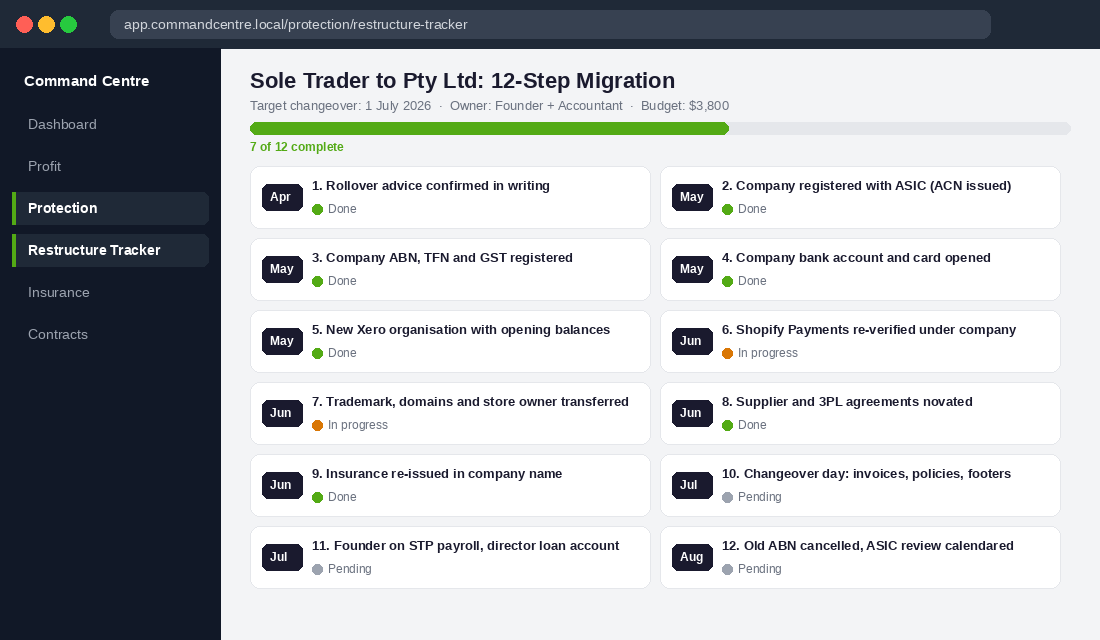
This is where most guides stop and where most founders get hurt. A structure change is not a form. It is an entity change, which means every system that knows your ABN has to be told about a new one, and Shopify Payments in particular does not make it easy. Here is the sequence, timed to a 30 June changeover so you get a clean financial year.
- Get the rollover confirmed in writing (April). Transferring your business assets (stock, brand, domain, goodwill) into a company is a CGT event. The small business restructure rollover and the Subdivision 122-A rollover let a sole trader move those assets into a company they wholly own without triggering CGT, provided it is a genuine restructure and turnover is under 10 million dollars. Have your accountant confirm which rollover applies and document it before you move a single asset.
- Register the company with ASIC (May). Use the Business Registration Service at business.gov.au or ASIC Connect. Cost is 636 dollars from 1 July 2026 (611 dollars before that). You get an ACN immediately. Choose a company name that matches your trademark, and note that “Pty Ltd” must appear on invoices and your website legal pages.
- Apply for the company’s own ABN, TFN and GST registration (same day). Your sole trader ABN cannot move across. Register the company for GST from day one if you are already registered personally. If you have not sorted GST properly yet, the Shopify GST Playbook covers the setup that most stores get wrong.
- Open the company bank account and merchant facilities (May). The company needs its own transaction account before anything else can be switched. Order a company credit card for ad spend at the same time.
- Set up the company Xero file (May). A fresh file with an opening balance sheet, not a continuation of your personal one. Your accountant will bring the stock and asset values across at the rollover cost base.
- Deal with Shopify Payments (June, allow two weeks). Shopify will not let you change the business type on an existing Shopify Payments account, because a sole trader and a company are different legal entities. The documented path is to contact Shopify Support from the store owner login, deactivate financial services (Payments, Balance, Capital, Credit) and re-verify under the company with the new ABN, ACN and director ID. Time this for your quietest week, keep a backup gateway like PayPal active so checkout never goes down, and expect a short payout gap while the new account verifies.
- Transfer the trademark, domains and Shopify account ownership (June). Record the assignment of your trademark to the company with IP Australia (there is a form and a small fee, and it can take weeks). Update the registrant on every domain. Change the Shopify store owner email to a company address and add yourself as a staff account.
- Novate supplier and 3PL agreements (June). Every contract in your personal name needs to be re-papered with the company as the party. This is your chance to strike out personal guarantees while the supplier is already re-signing.
- Move insurance and re-disclose (June). Product liability, public liability and stock cover all need the company as the insured. This is a material change; do not just update the name.
- Run the changeover on 1 July. Final sole trader BAS and tax return close off the old entity. First company transactions start on day one of the new financial year. Update the ABN and legal name on Shopify invoices, Klaviyo footers, your terms and conditions, privacy policy and returns page.
- Put yourself on payroll (July). You are now a director and an employee. Set up STP payroll in Xero, pay yourself a market wage with super, and stop transferring money to yourself ad hoc. Any loan from the company to you is a Division 7A loan, and the 2026-27 benchmark interest rate is 8.77 percent, so undocumented drawings get expensive fast.
- Cancel the old ABN and calendar the ASIC review (August). Cancel the sole trader ABN once the final return is lodged. Set a recurring reminder for the ASIC annual review fee (342 dollars, due within two months of your registration anniversary; late fees are 102 dollars, then 428 dollars).
Budget 2,500 to 5,000 dollars in accounting and legal fees for the whole migration, and 60 to 90 days of calendar time. The Shopify Payments step is the one that bites founders who leave it to the last week.
Tool Setup: Xero as the Company’s Spine
You can run a sole trader store out of a spreadsheet and a personal bank account. You cannot run a company that way, because the company’s books are a legal record and the ATO expects a clean line between company and director money. Xero is the tool most Australian ecommerce accountants work in, and here is the setup that makes the company structure actually deliver its benefits:
- Step 1: New organisation, not a rename. Create a fresh Xero organisation under the company ABN, set the financial year to 1 July and the tax basis to accrual. Ask your accountant to post the opening balance sheet with stock at rollover value.
- Step 2: Bank feeds on company accounts only. Connect the company transaction account and credit card. Never connect a personal account to the company file, even “just for now”.
- Step 3: Shopify integration. Use the Shopify integration by Xero (or A2X for larger stores) so each payout lands as a summarised sales, fees and GST entry that reconciles to the cent. Set this up on the first day of the new entity so there is no messy overlap period.
- Step 4: Director’s loan account. Create a current liability account called “Director loan: [your name]”. Every dollar that moves between you and the company that is not payroll or a declared dividend goes here, so Division 7A is visible at a glance.
- Step 5: Payroll with STP. Add yourself as an employee, set a monthly pay run with super, and enable Single Touch Payroll. This is what turns “I take money out sometimes” into a wage the ATO recognises.
How the Five Triggers Work as a System
Read individually, the triggers can look like five separate reasons to spend 636 dollars at ASIC. Together they describe a single moment in a store’s life: the point where the founder stops being the business and the brand becomes an asset in its own right.
Trigger 2 (product risk) and Trigger 4 (supplier exposure) are about protection. They usually fire first, often in the first 12 to 18 months of a physical product brand. Trigger 1 (retained profit) and Trigger 3 (equity and exit) are about value. They fire later and they are the reason the structure ends up paying for itself. Trigger 5 (brand, not job) is the one that tells you whether the other four are worth acting on at all.
Here is the pattern we see in eCommerce Circle members. The store that restructures at 600,000 dollars revenue because a supplier asked for a personal guarantee (Trigger 4) gets three quiet years of separate financials. When it hits 250,000 dollars of retained profit (Trigger 1), it is already keeping 20,000 dollars more a year in the business. When a buyer or partner shows up (Trigger 3), there is a clean Pty Ltd with a trademark, a Xero history and no personal contracts to unwind. Every trigger makes the next one cheaper.
The store that waits until the tax bill hurts does the same migration in a panic, in the middle of BFCM stock buying, with Shopify Payments offline for a week and a trademark still sitting in the founder’s name.
Your Structure Review Checklist
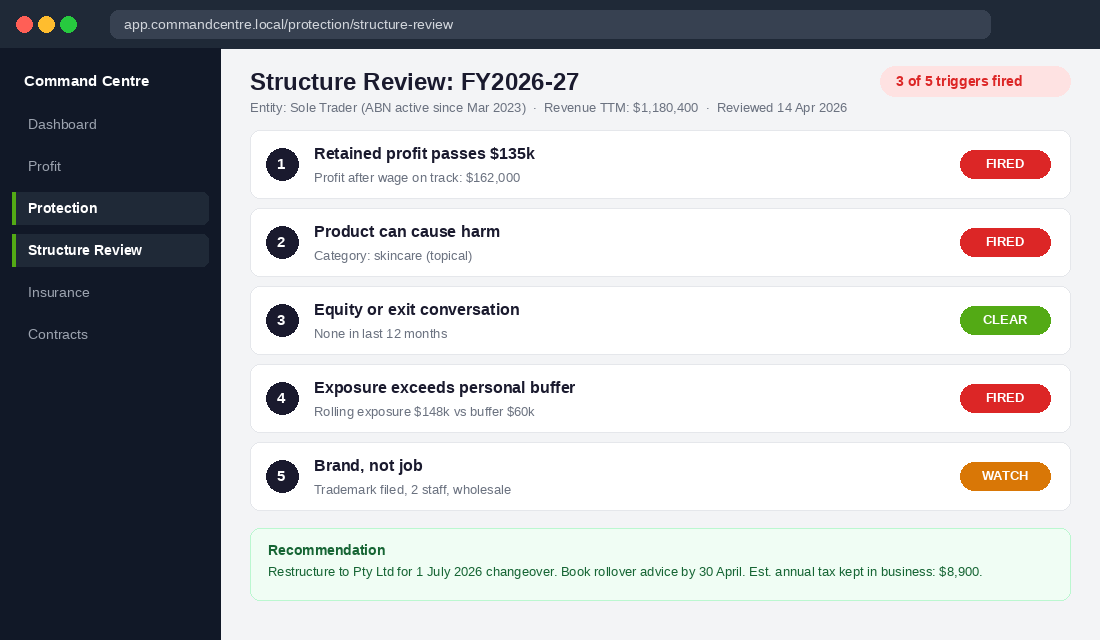
Run this once a year, ideally in April so you have time to act before 30 June. Any “yes” means book the accountant.
- Trigger 1: Is profit after a fair wage for yourself on track to pass 135,000 dollars this financial year?
- Trigger 2: Do you sell anything ingestible, topical, electrical, battery-powered, or for children?
- Trigger 3: Has anyone (co-founder, investor, key hire, buyer) asked about ownership in the last 12 months?
- Trigger 4: Does your rolling supplier, ad and tax exposure exceed what you could cover without touching your home?
- Trigger 5: Do you describe what you are building as a brand rather than a store?
- Housekeeping: Is the trademark, every domain and the Shopify store owner login held by the entity that owns the business?
- Housekeeping: Have you read every personal guarantee you have signed in the last two years, and capped or removed the ones you can?
- Housekeeping: Is product liability insurance in the correct entity name with a limit that matches your worst realistic claim?
Inside eCommerce Circle, structure and protection is one of the pillars we review with every member, because a store that is exposed personally cannot take the growth risks that scaling needs. If you want to see exactly where your store is being capped, take the free More Orders Scorecard. It takes two minutes, scores you across all 10 P’s, and shows you which one to fix first.