Your landed cost has crept up 18% in two years. Freight did some of it, the exchange rate did some of it, and your supplier’s “small annual adjustment” did the rest. So you raised prices, trimmed the ad budget, and told yourself that is just what scaling feels like in 2026.
What’s in This Article
Here is the part that stings. Research from Ardent Partners shows that businesses which actively manage their supplier spend save 6 to 12 cents in every dollar. The average procurement team banks 6.7% in savings every single year. Your store almost certainly has no procurement team. Which means nobody has ever properly negotiated the single biggest expense line in your business.
After working with hundreds of Aussie Shopify founders, we see the same pattern constantly: founders will rebuild their whole funnel to win 0.3% of conversion, but will not send one email that could take 10% off their cost of goods. This playbook fixes that. Five levers, one call structure, and the exact scripts to use.
Why Founders Pull Every Lever Except This One
Most founders never negotiate with suppliers for two reasons, and neither of them survives contact with reality.
“I’m too small to matter.” You are not negotiating with BHP. Your factory is usually a 30 to 200 person operation where a customer spending $150,000 a year is a real account. Losing you costs them real money, and replacing a reliable, repeat-ordering customer is as hard for them as replacing a good supplier is for you.
“I’ll damage the relationship.” The opposite is true. Suppliers respect customers who run their business professionally. A structured conversation about price, terms and volume signals that you plan to be around in five years. What damages relationships is the thing founders actually do: silently switching factories over a price rise they never pushed back on.
The founders inside our community who treat supplier negotiation as an annual discipline, the same way they treat pricing reviews, consistently pull 5 to 15% out of COGS over a couple of rounds. On a store doing $1.5m at a 38% cost of goods, a 10% reduction is $57,000 a year that drops straight to the bottom line. No new customers required.
Lever 1: Walk Into the Call Knowing Your Numbers Cold
Negotiating without data is begging. Negotiating with data is business. Before you ask for anything, you need four numbers for every supplier: total annual spend, spend by SKU, landed cost trend over 24 months, and what share of your total COGS that supplier represents.
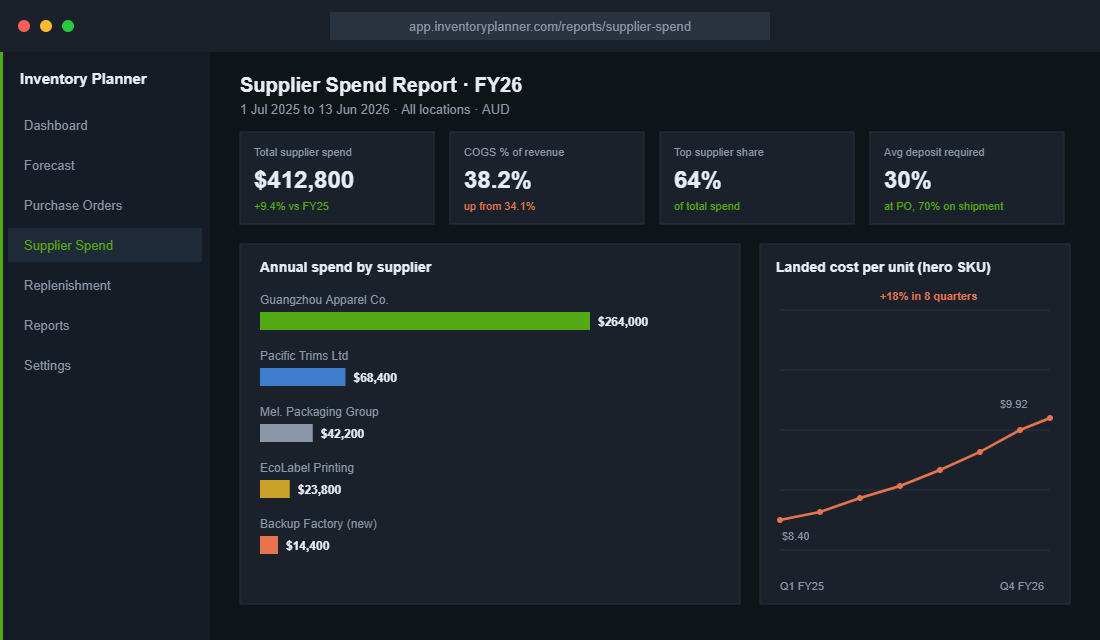
The fastest way to get this data is a purchasing tool that sits on top of Shopify. We use Inventory Planner with members for exactly this job. Setting it up takes an afternoon:
- Connect your Shopify store. Inventory Planner pulls your full order and product history in a few hours, no spreadsheet exports needed.
- Add your suppliers and assign SKUs. Tag every variant with its supplier and current unit cost so spend rolls up per factory, not just per product.
- Enter lead times and deposit terms. This unlocks the cash flow view: how much money sits inside purchase orders at any moment.
- Pull the supplier spend report. Sort by annual spend, biggest first. That order is your negotiation order.
While you are in there, check your demand forecast. Your forecast is your negotiation ammunition, because every lever below depends on you credibly committing to future volume. If your forecasting is guesswork, fix that first with our inventory forecasting playbook, then come back.
Lever 2: The Unit Price Conversation (Volume Tiers Beat Haggling)
Never ask “can you do a better price?” That question invites a 2% token discount and ends the conversation. Strong unit price negotiation is structured around volume tiers and commitment, not haggling.
Ask your supplier to quote three tiers: your current annual volume, 30% above it, and 60% above it. Factories price on production run efficiency, so the gaps between tiers are often 6 to 12% per unit. Then negotiate to lock the middle tier price against your forecast commitment, paid order by order. You get tomorrow’s price on today’s volume, they get a customer who has signalled growth in writing.
Three more unit price moves that work in the real world:
- Split materials from labour. Ask for the cost breakdown. If cotton or resin prices have fallen since your last quote (they move constantly), you have a factual basis for a reduction that requires nobody to lose face.
- Offer a longer commitment, not a bigger order. A 12-month rolling forecast with quarterly POs is worth more to a factory than one fat order, because it lets them plan production. Trade that planning certainty for price.
- Bundle SKUs into one negotiation. If the same factory makes five of your products, negotiate the catalogue, not the item. Total account value is your real size in their eyes.
Lever 3: Payment Terms, the Lever That Funds Your Growth
Unit price gets all the attention, but payment terms are usually worth more to a growing store. Here is why: Australian SMEs wait an average of 35.4 days to get paid by their large business customers, according to the Payment Times Reporting Regulator’s 2025 data. Meanwhile most founders are paying suppliers 30% up front and 70% before the stock even ships. You are being paid slowly and paying fast. That gap is why growth feels like a cash crisis.
The cost of that squeeze is real. 2025 survey data found 17% of Australian SMEs are losing more than $2,500 a month to late payments and cash flow gaps, up from 11% the year before. Every day of payment terms you win from a supplier directly closes that gap, interest free.
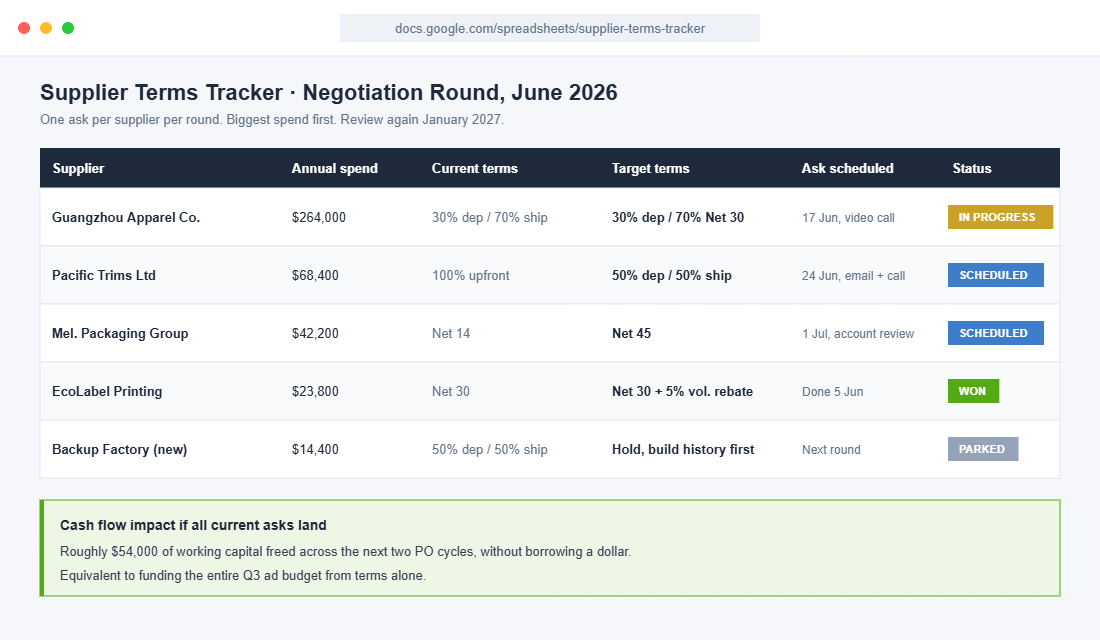
Move in steps, not leaps. The progression that works:
- From 100% upfront to deposit and balance. If you are paying everything before production, ask for 50/50. After two clean orders, push to 30/70.
- From balance-on-shipment to balance-on-arrival. Worth 2 to 6 weeks of float on sea freight from China, and it aligns their incentive with your delivery timeline.
- From arrival to Net 30. This is the milestone ask. Bring 12 months of perfect payment history to the conversation. Offer a modest early payment discount structure (the classic is 2% off if you pay within 10 days, otherwise full payment at 30 days) so they see upside either way.
One member running a homewares brand moved her main factory from 30/70-on-shipment to 30/70 Net 30 after three years of orders. On her PO cycle that freed roughly $54,000 of working capital. That is an entire quarter of ad spend she no longer needs to borrow or pre-fund.
Lever 4: MOQs and the Flexibility Trade
Minimum order quantities are where factories protect themselves and where founders quietly drown. Order the full MOQ on a product that misses and you do not just lose the order value, you lose the months of cash that dead stock sits on.
The counterintuitive play, straight from Shopify’s own MOQ negotiation guidance: offer to pay more per unit for a smaller run. Around 15% more per unit for half the MOQ is a fair opening position. It feels wrong until you run the cash maths.
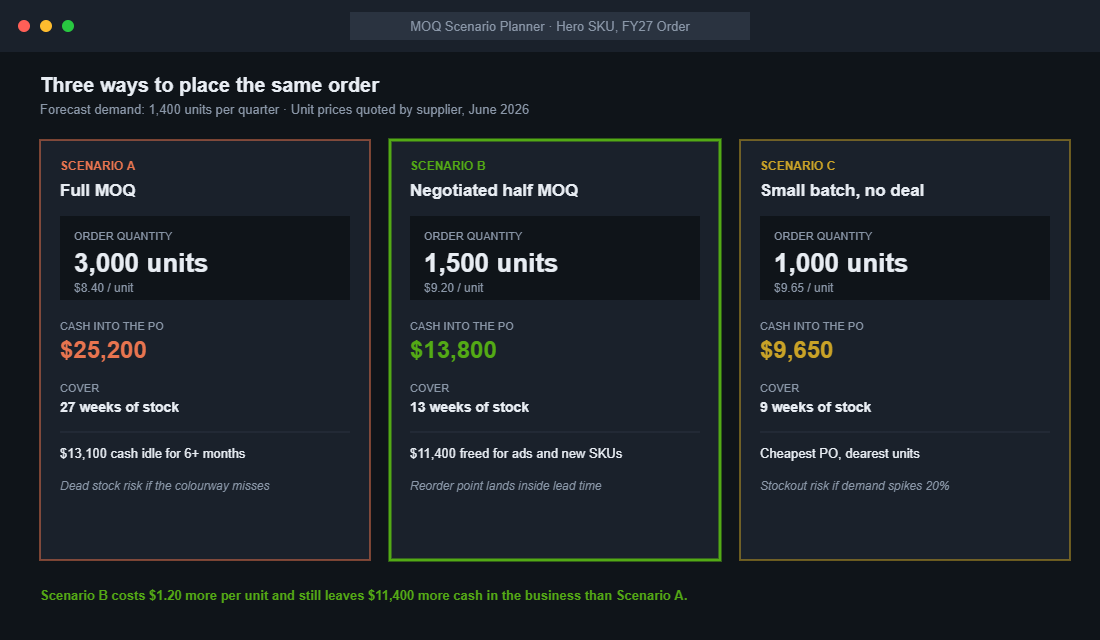
Other MOQ structures to put on the table:
- The master MOQ. Ask the factory to apply the minimum across your whole order, not per SKU or per colourway. Mixing three colours inside one production minimum is routine for most factories if you ask before the quote, and nearly impossible after.
- Separate the setup fee. If the MOQ exists to amortise tooling or screens, offer to pay the setup as a flat line item in exchange for a lower minimum. You convert a permanent inventory problem into a one-off cost.
- Pre-sell into the gap. A smaller first run pairs perfectly with a pre-order strategy: customer cash funds the reorder at the better volume tier you already negotiated.
Lever 5: The Leverage You Already Have (Commitment and a Credible Plan B)
Every negotiation runs on alternatives. Yours is the credible ability to move some production elsewhere. Theirs is the credible ability to replace your volume. Strengthen the first and you change every conversation above.
This is now mainstream practice, not paranoia. A McKinsey supply chain survey found 73% of companies are actively progressing dual-sourcing strategies, and IDC projects half of all firms will split orders across multiple regions rather than rely on a single low-cost hub. The big end of town is doing it because single-factory dependence showed its cost during every freight crisis of the last five years.
For a Shopify brand the move is simple: qualify a second factory with one small SKU. A 5% slice of your volume is enough. You learn their quality, they appear on your supplier list, and your main factory knows they exist. You never need to threaten anything. The line “we are consolidating our FY27 sourcing plan” carries all the weight on its own.
The flip side of leverage is commitment, and Australian brands use it at every scale. LSKD, the Queensland activewear brand now turning over more than $200 million a year, signed a 10-year supply partnership with materials company Samsara Eco to lock in recycled nylon for its core range. A decade of committed demand bought them supply security and priority on an input their competitors will queue for. Koala went the other direction with its sofa range, onshoring production to Australia to shorten lead times and cut its exposure to international freight swings. Different strategies, same principle: deliberate supplier structure as a competitive weapon.
You do not need a 10-year deal. A written 12-month rolling forecast, shared quarterly, is the small-brand version, and factories reward it.
The Negotiation Call Itself: Sequence, Script and the Email That Opens the Door
Do not ambush your supplier on a production call. Book the conversation properly, two to three weeks before your next PO, with an email like this:
“Hi Wei, we’re planning our FY27 orders and [brand] is forecasting 30 to 40% growth with you. Before we lock the plan, I’d like 30 minutes to review pricing tiers, payment terms and minimums so the structure works for both sides for the next 12 months. Would Tuesday or Wednesday your time suit?”
Notice what that email does. It frames the conversation around growth, signals a 12-month relationship, and names the three levers without demanding anything. On the call itself, follow a fixed sequence:
- Open with the relationship. Two minutes on what has worked: quality, defect rates, the reorder history. You are reminding them what your account is worth.
- Present the forecast. Share next year’s volume by quarter. This is the commitment you are trading against.
- Make one primary ask. Your biggest lever first, usually price tiers or terms. Anchor specific: “we need to get landed cost back under $8.90” beats “we need a discount”.
- Hold the silence. State the ask, then stop talking. The first counter-offer tells you how much room exists.
- Trade, never give. Every concession you make buys one back. Faster payment for lower price. Bigger commitment for lower MOQ. Longer contract for better terms.
- Confirm in writing same day. A short email with the agreed numbers, cc your operations inbox. Verbal agreements evaporate by the next PO.
One ask per supplier per round. Run a round every six months. The tracker does not need to be fancy, it needs to exist.
How the Five Levers Compound
Here is where this stops being a cost exercise and becomes a growth system. Take a store doing $1.2m with $420,000 of supplier spend. Round one of negotiation lands modest wins: 6% off unit costs on the main factory, balance payment moved from shipment to Net 30, and the hero SKU MOQ halved.
The 6% is worth about $15,000 a year in straight profit. The terms shift frees roughly $50,000 of working capital each cycle, which funds ad spend or the next product without debt. The halved MOQ means new colourways launch with half the risk, so you test twice as many. Each lever feeds the others: better cash funds bigger orders, bigger orders earn better tiers, better tiers widen the margin that funds the next test. That is the flywheel, and it started with one scheduled phone call.
The Five Mistakes That Blow Up Supplier Negotiations
We have watched plenty of founders walk into these conversations with good data and still come out worse off. The failure modes are predictable, so build the guardrails in advance.
- Negotiating during a crisis. If you call mid stockout or two weeks before BFCM production, you have zero leverage and they know it. The calendar is part of the strategy: negotiate in your quiet season, order in theirs.
- Bluffing a quote you do not have. “Another factory offered 15% less” is the oldest line in sourcing, and experienced suppliers will politely call it by asking for the spec sheet. Only reference alternatives you have genuinely qualified.
- Winning the price and losing the product. Squeeze hard enough and a factory will protect its margin somewhere you cannot see: thinner fabric, cheaper zips, a faster QC pass. Pair any meaningful price reduction with an agreed spec document and an inspection standard, in writing.
- Treating the agent as the decision maker. If you buy through a sourcing agent, remember they are paid a percentage of what you spend. For accounts above $100,000 a year it is worth asking for a direct relationship with the factory, or at minimum transparency on the factory invoice.
- Settling it on WeChat and never confirming. A term sheet does not need lawyers. One page covering price tiers, terms, MOQ, lead time, defect allowance and validity period, signed by both sides, prevents 90% of future disputes.
None of this requires aggression. The founders who get the best supplier outcomes are usually the calmest people in the room, because they did the preparation in Lever 1 and they know exactly what the account is worth to both sides.
Your Supplier Negotiation Checklist
Steal this for your next round. Thirty minutes of prep per supplier, run twice a year:
- Pull the data: annual spend, spend by SKU, 24-month landed cost trend, supplier share of COGS.
- Build the forecast: next 12 months of volume by quarter, written down, shareable.
- Rank your suppliers by annual spend. Negotiate biggest first.
- Pick one primary ask per supplier: price tier, terms step, or MOQ structure.
- Set your anchor number and your walk-away number before the call, not during it.
- Qualify a plan B with one small SKU before you need it.
- Book the call two to three weeks before your next PO, never during a crisis.
- Confirm everything in writing the same day, and diarise the next round for six months out.
Inside eCommerce Circle, supplier structure is one of the levers we work on with every member scaling past seven figures, because the cheapest growth capital in your business is the money already leaking out of your cost of goods. If you want a second opinion on your numbers before your next supplier call, let’s talk.