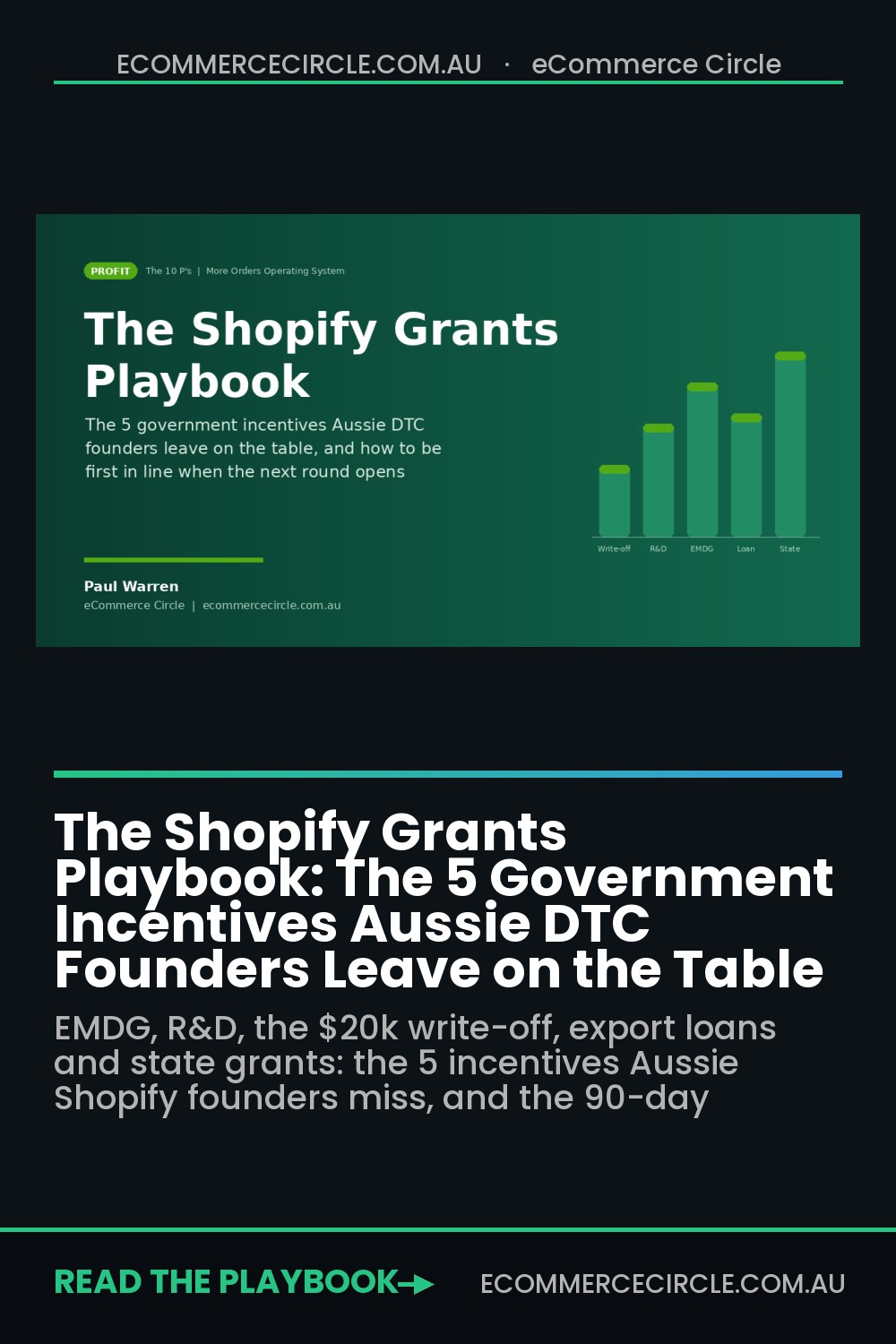
Every year, Aussie Shopify founders hand over tens of thousands of dollars to the ATO, then spend the next twelve months complaining that “the government does nothing for small business.” Meanwhile the same government is sitting on export grants that pay out an average of $54,000, a permanent $20,000 instant asset write-off, a 43.5% refundable R&D offset and an unsecured export loan that lands in your account 72 hours after approval.
What’s in This Article
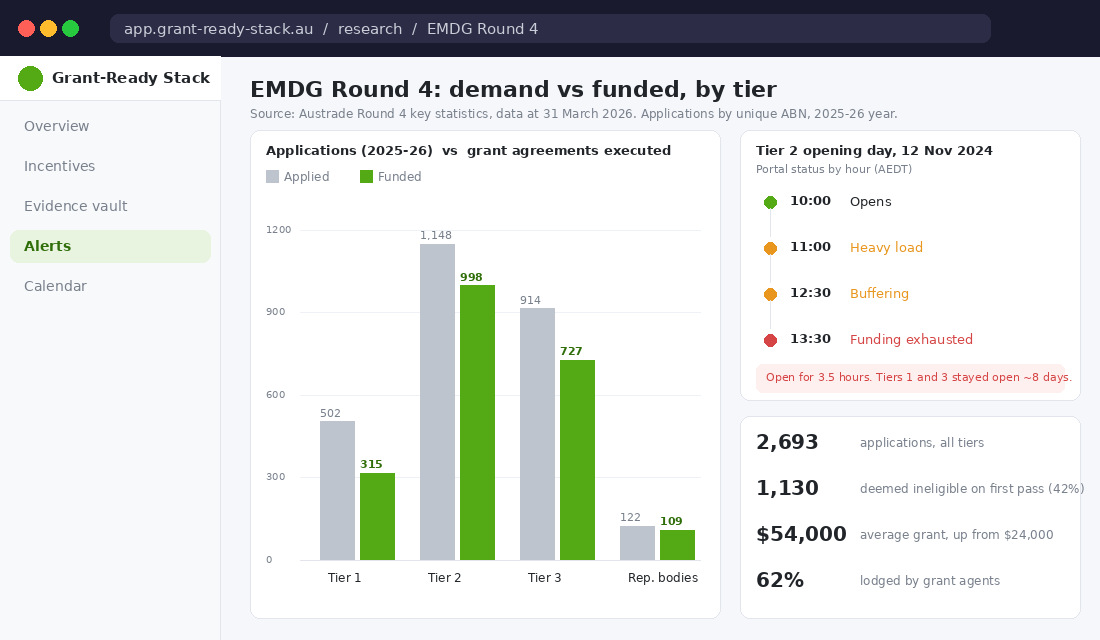
Most founders never touch any of it. Not because they are ineligible. Because grants feel like paperwork, the rounds open with almost no warning, and by the time they hear about one, it is closed. In the last Export Market Development Grant round, the most popular tier opened at 10am on a Tuesday and was fully subscribed by 1:30pm the same day. If you were not ready that morning, you were out for two years.
The brands that do get funded treat it like a system, not a lottery ticket. They know which incentives they qualify for, they keep the evidence clean all year, and they lodge in the first hour a round opens. This playbook walks you through the five incentives worth your attention, the eligibility gates for each, and the 90-day checklist that puts you at the front of the queue when the next round opens.
Why Aussie Shopify Brands Miss Out on Free Money
Austrade’s own numbers show over 60% of EMDG grantees declare turnover under $1 million, and around 60% have between two and nine employees. That is not big business. That is you. So why does the money go elsewhere? Three reasons keep coming up with members.
- Nobody is watching the calendar. Federal rounds run on a two-year cycle. State programs open and close in weeks, and Business Victoria has been known to open a program with 72 hours’ notice. If grants are not on someone’s job description, they get missed.
- The evidence is not ready. Austrade deemed 1,130 of the 2,693 Round 4 applications ineligible on first pass. That is 42%. Most of those were not bad businesses. They were businesses with an ABN under two years old, an ATO debt, or a missing document that could not be opened.
- Founders assume it is only for exporters. Two of the five incentives in this playbook have nothing to do with export. If you sell a single product to a single Melbourne postcode, you still qualify for at least one of them.
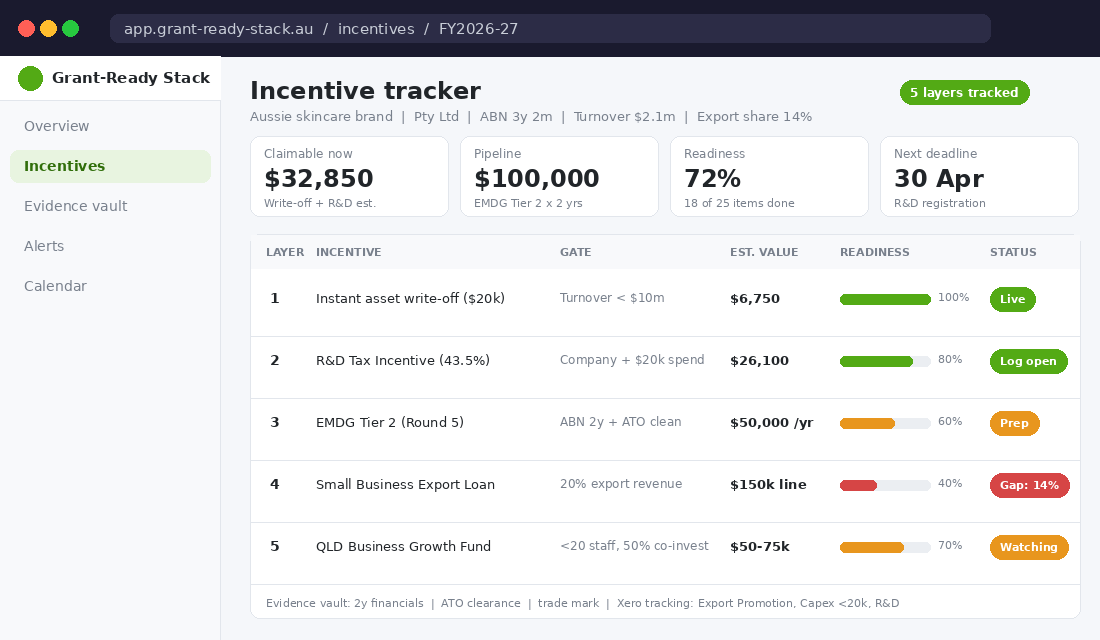
The fix is not “apply for more grants.” The fix is building what we call the Grant-Ready Stack: five incentives, each with a clear eligibility gate, a value estimate, and a readiness score you update quarterly. Once it exists, applying becomes a two-hour job instead of a two-week panic.
This is Profit work, not admin work. A $50,000 EMDG grant on a store with a 15% net margin is the equivalent of finding $333,000 in extra revenue. The cash conversion cycle playbook covers how to stretch every dollar you already have. This one is about the dollars you have not claimed yet.
Layer 1: The Permanent ,000 Instant Asset Write-Off (Every Store Qualifies)
For years this measure was renewed at the last minute on Budget night, and every accountant in the country held their breath. That is over. In the 2026-27 Federal Budget on 12 May 2026, the government made the $20,000 instant asset write-off permanent for small businesses with aggregated turnover under $10 million, starting 1 July 2026. No expiry date.
What it means in plain English: any eligible depreciating asset costing less than $20,000 (excluding GST if you are registered) that you buy and first use, or install ready for use, from 1 July 2026 can be deducted in full in that year. Not depreciated over five years. Written off now.
The threshold applies per asset, so five separate items under $20,000 each are all fully deductible. For a Shopify brand that looks like:
- Studio and content gear. Cameras, lighting rigs, a proper product photography setup. The full cost hits your deduction column this year.
- Warehouse kit. Pallet racking, a thermal label printer, a second packing bench, a pallet jack.
- Tech. Laptops for the team, a POS terminal for your pop-up, a NAS for your creative library.
- Vehicles under the cap. A second-hand van under $20,000 used for local deliveries.
The trap: the write-off reduces taxable income. It is not a cash refund. If you are running at a loss, it just deepens the loss you carry forward. Buy the gear because the business needs it, then take the deduction. Never buy gear in June “for the write-off” if the cash would have been better spent on stock for peak season.
Action step: add a line to your quarterly planning called “capex under $20k” and list every asset you plan to buy in the next 12 months. Tag each purchase in Xero with a tracking category so your accountant can find them in 30 seconds at tax time. If your Xero is still a mess, fix that first with the Xero reconciliation playbook.
Layer 2: The R&D Tax Incentive (43.5% Back, But Only If You Actually Did R&D)
This is the one that grant consultants love to sell and the ATO loves to audit. Get it right and it is the most generous incentive on this list. Get it wrong and you are repaying it with interest.
The numbers: if your company has aggregated turnover under $20 million, eligible R&D spend earns a 43.5% refundable tax offset. Refundable means that if you are in a tax loss, the ATO pays you cash. Spend $100,000 on eligible activities and you can receive $43,500 back. The 2026-27 Budget also proposed lifting that rate to 48% for income years starting on or after 1 July 2028, so the incentive is getting bigger, not smaller.
Three gates before you get excited:
- You must be a company. Sole traders and trusts cannot claim. If you are still trading under your own ABN, the business structure playbook covers the Pty Ltd decision.
- Minimum $20,000 of eligible spend in the income year.
- At least one core R&D activity with a genuine technical uncertainty, a hypothesis, and an experiment whose outcome you could not know in advance.
That third gate is where Shopify brands get burned. Building a new theme is not R&D. Setting up Klaviyo flows is not R&D. Reformulating a skincare product with a standard supplier tweak is not R&D. AusIndustry publishes a specific software sector guide because software claims are the most scrutinised category in the program, and “we built a custom app” is the exact phrase that triggers a review.
What does qualify? A supplement brand running structured stability trials on a formulation nobody has stabilised before. A furniture brand testing a new flat-pack joint through documented failure iterations. A DTC tech accessory brand engineering a charging circuit where the existing literature does not tell you whether the approach will work. The common thread is a written hypothesis, a test plan, recorded results, and a conclusion.
The deadline that catches people: you must register your R&D activities with AusIndustry within 10 months of the end of your income year. For a 30 June year-end that is 30 April. Miss it and the year is gone.
Action step: if you think you have a qualifying project, open a shared doc today titled “R&D log” and record the hypothesis, what you tried, what failed and what you learned, dated as you go. Contemporaneous records are what survive an audit. Then get a registered R&D tax adviser to review it before you register. The good ones will tell you when you do not qualify. That advice is worth paying for.
Layer 3: EMDG (The Grant That Closes in Hours, and How to Be First in Line)
The Export Market Development Grant has been running since 1974 and has funded more than 51,000 Australian businesses. It is the single most relevant grant for any Shopify brand selling, or planning to sell, outside Australia. It is also the one that has caused the most heartache in the last two years, so let’s be precise about how it works now.
The structure (Round 4 rules):
- Tier 1 (ready to export): $20,000 to $30,000 per year. Average grant executed: $28,738.
- Tier 2 (expanding in existing markets): $20,000 to $50,000 per year. Average: $48,723.
- Tier 3 (entering new key markets): $20,000 to $80,000 per year. Average: $73,132.
- Matched funding: you must spend at least as much as you receive on eligible promotion, and you must prove you can fund it up front.
- Eligibility: ABN active for at least two years, turnover between $100,000 and $20 million, ATO obligations up to date, and a product or service you own the rights to promote.
Grants are now paid up front rather than as reimbursements, which is a real improvement for cash flow. The average grant across Round 4 was $54,000, more than double the $24,000 average of Rounds 1 to 3. Fewer businesses got funded, but the ones who did got enough to matter.
What actually happened in Round 4: Austrade switched to first-come, first-served. Tier 2 opened at 10am AEDT on 12 November 2024 and closed at 1:30pm the same day with funding exhausted. Consultants hired computer labs and 80 temporary staff to lodge applications by the hundred. Sixty-two per cent of all applications came through agents. Founders in Perth were logged in at 6am local time. Across all tiers, 2,693 applications chased roughly $110 million a year.
Perth cosmetics founder Iris Smit, who built QuickFlick into an export brand, told the ABC that the uncertainty around her Tier 2 application forced her to delay overseas marketing, pull back on trade shows and hold off placing purchase orders with Australian suppliers. Melbourne ticketing company Ferve had previously used a $24,000 grant to push into North America and missed the Round 4 scramble entirely. These are not edge cases. This is what happens when a grant is treated as a one-off form instead of a standing capability.
Where it stands now: Round 4 is closed and there is no round open. The independent review led by Timothy Yeend was delivered on 2 July 2026 with 29 recommendations, including dropping first-in-first-served for a merit-based process and collapsing to two tiers. The government has not yet responded. On the program’s two-year cycle, Round 5 is expected to open around mid-2027 for the 2027-28 and 2028-29 years. That gives you roughly nine months to get ready, and readiness is the whole game.
The readiness checklist for Round 5:
- ABN age. If your trading entity is under two years old, the clock is running. Do not restructure into a fresh company six months before the round.
- ATO clean. Every BAS lodged, no payment plan in arrears. An ATO debt was one of the most common ineligibility triggers in Round 4.
- Export plan on one page. Target markets, channels, 12-month promotion budget. Round 4 grantees were targeting the USA (70%), UK (57%), Canada (40%) and Singapore (37%). If you are heading to the same places, the Shopify Markets expansion playbook shows you how to set the store up properly first.
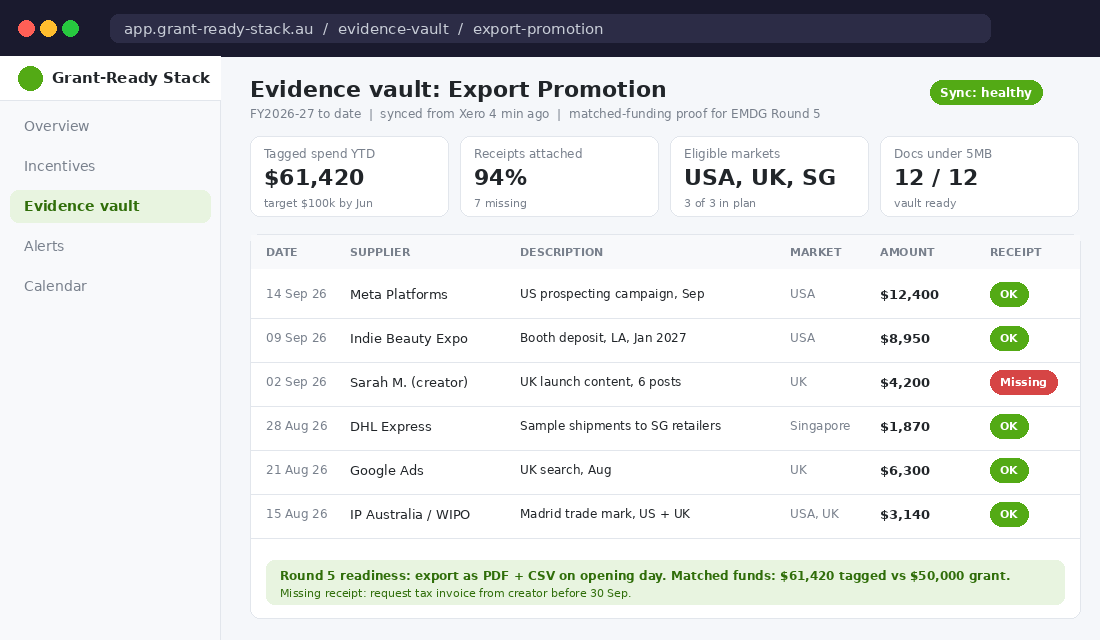
- Promotion spend tagged. Every overseas ad dollar, trade show fee, international influencer payment and foreign PR retainer gets a Xero tracking category called “Export Promotion”. When the round opens you export one report and you are done.
- Documents pre-loaded. Financials for the last two years, proof of matched funds, ownership evidence for your trade mark. Save them as PDFs under 5MB in a single folder. Austrade rejected applications because it could not open the files.
- Agent or self-lodge decided in advance. Agents lodged 62% of applications and 458 of their 581 ineligible outcomes were overturned on review, compared with 263 of 549 for self-lodgers. An agent is not mandatory, but if you self-lodge, rehearse the portal before opening day.
Layer 4: The Small Business Export Loan (No Property Security, Funds in 72 Hours)
Grants are free money, but they are slow and competitive. Sometimes what you need is fast money on fair terms, and that is where Export Finance Australia earns a place in your stack. It is the federal government’s export credit agency, and its Small Business Export Loan is built for exactly the situation Shopify brands hit when a wholesale order or a new market outgrows their cash.
The terms:
- Loan size: $20,000 to $350,000.
- Security: director’s guarantee only. No property security required.
- Eligibility: trading for at least two years, turnover between $250,000 and $10 million, an export-related funding need, and around 20% of revenue from export (with flexibility for export contracts and market development if you are below that).
- Speed: the initial online application takes about 20 minutes, and funds are available 72 hours from approval.
- Use of funds: international purchase orders, export market development, general export working capital, equipment, and, explicitly, online businesses growing an international customer base.
- No penalty for early repayment.
Bondi-born YBell Fitness is the case study Export Finance Australia itself uses. The brand had a patented 4-in-1 training tool and a large order from US gyms, but only about a year of manufacturing history, so the banks would not touch it. A direct loan from Export Finance Australia funded the US contract, freed up enough cash to launch the brand’s own ecommerce store during the pandemic, and YBell was acquired by TRX Training in 2023.
Notice the sequence. The loan funded a signed order, which de-risked the ecommerce build, which built the asset that got acquired. That is how to use debt in a DTC brand.
The trap: it is a loan, with interest, and your directors are personally guaranteeing it. Only draw it against a specific export need with a clear payback, such as a purchase order from a foreign retailer, inventory for a market you have already validated with paid traffic, or the landed cost of a container heading to a US 3PL. If US duty is part of that equation, read the US duty playbook before you sign anything.
Action step: even if you do not need the money today, run the eligibility check on the Export Finance Australia site and note the gaps. If you are at 12% export revenue, you now have a concrete target: get to 20% and you have a funding line that does not require you to mortgage the house.
Layer 5: State Grants and the Alert System That Catches Them
State programs are smaller, faster and far less contested than EMDG, and they are where the “72 hours’ notice” problem is worst. A few worth knowing about right now:
- Queensland Business Growth Fund: $50,000 to $75,000 (ex GST) for high-growth small and family businesses with fewer than 20 employees, paid across three milestones, to buy specialised equipment that lifts productivity, market share or export capacity. You co-invest at least 50%. Round 7 recipients have already been announced, so watch for Round 8.
- Victoria: Business Victoria runs rotating programs, including a Female Founders Co-Investment Fund offering $50,000 to $200,000 in matched funding for female-led businesses.
- New South Wales: Investment NSW releases more than 60 grant rounds a year, including matched R&D funding through CSIRO Kick-Start and wage subsidies of up to $10,000 for eligible hires.
You will never track this by hand. Set up the alert system once and let it come to you.
Tool: GrantConnect plus the business.gov.au Grants and Programs Finder. Setup takes 15 minutes:
- Step 1. Go to grants.gov.au and register as a user (free). This is the official register of every federal grant opportunity, and executed EMDG agreements are published here too.
- Step 2. In your profile, open Notification Settings and add keywords. Use broad ones: “export”, “small business”, “manufacturing”, “digital”, “retail”. GrantConnect’s own help page warns that settings which are too prescriptive lead to missed opportunities.
- Step 3. Add “Forecast Opportunities” to your watch list. That is how you get weeks of warning before a round opens instead of hours.
- Step 4. Go to business.gov.au/grants-and-programs, filter by your state and industry, and bookmark the results. It lists close to 600 active programs across all levels of government, including state ones GrantConnect does not carry.
- Step 5. Subscribe to your state’s business newsletter (Business Queensland, Business Victoria, Service NSW for Business) and to Austrade’s EMDG Update. Route them all to a “Grants” label so they do not drown in your inbox.
- Step 6. Put a 30-minute “grants review” in the calendar on the first Monday of each quarter to update the stack.
Action step: assign this to one person. In a small team that is usually the founder or the operations lead. If you have a bookkeeper or a fractional CFO, this sits naturally with them, and the finance team roadmap shows where that role fits as you grow.
The Grant-Ready Stack: How the Five Layers Compound
Look at the five layers together and a pattern shows up. They all draw on the same four pieces of evidence: a clean set of books, an ATO account in good standing, a trading entity with some history, and spend that is tagged by purpose. Build those once and every layer gets easier.
Here is how it plays out for a $2 million Aussie skincare brand over 24 months:
- Year 1, Q1: Pty Ltd is two years old, books are clean, “Export Promotion” and “Capex under $20k” tracking categories go live in Xero. GrantConnect alerts are on.
- Year 1, Q2: $18,000 photography studio and $9,000 label printer are written off in full under the instant asset write-off. Effective saving at the 25% company rate: about $6,750.
- Year 1, Q3: Stability trials on a new SPF formulation are logged as they happen. Registered with AusIndustry before 30 April. $60,000 eligible spend returns $26,100 in cash via the 43.5% refundable offset.
- Year 1, Q4: A UK retailer places a $180,000 order. Export revenue crosses 20%. A $150,000 Export Finance Australia loan funds the production run without touching the founder’s home.
- Year 2, mid-year: EMDG Round 5 opens. The one-page export plan, two years of tagged promotion spend and pre-loaded PDFs are lodged in the first 30 minutes. A Tier 2 grant of $50,000 a year lands for two years.
Add it up: roughly $133,000 in grants and offsets, plus a funding line that turned a scary order into a growth story. None of it required a single extra sale. All of it required the same four pieces of evidence, kept current. And the Export Chamber of Australia’s review puts EMDG’s return at $2.10 of extra exports per $1 of grant, so the promotion it funds is promotion you did not pull out of margin.
Your 90-Day Grant-Ready Checklist
Copy this into your project tool and work through it before Christmas. Everything here is a one-off setup that pays every year.
- Days 1 to 7: Eligibility audit. Confirm your entity type, ABN start date, aggregated turnover, employee headcount and export share of revenue. Write the five numbers on one page. That page tells you which layers are live today.
- Days 8 to 14: ATO health check. All BAS and income tax lodgements current, no overdue debt. If there is a payment plan, confirm it is not in arrears. This single item knocked out hundreds of Round 4 applicants.
- Days 15 to 30: Tracking categories. Create “Export Promotion”, “Capex under $20k” and, if relevant, “R&D” in Xero. Re-code the current financial year’s transactions. Brief your bookkeeper so it stays clean.
- Days 31 to 45: Alert system. GrantConnect registration, keyword notifications, forecast watch list, business.gov.au bookmarks, state newsletter subscriptions, a quarterly calendar block.
- Days 46 to 60: Evidence folder. Two years of financial statements, trade mark certificate, proof of funds, director IDs, all as PDFs under 5MB, in one shared folder with a naming convention.
- Days 61 to 75: The one-page export plan. Target markets, channels, promotion budget by quarter, and the 12-month revenue goal. This is your EMDG application in draft form nine months early.
- Days 76 to 90: Adviser decisions. Choose an R&D adviser if you have a qualifying project. Decide whether you will self-lodge or use an agent for EMDG, and book them now. The good agents fill up long before a round opens.
One caveat that matters: this is a coaching article, not tax or financial advice. Thresholds, rates and program rules change, and the EMDG rules in particular are likely to shift once the government responds to the Yeend review. Confirm every number with your accountant or a registered adviser before you rely on it.
Inside eCommerce Circle, Profit is one of the core pillars we work on with every member, and government incentives sit right alongside margin, pricing and cash flow as levers most founders have never pulled. If you want to see exactly where your store is being capped, take the free More Orders Scorecard. It takes two minutes and shows you which of the 10 P’s to fix first.