Most Aussie Shopify founders treat compensation like a one-time negotiation. They pay whatever it takes to close the offer, hope the new hire performs, and panic re-price 18 months later when the A-player walks. The result is a comp structure that lives in a Google Doc, drifts above market in some roles, sits below market in others, and quietly burns retention every quarter.
What’s in This Article
Here is the pattern. A founder hires their first marketing coordinator at $85,000 plus super. Twelve months later they offer a $10,000 raise because the coordinator asks. Two months after that, another team member asks for the same. Now the founder is paying $9,500 more per head than the SEEK 2026 benchmark, the bonus pool has no rules, and nobody on the team can tell you what a “good year” looks like in dollar terms.
That is the cost of an unstructured compensation system. The 2026 SEEK data is clear. eCommerce Managers in Australia earn between $105,000 and $125,000. Digital Marketing Specialists sit between $85,000 and $100,000. eCommerce Marketing Managers run $120,000 to $135,000. If your pay structure cannot answer “what is this person worth at market and what stretches them to outperform” in 30 seconds, you do not have a compensation system. You have a series of one-off deals.
This is the 5-Layer Pay Architecture we have walked hundreds of Aussie Shopify founders through inside eCommerce Circle. It is the difference between losing your best marketer to an agency offering $20K more, and building a team that compounds for five years.
Why Compensation Drift Costs You $30K to $80K Per Turnover Event
Before the framework, the math. Voluntary turnover in 2026 sits at around 13.5% on average. For a 6-person Aussie Shopify team that is about one resignation per year, every year. The cost of replacing a mid-level marketer is conservatively 6 to 9 months of their salary once you count recruiter fees, lost productivity during the gap, onboarding ramp, and the institutional knowledge that walks out the door with them.
For a $95,000 marketer, that is $47,500 to $71,250 in real cost. Three turnover events in a 24-month window can quietly drain $150,000 to $215,000 from a brand doing $2M a year. That is roughly a full quarter of contribution margin.
Worse, the brands that have a clean comp architecture poach from the brands that do not. Candidates with AI tool fluency are commanding 10 to 15% premiums into 2026. Candidates with Shopify Plus or marketplace fluency layer another 10 to 20% on top. If your structure cannot match a competitive offer with a transparent counter, you are losing on speed before you lose on dollars.
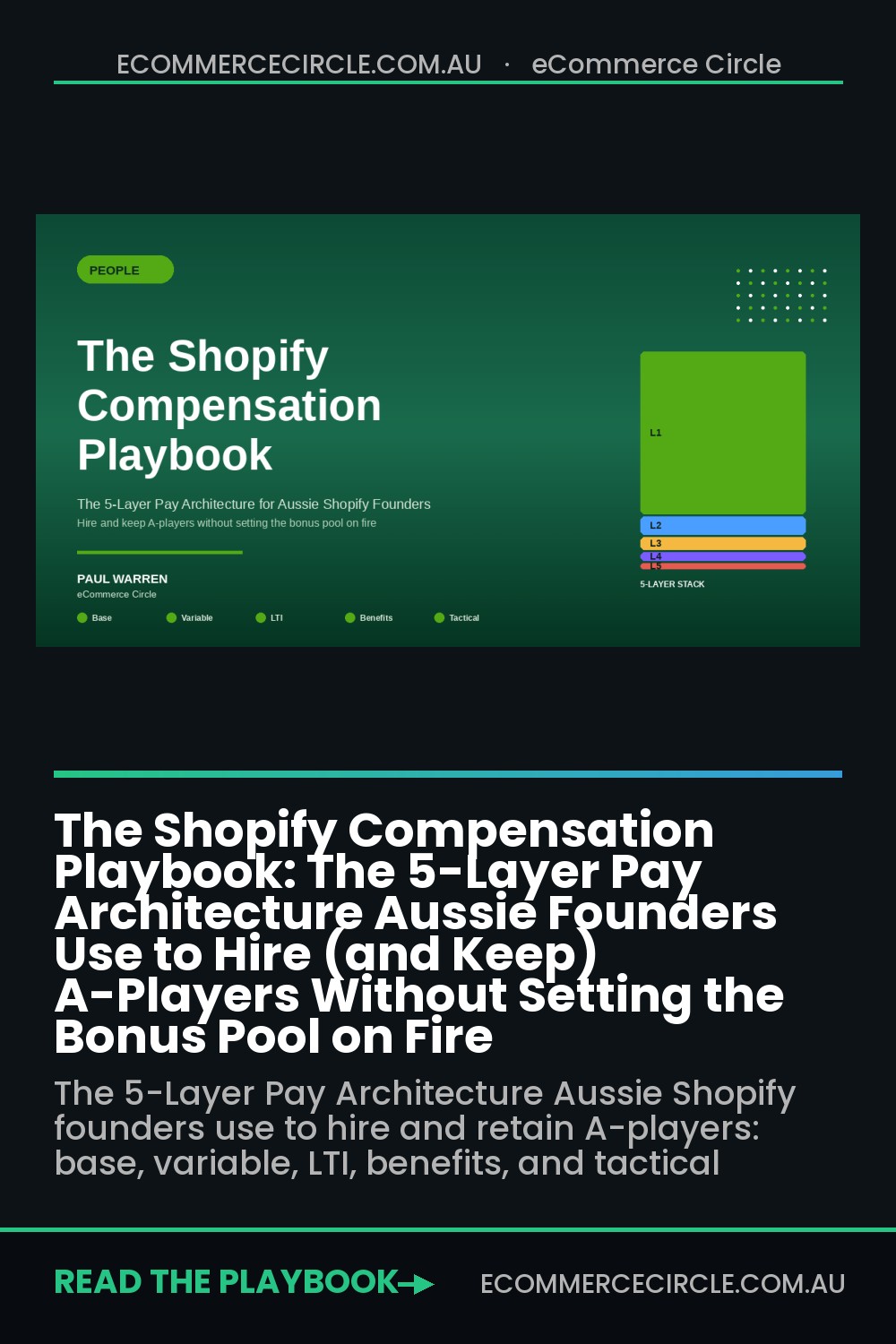
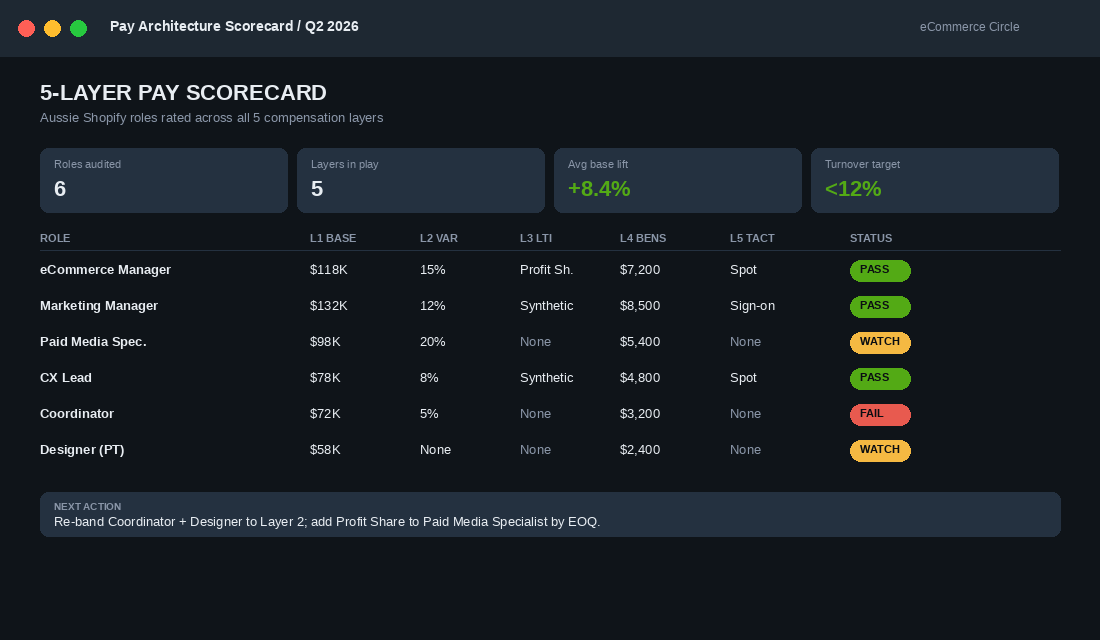
The 5-Layer Pay Architecture fixes this by separating four things most founders blur together: market-benchmarked base, performance-linked variable, long-term retention, and tactical bonuses. Each layer has its own job. None of them should ever be used to fix a problem another layer was meant to solve.
Layer 1: Base Salary Anchored to Real AU Market Benchmarks
Base salary should be 70 to 80% of total cash compensation for non-sales ecommerce roles. It is the layer that buys you predictability. It is also the layer most founders get wrong, either by paying significantly under market and watching A-players churn out, or by paying well above market and creating ceiling problems they cannot raise from later.
Anchor every role to a public, defensible benchmark. SEEK is the cleanest source for Australian roles. PayScale and the Michael Page Salary Guide work as cross-references. Set three bands per role.
- Band 1 (developing): 90 to 95% of the SEEK midpoint. For an eCommerce Coordinator, that is roughly $70,000 to $74,000 plus super.
- Band 2 (performing): 100 to 110% of the SEEK midpoint. For a Digital Marketing Specialist, that is roughly $92,000 to $102,000 plus super.
- Band 3 (top quartile): 115 to 125% of the SEEK midpoint. For an eCommerce Marketing Manager, that is roughly $145,000 to $160,000 plus super.
Apply the AI premium where it is earned. If your marketing manager can credibly run Klaviyo flows with AI-assisted personalisation, build Meta creative briefs from AI tools, and use ChatGPT or Claude inside their daily workflow with measurable output gains, they belong in Band 3. If they cannot, they sit in Band 2 until they can.
Apply the Shopify Plus premium the same way. A coordinator who can confidently configure Shopify Functions, B2B catalogues, and Markets is not a coordinator anymore. They are a specialist, and they should sit at the top of their band or move up to the next band entirely.
From 1 July 2025, the Australian Superannuation Guarantee rate is 12% of ordinary time earnings. From 1 July 2026, Payday Super kicks in, which means contributions must reach the fund within seven business days of pay date. Every base offer should be quoted as “$X plus 12% super” so candidates compare apples to apples. The brands that quote inclusive-of-super numbers lose 15 to 20% of candidates at the offer stage because the headline number looks low.
Layer 2: Variable Pay (Quarterly KPI-Linked Bonus)
The variable layer sits at 10 to 20% of base for non-sales roles. For sales-adjacent roles like Paid Media Specialist or eCommerce Manager, push it to 15 to 25%. The job of this layer is to align the team to the two or three metrics that actually move the business.
Three rules for variable pay that we hammer with every member.
- Maximum 3 KPIs per role. More than that and the team optimises for whatever feels easiest that quarter. We have seen brands with 7-metric scorecards where nobody hits anything and the bonus pool gets paid out anyway because of “context”.
- Tied to outcomes the role actually controls. A marketing coordinator does not control gross revenue. They control campaign send rates, email click rates, and SMS opt-in growth. Pay them on those, not the company P&L.
- Paid quarterly, not annually. Quarterly cadence keeps the feedback loop tight. Annual bonuses get forgotten by Q2 and de-motivate by Q4 because the year is already lost.
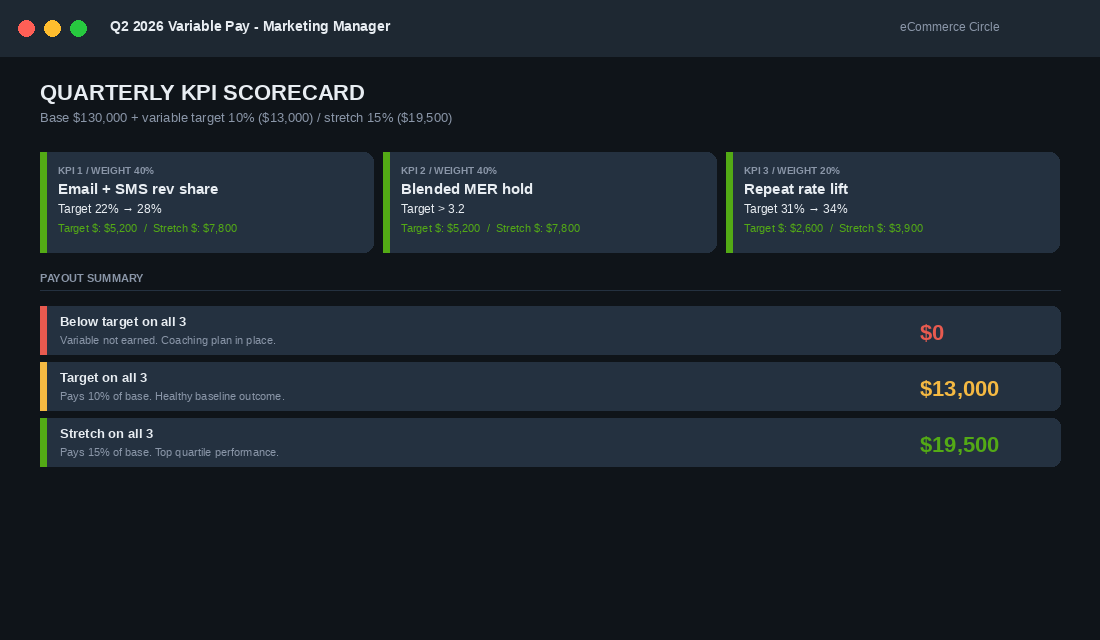
Example structure for an eCommerce Marketing Manager on a $130,000 base.
- KPI 1 (40% weight): Email and SMS revenue contribution lifts from 22% to 28% of total revenue by EOQ. Pays $5,200 at target, $7,800 at stretch.
- KPI 2 (40% weight): Blended Marketing Efficiency Ratio holds above 3.2 for the quarter. Pays $5,200 at target, $7,800 at stretch.
- KPI 3 (20% weight): Repeat customer rate improves from 31% to 34% within the quarter. Pays $2,600 at target, $3,900 at stretch.
At target, the manager earns an additional $13,000 across the year (10% of base). At stretch on all three, they earn $19,500 (15% of base). Stretch should not be unreachable. It should be where the top quartile lands two quarters out of four.
Do not blend variable pay with general “discretionary” bonuses. The moment the team senses the bonus is based on the founder’s mood, the system is dead. Write the rules down, share them at hire, and pay against them. If the rule needs to change, change it for the next quarter and tell the team why.
Layer 3: Long-Term Incentives (Profit Share or Phantom Equity)
This is the layer most Aussie founders skip and then regret three years in when their best people start fielding offers from VC-backed brands with real equity. You do not need to give away shares to compete. You need a long-term incentive that rewards retention and outcomes beyond the 12-month horizon.
There are three structures that work for private Aussie Shopify brands.
- Profit share pool: The cleanest. Set aside 5 to 10% of EBIT each year, allocated by tenure-weighted share to team members past their 12-month mark. Funds vest annually. Easy to model, easy to communicate, no legal complexity.
- Phantom equity: A contractual right to a cash payout calculated as if the team member held a small percentage of the company at a future trigger event (sale, capital raise, or 5-year anniversary). Typical allocations are 0.25% to 1.5% per senior team member, capped at 5 to 10% of total phantom pool. Needs an accountant and a lawyer to draft.
- Synthetic milestone bonus: A one-time payment that triggers at a revenue or profit milestone the team member contributed to (e.g. “you get $20,000 cash when we cross $5M ARR while you are still here”). Simple, illiquid risk for the team member, easy on the founder.
For brands under $3M revenue, the synthetic milestone bonus is usually the right starting point. Once you cross $3M and are committed to building a team of 8 plus, move to a profit share pool. Phantom equity makes sense for senior hires at $5M and above, particularly if you are eyeing a sale within 5 years.
The mistake we see most often is founders promising verbal equity. “When we sell, I will look after you.” That promise is worth nothing in court and worth less in retention. If you are going to commit to a long-term incentive, write it down, get it signed, and review it annually with the team member.
Layer 4: Benefits and Non-Cash (The Quiet Compounding Layer)
This is where small Aussie brands punch well above their weight. You will rarely beat a corporate retailer on base. You can beat them on the layer that actually shapes day-to-day life.
Five non-cash benefits that compound retention for 1 to 3% of total comp.
- Super top-up (0.5 to 2% above SG): Pay 12.5 to 14% super instead of the legal 12% minimum. Costs you $625 to $2,500 a year on a $95,000 base. Reads as “you take care of me” without changing take-home cash.
- WFH stipend ($600 to $1,200 a year): Splits across home internet, ergonomic chair, monitor, headphones. Reimbursed against receipts. Easy to track in Xero or QuickBooks.
- Learning budget ($1,500 to $3,000 a year): Specific to ecommerce skill development: a Klaviyo certification, a Meta Blueprint course, a paid CRO conference like CXL or Conversion Conference. Sets the expectation that you invest in their craft.
- Brand allowance ($50 to $150 a month in product): Free product credit. Costs you COGS, not retail. Team members become customers, advocates, and best-practice testers for your own checkout and CX.
- Wellness or flexible Fridays: Half-day Fridays in summer, or a $50 monthly wellness allowance for gym, yoga, or mental health support. Costs are minimal and retention impact is real.
The non-cash layer is also where you signal culture. Frank Body has been famously generous with team product credits and brand allowances since their early days, which is part of why their alumni network still champions the brand a decade later. Bondi Sands runs structured learning budgets that pull from formal training providers, which is why their marketing alumni show up at other Aussie brands as senior hires.
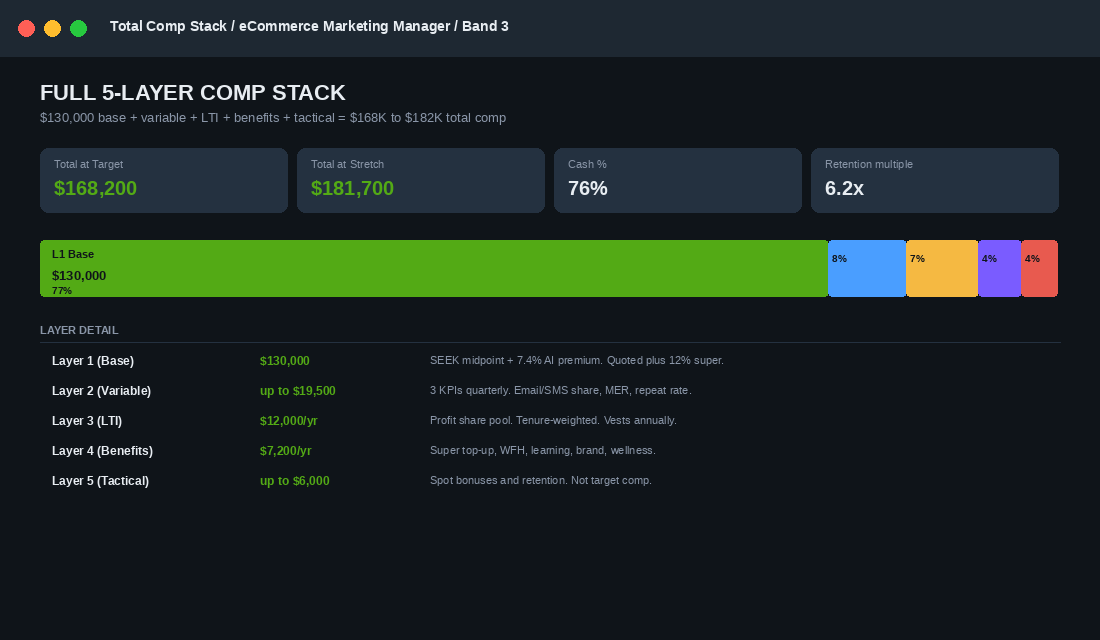
Total cost of a full Layer 4 stack: roughly $5,000 to $9,000 per team member per year. That is 3 to 7% of total comp on a typical mid-level role. The retention return is 6x to 10x what you spend, based on the data we have collected across hundreds of Aussie members.
Layer 5: Tactical Bonuses (Sign-On, Spot, Retention)
The final layer is your tactical toolkit. Three bonus types, each with a specific use case. Never blend them with Layer 2 variable pay.
- Sign-on bonus ($3,000 to $15,000): Used to close a candidate sitting on a competing offer or to bridge a gap where their notice period costs them earned bonus at their current employer. Paid at start or split across the first 6 months. Clawback clause if they leave within 12 months.
- Spot bonus ($500 to $3,000): Awarded in the moment for an exceptional contribution. The marketer who runs a flash sale that pulls $40K forward by Friday. The CX lead who personally rescues a $5K customer. Paid within the same fortnight as the win, named publicly in a team forum.
- Retention bonus ($5,000 to $25,000): Used to keep a key team member through a critical period (peak season, a migration project, a capital raise). Paid in full at the end of the locked period. Counter-offer style retention bonuses should be rare. If you are using them often, your Layer 1 to Layer 4 architecture is broken.
The point of Layer 5 is that it gives you precise tools for specific situations, without messing up your fairness narrative. The team understands that a sign-on bonus is part of the recruitment cost. They do not understand why the new hire is being paid 15% above them in base salary. Use the tactical layer for tactical problems. Keep your base bands clean.
The Compound Effect: What a Full 5-Layer Stack Looks Like
Take a $2M Aussie Shopify brand with 6 team members. Pre-architecture, the founder pays roughly $580,000 in total cash comp across the team. Turnover sits around 25% (1.5 resignations per year on average), and replacement cost runs to $80,000 to $120,000 a year. The team feels under-paid in some roles and over-paid in others, with no clear logic.
After the 5-Layer Architecture is in place. Total cash comp lands at around $610,000 (5% increase). Variable pay budget is $42,000, only paid when KPIs hit. Layer 3 profit share is funded only when EBIT clears its target. Layer 4 benefits cost around $30,000 across the team. Turnover drops to 8 to 12% within 12 months, saving $40,000 to $70,000 a year. The team understands exactly how to earn more without negotiating, and the brand is competitive on talent for the first time.
The math: net incremental cost of around $50,000 in good comp design saves $70,000 in turnover, while making the brand a destination rather than a stepping stone. The compounding gain over 3 years (retention savings, plus the value of a team that does not need to be re-built every 18 months) is well over $250,000 in margin terms.
The 30-60-90 Day Rollout
Do not try to install all five layers in week one. Sequence them.
- Days 1 to 30 (Audit and benchmark): Pull current base salaries into a single sheet. Map each role to a SEEK midpoint and a band (developing, performing, top quartile). Identify the over-paid (above Band 3) and under-paid (below Band 1) outliers. Decide which to re-band on the next review cycle.
- Days 31 to 60 (Variable pay design): Pick 2 to 3 KPIs per role. Set target and stretch numbers. Communicate the new structure with the team. First quarterly payout 90 days later.
- Days 61 to 90 (Long-term incentive and benefits): Commit to a Layer 3 structure that fits your revenue stage. Roll out the Layer 4 benefits stack. Document everything in a one-page comp policy that lives in your team handbook.
For the tooling, you do not need an HRIS to run this. A single Google Sheet with a tab per role, a tab for the bonus calculator, and a tab for the benefits ledger gets you 80% of the way. Brands above $5M usually graduate to Employment Hero or Deel for payroll and contracts, and Lattice or Pave for comp benchmarking, but the underlying logic is the same.
Three Failure Modes to Watch
- The “raise every 12 months” trap. Annual raises across the board, decoupled from market data, drift you above market in 3 years and then trap you. Always raise off a benchmark refresh, not off the anniversary date.
- The “everyone wins” bonus. If 100% of the team hits stretch every quarter, your targets are too easy. Recalibrate so that stretch sits where the top performers land 50% of the time.
- The verbal equity promise. A handshake is not retention. Either commit on paper or do not commit at all. The team will notice when the promise gets quietly forgotten and trust will not come back.
Tools That Actually Help
For the brands ready to install this properly, three platforms cover most of the operational layer.
- Employment Hero (from $8 AUD per employee per month): Aussie-built HRIS for sub-200-employee brands. Handles payroll, contracts, leave, super, and policies. The 5-Layer Architecture lives cleanly in their comp module. Setup takes 2 to 3 weeks for a 6-person team.
- Deel ($49 USD per contractor per month, $599 per employee for AU EOR): Best if you have global team members on top of your Aussie crew. Handles Filipino VAs from OnlineJobs.ph through to senior US hires, with compliance baked in.
- Pave or Lattice for benchmarking ($8 to $20 USD per employee per month): Pulls live comp data so you are not relying on SEEK once a year. Worth it past $5M revenue or 10 plus employees.
For under $3M brands, a single Google Sheet plus your existing accountant covers it. Do not over-tool early. The structure matters more than the software.
Build the Architecture Before You Need It
The brands that win on talent are not the ones with the biggest budgets. They are the ones with the clearest structure. A coordinator who knows exactly what gets them from $75K to $95K in 24 months will outperform a coordinator who is hoping for a “good year” raise. A marketing manager who has 0.5% phantom equity vesting over 4 years will weather an agency counter-offer that a flat-base manager will not.
Compensation is the second-highest-impact decision a founder makes after hiring itself. Treat it like the system it is. Install the 5 layers. Document them. Review quarterly. And you stop losing your best people for $10,000 reasons.
For more on how this fits with the broader People pillar, see the Marketing Manager Hire 5-Stage Roadmap, the Operations Manager Hire 90-Day Playbook, and the Founder Time Audit framework that frees up your week to actually manage the team you build.
Communicating the Package So It Actually Retains
A five-layer pay architecture only retains people if they understand it. The most common own goal we see is a founder who builds a genuinely competitive package, then describes it as a single base-salary number in the offer conversation. The variable pay, the profit share, the benefits, the retention bonuses all become invisible, and the hire compares your “salary” against a competitor’s total package and feels underpaid on day one.
Fix this with a one-page total rewards statement. Lay out every layer in dollars: base, target bonus at 100% of KPIs, the value of long-term incentives, the cash-equivalent of benefits, and any sign-on or retention bonuses. A package that reads as “AUD 95,000 base” suddenly reads as “AUD 128,000 total opportunity,” and that framing is the difference between an accepted offer and a counter you have to chase.
Then set a cadence. Revisit comp formally every 6 to 12 months, before your best people start looking, not after they hand in notice. A 10-minute proactive conversation costs you nothing. A reactive counter-offer after they have one foot out the door costs you leverage, team morale, and often the person anyway, since most counter-offer acceptances leave within a year.
Compensation is one piece of building a team that runs without you. If you are mapping out your next senior hire, our operations manager hiring playbook shows how the right structure and the right onboarding compound together.
Inside eCommerce Circle, compensation architecture is one of the core pillars we work on with every member. If you want a second opinion on yours, let’s talk.