When sales slow down, most Aussie Shopify founders reach for the same lever: a discount code. 15% off. 20% off sitewide. It works for a weekend, and then it quietly trains your best customers to wait for the next one.
What’s in This Article
There is an older move that protects your price, lifts your average order value, and makes customers feel like they won. Estee Lauder built a beauty empire on it from 1946, slipping a free sample of her face cream into the bag of every woman who bought a lipstick. The gift with purchase is nearly 80 years old, and it still outperforms most of what passes for promotion strategy today.
It works just as hard on Shopify. One fragrance brand running tiered gift-with-purchase rules through BFCM 2024 lifted average order value by 46% in a single campaign window. In this playbook you will get the 5-move GWP system: how to pick a gift people actually want, where to set the spend trigger, how to build it on Shopify in an afternoon, how to promote it like a product launch, and the margin guardrails that keep the whole thing profitable. Run it properly and a 15 to 30% AOV lift is a realistic target, without touching your price.
Why a Free Gift Beats a Discount (The Maths Most Founders Never Run)
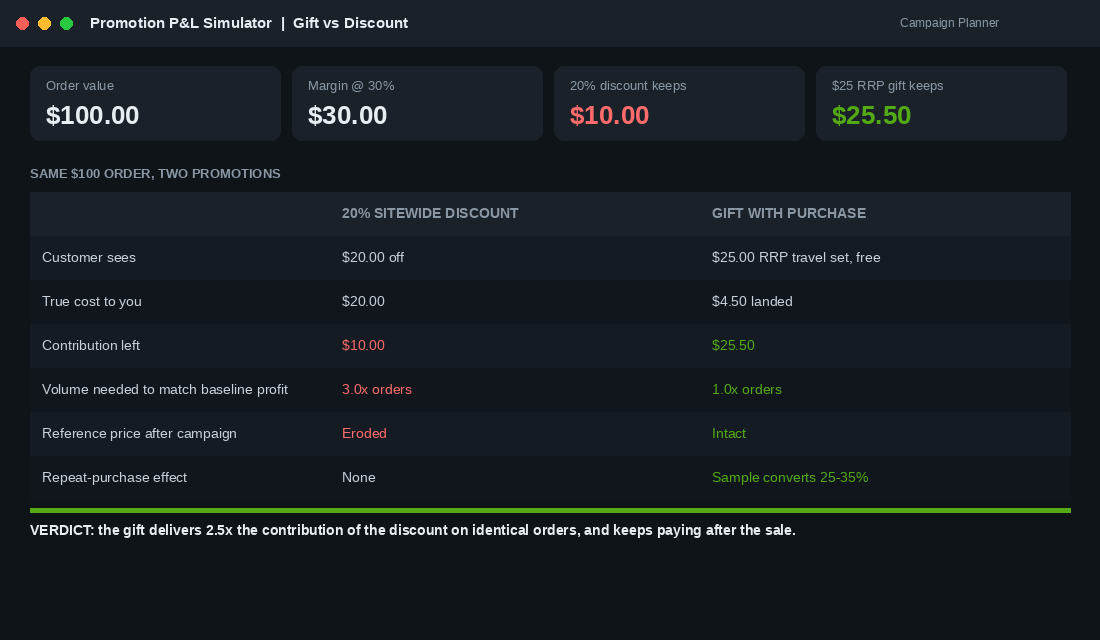
Start with the numbers, because they are brutal. Say your average order is $100 and your contribution margin is 30%, so you keep $30 per order. A 20% sitewide discount drops that to $10. You now need three times the order volume just to make the same money you made last week.
Now run the gift instead. A travel-size product with a $25 RRP might cost you $4.50 landed. Give it away on the same $100 order and you keep $25.50 of margin. The customer walks away feeling like they received $25 of value. You paid $4.50 for that feeling. That asymmetry, perceived value at retail price versus actual cost at COGS, is the entire engine of the gift with purchase. A discount costs you its face value. A gift costs you a fraction of what the customer thinks it is worth.
The psychology stacks on top of the maths. Behavioural economist Dan Ariely showed in Predictably Irrational that “free” breaks rational decision-making: when he offered people a premium Lindt truffle at half price or an ordinary Hershey’s Kiss for free, the crowd flipped to the Kiss the moment its price hit zero. Researchers call it the zero price effect. Free does not just feel cheap. It feels risk-free, and people go out of their way to get it.
Two more reasons the gift wins. First, price integrity: every discount erodes your reference price and teaches customers your RRP is negotiable, while a gift leaves the price intact for every future full-price order. Second, reciprocity: a genuine gift creates a small social debt that shows up later as reviews, referrals, and repeat orders. A markdown has never made anyone feel grateful.
And if the gift is a sample of another product in your range, it doubles as acquisition. Sampling research consistently shows around 73% of consumers are more likely to buy a product after trying a sample, compared to roughly 25% after seeing an ad for it. Estee Lauder knew this in 1946. The gift is not a cost centre. It is your cheapest marketing channel wearing a bow.
Move 1: Pick a Gift People Actually Want
Every failed GWP campaign fails here first. A gift nobody wants is worse than no gift at all, because it signals what you think your customers are worth. There are four gift types that work, and each does a different job.
- The sample that sells. A deluxe sample or travel size of the product you want this customer to buy next. This is the Lauder original, and it is still the strongest play because it pays twice: once in AOV today, once in full-size conversion later. Aim for a 25 to 35% sample-to-full-size conversion rate within 60 days. Roughly 35% of consumers who receive a beauty sample make an immediate follow-on purchase, and skincare brand U Beauty has reported conversion as high as 40% from samples to full-size orders.
- The slow mover with real value. A full-size product with a strong RRP that is not selling through. You clear dead stock, the customer gets something genuinely substantial, and your gift cost is inventory you had already paid for. Just make sure it is slow because of visibility, not because it is a dud. Gifting a product people did not want at full price does not make them want it.
- The branded keepsake. Merch that gets used: a tote, a headband, a scrunchie, a stubby holder. Frank Body has turned pink merch into a walking billboard for years. Every use is an impression, and the perceived value sits well above the unit cost of decent merch at volume.
- The delight gift. Adore Beauty has shipped a Tim Tam with orders for years. It costs well under a dollar, it has nothing to do with skincare, and customers post it constantly. It is so central to the brand experience that CEO Sacha Laing confirmed the Tim Tams and gifts with purchase are coming along as the company rolls out physical stores. The lesson: a tiny, consistent, on-personality gift can become a signature.
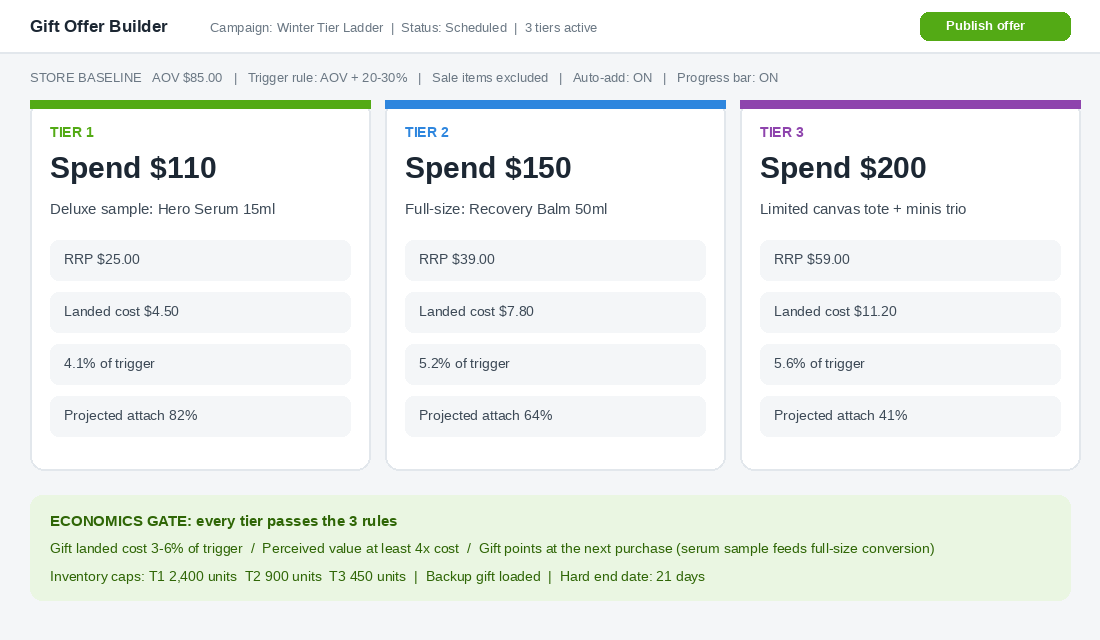
Whatever type you choose, hold it to three economics rules. The landed cost of the gift should sit between 3 and 6% of the qualifying order value. The perceived value (its RRP, or what it would obviously cost) should be at least four times your cost. And the gift should point at the next purchase you want the customer to make. A random trinket delights once. A sample of your hero serum builds your next quarter’s revenue.
Move 2: Set the Trigger Where It Changes Behaviour
The trigger is the spend level that earns the gift, and it is where most of your AOV lift actually comes from. Set it wrong and you give margin away on orders you were getting anyway.
The rule is the same one we use in the free shipping threshold playbook: set the trigger 20 to 30% above your current AOV. If your average order is $85, the gift kicks in at $110. That gap is close enough to feel reachable and far enough to change what goes in the cart. Shoppers already do this work willingly: studies show around 93% of online shoppers have added items to a cart specifically to qualify for free shipping. A visible free gift pulls the same behaviour, often harder, because the reward is tangible.
Once a single threshold is working, graduate to a tier ladder. Tiers are what produced that 46% BFCM AOV lift: spend $100 and get the deluxe sample, spend $150 and get the full-size, spend $200 and get the full minis set or the limited tote. Each tier resets the “I’m nearly there” maths in the customer’s head. Three tiers is the ceiling. Beyond that, the offer reads like a spreadsheet.
Mecca’s Beauty Loop program shows where this thinking ends up at maturity: reward boxes tied to annual spend levels, which quietly nudge customers to consolidate their entire beauty budget with one retailer to protect their tier. You do not need a loyalty program to borrow the principle. Spend levels plus desirable gifts will structure customer behaviour on their own.
Three trigger formats cover almost every use case. Spend X get Y is the AOV workhorse. Buy X get Y is for moving a specific SKU or supporting a launch (buy the shampoo, get the travel conditioner). Buy-from-collection triggers protect margin by only counting full-price items toward qualification. Whichever you run, always exclude sale items from qualifying. A gift on top of a discount is a margin fire.
Finally, decide the rhythm. An always-on threshold gift (usually the delight gift or merch) becomes part of your brand experience. Campaign GWPs (the strong samples and full-size gifts) should run in two to three week windows, no more than once a quarter per gift, so they keep their event energy. Run the same gift back to back and you have just invented discount-waiting with extra steps.
Move 3: Build It on Shopify in an Afternoon
Shopify gives you a free, native starting point: the Buy X Get Y discount type. Create a discount, set the customer-buys condition to a minimum purchase amount, set the customer-gets to your gift product at 100% off, and cap it at one use per order. It works, and for a first campaign it is plenty.
The native option has two real limitations. The gift is not added to the cart automatically (the customer has to add it themselves, and many never do), and there is no progress bar telling shoppers how close they are to qualifying. Those two gaps are exactly where the AOV lift lives, which is why most brands running GWP seriously move to a dedicated app.
Tool recommendation: BOGOS (Free Gift Bundle Upsell). It is the deepest gift logic on the Shopify App Store, with gift with purchase, buy X get Y, and spend X get Y offers, each configurable with eight targeting sub-conditions. Paid plans start at US$29.99 a month, which a single well-built campaign repays in a day. Setup looks like this:
- Step 1: Install and pick the offer type. Choose Spend X Get Y for an AOV threshold gift, or Buy X Get Y if you are attaching the gift to a specific product.
- Step 2: Set the trigger and the gift. Enter your threshold (AOV plus 20 to 30%), select the gift SKU, and exclude sale and clearance collections from qualifying.
- Step 3: Turn on auto-add and the progress bar. The gift should drop into the cart by itself the moment the threshold is hit, and the cart should show “You’re $23 away from your free gift” the whole way there.
- Step 4: Cap it. One gift per order, set an inventory limit on the gift SKU, and schedule a hard end date so the offer switches itself off.
- Step 5: Test on mobile in incognito. Add products, watch the progress bar update, confirm the gift auto-adds at the threshold and removes itself if the cart drops below it.
Two operational details that save support tickets. Give the gift a proper SKU at $0 so your 3PL or pick-pack process treats it like a real line item rather than a mystery. And load a backup gift into the offer so that if the hero gift sells out mid-campaign, the offer swaps rather than vanishing while your ads are still promising it.
Move 4: Promote It Like a Product Launch, Not a Footnote
A GWP that lives only in your cart drawer is a reward for people who were already spending. The lift comes from telling everyone before they shop. Treat the campaign like a launch.
- On site. Announcement bar sitewide, a callout on the PDP near the price (“Free deluxe serum with orders over $110”), the cart drawer progress bar doing the dollar-gap nudge, and a line at checkout confirming the gift made it into the order.
- In Klaviyo. Send a launch campaign to your engaged 90-day segment on day one, drop a reminder block into your abandoned cart flow for the campaign window, and send a last-48-hours email before the offer ends. Gift announcement emails routinely outperform discount emails on click-through because the creative is a product, not a percentage.
- Show the actual gift. Photograph it like a hero product. “FREE GIFT” text on a green background does nothing. A styled shot of the travel set sitting next to the full-size does everything.
- In paid social. A GWP gives your Meta ads a fresh hook without touching price. “Every order over $110 this week ships with our $39 mini trio, free” is a stronger ad than another 15% off, and it does not bleed your reference price in front of cold traffic.
One honesty rule, because Aussie customers have sharp memories and the ACCC has sharper teeth: every claim must be true. Real end dates that you honour. “While stocks last” only when stock is genuinely limited, with the backup gift ready. The fastest way to burn the reciprocity effect is for the gift to feel like a trick.
Move 5: Measure It Like a Channel
A gift with purchase is a promotion with a P&L, and it earns its place the same way a paid channel does. Five numbers, checked every Monday during a campaign:
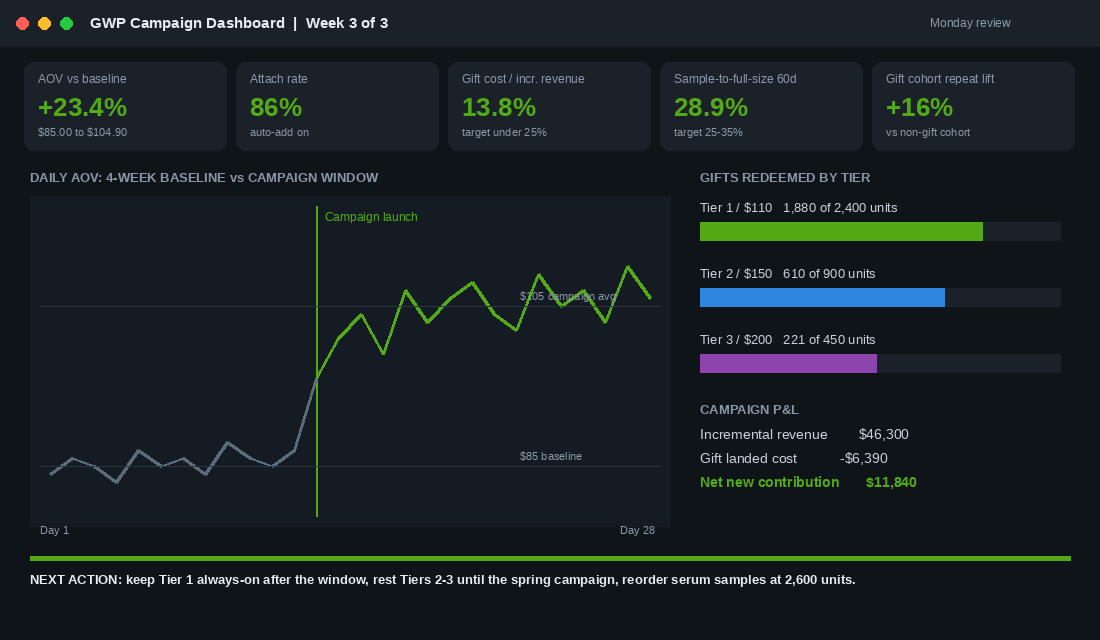
- AOV lift vs baseline. Compare campaign AOV to your trailing 4-week average. Target 15 to 30% during the window. If it is under 10%, your trigger is too low or the gift is too weak.
- Attach rate. The percentage of qualifying orders that include the gift. With auto-add running it should sit above 80%. Below that, the auto-add is broken or the gift is being removed, which is its own signal.
- Gift cost as a percentage of incremental revenue. Total landed cost of gifts shipped, divided by revenue above baseline. Keep it under 25%. Under 15% and you have room to run a richer gift.
- Sample-to-full-size conversion. Build a Klaviyo segment of gift recipients and watch what percentage buy the gifted product at full size within 60 days. The 25 to 35% band is the benchmark for a well-matched sample.
- Repeat rate of the gift cohort. Gift recipients should come back 10 to 20% more often than the same period’s non-gift customers. If they do not, the gift is not building the relationship and you should change what you give, not whether you give.
That last pair of numbers is where GWP separates itself from discounting permanently. A discount’s effect ends at the order. A good gift keeps paying through the next two orders, and you can see it in the cohort data.
The Four GWP Mistakes That Eat the Margin
- The junk gift. A flimsy pouch or a sachet nobody asked for signals what you think the relationship is worth. One bad gift produces negative reciprocity, which is worse than silence. If you cannot gift something genuinely good, gift nothing and fix your margins first.
- The trigger below AOV. Set the gift at $70 when your AOV is $85 and you are paying for behaviour that was already happening. The trigger lives above AOV, always.
- No cap, no end date. The gift sells out mid-campaign, the offer keeps promising it, and your support inbox fills with people asking where their gift is. Inventory cap, backup gift, hard end date. Every time.
- Stacking the gift on a sale. A gift on top of a discount on top of free shipping is three promotions fighting over one order’s margin. One lever per campaign. If you are discounting, discount. If you are gifting, gift. Your promotion architecture should make the choice explicit before the campaign brief is written.
The Compound Effect: What a Gift Engine Is Worth
Put the system together for a $2M brand doing 23,500 orders a year at an $85 AOV. You run an always-on threshold gift at $110 plus a tiered GWP campaign each quarter. A realistic outcome: 30% of orders stretch to qualify, lifting blended AOV around 9%, which is roughly $180,000 in additional annual revenue at close to full margin, because nobody touched the price list.
The gifts themselves, about 7,000 of them at $4.50 landed, cost around $32,000. So the direct trade is $32K of gift cost for $180K of high-margin revenue. Then the second payment arrives: if a quarter of those gift recipients convert on the sampled product within 60 days at an average $60 order, that is another $105,000 of revenue with zero acquisition cost attached. The discount lever cannot do any of that. It can only get cheaper.
GWP also plays well with the rest of your AOV stack. It slots alongside the bundling system rather than competing with it: bundles restructure what customers buy, the gift stretches how much they spend, and both leave your reference price alone.
Your 30-Day GWP Rollout
Print this and run it as written. By day 30 you will know exactly what a free gift is worth to your store.
- Week 1: Choose and cost the gift. Pick one gift type from Move 1, confirm landed cost is 3 to 6% of your target trigger, and check you can supply at least 6 weeks of projected volume plus a backup gift.
- Week 2: Build and test. Set the trigger at AOV plus 20 to 30%, build the offer (native Buy X Get Y or BOGOS), turn on auto-add and the progress bar, exclude sale items, cap one per order, and test the full journey on mobile.
- Week 3: Launch loud. Announcement bar, PDP callout, Klaviyo launch email to engaged segments, abandoned cart reminder block, and one styled photo of the gift everywhere the offer appears.
- Week 4: Measure and decide. Pull the five Monday numbers, kill or keep the gift, and lock the cadence: always-on for the signature gift, quarterly windows for the hero campaigns.
Eighty years after Estee Lauder packed the first free sample, the gift with purchase is still the cleanest trade in retail: pay cents on the perceived dollar, protect your price, and let generosity do the selling. Inside eCommerce Circle, promotion architecture like this is one of the core pillars we work on with every member. If you want a second opinion on your next campaign, let’s talk.