Here is the uncomfortable truth most Aussie founders are quietly ignoring. TikTok Shop is the fastest-growing sales channel in ecommerce history, it turned over roughly 66 billion US dollars globally in 2025 (almost double the 33.2 billion of the year before), and it still is not live for domestic selling in Australia. At TikTok Spotlight in Sydney, TikTok representatives confirmed there is no imminent local rollout. So most operators have filed it under “later” and moved on.
What’s in This Article
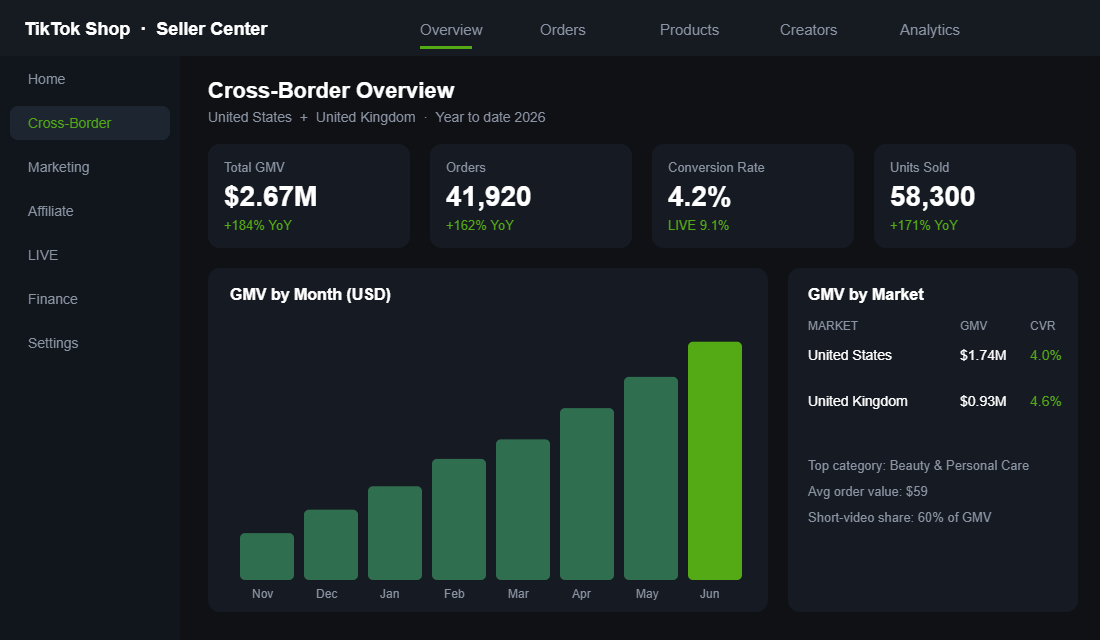
The smartest brands in this country did the opposite. They stopped waiting for a local button and started selling cross-border. HiSmile, the Gold Coast teeth-whitening brand, has already pulled more than 2.67 million US dollars in gross merchandise value through TikTok Shop in 2026, with sales uplifts of 1,194% in the US and a frankly silly 7,387% in the UK. EHPlabs, the Aussie supplement brand, did over 350,000 US dollars in a single Cyber Weekend.
That is the gap this playbook closes. You do not need to wait for TikTok Shop Australia. You need a deliberate cross-border system, and you need to be building the muscle now so that when the local channel does open, you are not starting from zero while your competitor is already doing seven figures. Let’s walk through exactly how the brands winning this game are set up.
The State of Play: Where TikTok Shop Actually Is
Let’s get the lay of the land right, because half the bad advice floating around is built on a misunderstanding of what is and is not available.
TikTok Shop is live for domestic selling in the US, the UK, Spain, Ireland, France, Italy, Germany, Mexico, Japan, Brazil, and across Southeast Asia. In June 2026 it added Poland, the Netherlands, Belgium and Austria. Australia is not on that list, and nothing TikTok has said publicly suggests it will be soon. The hold-up is infrastructure and fulfilment, not demand.
The scale is the part that should make you pay attention. TikTok Shop did 27.45 billion US dollars in global GMV in the first quarter of 2026 alone. There are more than 15 million sellers on the platform globally, and the US went from roughly 4,450 shops in mid-2023 to over 475,000. Short-form video drives close to 60% of everything sold there. This is not a fad channel you can safely ignore for two years.
So the question for an Australian operator is not “should I wait for the local launch.” It is “do the economics of selling cross-border into a live market stack up for my brand right now.” For a chunk of you, the honest answer is yes. For others it is “not yet, but start building the audience.” Both answers require you to understand the next part.
The Cross-Border Reality Check (Read This Before You Get Excited)
The cross-border opportunity is real, but the people selling you a dream on LinkedIn skip the boring bit: each TikTok Shop market is a completely separate, walled garden. You cannot sell into the US TikTok Shop from an Australian ABN. The platform requires a local legal entity, a local bank account (it pays out in local currency), and domestic warehousing that can hit pick-and-pack SLAs, usually under 48 hours.
Here is what that actually means in practice for the two markets most Aussie brands target:
- United States. You need a US business entity (an LLC is the standard route for non-residents) and an EIN. Stand-up cost for a comprehensive LLC plus banking typically runs 7,000 to 10,000 US dollars once you factor in registered agent, banking and tax setup.
- United Kingdom. You need a UK Limited company and immediate VAT registration as a non-established seller. There is no VAT-free threshold for overseas businesses, so you are charging and remitting VAT from your first sale.
- Fulfilment. Both markets effectively require local 3PL stock. TikTok rewards fast domestic delivery and penalises slow dispatch, so shipping singles from a Sydney warehouse will not cut it.
Then there are the platform economics. TikTok Shop charges a referral fee of around 6% on most categories (8% on fashion, 4% on food and beverage), plus payment processing of roughly 1% to 3.8%. Layer creator commissions of 10% to 30% and ad spend on top, and the all-in cost of selling can land anywhere between 35% and 55% of revenue depending on category. If your gross margin is thin, that maths does not work. If you sell a 60-to-80% margin beauty, supplement or accessories product, it absolutely can.
None of this is meant to scare you off. It is meant to make sure you go in with your eyes open, the same way we push every member to model contribution before they pour money into a channel. If the numbers clear, here is the five-move system.
Move 1: Build the Content Muscle Before You Build the Shop
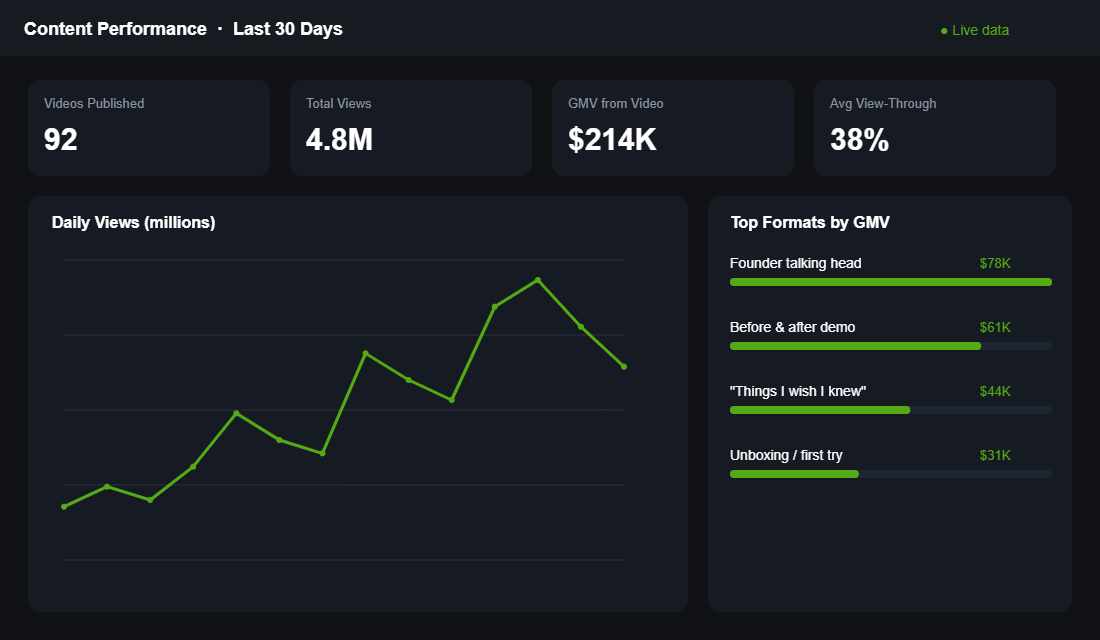
The single biggest mistake operators make is treating TikTok Shop like a new Shopify sales channel they can switch on. It is not. It is a content channel that happens to have a checkout attached. Roughly 60% of everything sold on TikTok Shop is driven by short-form video, and the brands winning are publishing daily, not weekly.
This is the move you can start today, with zero entity, zero VAT, zero warehouse. Build the organic audience and the content engine now so it is warm when the shop goes live. Specifically:
- Post 1 to 3 native videos a day. Not repurposed ads. Founder talking head, product demos, “things I wish I knew,” before-and-afters. The algorithm rewards volume and watch-through, not polish.
- Find your three repeatable formats. Most brands that scale lean on three or four content formats that consistently perform, then mass-produce variations rather than reinventing every clip.
- Treat creators as your production line, not a one-off. A content engine that can ship 30-plus assets a month is the actual asset here. We broke down how to build that team in our guide on when to build an in-house content engine.
Do this for 60 to 90 days before you ever flick the shop on. When you launch into a market with an existing audience and a library of proven hooks, your conversion curve looks completely different to a cold start.
Move 2: Pick One Beachhead Market and Commit
The brands that fail at cross-border try to launch the US and UK at once, split their focus, and do neither well. The brands that win pick one beachhead, prove the model, then expand. Choose deliberately.
- Go US if your product has broad appeal, you can absorb the higher entity cost, and your AOV is healthy. The US is the biggest prize and the most competitive. Average TikTok Shop order values sit around 25 to 75 US dollars depending on category, with US buyers averaging roughly 59 dollars per purchase.
- Go UK if you want a smaller, slightly less brutal market to learn in, you are comfortable with VAT from sale one, and your product suits British tastes. HiSmile’s UK uplift of 7,387% shows the headroom is enormous for the right product.
- Match the market to your category. Beauty and personal care is the number one category on TikTok Shop globally. Tech accessories, health and wellness, and fashion accessories also over-index. If you sit in one of those lanes, your odds are materially better.
Pick the market where your product, your margin and your content already have the best shot, and put 100% of your energy there for the first six months. One market done properly beats two done badly every single time.
Move 3: Stand Up the Entity and the Fulfilment Spine
This is the unglamorous move that actually unlocks the revenue. You cannot sell without local infrastructure, so treat it as a project with a deadline, not a someday task.
- Form the entity first. For the US, an LLC plus EIN. For the UK, a Limited company plus VAT registration. Use a specialist cross-border formation service rather than trying to DIY the banking, because a rejected bank application can cost you weeks.
- Line up a local 3PL. You need stock sitting in-country with a partner that can dispatch inside TikTok’s SLA. Send a sensible first shipment based on a conservative forecast, not your hopes.
- Sort tax and compliance early. US sales tax nexus and UK VAT are not optional. Build the remittance process before your first sale so you are not scrambling at quarter end.
Yes, this is a few thousand dollars and a few weeks of admin. But it is also the moat. Most of your Aussie competitors will look at this list, sigh, and go back to waiting for the local launch. That hesitation is your head start.
Move 4: Turn Creators and Affiliates Into Your Sales Force
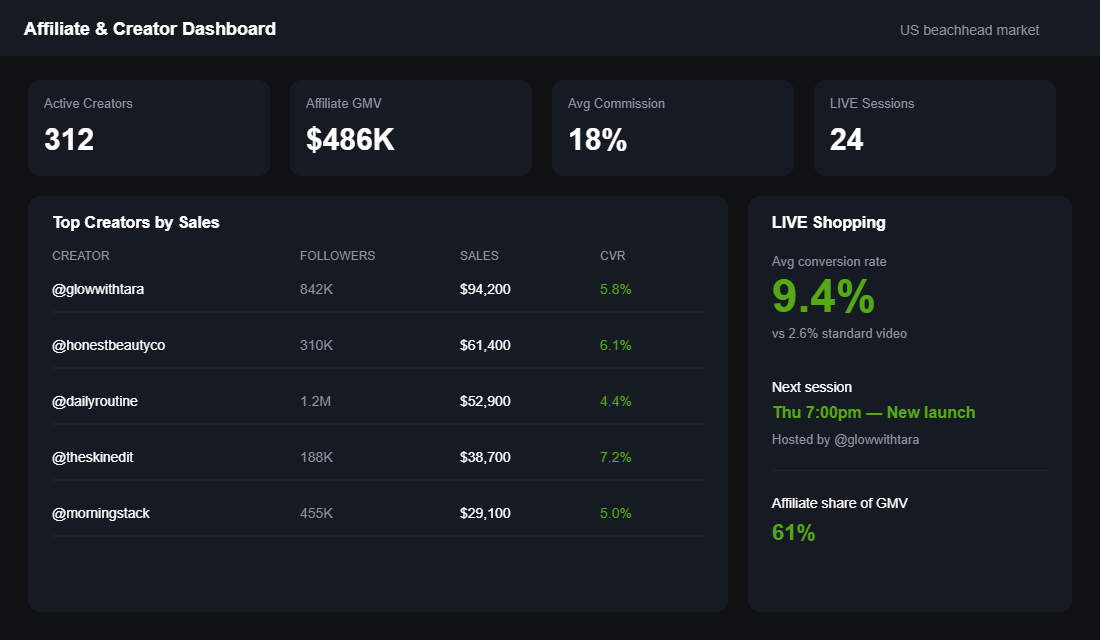
On TikTok Shop, creators are not a nice-to-have marketing layer. They are the distribution. The affiliate model is where the platform’s scale lives: a creator clips your product, tags it, and earns a commission on every sale. You are effectively renting a thousand micro-storefronts.
The numbers explain why this matters. Affiliate-driven content on TikTok Shop converts at 3% to 6%, well above the 1.5% to 3% you see from straight ads. And TikTok LIVE shopping sessions convert at 8% to 12%, which is three to eight times a standard product video. For context, a healthy traditional Shopify store converts somewhere around 2% to 3%. The channel mechanics are simply better at turning attention into orders.
- Seed aggressively. Send free product to dozens of relevant creators in your beachhead market and make it stupidly easy for them to join your affiliate program.
- Set commissions that creators actually chase. Category norms run 10% to 30%. Be generous early to build momentum, then optimise once you have data on which creators drive real sales.
- Run regular LIVE sessions. Even one scheduled LIVE a week, hosted by you or a creator partner, compounds. Scarcity and a live host are conversion machines.
Think of it as a commission-only sales team that scales without payroll. Your job is to recruit, equip and reward them, then get out of the way.
Move 5: Wire Up Tracking and the Shopify Channel
Once your entity exists in a live market, the Shopify side is the easy part. Shopify offers an official TikTok sales channel, and once your store is linked, product syncing keeps inventory, pricing and descriptions consistent across both platforms. The setup flow is roughly:
- Add the TikTok channel in Shopify. Install the TikTok app from the Shopify App Store and connect a TikTok for Business account.
- Verify the in-market entity. In the Shop Information section, click Verify and upload your local business documents. This is where the entity from Move 3 does its job. Without it, the channel will not approve you for that market.
- Sync your catalogue. Map the products you want to sell, confirm pricing in local currency, and push them live.
- Install the TikTok Pixel and Events API. This is non-negotiable. Without clean tracking you are flying blind on what content and which creators actually drive revenue.
That last point is where a lot of brands quietly bleed money. Attribution on social channels is messy, and if your pixel and server-side events are not set up properly, you will make bad spending decisions on bad data. We covered exactly how to close that gap in our conversion tracking playbook, and the same discipline you apply to Google Performance Max applies here. Measure properly or you are guessing.
The Three Mistakes That Kill Cross-Border Launches
We have watched enough brands attempt this to spot the patterns that sink them. Avoid these three and you are ahead of most.
- Treating it like a paid ads channel. Founders who come from a Meta and Google background try to buy their way in with Shop Ads from day one. TikTok Shop rewards organic content and creator volume first. Ads amplify what is already working, they do not manufacture demand from a cold catalogue. Earn the organic traction, then pour fuel on it.
- Under-stocking the beachhead. Nothing kills momentum like a viral video pointing at an out-of-stock listing. When a clip pops, you can sell a month of inventory in 48 hours. Brands that win forecast conservatively on the entity but stock aggressively on the hero SKU, because a stockout during a spike is lost revenue you never get back and a ranking hit on top.
- Ignoring the unit economics until it is too late. The all-in cost of selling can hit 55% of revenue. If you have not modelled creator commissions, the 6% referral fee, payment processing, 3PL and returns before launch, you can do six figures of GMV and still lose money. Build the contribution model first, the same way you would for any new channel.
None of these are exotic. They are the same discipline failures that hurt brands on every channel: confusing activity with traction, running out of stock, and not knowing your numbers. TikTok Shop just punishes them faster because the velocity is higher.
The Compound Effect: Why Starting Now Beats Waiting
Look at how these five moves stack. The content muscle from Move 1 feeds the creator army in Move 4. The beachhead focus from Move 2 makes the entity investment in Move 3 pay back faster. The tracking in Move 5 tells you which content and creators to double down on, which makes Move 1 sharper next quarter. It is a flywheel, not a checklist.
Now picture two Aussie brands in the same category. One waits for TikTok Shop Australia to launch and starts cold the day it does. The other spends the next 12 months building an audience, a content library, a proven creator network and a live cross-border operation in the US. When the local channel finally opens, brand two flicks a switch and ports a working system into a brand new market. Brand one is making its first video.
That is the real reason the HiSmiles and EHPlabs of the world are not waiting. They understand that the audience and the content engine are the durable assets. The shop is just where you collect the money. Around 20 Australian brands are already running this cross-border play. The window where it is still a competitive edge rather than table stakes is closing.
Your TikTok Shop Readiness Checklist
Before you commit a dollar, run your brand through this. If you can tick most of it, cross-border is worth a serious look. If you cannot, start with Move 1 and revisit in a quarter.
- Margin. Is your gross margin above 60%, so the channel’s 35% to 55% all-in cost still leaves contribution?
- Category fit. Are you in beauty, supplements, wellness, tech accessories or fashion accessories, the lanes that over-index on TikTok Shop?
- Content capacity. Can you ship at least 30 native videos a month, consistently?
- Beachhead chosen. Have you picked one market (US or UK) and committed to it for six months?
- Capital. Can you fund the entity, first 3PL shipment and seeding budget (realistically 15,000 to 25,000 AUD to do it properly) without straining cash flow?
- Tracking. Is your Shopify pixel and server-side event setup actually clean today?
Most brands will land in the middle: strong on content and category, not yet ready on entity and capital. That is fine. It tells you exactly where to start. Build the audience now, bank the capital, and be ready to move fast.
Inside eCommerce Circle, channel strategy like this is one of the core pillars we work on with every member, because the brands that win the next decade are the ones placing the right bets early. If you want a second opinion on whether TikTok Shop cross-border stacks up for your numbers, let’s talk.
TikTok Shop Australia: The Questions Everyone Is Actually Asking
These are the questions Aussie founders type into Google every week about this channel. Here are the straight answers, current as of August 2026.
Is TikTok Shop available in Australia?
No. TikTok Shop is not available in Australia. Australian shoppers cannot check out inside the app, and Australian businesses cannot open a domestic TikTok Shop against an Australian ABN. TikTok Shop is live for domestic selling in the United States, the United Kingdom, Ireland, France, Germany, Spain, Italy, the Netherlands, Belgium, Austria, Poland, Mexico, Japan, Brazil and across Southeast Asia. Australia is not on that list.
Does Australia have TikTok Shop?
Not as a local marketplace. What Australia has is TikTok the platform, without the shopping layer sitting underneath it. You can run TikTok content and TikTok ads here and send that traffic to your own Shopify store. What you cannot do is sell through TikTok Shop itself as an Australian seller. The workaround that does exist is the cross-border route covered in the five moves above.
When is the TikTok Shop Australia launch date?
There is no announced launch date. TikTok has not published one, and senior TikTok ANZ leadership has said publicly they are not aware of plans to bring TikTok Shop to this market. Treat any specific date you see circulating on social media as speculation. Plan your next twelve months on the assumption that it is not coming, and treat a local launch as upside rather than a strategy.
Does TikTok Shop work in Australia?
Partly, and the distinction matters. What works here today: organic TikTok content, TikTok Ads, link in bio, and product links that push a shopper to your own store to buy. What does not work here today: in-app checkout, the TikTok Shop Seller Centre for an Australian entity, the affiliate and creator commission programme, and TikTok Shop live selling. If someone is telling you they are running a TikTok Shop from Australia, they have set up an entity offshore.
Can Australians buy from TikTok Shop?
Not inside the app. An Australian shopper scrolling TikTok will not see the orange shopping cart and cannot complete a purchase through TikTok Shop checkout. Some overseas brands ship to Australia through their own websites, so the product may still be buyable, just not through TikTok. This is exactly why the local demand data is misleading. The interest is here. The infrastructure is not.
Can an Australian business sell on TikTok Shop?
Yes, but not as an Australian business. Each TikTok Shop market is a walled garden requiring a local legal entity, a local bank account that can receive payouts in local currency, and domestic warehousing that can hit pick and pack SLAs under 48 hours. For the United States that means a US entity and an EIN, typically 7,000 to 10,000 US dollars to stand up properly once you include registered agent, banking and tax setup. For the United Kingdom it means a UK Limited company and VAT registration from your very first sale, because there is no VAT free threshold for overseas sellers. Move 3 above walks through both.
Is TikTok Shop coming to Australia in 2026?
Nothing has been announced for 2026. The hold up is not demand, it is fulfilment and infrastructure. TikTok Shop leans hard on fast domestic delivery, and the local 3PL and returns network has to be in place before a launch makes sense for the platform. That is a build, not a switch, which is why nobody at TikTok is putting a date on it.
What should Australian brands do while they wait?
Build the audience now and decide on the entity later. The content muscle takes six to twelve months to develop and it is the part you cannot buy on day one of a launch. Brands that arrive with an existing audience and a proven content engine will out-earn brands that arrive with a shop and no reach. Work through the readiness checklist above, score yourself honestly on content, category, capital and tracking, and start with whichever one is weakest.
If you want a second opinion on whether cross-border TikTok Shop stacks up against your actual numbers, or whether your effort is better spent elsewhere this quarter, come and have a chat with us.