Your Meta account is spending money every hour on people who have no idea they have the problem your product solves. Your landing page then greets them with a hero banner that says “Shop the new range”. They leave in four seconds, your cost per purchase creeps up, and the report you look at on Monday tells you the creative is fatigued.
What’s in This Article
The creative is usually fine. The problem is that the message and the shopper are at different stages of the same journey. Australians spent $82.6 billion online in 2025, up 14% year on year, and that now accounts for 24% of all retail spending according to the Australia Post eCommerce Report 2026. There is no shortage of demand. There is a shortage of brands who bother to work out how much a shopper already knows before they write the headline.
Here is the number that should bother you. Meta cold traffic converts somewhere between 0.5% and 1.5% on most stores, while direct and branded traffic converts at 3% to 5%. That is a three to ten times gap, and most founders read it as “cold traffic is just worse”. It is not worse. It is earlier. Treating a stranger like a returning customer is the single most expensive mistake in Australian direct to consumer right now, especially with acquisition costs up 40% to 60% across the past two years.
Eugene Schwartz wrote the fix in 1966 in Breakthrough Advertising, and it has aged better than almost anything published about advertising since. He argued that every prospect sits at one of five levels of awareness, and the job of the marketer is not to be clever. It is to meet the prospect exactly where they already are. Sixty years later it is still the most useful diagnostic you can run on a Shopify store.
The five stages, and what each one actually wants
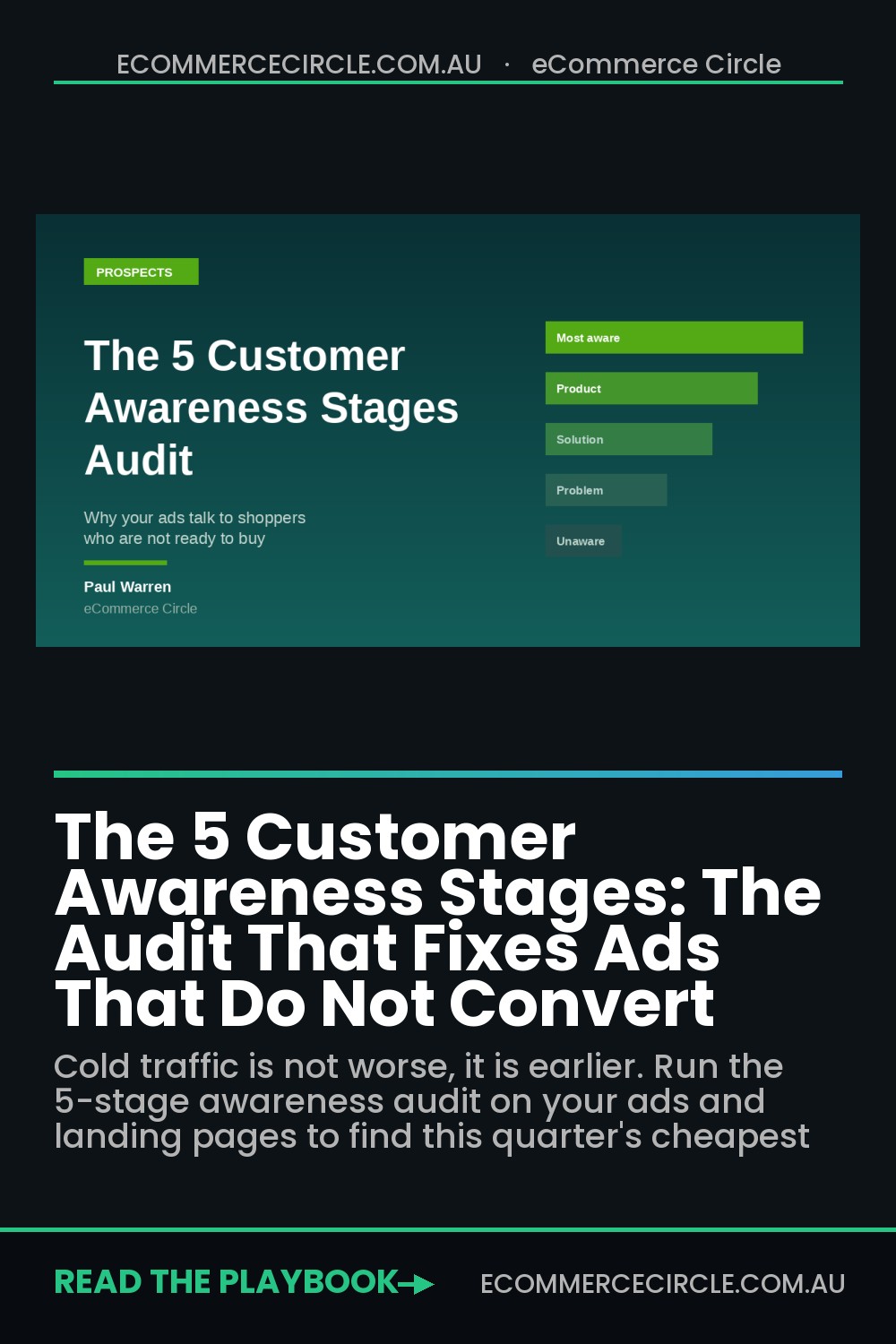
Before the tactics, get the ladder straight in your head. Each rung describes what the shopper knows, and each one demands a completely different opening line.
- Stage 1, Unaware. They do not know they have a problem. They are not searching for anything. You are interrupting them.
- Stage 2, Problem aware. They feel the pain but do not know a category of solution exists. “My back hurts every morning” and nothing more.
- Stage 3, Solution aware. They know the category solves it. They are comparing types of solution, not brands. “Latex or memory foam?”
- Stage 4, Product aware. They know your product exists. They are comparing you to two or three rivals and looking for reasons to trust you.
- Stage 5, Most aware. They want it. They are waiting for a reason to act now. Price, bonus, deadline, guarantee.
Every headline, ad hook, email subject line and landing page on your store speaks to exactly one of these. Most stores speak to stage 4 and stage 5 only, then buy traffic that is sitting at stage 1 and stage 2. That mismatch is the leak.
Stage 1: Unaware, and why you are quietly funding it
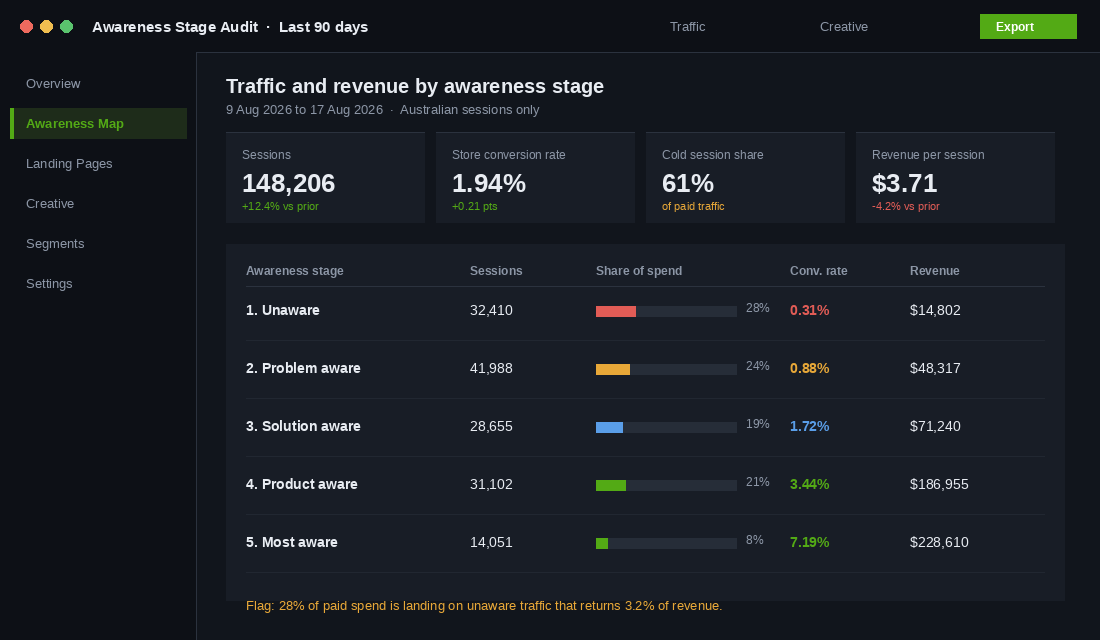
Unaware traffic is the most expensive audience you can buy and the one broad targeting hands you by default. These people are scrolling. They have no problem in mind, no category in mind, and no intention of spending money in the next ten minutes.
Almost no Australian store under roughly $2m a year should be deliberately buying stage 1. The economics do not work. You need to pay for the education, then pay again for the retargeting, then pay a third time to close. Brands that win at stage 1 are typically creating a category, and they fund it with content rather than direct response ads.
Modibodi is a good Australian example of stage 1 done properly. When they launched, most shoppers were not sitting at home thinking “I need leak-proof underwear”. They did not know the category existed. So the brand spent years on education, media coverage and frank conversation rather than discount codes, and built the category around themselves as it grew.
What to do this week if you are not a category creator:
- Cap your stage 1 spend. If broad prospecting is more than 25% of paid budget and it is not producing first purchases at an acceptable payback, cut it back before you touch the creative.
- Do not send stage 1 traffic to a product page. If you must run it, send it to a piece of content that names a problem, not a page that names a price.
- Judge it on assisted revenue, not last click. Stage 1 rarely closes. If you cannot see its downstream effect, you cannot justify it.
Stage 2: Problem aware, where most Aussie brands should be living
This is the richest and most neglected stage in Australian ecommerce. The shopper feels something. Their kid keeps getting cold on the school run. Their supplements taste like chalk. Their skin flakes every winter and they have tried three things that did not work.
They are not searching for your brand. They are searching for the problem. If your entire site is product pages and collection pages, you are invisible to them, and you are handing that traffic to a competitor with a blog or to a marketplace.
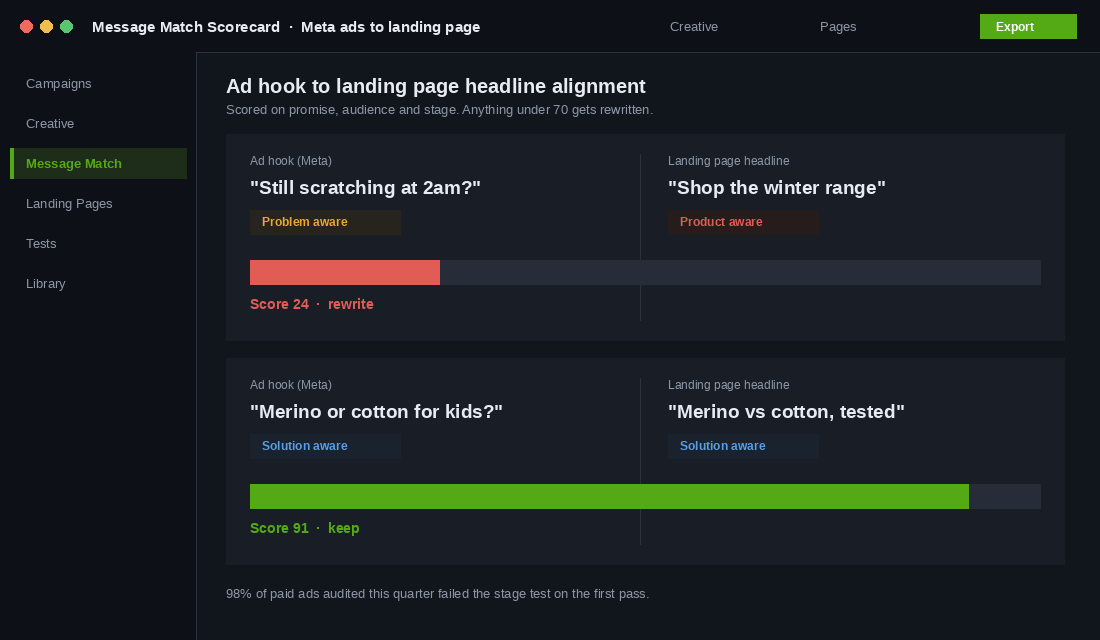
The move here is to open on the problem in the first three seconds and never mention the product until the shopper has nodded twice. In ad creative, that means a hook like “Still scratching at 2am?” rather than “20% off the winter range”. On site, it means a page whose headline repeats the problem back in the shopper’s own words.
The words matter more than the design. If you have never sat down and listed the exact language customers use to describe their pain, start with our founder-led customer interview script. Nine questions, run on ten recent buyers, will give you better stage 2 copy than any brief you could write from a desk.
Three practical assets that serve stage 2 well:
- A problem page. One page per major pain, written in plain language, ending with a soft product introduction. This is the page you send problem-led ads to.
- A diagnostic quiz. A short quiz that helps someone name their own problem, then routes them to the right product, moves them from stage 2 to stage 4 in about 90 seconds.
- A comparison of approaches. Not brands. Approaches. “Three ways people deal with X, and what each actually costs.”
Who Gives A Crap is the Australian brand that has made a career of stage 2 messaging. They rarely open with the specification of the toilet paper. They open with a problem that most people had not consciously connected to the product, then let the humour carry the education. The product argument arrives late, after the shopper already agrees with the premise.
Stage 3: Solution aware, the comparison nobody builds a page for
At stage 3 the shopper has accepted that a category of product fixes their problem. They are now working out which type. Merino or synthetic. Capsule or powder. Foam or latex. They are not yet comparing brands, which is exactly why this stage is so cheap to win.
Search demand at stage 3 is enormous and commercially warm. Organic search converts at roughly 2.7% to 2.8% across ecommerce, which is close to double what cold paid social manages, and the queries are phrased as comparisons. Yet most Shopify stores have zero pages that answer a comparison question honestly.
Bellroy has built an entire conversion engine at this stage. Their category pages do not open by selling a specific wallet. They open by helping you decide what kind of carry you need, with visual comparisons of bulk and capacity. By the time you reach a product, you have already made the type decision, and the product is simply the obvious answer to the choice you just made.
Build these three and you will own stage 3 in your category:
- An honest versus page. “Merino vs cotton base layers” with a table of cost, warmth, care and lifespan. Include where your option is the wrong choice. Shoppers trust the brand that admits a limit.
- A buying guide per collection. Sits above the product grid on the collection page. Two hundred words that answer “how do I choose” before the shopper has to guess.
- A cost-over-time calculator. Especially powerful for anything consumable or premium priced. Shifts the conversation from sticker price to cost per use.
One warning. Stage 3 content only pays if it links properly into stage 4. A comparison article that ends without a clear route to the right product is a very expensive brochure.
Stage 4: Product aware, stop selling and start removing risk
The stage 4 shopper knows who you are. They have your product page open in one tab and a competitor in another. Nothing you say about how good the product is will move them, because the competitor is saying the same thing.
What moves them is the removal of doubt. The average Australian household now buys from 16 different brands a year with an average basket of $96. They are not loyal to you yet, and they have been burned before by a size that did not fit or a delivery that never arrived.
At this stage your job is to answer the objection before it forms. If you have not mapped what those objections are, the objection mapping playbook walks through pulling them out of reviews, support tickets and chat logs.
The stage 4 checklist for any product page:
- Specific proof, not volume of proof. One review that says “I am 178cm and the medium fits perfectly” beats forty reviews saying “love it”.
- The comparison you are losing. Name the alternative and explain the difference in one honest sentence. If you do not, the shopper opens a new tab to find out.
- Delivery clarity in Australia. Three in four shoppers say a good delivery experience makes them shop online more. Show the metro and regional estimate on the page, not at checkout.
- Risk reversal that means something. “Free returns for 30 days” is table stakes. “Wrong size? We post the replacement before you send the first one back” is a reason to buy today.
Stage 5: Most aware, where the offer is the entire message
Your most aware audience is your email list, your SMS list, your repeat customers and anyone typing your brand name into Google. Email converts at roughly 4.2% and branded search converts at three to five times your non-branded traffic. This is the cheapest revenue in the business and the easiest to waste.
The classic error is treating this group like strangers. They do not need the founder story again. They do not need the hero video. They need one clear reason to act now, and they need the friction between wanting and buying reduced to almost nothing.
Three things that lift stage 5 revenue without any new traffic:
- A branded search landing experience. If someone types your name, do not drop them on a generic homepage carousel. Put the bestseller, the guarantee and the delivery promise above the fold.
- Deadlines that are real. Stock counts and end dates work until a shopper catches you resetting them. One caught lie costs more than the promotion made.
- Reorder shortcuts. For consumables, a one-tap reorder link in email will outperform any creative test you run this quarter.
The Awareness Stage Audit: a two-hour job you can run this week
This is the framework. Block out two hours, open a spreadsheet, and work through it in order. Every column is something you can fill in from data you already have.
Step 1. Tag every landing page. List your top 20 landing pages by sessions. Assign each one a single stage from 1 to 5. Not two. If a page cannot be assigned to one stage, that is your finding: the page is trying to talk to everyone and is converting nobody.
Step 2. Tag every live ad. Do the same for your top 15 ads by spend, judging only the first three seconds and the headline. Be honest. “Australia’s favourite X” is a stage 4 claim, not a stage 2 hook.
Step 3. Score the match. For every ad, compare its stage to the stage of the page it points at. Same stage scores 100. One rung apart scores 50. Two or more rungs apart scores 0. Anything under 70 goes on the rewrite list.
Step 4. Add spend and conversion rate. Now put dollars against each row. This is where the argument ends. You will almost always find a meaningful share of paid budget landing on stage mismatches that produce a tiny share of revenue.
Step 5. Fix the headline before you touch anything else. The cheapest fix in this whole audit is rewriting the landing page headline so it repeats the promise made in the ad. KlientBoost documented a 66% conversion lift from aligning ad copy with the landing page headline alone, with no change to offer, targeting or creative. A widely cited Disruptive Advertising case study published on Moz recorded a 212% lift in conversion rate and a 69% drop in cost per conversion from the same discipline.
Worth knowing before you start: roughly 98% of paid ads audited fail message match with their landing pages. If your first pass looks ugly, you are normal. It also means the fix is available to almost everyone reading this.
Build the awareness report in GA4 so you can see it every week
The audit is a one-off. To keep it honest you want a report that refreshes itself. GA4 will do this for free with a custom dimension, and the setup takes about 20 minutes.
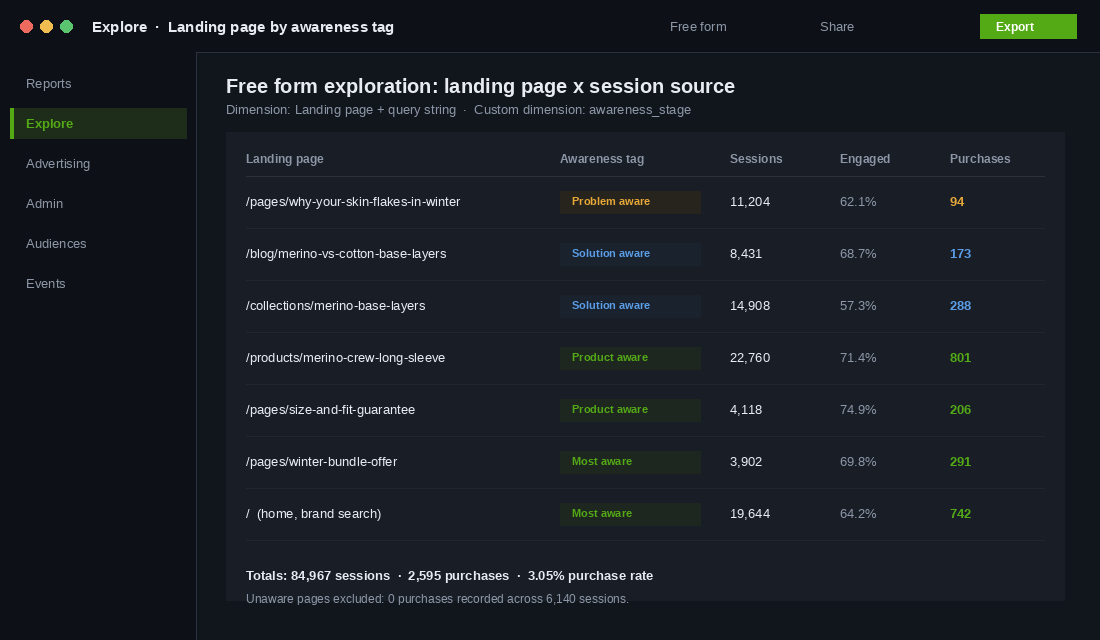
- Create the dimension. In GA4 go to Admin, then Custom definitions, then Create custom dimension. Name it awareness_stage, set scope to Event, and set the event parameter to awareness_stage.
- Send the value on page view. In Google Tag Manager, add a Data Layer variable called awareness_stage, then set it on each template. Simplest method is a lookup table keyed on page path: problem pages return “2 problem”, comparison pages return “3 solution”, product pages return “4 product”, offer and account pages return “5 most”.
- Pass it into the GA4 tag. On your GA4 configuration tag, add an event parameter named awareness_stage with the value set to that variable. Publish the container.
- Build the exploration. In GA4 open Explore, choose Free form, drag in Landing page and your new awareness_stage dimension as rows, and Sessions, Engaged sessions and Purchases as values. Save it as “Awareness stage report”.
- Add spend context. Export the exploration weekly and paste your Meta and Google spend beside each stage. Two minutes a week gives you the one view that keeps budget honest.
If you run Klaviyo, mirror the same logic there. A segment for people who have opened but never purchased is a stage 4 audience and should receive proof and risk reversal. A segment of repeat buyers is stage 5 and should receive the offer with no preamble. Same framework, different channel.
Why the stages compound once they line up
Here is the part that makes this worth two hours of your Tuesday. The five stages are not five separate tactics. They are one conveyor belt, and the value shows up in the handoffs rather than the individual pages.
When a stage 2 problem page routes cleanly into a stage 3 comparison, and that comparison routes into a stage 4 product page carrying the same promise, and that product page collects an email address that feeds a stage 5 sequence, three things happen at once. Your cold traffic stops being wasted, because it now has somewhere sensible to land. Your organic search picks up comparison queries you were never eligible for. And your email list grows with people who already understand the category, which is why they convert at multiples of cold traffic.
The compounding is real. A store doing 1.9% conversion overall is usually not a store with one broken page. It is a store where every stage is leaking 20% into the next one. Fix the handoffs and the blended number moves without a single new visitor. That is also why landing page architecture matters more than creative volume once you are past the first million.
With acquisition costs where they are, the brands that will still be here in three years are not the ones with the best hooks. They are the ones who worked out which shopper they were talking to before they opened their mouth.
Your next move
Pick your three highest-spend ads. Open the pages they point to. Write the stage number of each on a piece of paper. If the numbers do not match, you have found this quarter’s cheapest win, and it costs you a headline rewrite rather than a media budget.
Inside eCommerce Circle, awareness mapping is one of the core pillars we work through with every member, because it sits underneath ads, email and the site all at once. If you want a second opinion on yours, let’s talk.