Right now, somewhere in Sydney or Melbourne, an editor is building a Christmas gift guide. She has a spreadsheet of 40 slots, a folder of product shots, and a deadline in three weeks. Your product is not in her folder, and it will not be, because you are waiting until November to “do some Christmas PR”.
What’s in This Article
That is how most Aussie Shopify founders treat gift guides. They see a competitor in a “Best Gifts Under $100” roundup on a big lifestyle site, feel a pang, and fire off a cold email in the second week of December. By then the guide has been live for a month and the editor is already planning January.
The brands that show up in gift guides year after year do it differently. They treat gift guides as a system, not a lucky break. They pick the products an editor can say yes to, get affiliate-ready before they pitch, pitch inside the window, build their own guide that ranks for gift searches, then squeeze every placement for months. One good placement in a high-traffic guide can send more first-time buyers in a week than a month of prospecting ads, and it keeps working because the page stays live and keeps ranking.
This is the five-step version we run with founders at the end of September. Black Friday lands on 27 November 2026, and the online gift guide window is open now.
Why Gift Guides Matter More Every Christmas
Gifting is still the biggest single job your store does in Q4. The Australian Retailers Association and Roy Morgan forecast Aussies would spend $12 billion on Christmas gifts in 2025, an average of $757 per gift buyer, with 29 percent of shoppers saying they were buying earlier than the year before (ARA and Roy Morgan).
The problem for gift buyers is not money. It is ideas. McKinsey found 47 percent of shoppers need help working out what to buy (McKinsey), and Google’s own research shows holiday shopping starts well before Black Friday, with shoppers around 29 percent of the way through their list by the end of October (Think with Google). Gift guides exist to solve exactly that problem, which is why they get so much traffic.
And the guides themselves have changed. They are no longer a favour an editor does for a brand she likes. They are a revenue line. The ABC reported that Impact, which handles over half of Australia’s affiliate marketing by revenue, saw affiliate ad spend jump 18 percent on Cyber Monday 2024, and that typical commissions had risen from around 5 to 7 percent to 15 to 20 percent (ABC News). Some brands even lifted commissions from 5 to 15 percent for the BFCM weekend.
Translation: the guide your customers read on a big news or lifestyle site is very often built by a commerce team with a revenue target. If you are not set up to pay them, you are much harder to include. That is the single biggest thing most founders miss.
Meanwhile, Australians spent a record $82.6 billion online in 2025 and the average online transaction fell to $96 (Australia Post eCommerce Report). Shoppers are spreading spend across more brands. A trusted list that says “this one, for your dad, under $100” is exactly how a new brand gets picked.
Step 1: Build the Gift-Ready Shortlist (Five Products an Editor Can Say Yes To)
Editors do not feature brands. They feature products. Your pitch has to hand them something that drops straight into a slot like “for the coffee lover” or “under $50”, so before you write a single email, pick your shortlist.
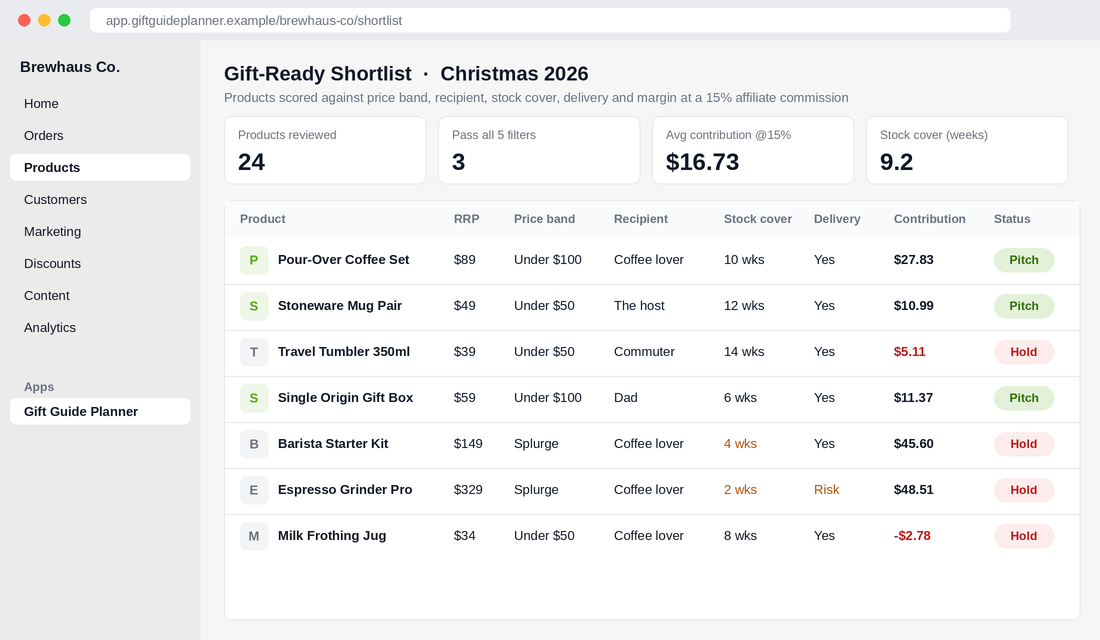
Pick three to five products using these filters:
- Price band fit. Most Aussie guides are organised by price: under $30, under $50, under $100 and “splurge”. Make sure you have at least one product sitting just under each threshold you want to target. $49 beats $52 every time.
- Recipient clarity. Could an editor put it under “for her”, “for dad”, “for the host” or “for the kids” without explaining it? If the product needs a paragraph of context, it is a harder yes.
- Stock depth. A placement that sells out in two days and then sends traffic to a “sold out” page for six weeks burns the relationship. Only pitch products where you have cover through Christmas, ideally 1.5 to 2 times your normal December run rate.
- Delivery confidence. If it ships from a 3PL in Melbourne and you can guarantee delivery before your Christmas cut-off, say so. Editors get complaints when readers miss Christmas.
- Margin to fund commission. You are about to pay 10 to 20 percent to the publisher. Products with thin margins go last on the list.
Then build the asset pack for each product: one clean cut-out on white, one lifestyle shot, a 40-word description written like the editor would write it, RRP in AUD, the exact product URL and your affiliate link. Put it all in a single shared folder with a short link. This alone puts you ahead of most brands that pitch, because the editor can build your slot in two minutes.
Who Gives A Crap is a useful example of thinking in gift-ready products. Toilet paper is not an obvious present, yet the brand’s limited-edition, gift-wrapped holiday rolls give editors a novelty gift with a clear price and a clear story, which is exactly the kind of product that fits a roundup slot.
If you have not yet mapped who actually buys from you in December, start with our Gift Buyer Playbook. The shortlist gets far sharper once you know which products gift buyers already choose.
Step 2: Get Affiliate-Ready Before You Pitch
This is the step that separates brands who get featured from brands who get a polite “we’ll keep you in mind”. Many commerce editors check one thing first: can we earn on this link? If you are not on the affiliate network they use, the answer is no, and you never hear why.
In Australia, the two networks you will hit most with publishers are Commission Factory, an Australian-founded network that bills itself as the Asia-Pacific region’s largest, and Impact. Many international publishers with Aussie editions also work through Skimlinks, which auto-monetises links to merchants on partner networks. If you are small and mainly working with creators, Shopify Collabs is a free starting point, but it will not get you into big publisher guides on its own.
Here is how to set up Commission Factory for a Shopify store in about a week:
- Apply as an advertiser on the Commission Factory site and book the onboarding call. Ask directly which publishers in your category run gift guides.
- Install the tracking. Commission Factory has a Shopify integration. Install it, place a test order through a test affiliate link, and confirm the sale shows in the dashboard before you tell anyone you are live.
- Set your base commission. For most Aussie DTC brands, 8 to 12 percent is a sensible base. Set a 30-day cookie window so a reader who comes back later still counts.
- Create a seasonal rate. Build a higher Q4 rate, say 15 percent from 1 November to 24 December, and tell the network team so they can promote you to publishers.
- Load your product feed so publishers can pull images, prices and links without asking you.
Now run the maths before you agree to any rate. Take a $89 product with a 62 percent gross margin, so $55.18 of gross profit. Take off roughly $12 for pick, pack and shipping and $2 for payment fees, leaving $41.18. A 15 percent commission is $13.35, leaving you $27.83 in contribution on a brand-new customer. Compare that with what Meta costs you to acquire the same customer in November, when CPMs climb. For most brands the affiliate sale is cheaper, and you only pay when it works.
We cover program structure, commission tiers and fraud controls in depth in our Affiliate Program Playbook. For gift guides specifically, the rule is simple: be live and tested before the first pitch goes out.
Step 3: Build the Hit List and Pitch Inside the Window
Timing kills more gift guide pitches than bad products do. Long-lead print (glossy magazines) closed its Christmas issues back in July and August. That ship has sailed for 2026. What is open right now is the part that matters most for a Shopify brand: online guides, newsletters and creators.
Here is the rough Aussie calendar we work to:
- Now to mid-October: big online lifestyle and news sites build their main Christmas guides. Pitch these first.
- Mid-October to mid-November: niche guides (for dads, for pets, for coffee lovers, for new mums), plus BFCM deal roundups. Pitch your price-band and recipient angles here.
- November to early December: newsletters, podcasts, TikTok and Instagram creators, and “last-minute gifts that still arrive in time” lists. Your delivery cut-off is the hook.
Build a hit list of 30 to 50 targets. For each one, find the actual person who writes the guide, not the generic editor inbox. Search the site for last year’s guide and note the byline. Keep a free SourceBottle account open too, because journalists post gift guide call-outs there every spring and they want product within days.
Keep the pitch short enough to read on a phone:
- Subject: Gift idea for your “under $100 for him” guide: [Product], $89
- Line 1: One sentence on what it is and who it is for.
- Line 2: One reason it is a good gift (made in Australia, 4.8 stars from 2,000 reviews, arrives gift-boxed).
- Line 3: “We’re on Commission Factory, product feed and hi-res images here: [link]. Happy to send a sample.”
- Sign-off: Your name, mobile, and your Christmas delivery cut-off date.
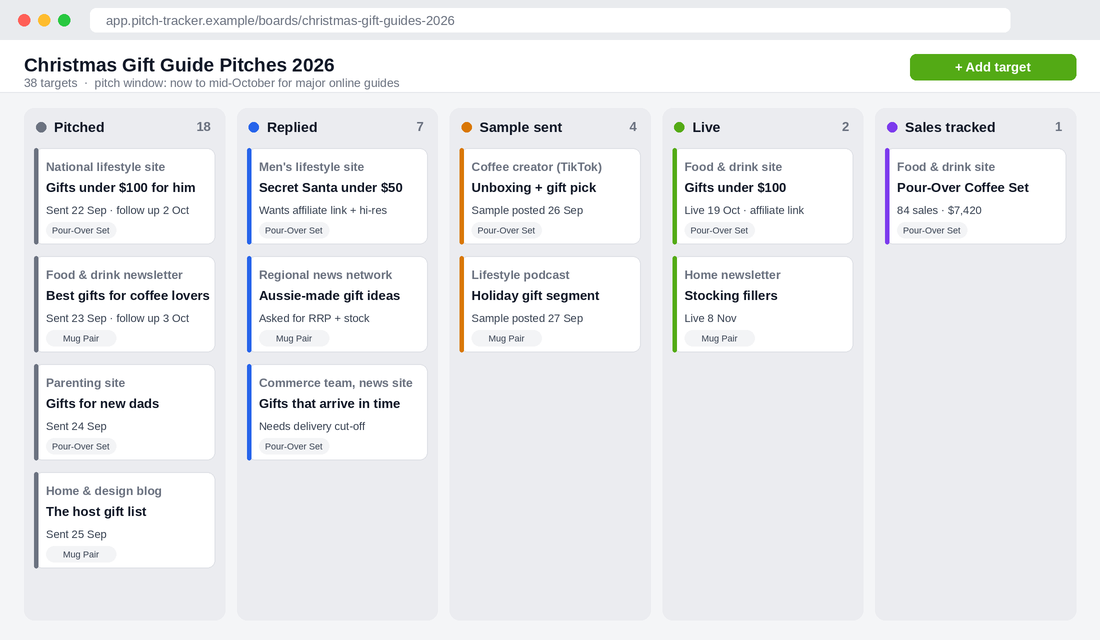
Follow up once after 7 to 10 days, and a second time at most. More than that and you are the brand she remembers for the wrong reason. Track every pitch in a simple board with columns for Pitched, Replied, Sample Sent, Live and Sales. Our PR Playbook has more on building a hit list without an agency, and the same rules apply here.
One more thing on samples. Offer them, but do not send unsolicited parcels to every editor on your list. Send to the ones who say yes or who have featured your category before. That keeps the cost to a few hundred dollars instead of a few thousand.
Step 4: Build Your Own Gift Guide That Ranks and Converts
Getting into other people’s guides borrows their traffic. Building your own lets you catch the shoppers who are searching “gift ideas for her Australia” or “gifts for coffee lovers” directly, and gives every placement, email and ad somewhere better to land than your homepage.
Two Aussie brands show the pattern well. Bed Threads runs a dedicated gift guide page, backs it with a journal post, and publishes pieces like the team’s own Christmas wishlist, then reuses the same format for Father’s Day with its own gift guide collection. Koala Living keeps its Christmas gift guide on a plain, evergreen /christmas URL rather than a year-stamped one, so every link it earns keeps pointing to a live page next year.
Here is how to build yours in Shopify in an afternoon:
- Use one evergreen URL. Create a page or collection at /gift-guide or /christmas-gifts. Do not put the year in the URL. Update the content each year and keep the links.
- Organise by how gift buyers think. Split the page into recipient sections (for her, for him, for kids, for the host) and price bands (under $50, under $100, splurge). Build each as its own Shopify collection using product tags, then feature them on the guide page.
- Add filters. Install the free Shopify Search & Discovery app and add price and “recipient” filters to the gift collections so shoppers can narrow down in one tap.
- Write for search. Use a title tag like “Christmas Gift Ideas 2026 | Gifts for Her, Him and Kids | [Brand]”, and give each section 60 to 100 words of genuinely useful copy. Search Console will show you which gift queries you already get impressions for.
- Show the delivery promise. Put your Christmas order cut-off at the top of the page and in the cart. Our Christmas Cut-Off Playbook walks through setting those dates by state.
- Add gift services where they matter. Gift wrap, gift notes and digital gift cards belong right on this page, not buried in the cart.
Link to the guide from your main navigation from 1 November, from your homepage hero, and from every email in your Christmas flow. It should be the most-linked page on your site in December.
Step 5: Squeeze Every Placement for Months
Most brands treat a placement as the finish line. It is the start. A single feature in a respected guide is social proof you can use in every channel until February.
Once a placement goes live:
- Add an “As featured in” strip to the product page and your gift guide page, with the publication’s name and a link to the article.
- Email your list. “As seen in [Publication]’s best gifts under $100” is one of the strongest subject lines you will send in November because it borrows authority your own brand cannot.
- Turn it into ad creative. A static of the product with a short quote from the guide, run to warm audiences and lookalikes. Only quote what the publication actually wrote, word for word.
- Share it with the editor. Post it, tag the publication, and thank the writer. Editors remember brands that send them traffic.
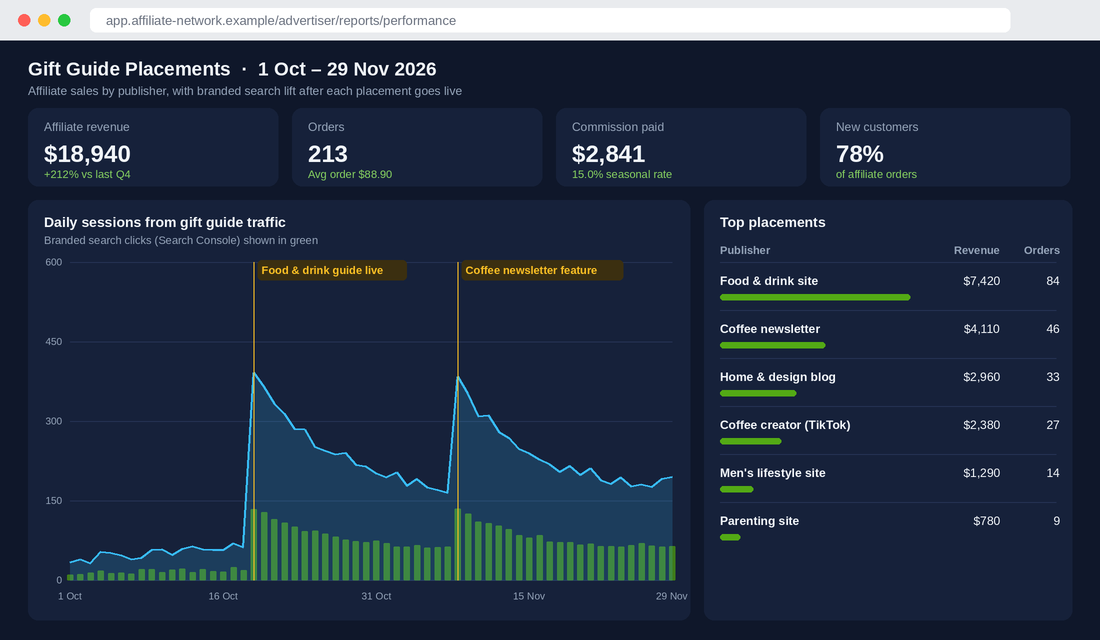
- Track it properly. Your affiliate network gives you last-click sales. Also watch branded search in Search Console and direct traffic in the days after a placement goes live. That halo is usually bigger than the tracked sales.
Stay on the right side of the ACCC while you do this. The regulator reviewed 118 influencers and found 81 percent had posted content that raised concerns, much of it around hidden commercial relationships (ABC News, reporting ACCC findings). When you pay a creator or publisher, make sure the content is clearly labelled as an ad or affiliate link, and never present a paid placement in your own ads as independent editorial.
The Gift Guide Checklist (Print This and Work Through It)
Use this as your working document for the next eight weeks:
- Week 1: Pick 3 to 5 gift-ready products using the five filters. Check stock cover through 24 December.
- Week 1: Build the asset pack for each product: white cut-out, lifestyle shot, 40-word blurb, RRP, URL. One shared folder, one short link.
- Week 1 to 2: Join Commission Factory or Impact. Install tracking, test a sale, set a base rate and a Q4 seasonal rate, load your product feed.
- Week 2: Run the contribution maths on each product at your seasonal commission rate. Cut any product that goes negative.
- Week 2: Build a hit list of 30 to 50 named writers. Set up SourceBottle alerts.
- Week 2 to 4: Send pitches to the big online guides. Follow up once after 7 to 10 days.
- Week 3 to 5: Pitch niche and price-band guides, then newsletters and creators.
- Week 4: Launch your own gift guide on an evergreen URL, with recipient and price-band collections, filters and your cut-off dates.
- Ongoing: Every placement gets an “As featured in” strip, an email mention, an ad variation and a thank-you.
- January: Record which publications drove sales, which products won and what commission you paid. That list is your head start for next year.
How the Five Steps Compound
On their own, each step is a small win. A tidy product shortlist. An affiliate account. A few pitches. A new page. Together they build on each other.
The shortlist makes your pitch easy to say yes to. The affiliate setup removes the silent reason editors pass. The placement sends new buyers and a burst of branded search. Your own guide catches that traffic and converts it, with the delivery promise front and centre. The “As featured in” proof then lifts conversion on your ads and emails for the rest of the season, which makes your paid spend work harder right when it costs the most.
And it carries into next year. The editor who featured you in 2026 already has your folder. Your evergreen gift guide URL already has links and rankings. Your January notes tell you exactly which products and publications to lead with. Brands that run this system for two or three years stop scrambling for Christmas coverage, because they have become the easy yes.
Where to Start This Week
Block ninety minutes before Friday. Pick your five products, check your stock cover, and start your affiliate application. Those three moves make everything else possible, and every week you wait is a week of guides being built without you.
Inside eCommerce Circle, Promotion is one of the core pillars we work on with every member, because the brands that win Christmas plan their visibility months before their competitors do. If you want to see exactly where your store is being capped, take the free More Orders Scorecard. It takes two minutes, there is no obligation, and it shows you which of the 10 P’s to fix first.