It’s the first week of October. You know Black Friday is coming on Friday 27 November, and like most Aussie Shopify founders, your plan is roughly this: pick a discount, build a banner, then pour money into Meta in the final week and hope the auction is kind to you.
What’s in This Article
Here’s the problem. By the time that week arrives, you’re paying peak prices to reach people who’ve never heard of you, at the exact moment every other brand in the country is shouting a discount at them. Your offer isn’t the reason you lose that week. Your list is.
The brands that have their best BFCM ever don’t win on the day. They win in October, by quietly building an early access list: a group of people who have put their hand up to buy, before the sale starts, in exchange for first pick. When the doors open, those people convert at four to six times the rate of cold traffic, and they do it before you’ve spent a dollar at peak CPMs. This playbook shows you how to build one in the eight weeks you have left.
Why Your Early Access List Matters More Than Your Discount
Australians spent a record $23.8 billion over the two-week Black Friday period in 2025, according to CommBank data, with online sales up 9.3% to $8 billion while in-store spending was flat. Australia Post processed more than 5.8 million parcels in a single day, its busiest delivery day on record. Globally, Shopify merchants did US$14.6 billion over the BFCM weekend, up 27% on the year before.
The demand is there. The question is who captures it, and at what cost. Two numbers from 2025 tell you where the advantage sits:
- 42% of BFCM sales came from owned channels. Klaviyo’s 2025 BFCM report found email and text drove 42% of BFCM GMV for its brands, and revenue from repeat buyers grew 13.6% year on year versus 9% from new buyers.
- Paid reach keeps getting dearer. Triple Whale’s BFCM data put Meta CPMs up roughly 7.8% year on year to US$22.26 across the weekend, and brands spent US$396.6 million in the four days before Black Friday alone. Everyone is fighting for the same eyeballs at the same time.
Put those together and the strategy writes itself. Buy attention in October when it’s cheaper, convert it in November when it’s expensive. An early access list is the vehicle that carries attention across that gap.
It also protects your margin. Klaviyo found the average BFCM discount fell from 29.1% to 26.2% in 2025. Brands are learning that being first matters more to shoppers than squeezing out an extra 5% off. Early access sells timing and certainty, not a deeper markdown. If you haven’t set your offer yet, work through our BFCM Offer Architecture first, then come back here.
The 5-Step Early Access List System
Here’s the system we walk members through every October. Each step builds on the one before, so do them in order.
- Size the list from your revenue target, so you know exactly how many sign-ups you need.
- Design the privilege, meaning what early access actually gets someone.
- Open five capture points that feed the list daily from now until launch.
- Run the warm-up sequence that keeps sign-ups engaged for six to eight weeks.
- Control the doors, with the mechanics that make “early” real on launch night.
Step 1: Size the List From Your BFCM Target (Not a Guess)
Most founders set a list goal like “as many as possible”. That’s not a goal, it’s a wish. Start from the revenue number instead.
If you’ve already built your numbers with our BFCM Target Maths, you know your weekend goal. Now decide what share of it the early access window should carry. For most stores we work with, 20 to 30% of BFCM revenue landing in the private window is a realistic, healthy target.
Then work backwards with this formula:
Sign-ups needed = (BFCM target × early access share) ÷ (early access conversion rate × AOV)
Here’s a worked example for a store with a $100,000 BFCM target:
- Early access share: 25%, so $25,000 needs to come from the private window
- Expected AOV in the window: $140 (early access buyers tend to buy bigger baskets, because they’re shopping with full size and colour availability)
- Expected conversion of list members: 8% (a conservative planning number; see the benchmarks below)
- $25,000 ÷ (0.08 × $140) = 2,232 sign-ups needed
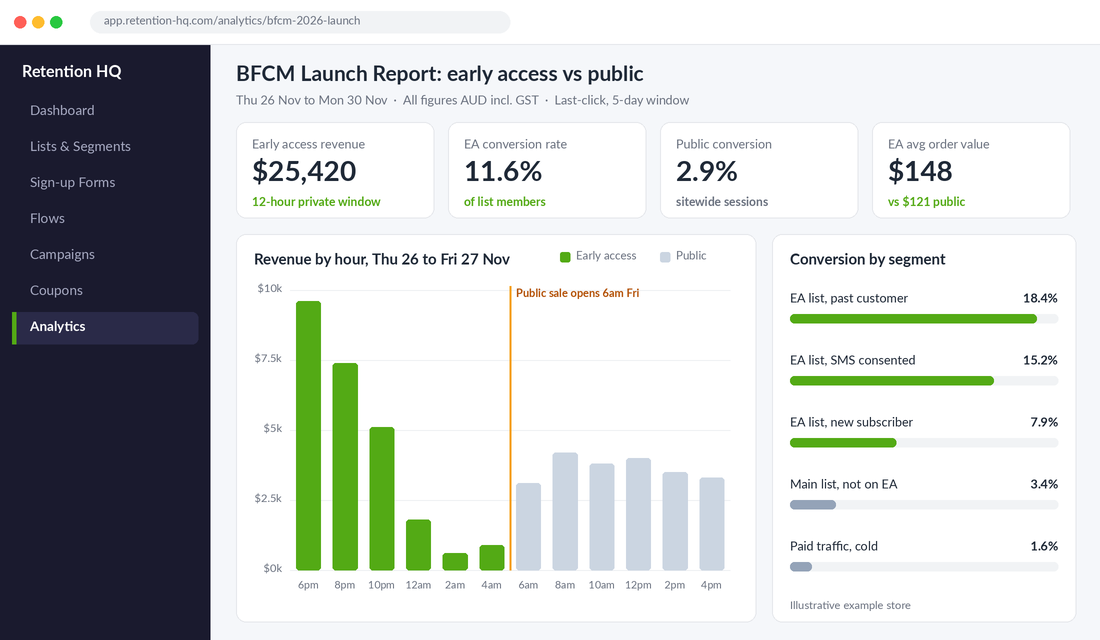
What conversion rate should you plan on? A small-business benchmark study on VIP early access found 24-hour windows converting at 15 to 20% of the list, 48-hour windows at 12 to 15%, and 72-hour windows at 8 to 12%. Plan on the low end. If your list is mostly brand-new subscribers rather than past customers, plan lower again, around 5 to 8%.
Divide your sign-up target by the weeks left (eight, from today) and you have a weekly number to hit. That number goes on your weekly scorecard next to revenue and ad spend, and it gets reviewed every Monday.
Step 2: Design the Privilege (What “Early Access” Actually Gets Them)
Here’s where most brands get lazy. “Sign up for early access” on its own is weak, because shoppers have been trained to know they’ll get the same deal a day later. You need to make the privilege concrete. Pick two or three of these:
- Time. A private window before the public sale. Twelve to 24 hours is the sweet spot for most stores; any longer and you’re just running an extra-long sale.
- First pick of stock. Full size runs, every colourway, the limited drop. This is the strongest lever for fashion, footwear and anything with variants that sell out.
- A private product or bundle. One SKU or bundle only available to the list. It gives people a reason to join beyond the discount.
- A gift with purchase, not a deeper discount. Offering early access members the same discount plus a free gift over a threshold protects margin and lifts AOV.
- Priority dispatch. “Your order ships first.” In a week when Australia Post is moving record volumes, this is a real benefit, and it costs you only a pick-pack rule.
What to avoid: giving the list a bigger discount than the public. It teaches your best customers to wait, and it drags your blended margin down on the orders you were most likely to get anyway.
Look at how Gymshark frames it: download the app, turn on notifications, build your wishlist early and check out faster than anyone else. The promise isn’t a bigger discount. It’s being first. Closer to home, Koala runs a dedicated Upcoming Sales page that tells shoppers what’s coming and gets them to register before the sale lands, turning deal-hunting traffic into a list months out.
Write your privilege in one sentence and test it on a friend: “Join the list and you’ll shop our Black Friday sale 12 hours early on Thursday night, before sizes sell out, plus get a free tote on orders over $150.” If they shrug, it’s not strong enough yet.
Step 3: Open Five Capture Points (and Feed the List Every Day)
One pop-up won’t get you to 2,000 sign-ups. You need several capture points running at the same time, each doing a different job.
1. An early access variant of your site pop-up
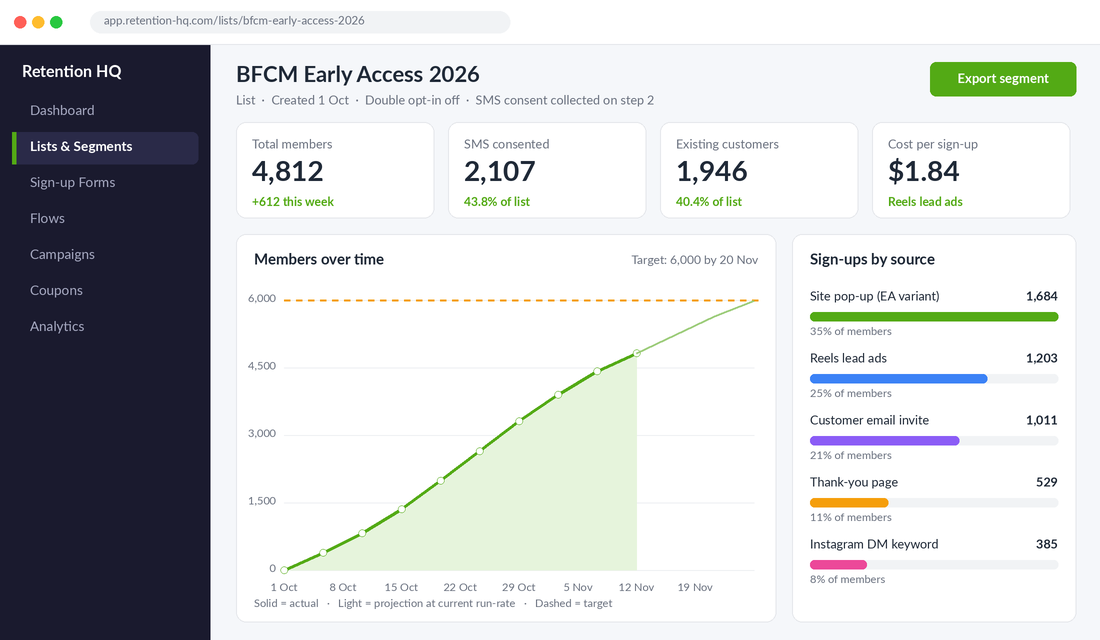
From now until launch, swap your standard welcome pop-up offer for the early access promise. Keep collecting email first, then SMS on step two. On most stores this becomes the single biggest source of sign-ups. Make sure existing subscribers who see it are simply added to the early access list, rather than being asked for their details again.
2. A dedicated early access landing page
Build one page on Shopify (for example /pages/early-access) with the privilege, the date and time, a countdown and a single form. This is the page every other channel points to: Instagram bio, email footers, Reels ads, influencer posts.
3. A direct invite to your existing customers
Your past buyers are the highest-converting people you’ll ever put on this list. Don’t assume they’ll join because they’re on your main list. Send a dedicated campaign: “You’re a customer, so you get first dibs. Tap to lock in your early access.” One click on a link that adds them to the list. No form.
4. Your thank-you page and order confirmation
Every order placed between now and November is a warm buyer. Add a block to your thank-you page and order confirmation email inviting them onto the early access list. It costs nothing and it catches people at peak goodwill.
5. Cheap October ads pointed at the list, not a product
This is the move most brands miss. Run a small Meta campaign in October with the early access page as the destination, optimising for leads or sign-ups. You’re buying future buyers at October prices instead of November prices. Triple Whale’s data found Reels placements ran at CPMs 30 to 40% lower than Feed during BFCM, so lean into short vertical video: a founder-to-camera clip explaining the privilege works well. Track your cost per sign-up weekly; anything under a few dollars for a warm, opted-in buyer is usually a bargain compared with what that same click costs in the last week of November.
A bonus sixth point if you’re active on Instagram: a DM keyword (“Comment EARLY and we’ll send you the link”). If you already run DM automation, point the keyword at the early access page.
On SMS: collect it, because Klaviyo found customers reached on more than one channel placed 11% more orders during Cyber Week 2025. But collect it properly. Under Australia’s Spam Act you need clear consent and a working opt-out, and your consent wording should say what they’re signing up for. If you haven’t checked your forms recently, check them before you turn the new pop-up on.
Step 4: Run the Warm-Up Sequence (Keep Six Weeks of Sign-Ups Hot)
Here’s the trap. Someone who joins your list on 3 October has forgotten about you by 26 November unless you give them a reason to stay interested. A warm-up sequence solves that. It’s a flow triggered when someone joins the list, with a few date-fixed messages layered on top in the final week.
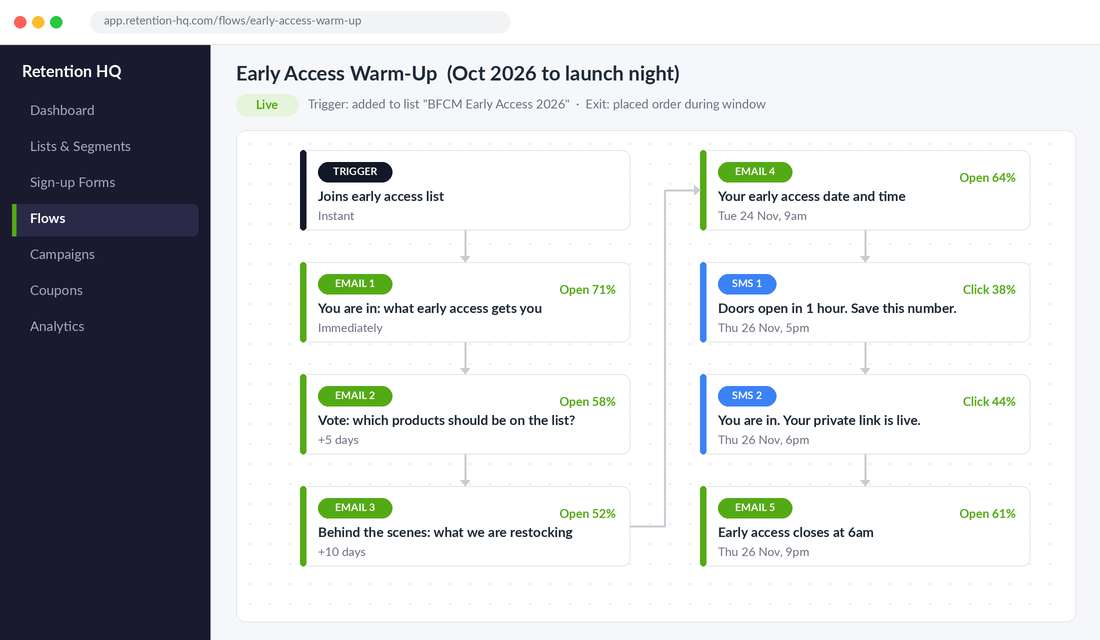
Here’s the sequence we recommend:
- Email 1 (immediately): “You’re in.” Confirm the privilege, the date and the time. Tell them to add you to their contacts. Show three best-sellers they’ll get first pick of.
- Email 2 (+5 days): “Help us choose.” Ask them to vote on which products should be in the sale, or which bundle you should build. Every click is a zero-party data point you can use to personalise launch night.
- Email 3 (+10 days): “Behind the scenes.” Restocks landing, the new colourway, the team packing orders. This builds anticipation without giving away the offer.
- Email 4 (Tuesday of launch week): “Your date and time.” The exact moment doors open, how to shop (log in, check out fast, use the private link) and what’s likely to sell out.
- SMS 1 (an hour before doors open): “Doors open in one hour.” Short, clear, no discount code yet.
- SMS 2 (doors open): “You’re in. Your private link is live.” The link, nothing else.
- Email 5 (a few hours before the window closes): “Early access closes at 6am.” The final nudge, with the best-sellers still in stock.
Setting it up in Klaviyo (about 30 minutes)
Klaviyo is what most of our members use, and it handles every piece of this natively (Omnisend has equivalent features if that’s your platform):
- Create the list. Go to Audience, then Lists & Segments, then Create New, then List. Name it “BFCM Early Access 2026”.
- Build the form. Under Sign-up Forms, duplicate your current pop-up, rewrite the offer around your privilege, and set the submit action to add people to the new list. Add a second step for SMS with clear consent wording.
- Build the flow. Under Flows, create a flow with the trigger “Added to list” and select the early access list. Add Emails 1 to 3 with the delays above. Add a flow filter so anyone who places an order during the window exits.
- Create the codes. Under Coupons, create a unique Shopify coupon (single use, tied to your sale discount). Insert it into SMS 2 and Email 5 with the coupon block, so every member gets their own code.
- Schedule the launch messages. Send Email 4, SMS 1, SMS 2 and Email 5 as date-fixed campaigns to the list, so they land at exact times regardless of when someone joined.
On frequency: your early access members have explicitly asked to hear from you about this sale, so this is the one audience you can mail more often without fatigue. For the rest of your list, follow the tiered approach in our Email Frequency Playbook.
Step 5: Control the Doors (Make “Early” Real on Launch Night)
If someone outside the list can find your sale early, the privilege is fake and your list members will notice. You need a mechanism that genuinely restricts access. Three options, from simplest to most robust:
- Unique single-use codes. Generate a unique Shopify discount code for each list member through your email platform and include it in SMS 2 and Email 5. Codes can’t be shared on deal sites because each works once. This is the simplest and works for most stores.
- A locked collection page. Use an access-control app such as Locksmith to lock your sale collection so only customers with an “early-access” tag (or a secret link) can see it. Sync the tag from your email platform to Shopify customers.
- Customer-tag discounts. Set an automatic discount that only applies to customers carrying the early access tag, so members see sale prices once logged in. This is the smoothest shopping experience but needs customer accounts to be in good shape.
Whichever you choose, test it end to end with a real phone the day before: join the list with a new email, receive the code, add to cart, check out. Then try it with an email that isn’t on the list and confirm it fails.
Finally, decide your window and don’t extend it. Our default recommendation: open early access at 6pm on the Thursday before Black Friday and open the public sale at 6am Friday. That’s 12 hours, it avoids clashing with the public peak, and it gives you a clean read on how the list performed.
The Early Access Countdown Calendar (Your Week-by-Week Checklist)
Here’s the whole system on one page. Print it, drop it into your project board, and tick it off every Monday.
| Week | Dates (2026) | What gets done |
|---|---|---|
| 1 | 1 to 7 Oct | Set BFCM target and early access share. Calculate sign-ups needed. Write the privilege sentence. Create the list in your email platform. |
| 2 | 8 to 14 Oct | Build the /pages/early-access landing page. Swap the pop-up to the early access variant. Add the thank-you page block. Build warm-up Emails 1 to 3. |
| 3 | 15 to 21 Oct | Send the existing-customer invite campaign. Launch the October Reels sign-up ads with a small daily budget. Set up the DM keyword. |
| 4 | 22 to 28 Oct | Review cost per sign-up and source mix. Double down on the best two sources. Send a second customer invite to non-openers. |
| 5 | 29 Oct to 4 Nov | Check progress against the weekly target. Decide your door mechanism (codes, locked collection or tag discount) and build it. |
| 6 | 5 to 11 Nov | Lock the sale range using the votes from Email 2. Build Email 4, SMS 1, SMS 2 and Email 5. Brief customer service on how early access works. |
| 7 | 12 to 18 Nov | Final push on sign-ups: remind your main list, post the countdown on socials, retarget landing page visitors who didn’t join. |
| 8 | 19 to 26 Nov | Test the doors end to end on mobile. Schedule all launch-week messages. Open early access at 6pm Thursday 26 November. |
If you’re behind on any week, don’t skip ahead. A smaller list with a strong privilege and a working door mechanism beats a big list that turns up to a sale anyone could have found on a deal site.
How It All Compounds: The List Is the Asset, Not the Sale
Step back and look at what you’ve built by the end of November.
You’ve got a few thousand people who raised their hand to buy, many with SMS consent, tagged with the products they voted for. You’ve moved a chunk of your BFCM revenue into a private window where you’re not paying peak CPMs to win it. And because early access buyers convert first, your paid budget on Friday can focus on finding new customers rather than re-buying the ones you already had.
Then the list keeps working after the weekend. Those members are the obvious first audience for your Christmas cut-off campaign, your Boxing Day sale and your January launches. Anyone who bought during early access goes straight into your post-purchase flow. Anyone who joined but didn’t buy is a warm lead you can win in December with a gift-focused message.
That’s the compounding effect. Each step makes the next one cheaper: the privilege makes capture easier, capture feeds the warm-up, the warm-up lifts launch-night conversion, and launch night produces the customers who make your repeat revenue grow, which is exactly where Klaviyo’s data shows the growth is coming from.
The brands that treat BFCM as a four-day sale spend November chasing it. The brands that treat it as an eight-week list-building campaign spend November collecting on it.
Your Next Step
Inside eCommerce Circle, building owned demand before peak season is one of the core pillars we work on with every member, and early access lists are one of the fastest wins we see each October. If you want to see exactly where your store is being capped, take the free More Orders Scorecard. It takes two minutes, there’s no obligation, and it shows you which of the 10 P’s to fix first.