Walk into most Shopify stores turning over 80k a month and you will find the same quiet problem. Forty products in the catalogue, attention spread evenly across all of them, and a founder who could not tell you which single product actually pays the wages.
What’s in This Article
Here is the uncomfortable pattern the data keeps repeating: across thousands of ecommerce businesses, one product tends to drive 40 to 60% of total revenue. Another two or three carry 25 to 30%. The remaining 70 to 80% of the catalogue fights over the scraps.
That one product is your hero. The brands that scale profitably are not the ones with the widest range. They are the ones who found their hero early, pointed everything at it, and refused to get distracted. First Round Capital’s portfolio analysis found that DTC brands launching with five or fewer products reached profitability 2.3 times faster (a median of 14 months) than brands that launched with twenty or more (32 months). Concentration is not a limitation. It is the strategy.
What a Hero Product Actually Is (and What It Isn’t)
A hero product is not just whatever sold best last week. A cheap add-on can move the most units and still acquire nobody. Your hero is the product that brings new customers in the door cheaply, gets associated with your brand, and opens the path to everything else you sell.
Run any candidate through three tests:
- Revenue share. Does it carry a disproportionate slice of sales, not just rank in the top ten?
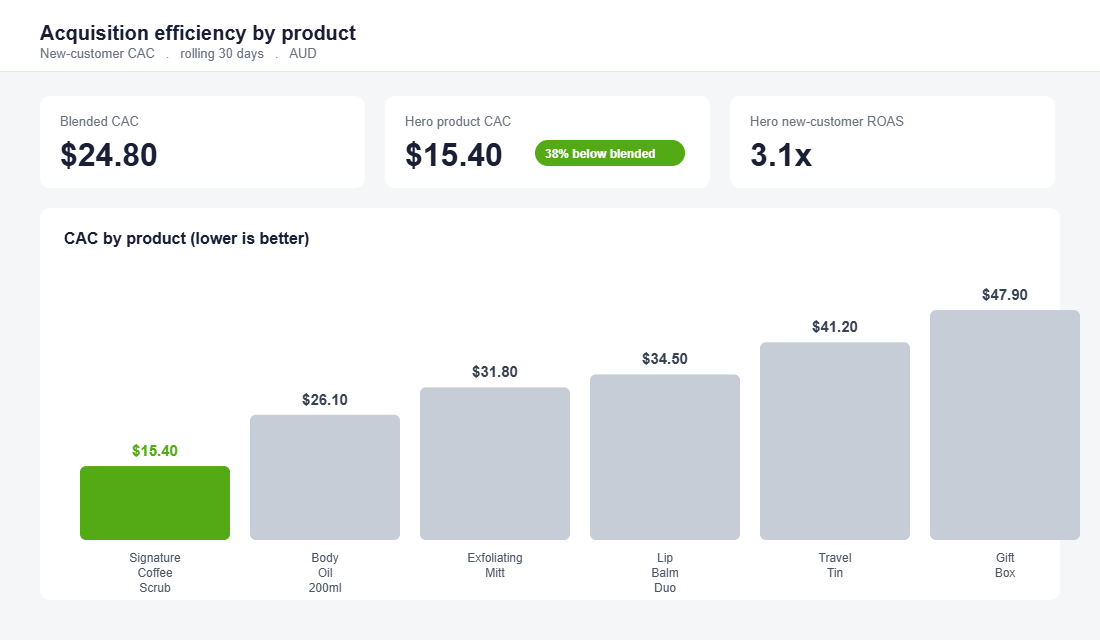
- Acquisition cost. A true hero usually has the lowest CAC in the range, often 30 to 50% below the rest of your products, because it is the easiest thing to sell to a cold audience.
- Brand association. When someone pictures your brand, do they picture this product? Frank Body was the Original Coffee Scrub. Bondi Sands was the self-tanning foam. Hismile was the teeth-whitening kit. The brand and the product were the same thing in the customer’s head.
If a product passes all three, you do not have a bestseller. You have a growth engine. Now you treat it like one.
Step 1: Find Your Hero in the Data, Not Your Gut
Most founders think they know their hero. Half of them are wrong, because they are looking at units sold or what they personally love, not contribution. Shopify gives you the answer for free.
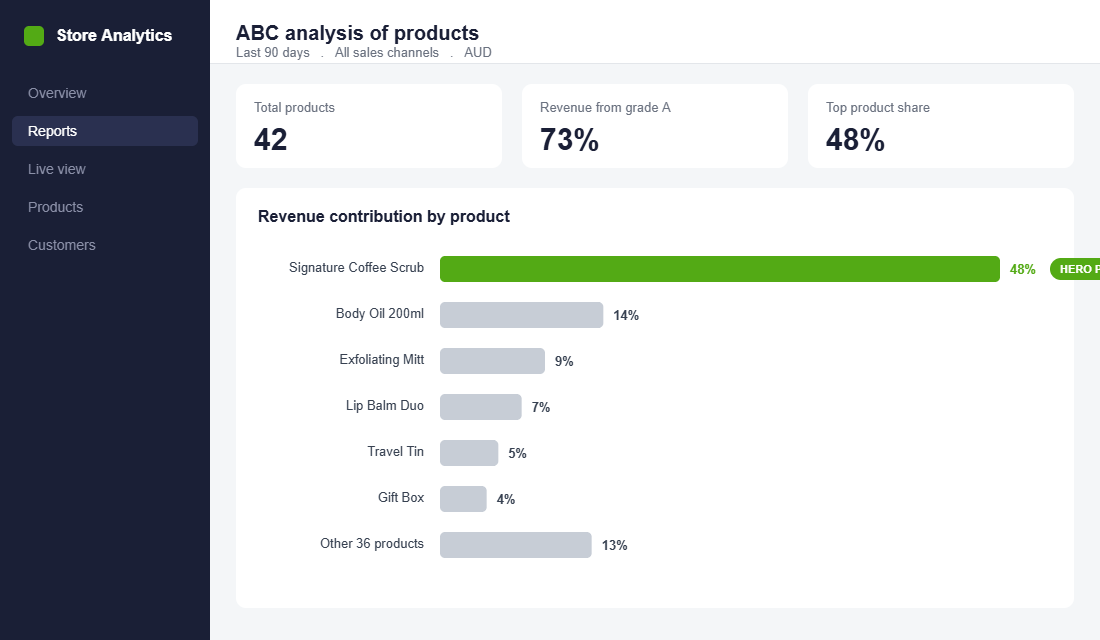
Open the ABC analysis of products report. The setup takes about two minutes:
- Go to Analytics, then Reports in your Shopify admin.
- Open ABC analysis of products (under the Inventory or Sales report group, depending on your plan). If you are on Basic, use Sales by product instead and sort by net sales.
- Set the date range to the last 90 days so seasonal noise does not skew it.
- Grade A products are your top contributors. Read the percentage each one carries, not just the order.
The tell is one bar that towers over the rest. In the report below, a single product carries 48% of revenue while the next best carries 14%. That gap is the signal. If your top three products each sit at a flat 9 or 10%, you do not have a hero yet. You have a fragmented catalogue, and that is a different problem to solve first.
Step 2: Pressure-Test the Candidate Before You Bet On It
Revenue alone can lie. A product that sells well but loses money when you add acquisition cost is a trap, not a hero. Put your candidate through four gates before you pour fuel on it.
- Gross margin. A hero has to fund its own acquisition. For DTC you generally want 60% or more, because that headroom is what lets you outspend competitors to win the first sale.
- Conversion rate. The average Shopify store converts at about 1.4%, and the best 10% clear 4.7%. Your hero’s product page should beat the site average comfortably and push its add-to-cart rate above the 4.6% benchmark. If it converts like everything else, the page is not pulling its weight.
- Repeat or replenishment behaviour. Does it bring people back? Repeat customers generate revenue roughly 16 times more efficiently than one-time buyers, so a hero that drives reorders compounds.
- Proof. Review volume and rating. A hero usually has the deepest social proof in the range, which is exactly why it converts cold traffic.
A product that clears all four is rare, and that is the point. You are not looking for a good product. You are looking for the one that earns the right to your homepage, your ad budget and your attention.
Step 3: Rebuild the Store Around the Hero
This is where most founders flinch. Your homepage is probably a polite grid that gives every product equal billing. That is fair to your catalogue and unfair to your business. The hero should dominate.
- Homepage. Lead with the hero above the fold. One clear product, one clear reason to care, one button. The range can live further down.
- Product page. Give the hero your sharpest assets. This is the page that earns the lowest CAC, so it deserves your best product photography and your most persuasive product copy, not a spec sheet.
- Dedicated landing page. Build the hero its own page for paid traffic, stripped of distractions, so cold visitors land somewhere built to convert them on that one product.
When 70% of carts are abandoned across ecommerce, every point of friction on your highest-traffic page is costing you real money. The hero page is the one to obsess over first.
Step 4: Scale the Hero With Paid and Content
Because your hero has the lowest CAC in the range, it is the most efficient thing you can put money behind. So put the money there. As a rule of thumb, the bulk of your acquisition budget and creative testing should point at the hero, not get sprayed across the catalogue.
Run your creative testing almost entirely on the hero. Build angles around the one problem it solves, gather user-generated content for it specifically, and let the winners run. A focused hero campaign beats ten half-funded product campaigns every time, because the algorithm and your team both get to concentrate.
This is also where the brand association compounds. The more a single product fronts your ads, the faster the market learns what you are known for, and the cheaper that recognition makes every future sale.
Step 5: Build the Range Off the Hero’s Back
Concentration does not mean you only ever sell one thing. It means the rest of your range exists to monetise the customers the hero already acquired cheaply. The hero opens the relationship. The range deepens it.
- Complementary bundles. Pair the hero with the products that naturally go with it to lift average order value on the first purchase.
- Good, better, best. Offer a step up from the hero for the buyers who want more, so you capture higher spenders without confusing first-timers.
- Replenishment and subscription. If the hero gets used up, make reordering effortless. This is where the 16x efficiency of repeat buyers actually lands in your bank account.
- Post-purchase offers. The moment after someone buys the hero is the cheapest selling opportunity you will ever get. Use it.
Sequence it that way and your catalogue stops being forty equal bets. It becomes one engine that acquires, surrounded by products that profit from what the engine brings in.
The Compound Effect: Why Concentration Beats Breadth
Here is how the pieces lock together. The hero acquires customers at the lowest cost in your range. That efficiency throws off profit. That profit funds the range that raises average order value and lifetime value on those same customers. Higher lifetime value means you can afford to acquire even more aggressively on the hero. The flywheel turns.
Spread thin and none of that happens. Forty products mean forty mediocre pages, forty under-funded ad sets, and a brand the market cannot summarise in one sentence. The academic data backs the concentrated path too: the heavy half of a brand’s buyers drives around 71% of online sales, and a focused hero is how you reliably create those heavy buyers in the first place.
Your Hero Product Scorecard
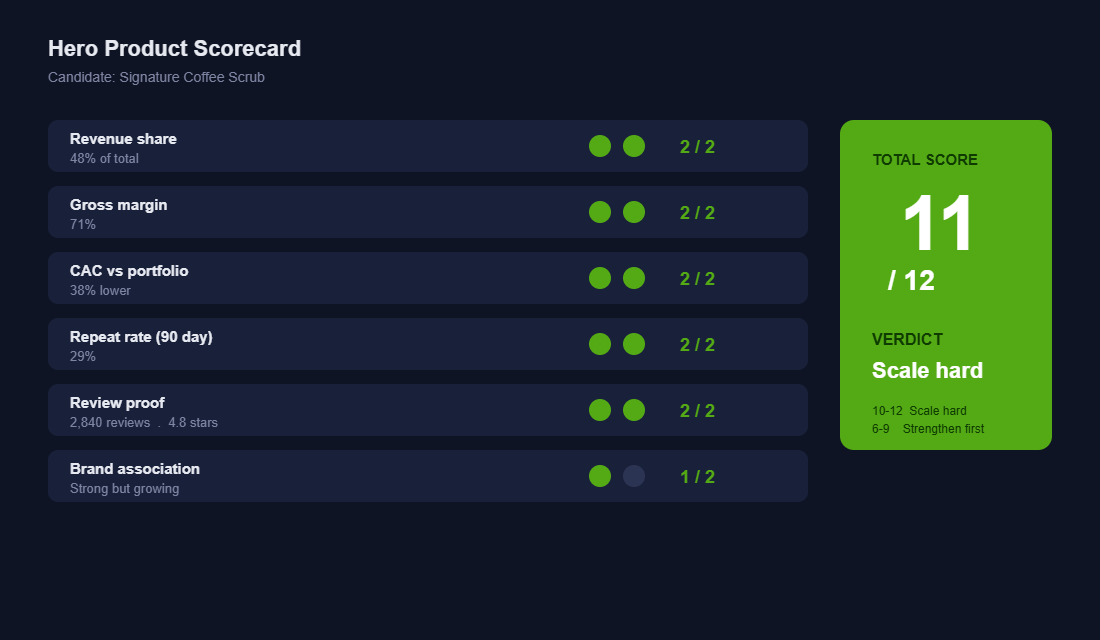
Before you commit budget, score your top candidate. Give it 0, 1 or 2 on each of the six criteria below, then add it up.
- Revenue share. 2 if it carries 30% or more of sales, 1 if 15 to 29%, 0 below that.
- Gross margin. 2 if 60% or more, 1 if 45 to 59%, 0 below.
- CAC vs the rest of the range. 2 if clearly lowest, 1 if middle, 0 if expensive to sell.
- Repeat or replenishment rate. 2 if strong, 1 if some, 0 if one-and-done.
- Review proof. 2 if deep and high-rated, 1 if building, 0 if thin.
- Brand association. 2 if it defines the brand, 1 if recognisable, 0 if anonymous.
10 to 12: scale hard, this is your hero. 6 to 9: strengthen the weak criteria before you pour spend in. Under 6: it is a bestseller, not a hero, and you have more foundational work to do first.
Inside eCommerce Circle, finding and scaling the hero is one of the first things we work on with every member, because it makes every other decision easier. If you want a second opinion on which of your products is really carrying the brand, let’s talk.