You have probably blamed the algorithm. The campaign that printed money in March quietly died by May, your cost per purchase crept up week after week, and the easy explanation was that Meta changed something. Meta did change something. But the one lever you can actually pull never moved: your creative.
What’s in This Article
Here is the uncomfortable truth most Aussie DTC founders have not fully absorbed. After Meta rebuilt its ad delivery system (the update everyone calls Andromeda), creative quality now drives an estimated 50 to 60% of auction outcomes. The audience tricks, lookalikes and detailed targeting that used to be the game are increasingly decided for you. The ad itself is the input still firmly in your hands.
And the brands winning right now are not the ones with the single best ad. They are the ones with the best testing system. Brands shipping 20 or more new ads a month see roughly 65% higher ROAS than those testing fewer than 10. This is a velocity game wearing a creative costume. Below are the five systems we use with founders inside eCommerce Circle to find winners fast, without setting fire to the budget.
System 1: Build a Creative Thesis Before You Build a Single Ad
Most testing fails before the first dollar is spent because there was never a thesis. Founders brief their editor with “make three reels” and then wonder why nothing scales. A winning creative is not a lucky video. It is a specific message, aimed at a specific objection, that you predicted would work and then proved.
Start with the actual words your customers use. Pull your last 50 five-star reviews, your post-purchase survey responses, and the questions that fill your inbox. You are mining for three things: the problem people thought they were buying, the objection they almost did not buy over, and the moment the product finally clicked for them. Those three become your angles.
This is exactly where declared customer data earns its keep. If you are already collecting it through your zero-party data system, you have a head start on knowing which message lands with which segment. The same discipline that sharpens your product page copy should drive your ad angles. Your best-converting PDP line is very often your best-performing hook, already written and already validated by buyers.
A practical target: walk into every test month with at least three distinct angles, each tied to a real objection, not three versions of “our product is great”. One angle might attack the price objection by reframing cost per use. Another might tackle the trust objection with social proof. A third might sell the outcome rather than the features. Different objection, different person, different ad.
System 2: The 3-3-3 Matrix (Structure Beats Inspiration)
Once you have angles, you need a production structure so volume does not depend on a flash of inspiration. The framework that has held up best is the 3-3-3 matrix: three angles, three formats, three hooks. That is 27 assets from a single brief, and brands running it have reported around a 30% lift in outbound click-through rate year on year.
The formats are non-negotiable because Meta places ads differently across Reels, feed and Stories. Each angle ships as a Reel, a static image, and a carousel. Then you rotate three hooks across the critical first three seconds, because the hook is where most of the variance lives. The same body of an ad can double or halve its performance purely on which three seconds open it.
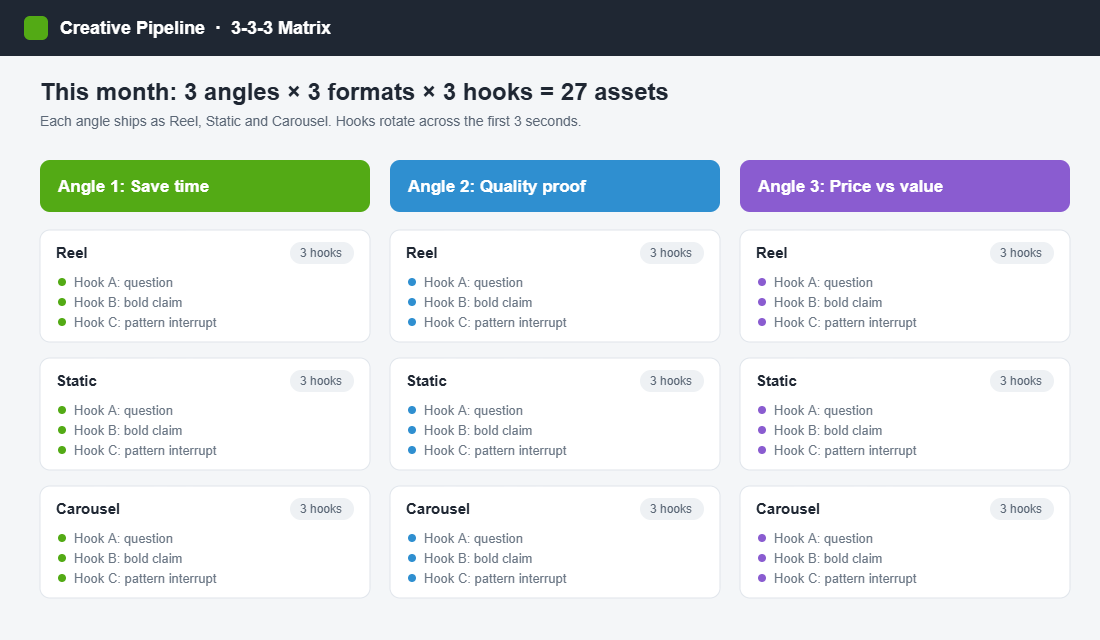
If 27 assets a month sounds like a lot, match it to spend. As a rough guide for Australian accounts: at $15k to $50k AUD a month in ad spend, aim for 15 to 25 new creatives monthly. At $50k to $100k, push to 30 to 50. The brands that complain testing does not work are almost always testing two ads a fortnight and calling it a strategy. Volume is not optional. It is the strategy.
Five Hook Patterns Worth Testing First
If the first three seconds carry most of the weight, it pays to have a shortlist of hook patterns that consistently earn the scroll-stop. These are the openings we see clear the 25 to 30% hook-rate bar most often for Aussie stores. Rotate them across your three angles.
- The pointed question. Open with the exact question running through your customer’s head. “Still paying $40 a month for something you use twice?” The viewer answers in their own mind and keeps watching.
- The bold claim plus proof. State an outcome that sounds almost too good, then immediately back it with a number or a demo. The claim stops the scroll, the proof keeps it.
- The pattern interrupt. A visual that does not look like an ad. A hand entering frame, an unexpected setting, a jump cut. It buys you the half-second to deliver the message.
- The relatable problem. Show the frustration before the product. The pile of tangled cables, the failed dinner, the cart abandoned at checkout. Recognition is a powerful hook.
- The founder to camera. A real person, talking plainly about why they built the thing. Low production, high trust. This is the format Aussie brands underuse the most.
None of these are clever for the sake of it. Each maps to a buyer who is mid-scroll and one swipe from gone. Test the pattern, not just the polish.
System 3: Read the Metrics in the Right Order
This is where most founders sabotage good creative. They judge a brand-new ad on ROAS after 48 hours, panic, and switch it off before it ever cleared the learning phase. ROAS is a lagging metric. To diagnose a creative early, read the funnel from the top down.
- Hook rate (3-second view rate). Did the first three seconds stop the scroll? Aim above 25 to 30%. A weak hook rate means the problem is the opening frame, full stop.
- Outbound CTR. Did the stopped scroller want to click? Benchmark is 1.0 to 1.5%. Strong hook but weak CTR usually means the middle of the ad did not earn the click.
- Add-to-cart rate. Above 5% of clicks is healthy. If clicks are strong but ATC is weak, the gap is the landing page or a promise the ad made that the product page did not keep.
- CPA and ROAS. Only judge these once the ad has cleared roughly 50 conversions. Median Meta ROAS sits near 2.92x, so anything in the 2.25x to 3.3x band is performing normally, not failing.
Reading in this order tells you what to fix, not just that something is broken. A high hook rate with a low CTR is a completely different problem from a low hook rate, and they need opposite fixes. A scorecard makes the pattern obvious at a glance.
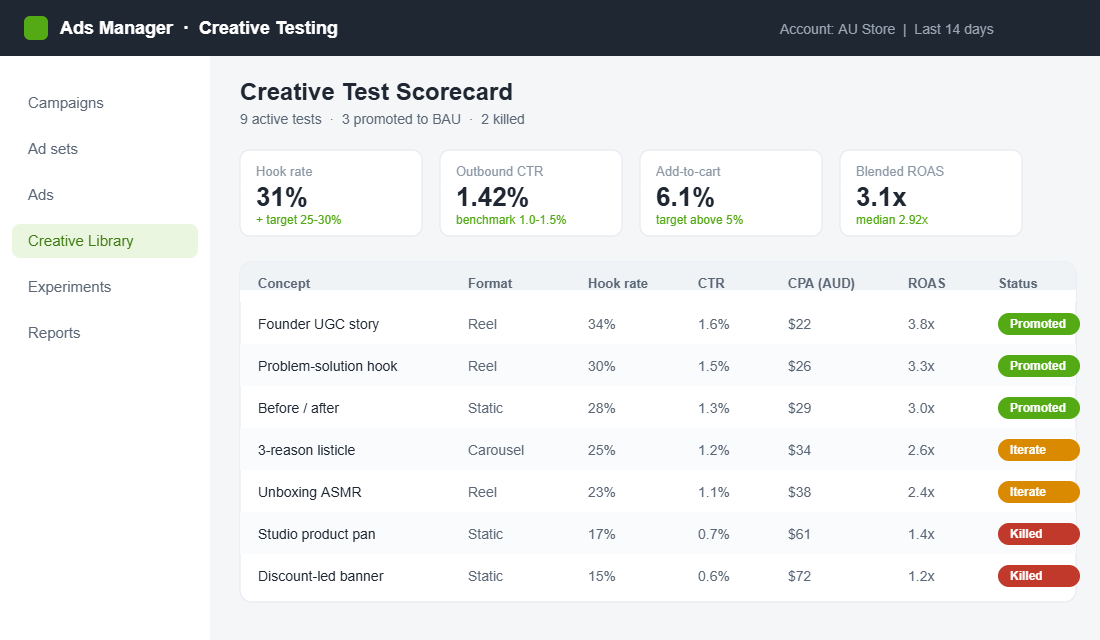
Look at the scorecard above. The studio product pan has a respectable production budget and a terrible 17% hook rate, which drags every downstream number with it. No amount of spend fixes a frame nobody stops for. Meanwhile the founder UGC story, shot on a phone, clears every gate and earns a $22 CPA. That contrast is the whole game in one screen.
None of this works if your tracking is shaky. If your numbers disagree between Meta and Shopify, fix that first. Our conversion tracking playbook walks through the server-side setup that keeps these decisions honest in a post-iOS world.
System 4: Kill, Iterate or Scale (Decide With Rules, Not Feelings)
A test is only useful if it ends in a decision. Set the rules before the test runs so you are not negotiating with yourself at 11pm. Here is the simple three-way call we coach founders to make once an ad has had a fair run and enough spend behind it.
- Scale when hook rate, CTR and CPA all beat your account benchmark. Move it into your evergreen “best-of” ad set and feed it budget gradually. Sudden 5x budget jumps reset the learning phase and spike your cost per purchase.
- Iterate when one metric is strong and another is weak. Good hook, soft CTR? Keep the opening, rebuild the middle. This is where most of your compounding wins come from, because you are improving a near-miss instead of starting from zero.
- Kill when the hook rate is poor and CPA is well above target. A bad opening frame rarely gets rescued by spend. Cut it, bank the learning, and move budget to the next contender.
Aussie brands prove the iterate-and-scale loop works. Frank Body built its early growth almost entirely on user-generated content, testing real customer photos and captions until the winners were obvious, then scaling them hard. HiSmile leaned on relentless creative volume paired with creator content rather than betting on one hero video. The pattern is identical: lots of swings, ruthless culling, then pour fuel on the proven winner.
System 5: Manage Fatigue Before It Manages You
Even a winner has a shelf life. At scale, creative fatigue now sets in within 10 to 14 days. The clearest early warning is frequency: once the same person has seen the ad more than 3.5 times, click-through rate falls and CPM rises at the same time. You end up paying more to reach people who are already tired of you.
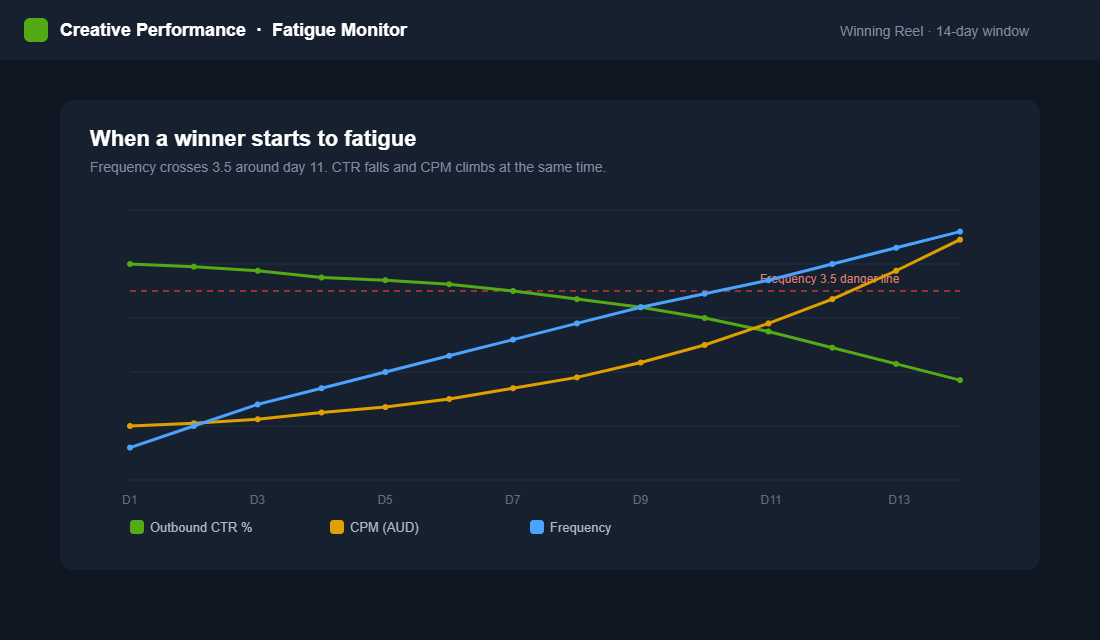
The fix is not to constantly chase brand-new concepts. It is to keep a pipeline so a fresh variation of a proven angle is always ready to swap in. This is why the 3-3-3 matrix matters: when your top Reel fatigues, you are not starting a panicked brief, you are promoting the next variant of a concept you already know works. Refresh the asset, keep the winning message.
A standing rule that saves a lot of wasted spend: set a frequency alert at 3.0 in your reporting, and treat 3.5 as the line where the current creative comes out and the next one goes in. Make it automatic, not a judgement call you make when you happen to notice the numbers slipping.
The Tool: Set Up a Clean A/B Test in Meta Ads Manager
You do not need expensive software to test properly. Meta’s built-in A/B Test (found under Experiments) isolates one variable so the result is trustworthy. Here is the exact setup.
- In Ads Manager, open the Experiments tool from the left-hand menu, or tick an existing campaign and click A/B Test.
- Set the variable to Creative. This holds audience, placement, budget and optimisation event constant so the only thing changing is the ad itself.
- Add your variants. Test two to three creatives at a time. More than that and each one starves for data.
- Choose Cost per result as the key metric and set a run length of at least 7 days to clear the learning phase.
- Budget it so each variant can earn roughly 50 optimisation events across the test. Below that, the result is noise, not a verdict.
- Launch, then resist judging on day two. Read hook rate first, then CTR, then let CPA settle before you call a winner.
For creative-level reporting at scale (hook rate, hold rate and thumb-stop by asset in one view), a dedicated tool like Motion or Triple Whale pays for itself once you are shipping 20-plus ads a month. Until then, the native scorecard view is enough to run this whole system.
Four Testing Mistakes That Quietly Drain Budget
Even founders who run a structured process lose money to the same handful of errors. Watch for these.
- Testing too many variables at once. Change the hook and the audience and the offer in one test and you learn nothing, because you cannot tell which change moved the needle. One variable per test.
- Pulling ads too early. Killing a creative inside 48 hours before it clears the learning phase throws away ads that were about to work. Give it seven days and 50 events before you judge.
- Confusing a creative problem with an audience problem. When results dip, founders rush to broaden targeting. Post-Andromeda, the answer is almost always a fresh creative, not a new audience.
- Never writing down the learning. If you do not log why a winner won, you repeat the test every quarter. Keep a simple swipe file of proven angles, hooks and formats so each month starts ahead of the last.
Budget the Test Without Starving the Engine
A question we get constantly: how much of the ad budget should go to testing versus scaling proven winners? The split that keeps the engine fed without gambling the month is roughly 80/20. Put 80% behind your proven, profitable creative and reserve 20% for the testing ground where new contenders earn their place.
That 20% is not a cost. It is the R&D line that refills your winners as they fatigue. Skip it for a few weeks and you will feel it a month later when your hero ads tire and there is nothing tested and ready to replace them. The brands that stall are almost always the ones that quietly stopped testing the moment results got good.
- 80% to scaling: evergreen ad sets running your proven winners, scaled in measured 20 to 30% budget steps.
- 20% to testing: the always-on lab where this month’s 3-3-3 batch competes for a promotion.
- Review the split monthly: if nothing new is graduating to the scaling bucket, your testing budget or your creative volume is too low.
How the Five Systems Compound
Run one system in isolation and you get a marginal lift. Run all five and they stack into a machine. A sharp thesis means you test messages that were always likely to land. The 3-3-3 matrix means you never run dry on assets. Reading metrics in order means you diagnose fast instead of guessing. Clear kill-iterate-scale rules mean budget flows to winners automatically. And fatigue management means your winners get replaced on your schedule, not the algorithm’s.
The payoff is not a single hero ad. It is a steady supply of profitable creative and a cost per purchase that trends down while competitors blame the platform. That is the difference between buying ads and building an acquisition engine you actually control.
One Australian footnote worth keeping front of mind: the ACCC takes a dim view of fake urgency and unsubstantiated claims in advertising. Test hard, but keep every hook honest. A winning ad that triggers a complaint or a chargeback dispute is not a win.
Your 14-Day Creative Testing Sprint
Steal this as a repeatable fortnightly cycle. Run it on loop and creative testing stops being a scramble and becomes a system that quietly lowers your acquisition cost month after month.
- Days 1 to 2: Mine reviews, surveys and DMs. Lock three angles tied to real objections.
- Days 3 to 5: Produce the 3-3-3 matrix. Three angles, three formats, three hooks.
- Day 6: Launch as a clean A/B test. One variable: creative. At least a 7-day run.
- Days 7 to 11: Read top-down. Hook rate above 25-30%, CTR 1.0-1.5%, ATC above 5%.
- Day 12: Decide. Scale the winners, iterate the near-misses, kill the duds.
- Days 13 to 14: Queue the next variants so fatigued winners get replaced on cue.
- Always-on: Frequency alert at 3.0, hard swap at 3.5, and log every learning.
Inside eCommerce Circle, building a creative testing system like this is one of the core pillars we work on with every member. If you want a second opinion on yours, let’s talk.
Related reading: our Meta ads creative testing framework.