Two in three Aussie Shopify founders we talk to right now are thinking about the same thing: where the next leg of growth comes from when the home market gets crowded and Meta CPMs keep climbing. The answer most of them reach for is international. NZ first, then the US, then the UK. The pitch sounds simple. Switch on Shopify Markets, flip a currency toggle, run a few US ads, watch the orders roll in.
What’s in This Article
That is not how it plays out. Most founders who flick the international switch see a sharp jump in sessions, a flat conversion rate, a horrifying refund queue from buyers who did not realise duties were extra, and a CAC that is double their domestic number inside six weeks. They quietly turn it off and tell themselves “we will revisit next year.”
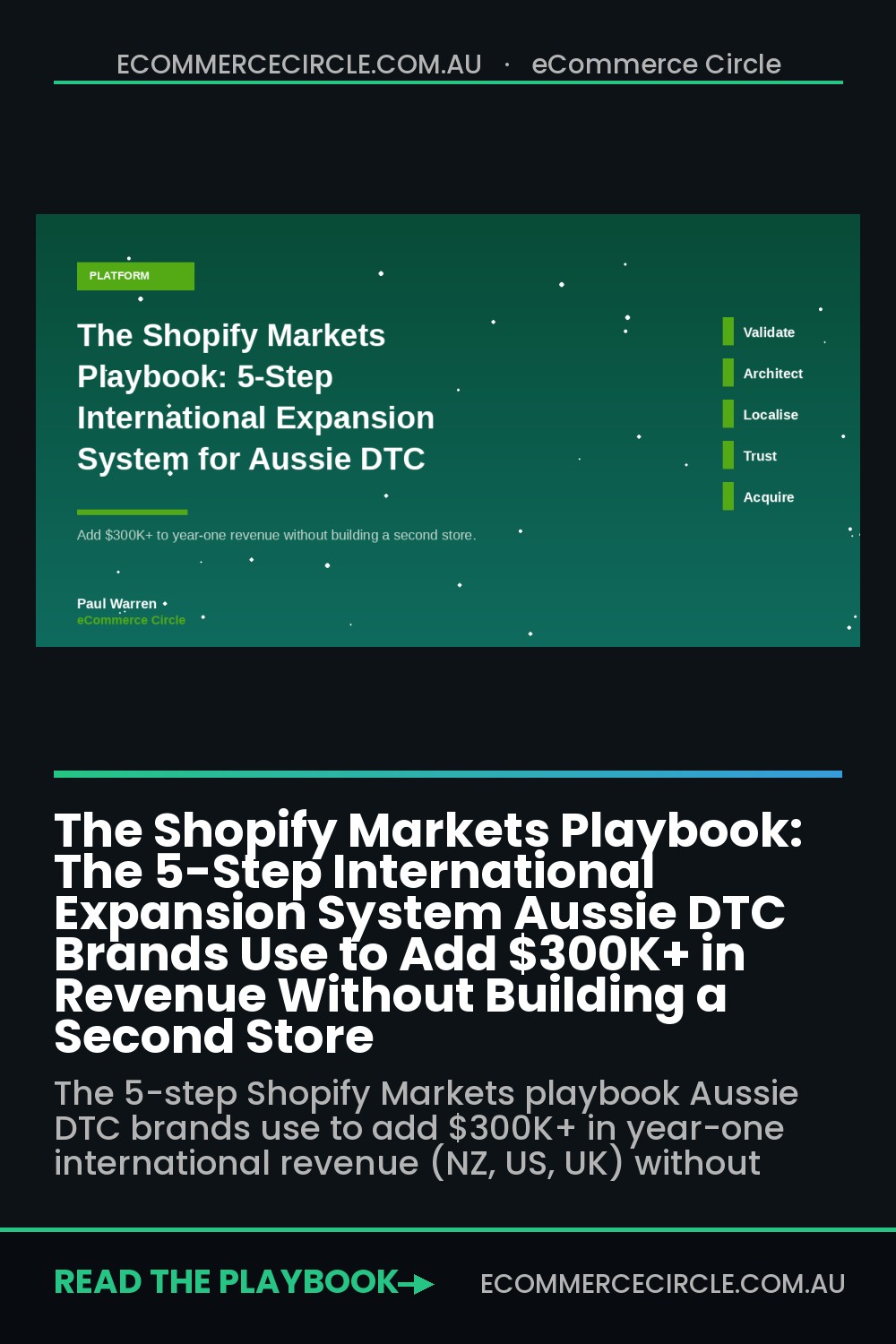
The Aussie brands that actually crack it (Showpo shipping to 100 countries, Bondi Sands in 30,000+ stores worldwide, Frank Body expanding into Europe) do not treat international as a setting in their Shopify admin. They treat it as a 5-step launch playbook. Validate, architect, localise, build trust, acquire. Get all five right and Shopify Markets becomes a $300K+ revenue lever in year one. Skip any of them and you bleed money learning lessons that are already documented.
Why International Is the Most Honest Growth Lever in 2026
The numbers are unusually clean for a growth lever. Global ecommerce hits roughly $7 trillion in 2026. Three in five shoppers now buy from a brand outside their home country at least once a year. Shopify supports 230 currencies and 170 languages out of the box, with Shopify GMV crossing $378 billion in 2025 (up 29% year on year). The infrastructure exists. The demand exists. What is missing for most Aussie founders is the discipline.
There is a tax angle too. The Australia-UK Free Trade Agreement (in force since 2023) zeros out tariffs on most consumer goods into the UK. NZ is part of the CER framework, which means goods cross essentially friction-free. The US is the biggest prize and the hardest market, but de minimis thresholds and the maturity of cross-border 3PL networks make it more accessible than it has ever been. The point is, the tailwinds are real. The question is whether your store is set up to catch them or designed to repel them the moment a foreign IP loads the page.
Here is the punchline before the playbook. Localised currency display alone increases conversion by around 24% on average. 92% of global shoppers prefer sites that display prices in their own currency. 33% will abandon a checkout outright if pricing is only in USD. These are not edge-case stats. They are the cost of doing nothing.
Step 1: Validate the Market Before You Spend a Dollar
The biggest mistake we see is treating “international” as one decision. It is not. NZ is one market. The US is another. The UK is a third. France, Germany, Singapore, Canada all behave differently. Every market has its own customer behaviour, payment preferences, delivery expectations, ad costs, and competitive landscape. You validate one market at a time, with cheap signals, before you commit budget.
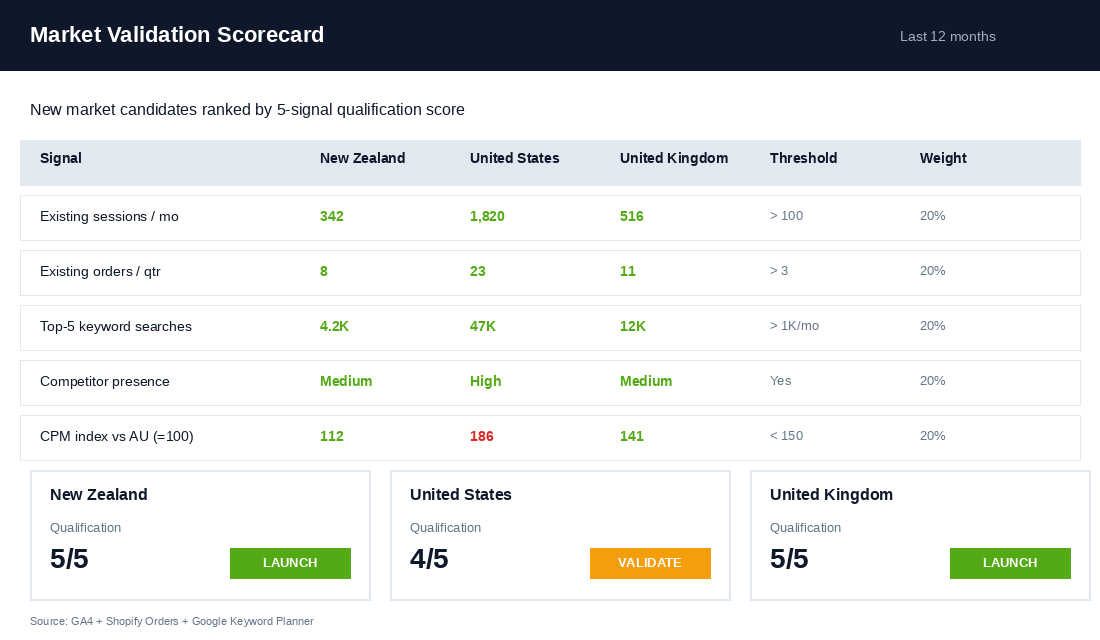
Here is the 5-signal validation scorecard we run on every market before greenlighting an expansion:
- Existing organic traffic. Pull GA4 by Country dimension for the last 12 months. If a market already produces 100+ sessions a month with zero promotion, that is a market validating itself. Highly suggestive when the bounce rate is below 70% and there is at least one order in there already.
- Existing organic orders. Filter Shopify Analytics by shipping country. Even 3 to 5 unsolicited orders in a quarter from a single market is a strong signal that demand exists at full retail with zero localisation.
- Search demand benchmarks. Use Google Keyword Planner targeted at the country to check monthly search volume for your top 5 product keywords. Anything above 1,000 combined searches a month is workable. Under 500, you have an awareness problem, not a localisation problem.
- Competitor presence and pricing. Identify three competitors selling in that market. Check their landed price, shipping promise, returns policy, and review volume from in-country buyers. If competitors are pricing 30% above Australia and getting reviews, the willingness to pay is there.
- Channel CPM and CPC. Set up a $50 to $100 Meta or Google test campaign targeted to the country (engagement objective only). Run for 7 days. Compare CPM to your Australian baseline. If foreign CPMs are within 50% of home, the market is workable. If they are 3x, you need an organic strategy first.
If a candidate market clears at least three of those five signals, it qualifies for a paid validation test. Run a 4-week geo-holdout campaign with a real budget (we lay out the exact methodology in our incrementality testing playbook). If you cannot get to a workable CAC inside that 4-week window, the market is not the problem. Your offer is not yet ready to travel. Park it and revisit in 6 months.
Step 2: Choose the Right Architecture (Markets, Managed Markets, or a Second Store)
This is the single most expensive decision in the playbook and the one most founders get wrong. There are three real options. Each has a different cost, control profile, and best-fit scenario.
- Standard Shopify Markets (free, included on every plan). One store, multiple markets. Each market gets its own pricing, currency, language, domain or subfolder, tax setup, and product catalogue. You handle compliance, duties, and merchant of record yourself. Best for: low to mid complexity expansion (NZ, UK, EU markets where you have a 3PL or are happy to ship from AU).
- Shopify Managed Markets (paid, formerly Markets Pro, powered by Global-e). Adds Global-e as merchant of record, handles duties and import taxes at checkout, supports 130+ local payment methods, manages international fraud, and remits taxes to the right authority. Fee structure: 3.5% transaction fee (3.25% on Shopify Plus) plus a 1.5% currency conversion fee. Best for: aggressive US expansion where you do not want to set up a US entity or handle landed cost disputes.
- A second Shopify store with a country-code domain. Separate admin, separate inventory, separate everything. Maximum control, maximum overhead. Best for: brands doing $5M+ in a single international market who need full SKU separation, distinct teams, and different brand positioning.
Our default recommendation for an Aussie brand doing under $5M annually is standard Shopify Markets with a subfolder URL structure (yourbrand.com/en-us/, yourbrand.com/en-gb/, yourbrand.com/en-nz/). Subfolders consolidate SEO authority on your main domain, hreflang tags are generated automatically, and you keep a single Shopify admin. The temptation to use separate ccTLDs (yourbrand.us, yourbrand.co.uk) is real but the SEO maths is brutal. You will spend 18 months building authority on a domain that has none.
Upgrade to Managed Markets when one of three things happens. First, your US revenue passes $30K a month and customer service is drowning in landed-cost complaints. Second, a US distributor or wholesaler asks for compliant tax invoicing you cannot produce yourself. Third, you start seeing repeated chargebacks or fraud on international orders that your current setup cannot screen for.
Step 3: Localise the Offer, Not Just the Currency
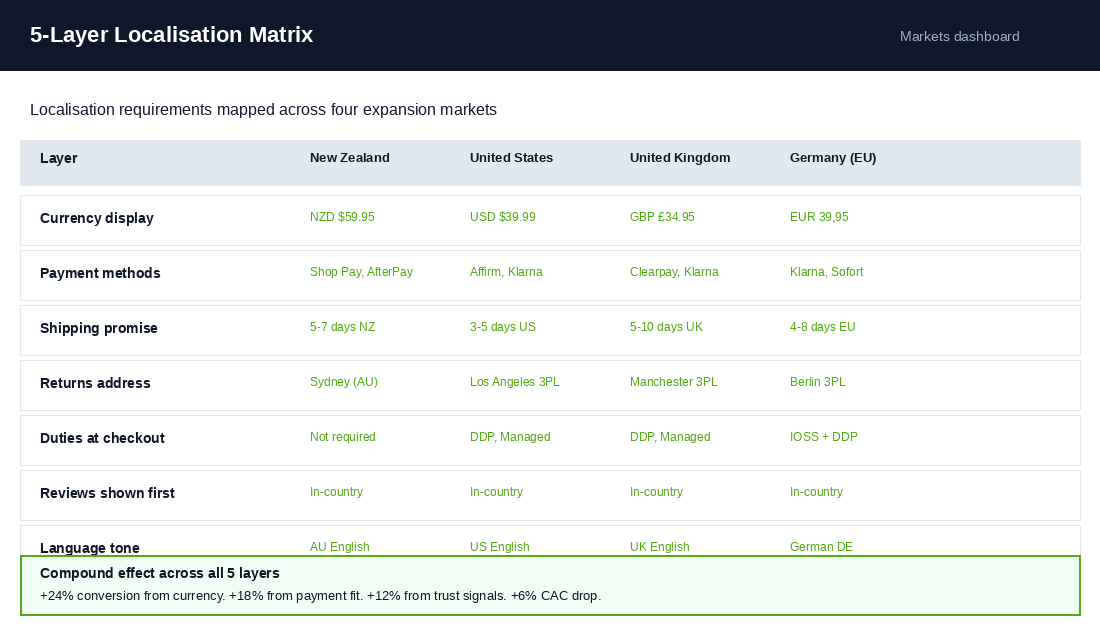
Currency conversion is table stakes. It earns you the right to compete. It does not win you the sale. The brands who actually convert international traffic at Australian rates (or better) localise the offer across five layers. Currency is layer one. The other four are where most founders quietly leak revenue.
- Currency display and rounding. Show prices in local currency, not a tiny converted symbol next to AUD. Round to local conventions: prices ending in .99 in the US, .95 or whole pounds in the UK, whole-dollar amounts in NZ. A $29.47 USD price that converts from $44.99 AUD signals to the buyer that you have not made any effort. Set “smart rounding” in Markets to fix it in one click.
- Payment methods that match the market. Shop Pay and Apple Pay are universal. PayPal is non-negotiable. The US adds Affirm and Klarna. The UK adds Clearpay and Klarna. Germany needs Klarna Pay Later and Sofort. Digital wallets account for 51.4% of cross-border ecommerce payment volume in 2025, so a thin payment stack is a 30%+ cart drop in disguise.
- Landed cost and duties transparency. The “$24 surprise charge from DHL at the door” is the single largest cause of negative international reviews. Either use DDP (delivered duty paid) shipping where Shopify or your 3PL handles import tax at checkout, or show a clear landed-cost estimator on the cart page. Hiding it is fraud-adjacent and tanks your repeat rate.
- Shipping promise that matches local expectations. US buyers expect 3 to 5 day shipping at minimum. NZ buyers will tolerate 5 to 7. UK buyers want 5 to 10 from Australia, faster if you have a UK 3PL. State the delivery window on the product page, in the cart drawer, and at checkout. Vague “international shipping available” copy loses more sales than the actual delivery time does.
- Language and tone. Australian English is fine for NZ and the UK with minor adjustments (no “thongs” on a US site unless they are underwear). The US needs imperial measurements alongside metric, “sale” not “specials”, and “color” not “colour” on the product copy. AI translation is acceptable for category pages. PDP copy and emails should be human-edited.
The compound effect of getting these five right is between 35% and 60% conversion lift on international traffic compared to a non-localised store. We have seen Frank Body grade brands push international conversion to within 10% of their AU rate inside 12 months by treating each layer as its own project rather than batching it all into a single “launch the market” sprint. This is exactly the same discipline behind our checkout optimisation audit: shave seconds and cognitive load off every step.
Step 4: Build the Trust Layer Foreign Buyers Need to Convert
A first-time US buyer landing on an Aussie store has a single dominant question. “Is this brand real?” They have no friend who has bought from you. No magazine in their gym has reviewed you. They cannot pop into a David Jones or Mecca to handle the product. Every trust signal you have built up domestically over five years has to be rebuilt for a buyer who arrived 14 seconds ago. The trust layer has four components.
- Market-specific reviews on PDPs. Filter your Judge.me, Stamped, or Okendo review widget to surface in-country reviews first. A US buyer reading 20 US reviews converts at roughly 2x the rate of one reading 20 AU reviews. If you do not have in-country reviews yet, prioritise harvesting them in the first 90 days with a post-purchase email asking US buyers specifically.
- Shipping and returns policy in local terms. A returns policy that says “post back to PO Box, Bondi Junction NSW” is a deal-breaker for a US buyer. You need either a US returns address (every modern 3PL offers this) or a “no return needed, refund issued” policy on low-value items. State the policy on the PDP, in the cart, and at checkout. Visibility beats generosity.
- Customer service in their time zone. Aussie business hours are roughly US PST 4pm to midnight, US EST 7pm to 3am, UK 9pm to 5am. Either staff a VA in-market (Filipino or US-based) for live chat coverage, or set crystal-clear response time expectations (“we reply within 12 hours, every weekday”) on your contact and FAQ pages. Silence at 11am New York time is read as “they have gone out of business.”
- Local trust badges and press logos. If you have been featured in a US or UK publication (Vogue, Refinery29, Cosmopolitan, GQ, the Guardian), put that logo bar at the top of your in-market homepage. If you have not, work toward it. Press logos do more for first-time-international-buyer conversion than almost any other on-site change.
Trust is the layer that compounds. Every in-country review, every in-market press hit, every PR appearance feeds the next 100 first-time buyers. Most Aussie founders underinvest here because the work is unsexy and the payoff is slow. The brands that have actually scaled internationally treat the trust layer as a 12-month investment, not a launch checklist. Worth it. The CAC delta between a “trustless” international launch and a fully built-out trust layer is typically 40 to 60%.
Step 5: Acquire Customers Without Setting Your CAC on Fire
This is where most international expansions go to die. The default playbook is to take your Australian Meta campaigns, swap the country setting to the US, and watch CPMs scale to $42 and ROAS collapse to 0.6. The reason is simple. Your Aussie ads were optimised against a creative library, an audience signal stack, and a competitive landscape that does not exist in the US. You have to rebuild the ad account from zero. Most founders run out of patience at week three.
Here is the channel sequence that actually works for Aussie brands launching into a new market, in priority order:
- Channel 1: Existing customers in the target country. Pull every customer record with a shipping address in the target market and run a Klaviyo flow announcing the new local-currency store, local returns address, and local shipping promise. Free, instant, highest ROAS you will ever see. Most brands have between 50 and 500 in-market customers already and have never targeted them as a segment.
- Channel 2: Organic search and content. Translate or rewrite your top 10 highest-traffic blog posts for the new market with localised currency examples and in-country brand references. Hreflang tags handle the rest. Organic from a credibility-built blog generates buyers at $0 CAC. Slower than paid, infinitely more durable.
- Channel 3: Paid search before paid social. Google Search ads on bottom-of-funnel queries (“buy [brand name] USA”, “[product category] Australia US shipping”) convert at 5 to 10x the rate of cold Meta ads in a new market because intent is already there. Spend the first $5K to $10K of paid budget here, not on Meta prospecting.
- Channel 4: Meta retargeting and warm prospecting. Once you have 2,000 to 5,000 in-market site visitors, you can run profitable retargeting and lookalike prospecting. Building the audience first via channels 1 to 3 makes Meta work in month 3 instead of failing in month 1.
- Channel 5: In-market PR and influencer. Identify 5 to 10 in-country micro-influencers (10K to 100K followers, niche-aligned) and run a gifting + commission program. Two or three good PR placements (gym press, food press, fashion press, depending on category) seed enough credibility for paid Meta to convert.
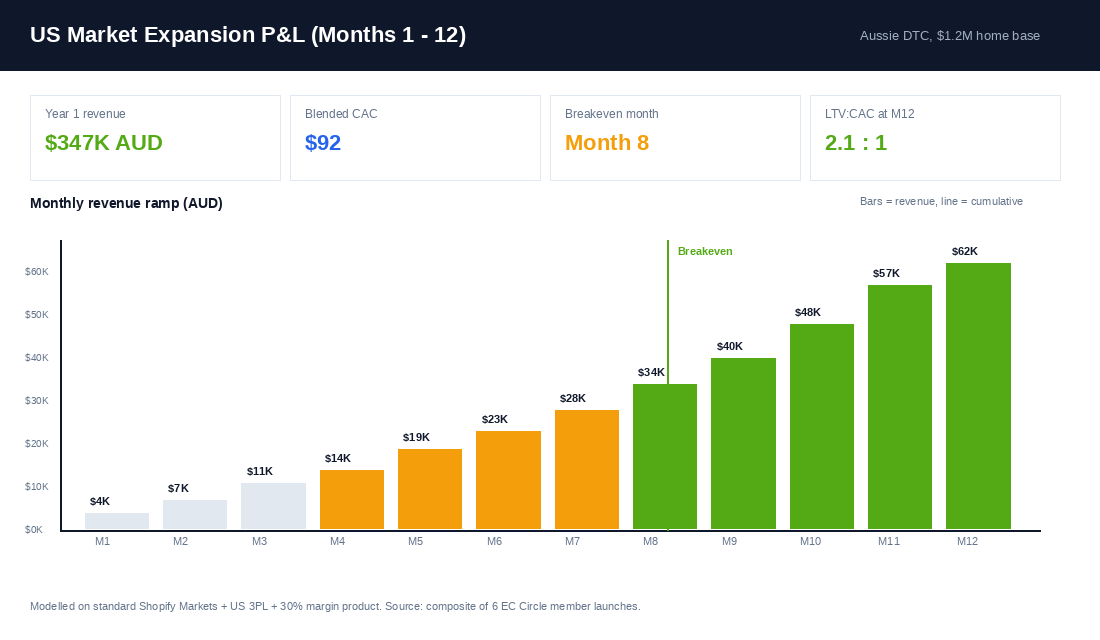
The brands that crack this sequence usually break even on CAC by month 4 to 6 in NZ, month 6 to 9 in the UK, and month 9 to 12 in the US. Justifying the negative CAC in the early months is exactly what your customer lifetime value model is for. If your AU LTV is $180 and your blended international CAC stabilises at $90, you are buying a 2:1 LTV:CAC at maturity. That is a real business.
The Compound Effect of Getting All Five Right
Each step looks like a small lever. None of them on their own will transform your business. The reason the 5-step sequence works is that the levers multiply, not add. Validation cuts wasted spend on the wrong market by 80% to 90%. Architecture saves you a 6-month replatform 18 months down the track. Localisation buys you the 24% conversion lift the global stats promise. Trust takes another 30% to 50% off your CAC. Acquisition channel sequencing buys you profitable scale by month 6 instead of month 18.
Stack those together and a brand turning over $1.2M in Australia can credibly add $300K to $600K of international revenue inside the first 12 months at a blended margin within 5% of their AU number. That is what Showpo, Bondi Sands, Frank Body and MCoBeauty did in their early international years. None of them had a magic product the home market lacked. They had a sequencing discipline most founders skip.
The brands that fail at international are the ones who treat it as a feature flag in Shopify. The brands that win treat it as five separate projects with a 12-month timeline and a P&L per market. Same platform. Same product. Wildly different outcomes.
Your 30-Day Action List
If you are reading this and thinking “we have already turned Markets on,” start here:
- Week 1. Pull GA4 by country for the last 12 months. Pull Shopify orders by shipping country. Identify the top 3 candidate markets by existing demand.
- Week 2. Run the 5-signal validation scorecard on each. Pick one market to commit to (resist the urge to launch all three at once).
- Week 3. Audit your current Markets setup against the 5-layer localisation matrix. Document every gap. Prioritise currency rounding, payment methods, and landed-cost transparency first. They are the highest-impact fixes.
- Week 4. Build the in-market customer Klaviyo flow. Set up the bottom-of-funnel Google Search test. Identify three in-market PR or influencer targets. Book the work.
By the end of 30 days you will have a launch plan, a market commitment, and the first three acquisition tests running. By day 90 you will know whether the market is real or whether you need to redirect to a different country. That is the discipline. International is not magic. It is the same operating system you used to scale to $1M in Australia, applied with intention to a new geography.
The Landed Cost Check: Price Each Market So It Actually Makes Money
The most common way an international launch fails is not low demand. It is a founder who prices the US at the AUD price converted, ships a $45 order for $28 in postage, absorbs a duty surprise, then wonders why the “profitable” new market is bleeding cash three months in. Run the landed cost numbers per market before you switch anything on.
For each market, build a one-line P&L on your average order:
- Shipping reality. Australia Post international standard for a 1kg parcel runs roughly $30 to $45 to the US or UK and $20 to $28 to NZ. If your AOV is under $80, free international shipping is a loss on every order. Either lift the free-shipping threshold for that market (Shopify Markets lets you set it per market) or use a consolidator like Sendle International or a 3PL with US injection to bring the per-parcel cost under $15.
- Duties and taxes. The US removed its US$800 duty-free de minimis in 2025, so US buyers now face duties on every parcel unless you charge them upfront with Shopify’s duties and import taxes feature. The UK collects VAT at checkout on consignments under £135, the EU does the same under €150 via IOSS, and NZ requires you to register for GST once you pass NZ$60k in annual sales there. A buyer who gets a surprise customs bill at the door does not reorder, and often charges back.
- Payment and FX fees. Shopify Payments adds a 1.75% currency conversion fee on top of the transaction fee when you sell in a foreign currency. Budget it. On a $100 order that is $1.75 you did not have in your domestic margin.
- Returns. International return rates for apparel run 15 to 25%, and the return leg costs the same as the outbound one. Either price returns in, use a local returns hub through your 3PL, or offer store credit plus keep-the-item on low-value orders rather than paying $35 to bring back a $40 product.
Once you know the true landed cost, set market pricing deliberately rather than by conversion. Most Aussie brands find their US price needs to sit 10 to 20% above the straight FX conversion to hold contribution margin, and that US shoppers do not blink at it because they are comparing you to local brands, not to your AUD price. Use Shopify Markets price adjustments per market and round to the local psychological price point (US$49, not US$47.83).
If the numbers only work in one market, start there. For most Aussie brands that market is New Zealand, where shipping is cheapest, the GST rules are simple and the buyer already trusts Australian brands. The New Zealand expansion playbook walks through that launch step by step, and a clean NZ result is the best proof you will get before spending real money on the US.
Inside eCommerce Circle, international expansion is one of the core pillars we work on with every member who has hit a domestic ceiling. If you want a second opinion on whether your store is set up to travel, let’s talk. If you want to see which of the 10 P’s is capping your orders right now, take the free More Orders Scorecard. It takes two minutes and tells you exactly where to start.