Most Aussie Shopify founders treat bundles like a fire sale. A pile of stock that is not moving fast enough, a 30% off sticker slapped across the lot, and a quiet hope that the discount does the heavy lifting. It usually does not. The brand looks cheaper, hero margin gets eaten, and the bundle becomes a permanent crutch the moment it converts.
What’s in This Article
The brands lifting AOV 25 to 40% with bundles are not running fire sales. They are running a four-type bundle system that pulls different psychological levers for different shoppers. Some are buying for variety. Some are buying for value. Some are buying for convenience. A single discount blob does not serve any of them well.
This is the playbook we use inside eCommerce Circle with brands turning $40K to $500K a month on Shopify. Four bundle types, when to deploy each, the apps that actually deliver, and the pricing math that protects margin instead of trashing it. By the end, you will know exactly which bundles to build first, which to retire, and how to move slow stock without ever putting your hero product on sale.
Why Most Aussie Founders Get Bundling Wrong
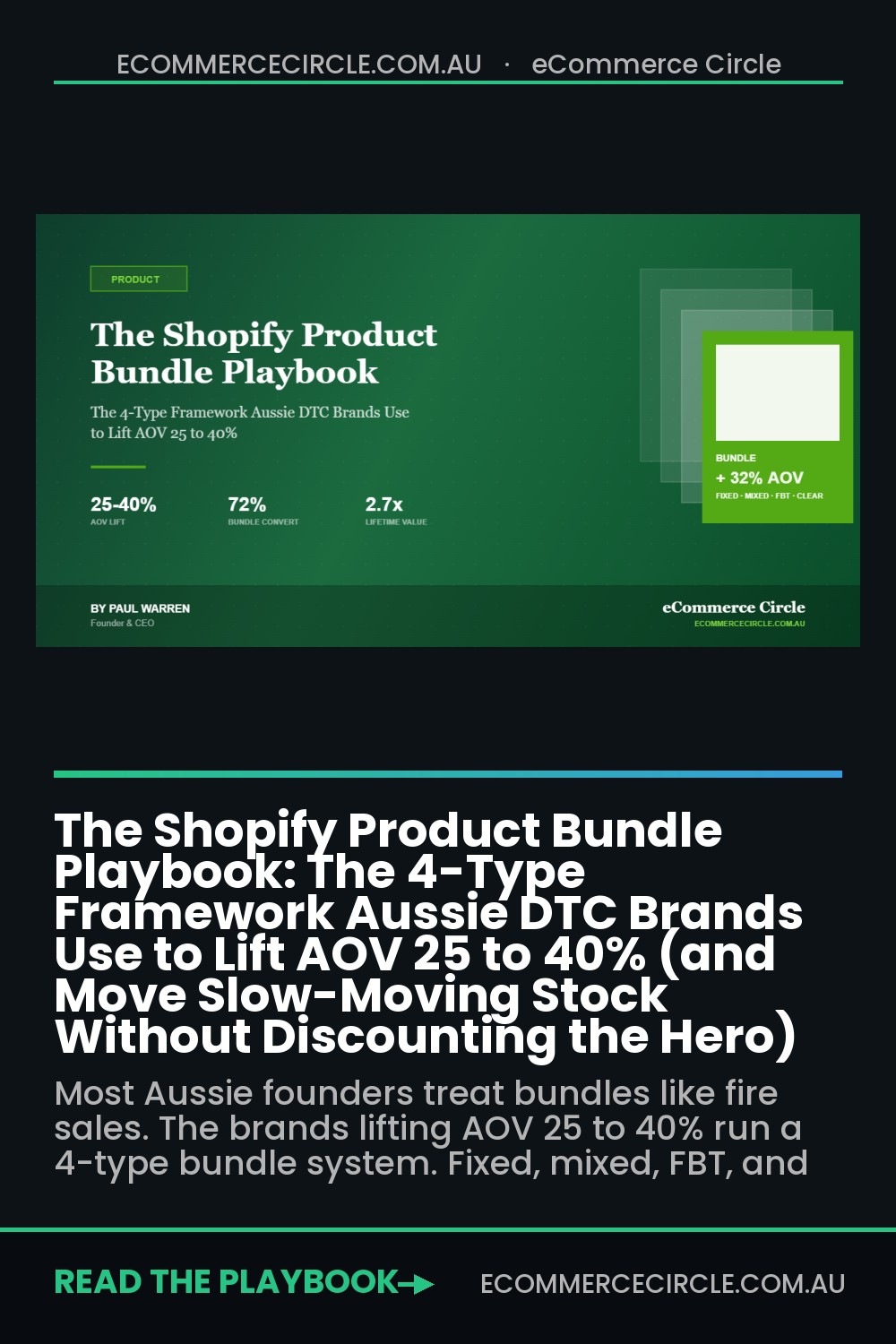
The data on bundling is loud. Industry research shows product bundles lift average order value by 20 to 35% on a typical Shopify store, and the best operators are pushing 55% AOV lifts and 86% revenue per user gains with intentional bundle design. Bundled customers also show 2.7x higher lifetime value than single-item buyers, which means bundling is not just an AOV play, it is a retention play.
And yet, most Shopify stores we audit have one bundle. Maybe two. Sitting in a “Bundles” collection no one ever sees, with a single 15% discount, and zero placement anywhere a real shopper would find it. The founder shrugs and says “bundles do not really work for our category”. They never tried four. They never tried placement. They never tried pricing logic that scales with cart size.
The shift you need to make is this. A bundle is not a discounted multi-pack. A bundle is a merchandised purchase decision. It is your store telling the shopper “you are not buying one moisturiser, you are buying a 30-day skincare routine”. That reframe is the entire reason HiSmile bundles now feature in more than 80% of their orders, quadrupling cart size on a category that used to sell single SKUs. The discount is not what is doing the work. The decision shortcut is.
Bundle Type 1: The Hero Bundle (Your Fixed Starter Pack)
The Hero Bundle is the single fixed bundle every store needs. It is your starter pack. The 3 to 5 products that, in your opinion, every new customer should own to get the full experience of your brand. Same SKUs every time. One price. One landing page. This is pure bundling, the textbook Adams and Yellen definition where the customer can only buy the set, not the components individually inside the bundle context.
Hero Bundles do three jobs at once. They give first-time shoppers a confident purchase path when they have not learned your range yet. They lift AOV on cold traffic where the shopper has no anchor for what a “normal” cart looks like with you. And they hand your paid media team a single SKU to advertise, which is dramatically easier to test against creative than a sprawling catalogue.
The math on a Hero Bundle is simple. Take your hero product, add 2 to 4 complementary SKUs that have a real “and then” relationship with it (the cleanser before the serum, the carrier before the supplement, the brush before the polish), and price the set at a 10 to 15% discount versus buying each item separately. Not 30%. The Hero Bundle is not a discount play, it is a decision-shortcut play. Most founders over-discount the Hero Bundle and signal “this is the budget option” instead of “this is the smart option”.
- Place it on the homepage. A dedicated module above the fold. Not buried in a collection.
- Place it in the main nav. “Starter Pack” or “The Essentials” as a top-level menu item.
- Place it on the PDP of your hero product. “Save 12% when you add the full routine” as a Frequently Bought Together block.
- Run it as a dedicated Meta ad set. Cold traffic landing on a bundle-specific page, not a collection page.
Bundle Type 2: The Build-Your-Own Bundle (Mixed)
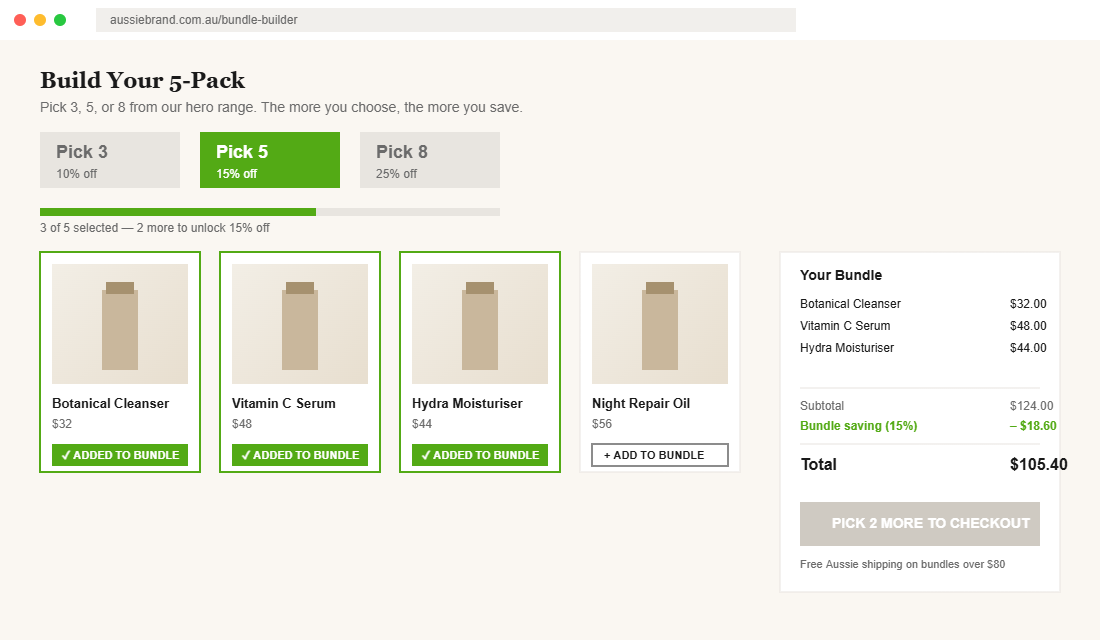
The Build-Your-Own Bundle is where the AOV magic really lives. The customer picks any 3 (or 5, or 8) items from a defined pool, and the discount scales with how many they choose. Pick 3 for 10% off, pick 5 for 15% off, pick 8 for 25% off. This is mixed bundling in its purest form, and the research is unambiguous. Mixed bundling consistently outperforms pure bundling when shoppers have real preference variance across your range.
Bundle-builder sessions are remarkable. Industry data shows 72% of bundle builder sessions end with items added to cart, which is a conversion rate roughly 20x the typical Shopify benchmark of 2 to 4%. The reason is psychological. The shopper has invested 30 seconds choosing what they want, and that effort creates ownership before they have paid a cent. Walking away from the bundle now feels like a loss.
The build-your-own bundle is the highest-return tool you have for a brand with flavour variants, scent variants, colour variants, or any range where the customer wants to “try a few” rather than commit to one. HiSmile built their bundle empire on this exact mechanic with toothpaste flavours. Frank Body does it with scrub flavours. Skincare brands do it with sample-size sets. Pet food brands like Maev have lifted order value 20% and units sold 20% on a build-your-own mechanic alone.
The non-obvious rule. Cap the pool. Do not let the customer choose from your entire 80-SKU range. Pick the 12 to 20 SKUs you actually want to push, lock the pool to those, and the decision becomes a fun curation exercise instead of an overwhelming spreadsheet. The discount ladder also needs to feel earned, not given. 3 for 10%, 5 for 15%, 8 for 25% works because the jumps are visible at every tier. A flat 15% on any 3 or more is forgettable.
Bundle Type 3: The Frequently Bought Together (PDP Cross-Sell)
The Frequently Bought Together (FBT) bundle is the most under-used asset on a Shopify PDP. Amazon famously credits FBT widgets with 35% of its revenue. On Shopify, the typical store either runs no FBT at all or runs a default app widget pulling random “you might also like” products that nobody clicks. The opportunity is enormous and the bar is low.
FBT works because of attention timing. The shopper is on a PDP, they are already convinced enough to be reading the description, and a “Save 8% when you add the matching XYZ” prompt at that exact moment is the lowest-friction upsell window in the entire funnel. The conversion rate on PDP FBT bundles routinely sits between 5% and 12%, depending on category and offer, which is significantly better than post-purchase upsells (typically 8 to 12% of buyers) and dramatically better than email cross-sells.
The build is straightforward. For your top 10 SKUs by revenue, manually curate the 2 or 3 products that genuinely belong with each one. Not what the algorithm guesses. What you, the founder who knows the range, would tell a customer in a store. Then build a PDP block that shows the hero product plus the curated add-ons with a single “Add bundle to cart” button and a stacked discount that appears only when the full bundle is in the cart. The “all or nothing” mechanic is what lifts the AOV. A la carte selection of the add-ons defeats the bundling psychology.
Bundle Type 4: The Slow Mover Clearance Bundle (Without Wrecking Brand)
Every Shopify store has them. SKUs sitting in the warehouse, eating storage, costing capital, and refusing to move. The instinct is to put them on sale. Don’t. A standalone 40% off on a SKU you have been selling at full price for 18 months trains your customer base to wait. It also tells the algorithm that the SKU was never worth what you charged for it.
The Slow Mover Bundle solves this by wrapping the dead stock with a fast-moving hero. Bundle the slow scent with the bestselling scent at a slight discount versus buying both separately, and the customer perceives they are buying the hero plus a “free trial” of something new. You move the slow SKU at full nominal price, the hero stays at full margin, and the bundle protects pricing integrity across your whole catalogue.
The math works because of bundle-pricing perception. Customers do not parse component pricing inside a bundle the way they parse a discounted standalone SKU. A bundle of two scents at a 15% blended discount feels like a deal. A 40% off sticker on a single scent feels like the brand is panicking. The same dollar of margin loss buys you a very different brand signal in each case. This is the cleanest application of mixed bundling in retail, and most Aussie brands ignore it because the operations look like work.
- Pair slow stock with hero stock, never slow with slow. Two dead SKUs in one bundle is still a fire sale.
- Cap the discount at 15%. Anything more and you are training customers to expect bundle pricing on the hero.
- Run it for 60 days, then retire it. Slow mover bundles are operational tools, not permanent SKUs. Once the stock is gone, kill the bundle.
- Do not advertise it to cold traffic. Slow mover bundles are for warm traffic and email lists. They cannibalise hero ads otherwise.
The Bundle Tech Stack: Native vs Rebuy vs Bold
Three real choices for the Aussie Shopify operator. The native Shopify Bundles app (built on Shopify Functions, free, fixed bundles with proper inventory sync). Bold Bundles (mature, mix-and-match, BOGO, volume discount, mid-tier pricing). Rebuy Dynamic Bundles (AI-powered, personalised, premium pricing, best for stores above $200K a month). The decision tree below is the one we apply inside the eCommerce Circle workshop.
- Use native Shopify Bundles for your Hero Bundle. It is free, the inventory sync is rock solid because it lives at the platform level, and 70% of fixed-bundle use cases work perfectly on it. Do not pay for an app to do something Shopify now does natively.
- Use Bold Bundles or a comparable mid-tier app for Build-Your-Own and Slow Mover bundles. Mixed bundling with tiered discounts is where Bold actually earns its monthly fee. The native app cannot do “pick any 5 from this pool with a scaling discount”, and that is where the AOV lift lives.
- Use Rebuy for PDP Frequently Bought Together and post-purchase upsells. The AI-driven recommendation engine genuinely outperforms manual curation once you are running enough traffic to feed it data, which usually means above $200K a month in revenue.
A common mistake. Founders stack two or three of these apps simultaneously without a clear job-to-be-done for each one. The result is a checkout that loads slowly, three competing discount widgets fighting on the same page, and a code base nobody on the team understands. Pick the minimum tool for each bundle type and resist the urge to over-engineer. Most $1M-a-year Aussie stores run perfectly well on native Bundles plus one mid-tier app. Nothing more.
The Bundle Pricing Math: What Discount Works (and What Wrecks Margin)
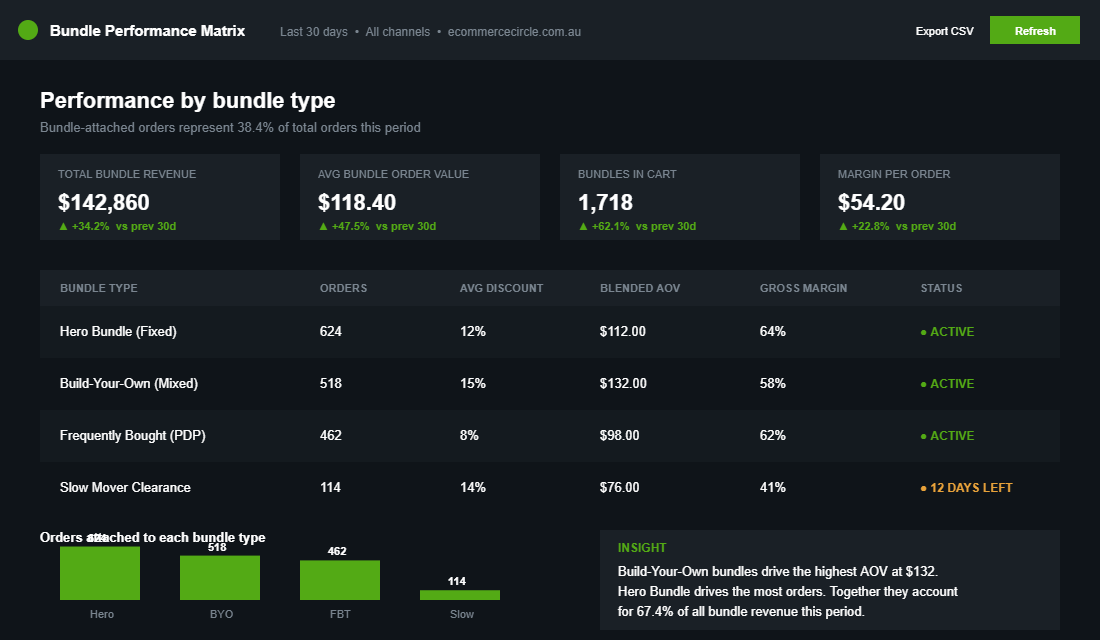
The number that matters is bundle margin contribution, not bundle discount percentage. A 25% discount on a bundle with 70% gross margin still contributes more dollar margin per order than a single hero SKU at full price. A 25% discount on a bundle with 40% gross margin is a slow-motion business kill. Most Aussie founders cannot tell you which of their bundles falls into which camp because they have never run the math.
The framework we use looks like this. Calculate the blended COGS of the bundle (sum the COGS of every component). Calculate the bundle’s selling price after discount. Subtract COGS from selling price to get the dollar margin per bundle. Compare that dollar margin to the dollar margin of your hero product sold standalone. If the bundle generates more dollar margin per order, it is a winning bundle. If it generates less, the discount is too deep or the components are wrong.
The discount tiers that consistently work in our portfolio of Aussie DTC clients. Hero Bundle: 10 to 15%. Build-Your-Own: 10% / 15% / 25% laddered by quantity. Frequently Bought Together: 5 to 10%. Slow Mover Bundle: 10 to 15% blended. Anything above 25% on any bundle type starts cannibalising hero AOV, anchoring future expectations, and showing up in your MER as a margin compression instead of a revenue expansion. A 68% lift in upsell efficiency over acquisition spend is the industry benchmark for well-designed bundling, and that only holds when the discounts stay disciplined.
The Compound Effect: How the Four Bundles Work as a System
Each of these four bundle types is decent on its own. Stacked together, they form a system that meets the shopper at every stage of intent and lifts AOV at every entry point into your store. The Hero Bundle catches the cold-traffic shopper who does not know your range. The Build-Your-Own catches the warm shopper exploring variety. The Frequently Bought Together catches the convinced shopper already on a PDP. The Slow Mover Bundle keeps your operations clean without damaging brand pricing.
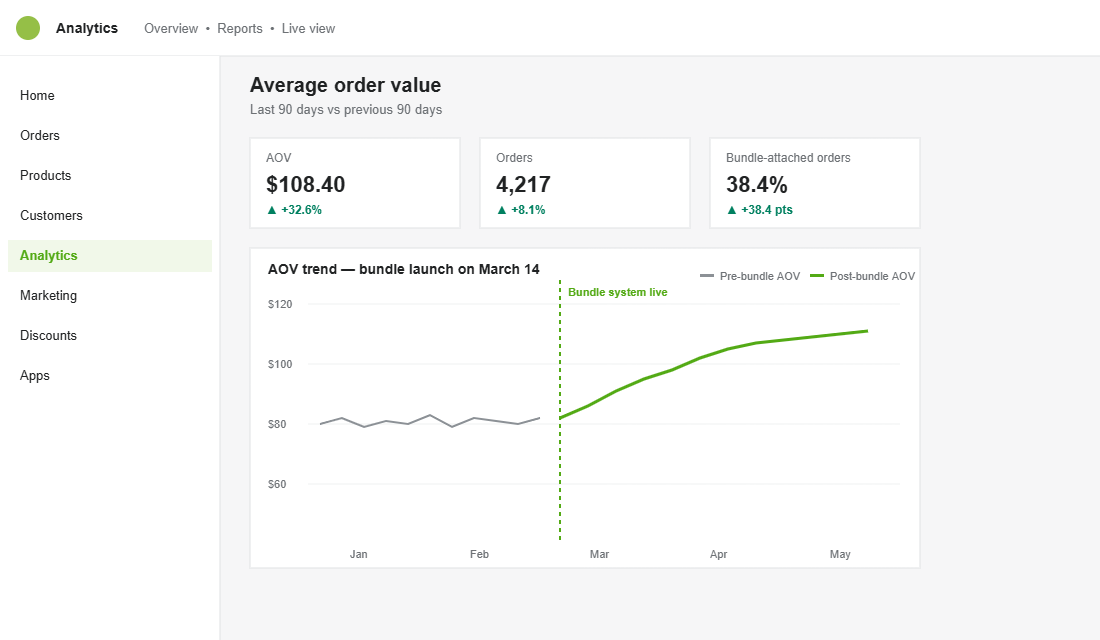
The compounding math is meaningful. If your baseline AOV is $80, and the Hero Bundle lifts cold-traffic AOV to $115, the Build-Your-Own lifts collection-page AOV to $140, and the PDP FBT adds another $12 to bundle-qualified orders, your blended AOV moves from $80 to roughly $108 to $115. That is a 35 to 45% lift on the same traffic, same ad spend, same brand. Bundles are the single highest-leverage AOV move a Shopify store can make in 2026, and most stores have done none of this work.
Bundles also defend you against the rising cost of paid acquisition. With CPMs continuing to climb on Meta and Google, the brands surviving are the ones extracting more revenue per session, not finding cheaper sessions. A 30% AOV lift from bundles directly compounds with the work you are already doing on your Marketing Efficiency Ratio (MER), your hero product positioning, and your product description copy. Bundles are not a tactic. They are an architectural layer in your store.
Your 7-Day Bundle Build Checklist
Run this sequence in your store this week. It will take a Shopify-literate operator or developer roughly 8 to 12 hours total across the week, and you will see results in the data within 14 days.
- Day 1. Pull your last 90 days of orders into a spreadsheet. Calculate baseline AOV, identify your top 10 SKUs by revenue, and identify the 5 to 10 slowest-moving SKUs by sell-through rate.
- Day 2. Build the Hero Bundle. Pick 3 to 5 complementary SKUs anchored by your bestseller. Price at a 10 to 15% discount. Use native Shopify Bundles to build it.
- Day 3. Add Hero Bundle placements. Homepage hero module above the fold, main nav entry called “Starter Pack” or “Best Sellers Bundle”, and a slot in the first three rows of your bestseller collection.
- Day 4. Turn on Frequently Bought Together on your top 10 PDPs only. Do not roll it out store-wide on day one. Pair by real order data, not by what you think goes together.
- Day 5. Build the Build-Your-Own Bundle for your widest variant range. Set the tier breaks at 3, 6 and 12 units, and make the middle tier the one you actually want people to pick.
- Day 6. Build one Slow Mover Clearance Bundle. Anchor it with a hero SKU so it reads as a value pack, not a dumping ground. Cap the quantity and give it an end date.
- Day 7. Set up reporting. Tag every bundle SKU with a
bundle-prefix so you can filter them in Shopify Analytics, and set a calendar reminder to review AOV, attach rate and bundle margin on day 14.
How to Tell If Your Bundles Are Actually Working
This is where most Aussie founders stop. They build the bundles, watch AOV tick up, and call it a win. Then three months later margin has quietly gone backwards and nobody can say why.
Four numbers tell you the truth. Track them fortnightly, not daily, because bundle data is noisy at low order volumes.
- Bundle attach rate. The share of orders containing at least one bundle SKU. A healthy store lands between 15 and 30% within 60 days. Under 10% means your placement is wrong, not your bundle.
- Blended AOV versus pre-bundle baseline. Compare the same 30-day window against the equivalent window before launch. A 15 to 25% lift is a good result. A 40% lift usually means you are cannibalising multi-item orders that would have happened anyway.
- Contribution margin per order, not gross margin percentage. Bundles almost always drop margin percentage and raise margin dollars. If your margin percentage fell from 62% to 55% but dollars per order went from $38 to $51, you are winning. Judge the dollars.
- Bundle return rate versus single-SKU return rate. Watch this one. Build-your-own bundles often carry a 3 to 6 percentage point higher return rate because customers gamble on variants they would not have bought alone.
Shopify’s native Analytics will get you attach rate and AOV. For contribution margin per order you want something that ingests COGS and shipping, which means Lifetimely, Triple Whale or a properly built Google Sheet. A spreadsheet you actually open beats a dashboard you ignore.
One warning on cannibalisation. Before you launch, note the share of your orders that already contain two or more units. If that number was 34% and your bundle attach rate lands at 22%, a large slice of those bundle orders are people who were going to buy two items anyway, and you just handed them 15% off for the privilege. The fix is not to kill the bundle. It is to tighten the discount and move the bundle further up the funnel where it wins new customers instead of discounting existing ones.
The Bundle Mistakes That Cost the Most Money
Three errors show up again and again in Aussie stores, and all three are expensive.
Discounting the bundle and running a sitewide sale at the same time. Stack a 15% bundle discount on a 20% Click Frenzy promotion and you have just sold your hero product at 32% off. Set an app-level or Shopify Function rule that excludes bundle SKUs from sitewide codes before peak season, not during it.
Ignoring freight on the clearance bundle. A six-unit value pack that ships in a satchel is fine. The same pack in a carton that tips you into the next cubic weight bracket can eat $9 to $14 an order in Australia, which is often the entire margin on the discount you just gave. Weigh and measure the packed bundle before you price it.
Letting bundles break your inventory maths. If your bundle is a separate SKU rather than a component-linked bundle, Shopify will not decrement the individual products, and you will oversell your hero. Use native Shopify Bundles or an app with true component inventory sync. Getting this wrong during BFCM is how founders end up refunding 200 orders in December.
Fix those three and the four-bundle system does what it is supposed to do: raise the value of traffic you already paid for.
Inside eCommerce Circle, bundle architecture and the margin maths behind it is one of the core pillars we work on with every member. If you want a second opinion on whether your bundles are lifting profit or just moving it around, let’s talk.