You have spent three years learning how to buy traffic, and you are still paying more for it than you did last year. Meanwhile the biggest sales channel in the country is sitting in a hall twenty minutes from your warehouse, and the entry fee is roughly what you spend on Meta in a slow week.
What’s in This Article
Here is the number most online founders never sit with properly. Online retail is only about 12.7% of total Australian retail turnover according to the final ABS Retail Trade release in June 2025, and the NAB index puts it closer to 14.6%. Take the generous end of that range and you still land on the same conclusion: roughly 85 cents in every retail dollar in this country is still spent with a human present.
Most Shopify founders treat markets and pop-ups as a hobby. They book a stall because a friend did one, they price the weekend on vibes, they sell a decent amount of stock, and three weeks later they cannot tell you whether it made money. That is the wrong approach, and it is why so many brands do one market, decide it was not worth it, and never go back. Run properly, a pop-up is not a novelty. It is a customer acquisition channel with a knowable cost per acquisition, a first-party email list you own outright, and product feedback you cannot buy from any research panel.
Why In-Person Selling Got More Valuable, Not Less
Australians spent a record 82.6 billion dollars online in 2025, up 14% year on year, with 9.8 million households (82% of all households) shopping online, according to the Australia Post eCommerce Report 2026. Sounds like online is winning. Look one layer deeper and the picture changes.
The same report shows the average online basket has shrunk to 96 dollars, and households now buy from an average of 16 different brands a year. People are buying more often, from more brands, in smaller amounts. That is a market where being memorable matters more than being findable. It is very hard to be memorable in a 3 second scroll. It is very easy to be memorable when someone holds your product, meets the person who made it, and walks away with your card in their pocket.
The cross-channel data backs it up. Omnichannel customers spend around 16% more per order and carry roughly 30% higher lifetime value than single-channel shoppers. The ICSC halo research found that a shopper who spends 100 dollars in person and then buys online with the same retailer inside 15 days averages a net spend of 267 dollars. The in-person transaction is not the return. It is the trigger.
Two Australian brands make the case better than any statistic. July launched online in 2019 and now runs 15 permanent stores in Australia, including its largest at QV in Melbourne. Bared Footwear, built by podiatrist Anna Baird, has five Australian stores and ran two New York pop-ups in 2025 that generated close to 1 million dollars in combined revenue across six trading days before committing to a permanent US site. Neither brand jumped straight to a lease. They tested demand in temporary space first, with a stopwatch and a spreadsheet.
Step 1: Choose the Event by Basket Size, Not by Postcode
The single most common mistake is picking the market that is closest or cheapest. Proximity has nothing to do with profit. The only question that matters is whether the people walking through that door already spend at your price point on your category.
The Australian event landscape splits into three tiers, and the fee tells you the tier before anyone tells you the footfall:
- Community and weekend markets: 40 to 145 dollars a day. High foot traffic, low intent, average spend usually under 40 dollars. Good for products under 50 dollars and for cash-flowing slow stock. Poor for anything considered.
- Established urban and food markets: 145 to 370 dollars a day. Regular crowd, some buying intent, mixed demographics. This is your testing ground before you commit to a premium event.
- Curated design and maker events: 1,000 dollars and up for the weekend. The Finders Keepers runs over 250 independent stalls in the Royal Exhibition Building, with a debut stall from 1,090 dollars for a 2m by 2m space across three trading days and standard stalls from 1,740 up to 3,650 dollars for a 6m by 2m corner. Attendees turn up with a wallet and an intention.
Before you apply anywhere, do the walk. Go to the event as a shopper the round before you plan to trade. Stand near the entrance for twenty minutes and count. How many people carry a paid bag? How many stalls in your category are there, and are they busy or bored? Ask two stallholders one question: “would you book again?” You will learn more in an hour than from any organiser media kit.
Then apply a filter I use with members. If your average online order value is under 60 dollars, a premium curated event will struggle to clear its own fee unless you can lift basket size with a bundle. If your AOV is over 120 dollars, community markets will waste your weekend. Match the tier to the ticket.
Step 2: Run the Breakeven Maths Before You Pay the Stall Fee
This is the step almost everybody skips, and it takes eleven minutes. You need one number before you commit: how many units you have to sell just to walk out even.
Split your costs into fixed and variable. Fixed costs are everything you pay whether you sell one unit or four hundred: the stall fee, fixtures and signage amortised across the number of events you will use them for, staff hours including casual loading, travel, parking and freight. Variable costs are what each individual sale costs you: landed product cost plus the card fee.
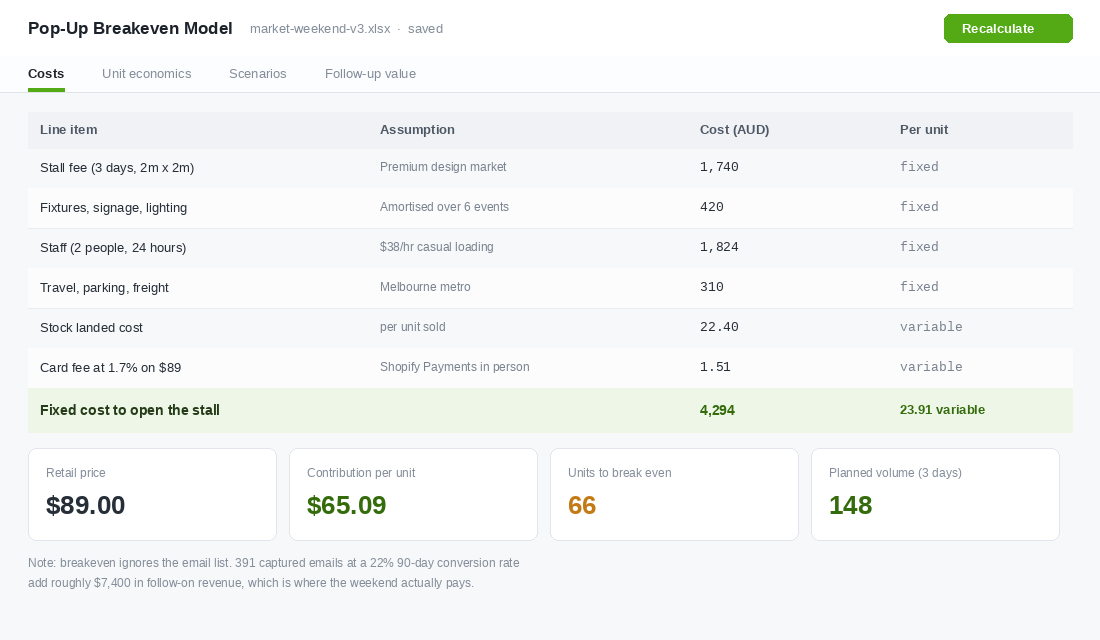
Worked example on a premium three day event. Fixed costs: 1,740 stall, 420 fixtures, 1,824 staff (two people, 24 hours, 38 dollars an hour), 310 travel and freight. That is 4,294 dollars to open the door. Your product retails at 89 dollars, lands at 22.40, and the card fee at 1.7% is 1.51. Contribution per unit is 65.09 dollars. Divide 4,294 by 65.09 and you get 66 units to break even.
Now the question becomes answerable. Sixty-six units across three days is 22 a day, or roughly three an hour in an eight hour trading day. If the event pulls 12,000 people over the weekend, you need a conversion rate of 0.55% of total footfall. That is a fair bet. If the event pulls 1,500 people, you need 4.4%, which is not. Same stall fee, completely different decision.
Two rules that keep this honest. First, pay your own time. If you are standing at the stall for 24 hours, cost it at what you would pay someone else, or you will fool yourself into believing marginal events are profitable. Second, amortise fixtures across their real life, not the first event. A 2,500 dollar stall kit used six times is 420 a market, not 2,500. If you want the full method behind contribution maths, our contribution margin playbook walks through it for online orders as well.
Step 3: Set Up Shopify POS So Every Sale Lands in One Ledger
If you take payments through a standalone card reader or, worse, a bank transfer and a notebook, you have thrown away the entire strategic value of the weekend. You will have money. You will not have data, inventory accuracy, or a customer record you can market to.
Shopify POS Lite is included on every Shopify plan at no extra cost. POS Pro is 89 dollars a month per location, or 79 on annual billing, and adds multi-location inventory, per-store reporting and staff permissions. For a single weekend, Lite is usually enough. If you are running four or more events a year, or sending staff without you, Pro pays for itself on inventory accuracy alone.
Set it up in this order, and do it the week before, not the morning of:
- Create the pop-up as its own location. Settings, then Locations, then Add location. Name it after the event, not “Retail”. You want “Pop-up: Melbourne October” so that six months later the reporting still means something.
- Allocate stock to that location. Move the units you are taking out of your main warehouse inventory in Shopify before you pack the car. If you skip this, your online store keeps selling stock that is sitting in a crate in Carlton.
- Install the Shopify POS app and pin the location. Log in on the device you will actually use, select the pop-up location, and confirm the till shows the right stock counts.
- Turn on Tap to Pay. Shopify POS supports Tap to Pay on both iPhone and Android in Australia. You need an iPhone XS or newer. It costs nothing, needs no hardware, and clears a queue faster than any reader. Keep a Tap and Chip Reader (about 49 dollars) as your backup device on a second phone.
- Create staff PINs and permissions. Even if it is just you and one helper. It is how you find out which shifts sold what.
- Build a market-only discount and a market bundle. Create them as POS-only so nothing leaks to your website. Our dead stock playbook covers how to structure clearance bundles that move slow lines without training customers to wait for sales.
- Test one full transaction the night before. Sell yourself something for one dollar, refund it, and confirm it appears against the right location in your admin. Do not discover a login problem at 9:02am with six people waiting.
One practical note on connectivity. Exhibition halls are notorious for dead mobile coverage once 8,000 people arrive. Take a phone on a different carrier as a hotspot, and download your product images to the device before you leave home.
Step 4: Build the Stall Around One Decision
Online, you have a full product page to do the persuading. At a market you have about four seconds of peripheral vision as someone walks past, and if you win those four seconds you get maybe ninety more.
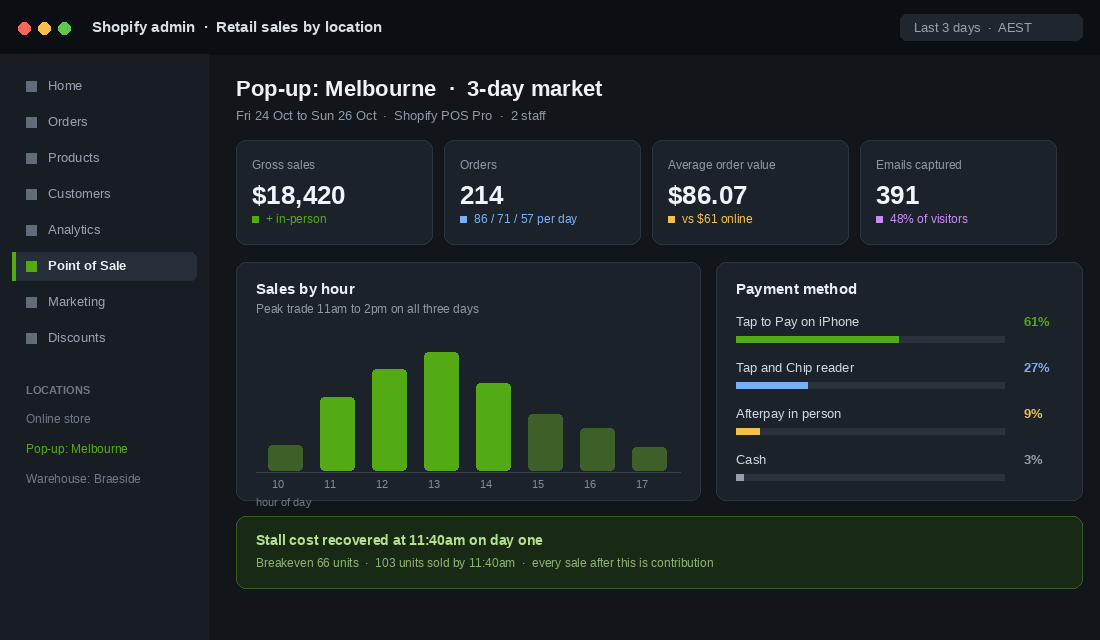
Most founders bring their entire catalogue. That is a mistake born of optimism. A wall of forty SKUs makes the decision harder, and a harder decision means a slower browse, which means fewer people served per hour, which means you miss your breakeven number during peak trade. In-person sales cluster hard: on most weekend events the window from 11am to 2pm delivers more than half the day’s revenue. Your stall has to be built for throughput in that window.
- Three price points, maximum. An entry item under 40 dollars, a hero item at your core price, and one premium option or bundle. The entry item is what converts the browser. The hero is what pays for the weekend.
- One sign, readable from six metres. Brand name and what you actually make. Not a tagline. If someone cannot tell what you sell from across the aisle, they walk on.
- Put the product at hand height, not table height. Risers and a back wall get your product into eye line. Flat trestle displays read as clearance.
- Let people touch it. Have a designated demo unit that is allowed to get scuffed. Handling is the entire reason in-person converts better than a PDP.
- Post-market pickup and shipping. Sell items you did not bring by taking the order on POS and shipping it. This is free revenue that costs you nothing in stall space.
Write down the three questions you get asked most across the weekend. You are running free qualitative research at a scale most brands pay an agency for. Those questions belong on your product page on Monday, because if 40 people at a stall need to ask it, several thousand online shoppers wanted to ask it and left instead.
Step 5: Capture the People Who Do Not Buy
Here is the reframe that changes pop-up economics completely. On a good weekend, maybe 3% of the people who look at your stall will buy. The other 97% are not a failure. They are the actual asset, and almost nobody collects them.
A well-run stall captures 300 to 400 email addresses across three days, which is a first-party list of people who have physically met your brand. Compare that with what you pay for a cold email subscriber through paid social and the maths gets uncomfortable in a good way.
How to actually get them, in order of what works:
- Email receipts at the till. Shopify POS prompts for an email on checkout. Every buyer becomes a customer record with the pop-up location attached. Ask, do not assume: “want the receipt emailed, and would you like ten dollars off your next order?”
- One tablet, one field, one reason. A single iPad running a simple sign-up. Ask for email only. Every extra field cuts completion. Give a real reason to sign up: early access to the next drop, not a vague newsletter.
- A prize draw with a genuine prize. A product bundle worth 200 dollars will out-collect a discount code four to one. Make sure the entry form carries an explicit marketing consent tick so your list is clean under Australian privacy and spam rules.
- Tag the source at capture. Every address must carry the event name. Untagged lists are dead lists because you can never write to them with context.
Ask one qualifying question if you can do it conversationally: “what were you looking for today?” Type the answer straight into a note on the customer record. That is zero-party data of a quality you will never get from a popup form, and our zero-party data playbook covers how to structure it so it stays usable.
Step 6: Run the 30-Day Follow-Up That Pays for the Weekend
The stall does not pay for itself on the day. It pays for itself in the four weeks after, and only if you have built the flow before you leave for the event.
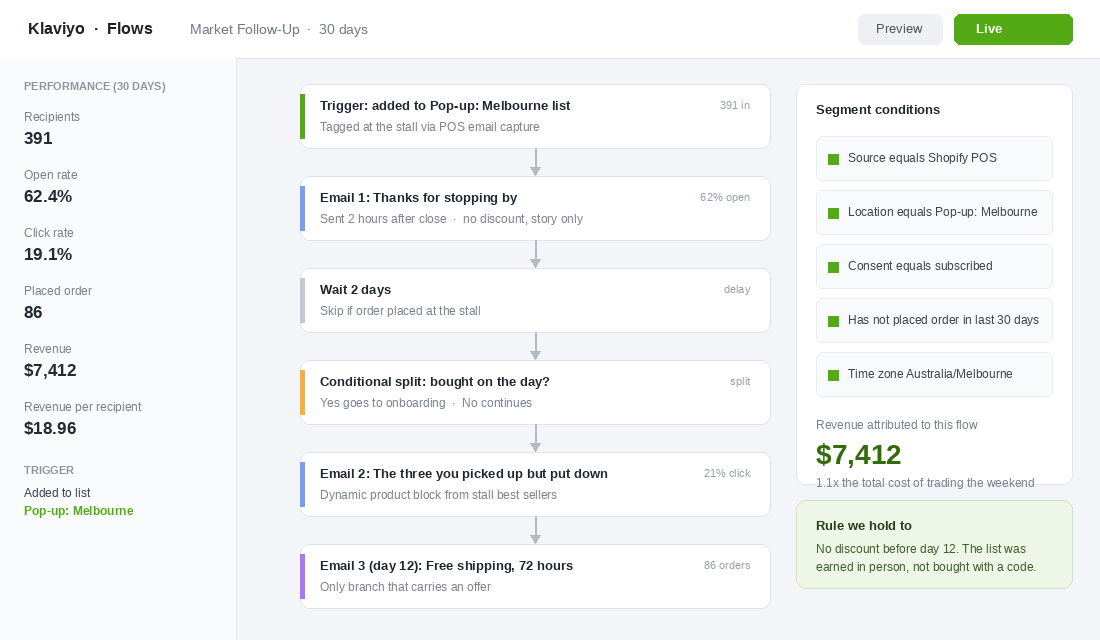
Build it in Klaviyo (or your ESP of choice) as a list-triggered flow on the event list. Four components:
- Email 1, sent two hours after the event closes. Subject line names the event. No discount. Thank them, tell them the story of the thing they picked up, link to the three products that sold best on the day. Open rates on this email routinely clear 60% because the memory is still warm.
- Wait two days, then split on purchase behaviour. Buyers go into a product onboarding sequence about getting the most out of what they bought. Non-buyers continue down the acquisition branch. Sending a “come back and buy” email to someone who already bought at the stall is the fastest way to look like you were not paying attention.
- Email 2, day four, no offer. Handle the objection that stopped them. Sizing, care, materials, delivery time. Use the three questions you wrote down at the stall. This email exists to remove friction, not to discount.
- Email 3, day twelve, one offer with a real deadline. Free shipping for 72 hours or a modest first-order incentive. One offer, once. Hold the line on not discounting before day twelve. The list was earned in person, and training it to wait for a code destroys the margin advantage you just built.
Measure the flow against the full cost of the weekend, not just the stall fee. A list of 391 addresses converting at around 22% over 90 days at an 86 dollar average order returns roughly 7,400 dollars in follow-on revenue. On our worked example that alone covers the 4,294 dollars of fixed cost with room to spare, before you count a single unit sold on the day.
The Compound Effect: One Weekend, Three Assets
Once the six steps run together, you stop thinking about pop-ups as a revenue event and start seeing what they actually produce. Every weekend generates three assets, and only one of them is cash.
Asset one is the customer list. Four hundred first-party contacts a year from three events, with a source tag and a conversation attached. That is a list you own, unaffected by an algorithm change, a policy update or a rising CPM.
Asset two is the product intelligence. You watched two hundred people pick up your product and put it down. You know which colourway everybody reached for and which one nobody touched. You know the exact sentence people use when they describe what you sell, which is the sentence that belongs at the top of your product page. Buy that from a research firm and it is a five figure engagement.
Asset three is the content. Three days of a real stall, real customers and real reactions is a quarter of organic social and email creative, shot for the cost of asking a friend to film for an hour. Founder-in-the-stall footage consistently outperforms studio product video because it is unfakeable.
Now layer the halo effect on top. Those in-person buyers spend meaningfully more with you over the following fortnight than a cold online customer would, and they carry roughly 30% higher lifetime value as omnichannel shoppers. Three events a year with a disciplined follow-up compounds into a customer base with a materially better repeat rate than a store that only ever acquires through the feed. That is how July got from an online launch in 2019 to fifteen Australian stores, and how Bared validated New York before signing anything.
Your One-Page Pop-Up P and L
Copy this into a spreadsheet and fill it in before you pay any deposit. If the last line does not clear zero on a conservative footfall assumption, do not book the event.
- Fixed costs. Stall fee. Fixtures and signage divided by planned events. Staff hours at real hourly cost including your own. Travel, parking, accommodation, freight. Insurance and any council permit. Add them up. This is your number to beat.
- Variable cost per unit. Landed product cost plus card fee at 1.7% of retail. Nothing else.
- Contribution per unit. Retail price minus variable cost.
- Breakeven units. Fixed costs divided by contribution per unit.
- Required conversion rate. Breakeven units divided by expected footfall. Anything above 3% is optimistic. Anything under 1% is a good bet.
- Email capture target. Set it at 40% of the people you speak to, and track it hourly on the day so you can correct on Saturday rather than regret it on Sunday.
- Follow-up revenue target. Captured emails multiplied by 20% conversion multiplied by your online AOV. Track it in the flow for 90 days.
- True result. Day-of contribution plus 90 day follow-up revenue, minus fixed costs. This is the only number that tells you whether to rebook.
Run this for three events and you will have something almost no Australian online brand has: a repeatable, costed, in-person acquisition channel with a known payback period. Most of your competitors will still be bidding against each other for the same 15% of retail while the other 85% walks past their empty stall.
Inside eCommerce Circle, working out which acquisition channels actually deserve your next dollar is one of the core pillars we work on with every member. If you want a second opinion on yours, let’s talk.