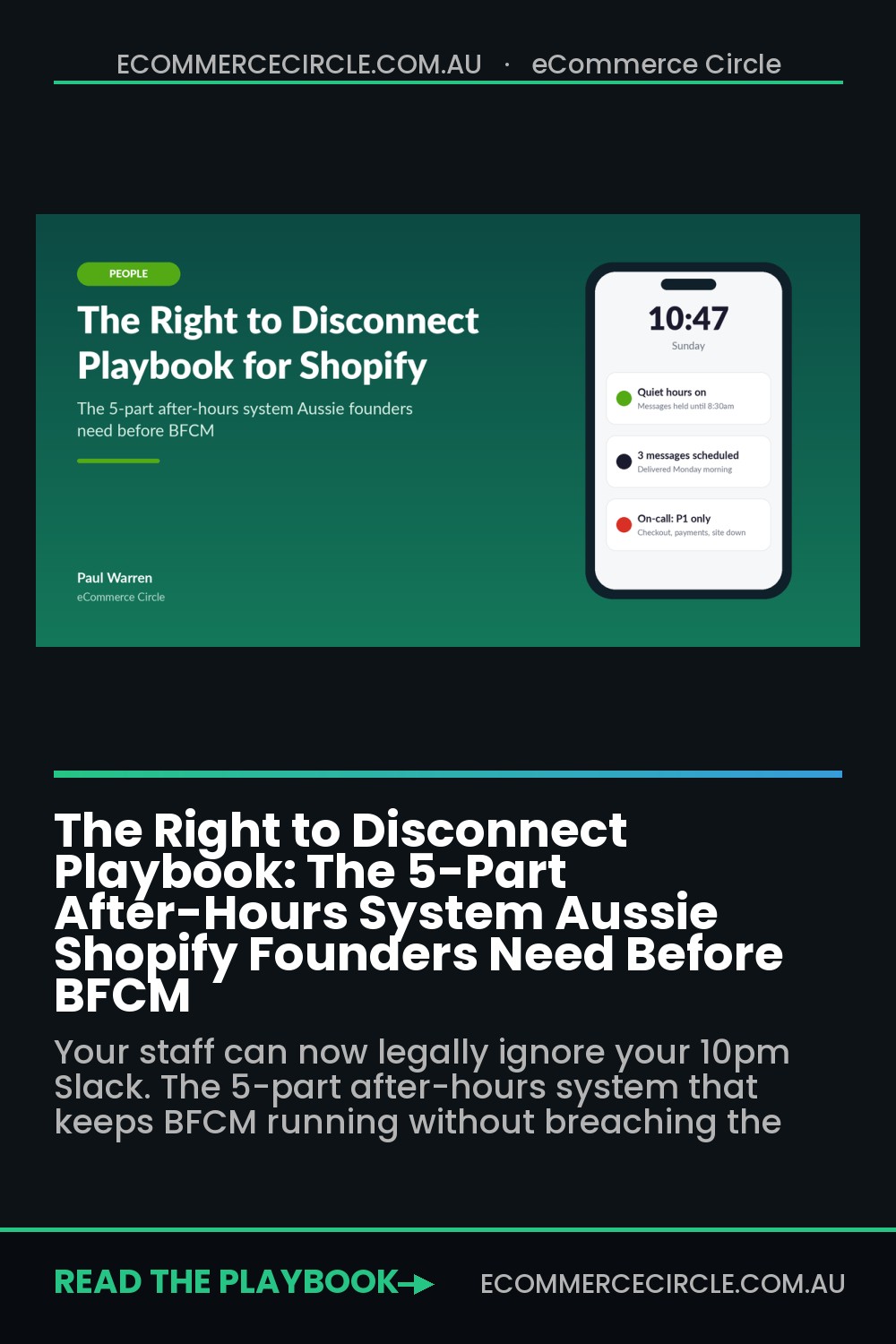
It is 10:47pm on a Sunday. You have just had a great idea for Tuesday’s email, so you drop it in Slack before you forget. Then you remember the 3PL flagged low stock on your hero SKU, so you tag your ops lead. Then you check Meta and fire off a note to your media buyer about CPMs.
What’s in This Article
Three messages, sixty seconds, and you feel productive. Your team feels something else. And since 26 August 2025, every one of those employees has a legal right to ignore you.
Most founders I talk to either do not know the right to disconnect applies to them, or they assume it only bites big corporates. It does not. It now covers every small business employee in the country, and Black Friday is the exact week most Shopify founders are most likely to trip over it. The brands that get this right do not go quiet after hours. They build a system where the store trades 24/7, a small number of genuine emergencies get a phone call, and everything else waits until 8:30am. That system is what this playbook gives you.
This article is general information for Australian Shopify founders, not legal advice. Check your modern award and your employment contracts, and call the Fair Work Ombudsman on 13 13 94 if you are unsure how the rules apply to a specific person.
What the Right to Disconnect Actually Says (in Plain English)
The law sits in sections 333M to 333W of the Fair Work Act. It started for businesses with 15 or more employees on 26 August 2024 and extended to small businesses, meaning fewer than 15 employees, on 26 August 2025. According to the Fair Work Ombudsman, an employee can refuse to monitor, read or respond to contact outside their working hours unless that refusal is unreasonable.
Three details matter most for an online store:
- It is not a ban on you sending messages. You can still send a Slack at 10pm. Your employee is simply protected if they ignore it, and you cannot discipline or sideline them for doing so. The right is a workplace right under the general protections rules.
- It covers third parties too. Contact from suppliers, your 3PL, agencies and customers counts. If your support person has your helpdesk app on their personal phone, customer tickets at midnight are in scope.
- “Unreasonable” is decided by five factors. The reason for the contact, how it is made and how disruptive it is, whether the person is paid extra to be available or work extra hours, their role and seniority, and their personal circumstances including caring responsibilities. Contact that is required by law is always reasonable.
If a dispute cannot be sorted out at work, either side can take it to the Fair Work Commission, which can make stop orders. Breaching one of those orders carries penalties of up to $18,780 per contravention for an individual and $93,900 for a company, according to the Small Business Association of Australia figures reported by Information Age.
The fines are not really the point, though. The point is that your team now has a clear legal footing to say “not tonight”, and most small stores have never written down what counts as tonight’s problem.
Why This Hits Shopify Brands Harder Than Most Small Businesses
A café closes at 3pm. Your store never closes. Orders, tickets, ad spend and 3PL alerts arrive around the clock, and in most small DTC teams the only thing standing between those alerts and your staff’s personal phones is your own self-control at 10:47pm.
The data says that self-control is not holding. The Australia Institute’s Centre for Future Work found Australian employees still do 3.6 hours of unpaid overtime a week in 2025, around 173 hours a year and close to $8,000 each in lost wages. Workers aged 18 to 24, the age bracket many Shopify brands hire for support and social roles, do the most at 4.7 hours a week. In the 2024 survey, the second most common reason for working outside hours (31%) was covering for staff shortages when someone else is away. That is every small team during peak.
The culture has not caught up with the law either. Only a quarter of workers in an April 2025 survey said their workplace had a formal policy or structure around the right to disconnect. Recruiter Robert Half found 56% of Australian employers had received formal requests or complaints from staff wanting to exercise it. And Elmo Software’s employee sentiment research found two in five workers still felt uncomfortable ignoring after-hours messages, while one in six had copped negative consequences for not replying.
Now add Black Friday. The ARA and Roy Morgan tipped Australians to spend a record $6.8 billion over the 2025 Black Friday to Cyber Monday weekend. This year Black Friday lands on Friday 27 November and Cyber Monday on 30 November. That is four days where a broken checkout costs real money, and four days where a panicked founder is most likely to message everyone about everything.
You do not solve that by promising never to contact anyone. You solve it with a system.
Part 1: Map What Actually Breaks After Hours
Before you write a single policy, find out what your after-hours contact actually is. Most founders are shocked by this step.
Scroll back through the last 90 days of Slack, WhatsApp, email and text messages you sent to employees outside their rostered hours. Export them into a sheet, or just count them by hand over a coffee. Then sort every message into one of three tiers:
- P1: Revenue is stopping right now. Checkout is down, payments are failing, the site is offline, a theme publish broke the cart, or ad spend is running wildly over its daily cap. If nobody acts tonight, you lose money tonight.
- P2: It matters, but 8:30am is fine. The 3PL flagged a stock-out, an influencer posted early, a wholesale customer needs a quote. Important, but nothing gets worse by morning that a ticket cannot fix.
- P3: It is a thought, not an incident. Email ideas, “can you look at this”, weekly numbers questions and most customer complaints. None of these need a human tonight.
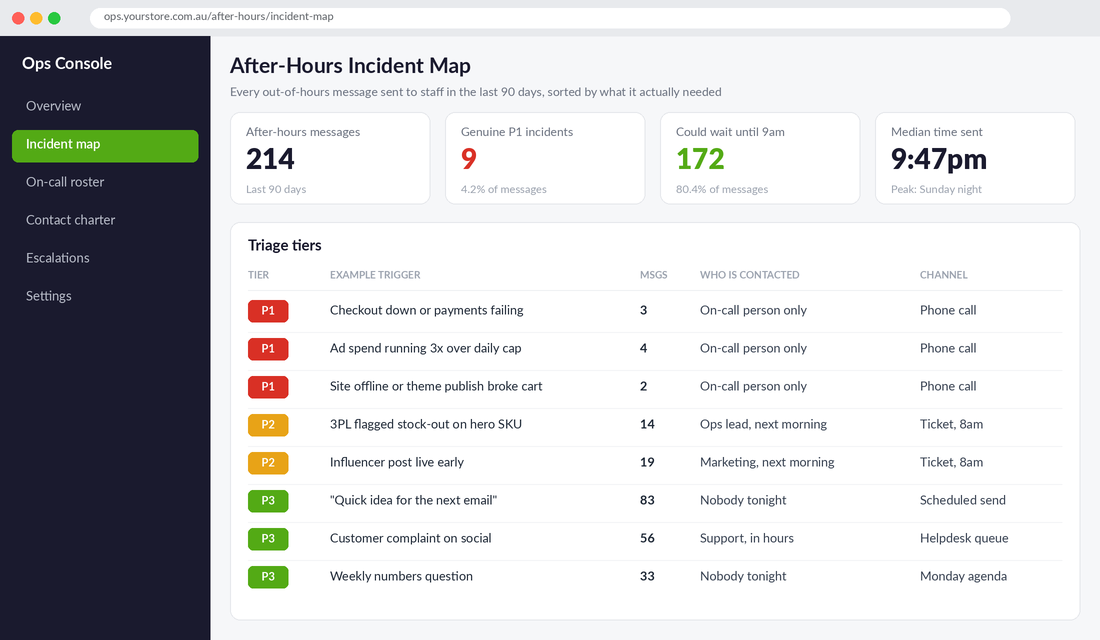
When we run this with founders, the pattern is nearly always the same. Genuine P1 incidents are a tiny slice of after-hours messages. P3 thoughts are the overwhelming majority, and the median send time is somewhere between 9pm and 11pm on a weeknight or Sunday.
That tells you something important. Your after-hours problem is mostly a founder habit, not an operational need. Which means most of it can be fixed with tooling and discipline rather than rosters and allowances. The P1 slice is what you build a proper on-call system around. Everything else gets scheduled.
Write your P1 list down. For most Shopify brands it is five to eight triggers long. If yours is longer than ten, you are probably calling P2 problems emergencies.
Part 2: Write a One-Page After-Hours Contact Charter
The Fair Work Ombudsman encourages employers to talk with staff about out-of-hours contact before it happens and to record what is agreed in writing. For a small online store, that becomes a single page I call the After-Hours Contact Charter. It maps directly onto the five reasonableness factors, which is exactly why it works.
Your charter answers six questions:
- What are our working hours? Per role, including any flexible arrangements. If your support lead finishes at 3pm for school pickup, that goes in.
- What counts as an after-hours incident? Paste your P1 list from Part 1. Nothing else qualifies.
- Who gets contacted for each incident? One named person per night, never the whole team.
- How are they contacted? One channel for emergencies, usually a phone call followed by a text. No Slack, no email, no Instagram DMs outside hours.
- How is availability paid for? An on-call allowance, overtime, time in lieu, or a salary that expressly factors it in for senior roles. Check your award first.
- When do we review it? After every peak event and whenever someone’s hours change.
Two rules make the charter hold up. First, role and seniority do the heavy lifting. It is far more reasonable to expect a salaried operations manager to take a call about a broken checkout than a casual customer service assistant. Put that difference in writing and reflect it in pay. Second, third parties go through the same door. Tell your 3PL, your agency and your key suppliers which number to call for real emergencies and that everything else is answered next business day.
If you employ people across states or on different awards, run the charter past the award check in our Employment Compliance Playbook first. All modern awards now include a right to disconnect term, and some allow specific out-of-hours contact rules, so the award wins over your charter wherever they disagree.
One note on offshore VAs and contractors. The law protects your employees, so a VA engaged through an overseas agency or an independent contractor sits outside it. Include them in the charter anyway. The same clarity stops burnout and stops you paying for “urgent” work at midnight that could have waited.
Part 3: Pay for Availability Instead of Assuming It
This is the part most founders skip, and it is the one that decides whether a refusal is reasonable. The factors explicitly ask how much the employee is compensated for being available or for working extra hours. If you pay nothing and expect a reply, you are relying on goodwill. If you pay for a defined window and a defined type of incident, you have an arrangement.
For most small Shopify teams, a simple peak on-call roster looks like this:
- A defined window. For example 6pm to 10pm AEDT during the four BFCM days, when a checkout failure would hurt most. Outside the window, P1s go to the founder.
- One person per night, rotated. Nobody is on call two nights running if you can avoid it.
- A flat allowance per night rostered, paid whether or not the phone rings. The exact figure depends on your award and contracts. Some awards specify on-call or availability allowances, so check yours before you pick a number.
- Work done is paid on top. Any call that turns into real work is logged and paid as overtime or time in lieu under the award.
- The founder is always the backup. You own the business. You carry the last line of the pager.
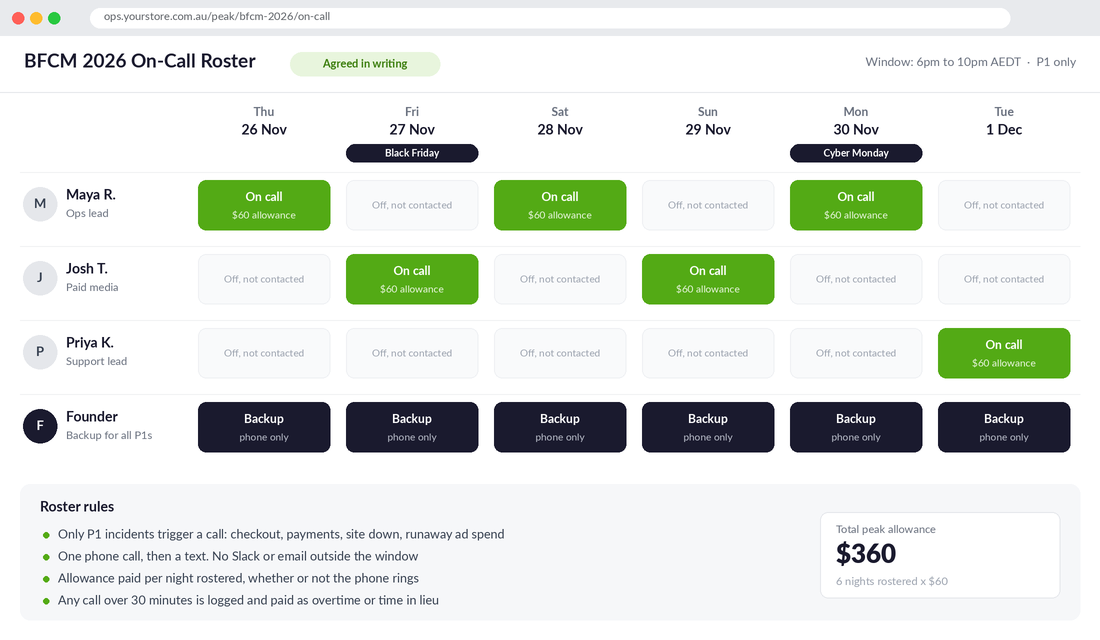
Run the maths and it is cheap. Six nights of cover at a modest allowance costs a few hundred dollars across BFCM week. Compare that with a checkout outage during Black Friday evening, or with losing a good operator who quietly decides your store is not worth the Sunday night stress. Our Team Retention Playbook walks through what it really costs to replace someone you wanted to keep, and it runs well into the thousands once recruitment, onboarding and your own time are counted.
For senior salaried people, like a 2IC or an operations manager, write the expectation into the role. Their employment contract and position description should say that reasonable out-of-hours contact for P1 incidents is part of the job and is factored into their salary. That is the Fair Work Ombudsman’s own example of when refusing contact can be unreasonable: extra pay, a senior role, and an expectation made clear in advance.
Part 4: Rebuild Your Comms Stack So the Default Is Silence
Here is where the P3 majority from Part 1 disappears. You do not need willpower. You need your tools to hold messages until morning by default and let only P1 alerts through.
Start with the founder habit, because it is the biggest source of contact:
- Schedule send, every time. Slack, Gmail and Outlook all let you schedule a message. In Slack, click the arrow beside the send button and choose a time. Make “tomorrow at 8:30am” your default after 6pm.
- Set team notification schedules. In Slack, each person can set a notification schedule under Preferences, then Notifications. Ask every employee to set theirs to match their working hours so nothing buzzes after close.
- Move ideas into a parking lot. A single “Monday agenda” doc or Slack canvas where your 10:47pm thoughts go. You get the idea out of your head without putting it into someone else’s evening.
Then fix the customer side. Your store should keep selling and taking tickets all night, but your team should not see them until the morning. Set this up in your helpdesk in about 20 minutes. Here is the process in Gorgias; Zendesk, Freshdesk and Re:amaze have equivalent settings:
- Set business hours. In Gorgias go to Settings, then Business hours, pick your timezone (Australia/Melbourne or Sydney handles AEST and AEDT automatically) and enter hours per day.
- Create an outside-hours auto-reply. Build a rule that triggers when a ticket is created outside business hours and replies with a friendly message stating when you will be back and where to find order tracking.
- Remove helpdesk push notifications from personal phones for anyone not rostered on call. If they want the app, they turn notifications off outside hours.
- Update your contact page so customers know your support hours and response time before they write in.
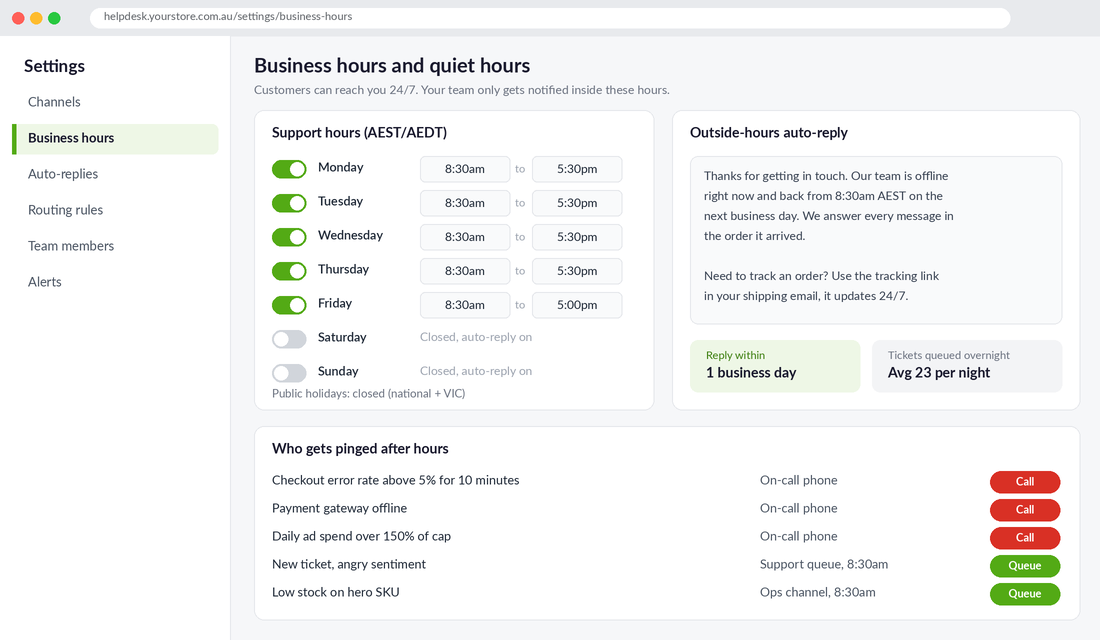
Big Aussie brands already run this model in public. Fashion label Peppermayo lists customer service hours of Monday to Friday, 9am to 5pm AEST, excluding public holidays, while its store trades around the clock. Beginning Boutique publishes customer care hours of Monday to Friday, 7am to 6pm AEST. Neither brand is losing sales for it. Customers do not need a reply at midnight. They need to know when a reply is coming, and they need order tracking that works without a human. Our Support Deflection Playbook covers how to answer the most common questions before a ticket is ever created.
Last, route the genuine P1 alerts to the on-call phone, not a group channel. Use Shopify Flow, your uptime monitor, and your ad platform’s automated rules to trigger a text or call for checkout errors, payment gateway failures, site downtime and runaway ad spend. Everything else lands in a channel people read at 8:30am.
Part 5: Run a BFCM Peak Protocol, Then Debrief It
Peak is where good intentions collapse, so give it its own protocol and lock it in early. Here is the timeline I would run for Black Friday 2026:
- By Friday 30 October: Finalise your P1 list and Contact Charter. Walk every employee through it in a short meeting and get written acknowledgement.
- By Friday 13 November: Publish the on-call roster for 26 November to 1 December. Confirm allowances, windows and phone numbers. Tell your 3PL, agency and payment provider who to call.
- Week of 16 November: Test every P1 alert. Deliberately trip your ad spend rule and your uptime monitor. Make sure the right phone rings.
- 26 November to 1 December: Run the roster. Founder schedules every non-P1 message. Daily 15-minute stand-up at 8:30am handles everything that queued overnight.
- Friday 4 December: Debrief. How many P1 calls actually happened? Were any “emergencies” really P2? Did anyone work extra time that needs to be paid?
Pay special attention to the debrief. Most teams discover the on-call phone rang once or twice across the whole weekend. That is the proof you need that the system works, and it gives everyone permission to switch off for Christmas trading, which is the next peak straight after.
If you are already planning a code freeze or theme change for peak, fold the P1 alerts into that plan. A frozen theme and a tested alert chain together remove most of the reasons anyone gets a call at all.
The Founder Is the Biggest Risk in the System
I will be direct, because this is where it usually breaks. In a team of five or eight, the after-hours culture is you. If you send Slack at 10:47pm, your team reads it as an expectation, whatever your charter says. The Elmo finding that two in five workers feel uncomfortable ignoring messages is not about the law. It is about the boss.
Three founder rules fix most of it:
- Never send outside hours without scheduling. If it is not a P1, it waits. No exceptions for “just a quick one”.
- Say it out loud. Tell your team in a meeting that you will never judge anyone for not replying outside hours, then prove it by never raising it.
- Model it yourself. Take your own evenings off where you can. Your judgement on a Monday morning is worth more than your reactivity on a Sunday night.
This is not about being soft. Teams that trust their evenings are protected are more willing to step up for the rare genuine emergency, because it is rare and because it is paid.
How the Five Parts Compound
Each part on its own helps. Together they turn after-hours contact from a vague cultural problem into an operating system.
The incident map shrinks the problem dramatically, because most contact turns out to be founder thoughts that can be scheduled. The Contact Charter turns the remaining contact into a written, reasonable arrangement based on the same factors the Fair Work Commission would look at. Paid availability converts goodwill into a fair deal. The comms stack enforces the whole thing automatically, so it does not depend on anyone’s willpower at 10:47pm. And the peak protocol stress-tests it on your biggest four days of the year, then feeds what you learned back into the charter.
The result is a store that trades 24/7, a team that switches off at night, and a founder who knows exactly who is covering a broken checkout at 8pm on Black Friday. That combination is what lets a small team scale without burning out its best people, and that is one of the constraints that most often caps Aussie Shopify brands between $1 million and $5 million.
Your After-Hours Contact Checklist
Work through this before 30 October and you will go into BFCM compliant and calmer:
- ☐ Counted every after-hours message to employees over the last 90 days
- ☐ Sorted them into P1, P2 and P3 and written a P1 list of eight triggers or fewer
- ☐ Checked the modern award for each employee for right to disconnect and on-call terms
- ☐ Written a one-page After-Hours Contact Charter covering hours, incidents, contacts, channel, pay and review
- ☐ Updated contracts and position descriptions for senior roles that carry reasonable P1 availability
- ☐ Set an on-call allowance and a BFCM roster with one person per night
- ☐ Switched on schedule send as the founder default after 6pm
- ☐ Asked every employee to set a notification schedule that matches their hours
- ☐ Configured helpdesk business hours, an outside-hours auto-reply and removed out-of-hours push notifications
- ☐ Published support hours and response times on the contact page
- ☐ Routed P1 alerts from Shopify Flow, uptime monitoring and ad rules to the on-call phone
- ☐ Told your 3PL, agency and key suppliers who to call in a real emergency
- ☐ Booked a debrief for Friday 4 December
Where to Start This Week
Do Part 1 tonight, or better, tomorrow at 9am. Count the messages. Once you see how few of them were real emergencies, the rest of the system is easy to justify to yourself and to your team.
Inside eCommerce Circle, building a team that runs the store without the founder on call 24/7 is one of the core People pillars we work on with every member. If you want to see exactly where your store is being capped, take the free More Orders Scorecard. It takes two minutes and shows you which of the 10 P’s to fix first.