You’ve boosted a few posts. You’ve run some traffic campaigns. Maybe you’ve even tried Advantage+ once or twice. But your Meta ads feel like a slot machine — sometimes they work, sometimes they burn cash, and you have no idea why.
What’s in This Article
The problem isn’t Meta. The problem is that most Shopify brands don’t have a campaign structure. They have a collection of random ad sets thrown together without a strategy for how cold traffic becomes warm traffic becomes paying customers. And without that structure, you can’t scale — because you don’t know what’s working, what’s breaking, or where to put the next dollar.
The brands spending $30K-$50K/month profitably on Meta all follow the same fundamental structure. It’s not complicated, but it is deliberate. Here’s exactly how to build it.
The Three-Tier Campaign Structure Every Shopify Store Needs
Think of your Meta ad account as a funnel with three layers. Each layer has a different job, different audiences, different creative, and different success metrics. Mixing these up is the #1 reason brands can’t scale.
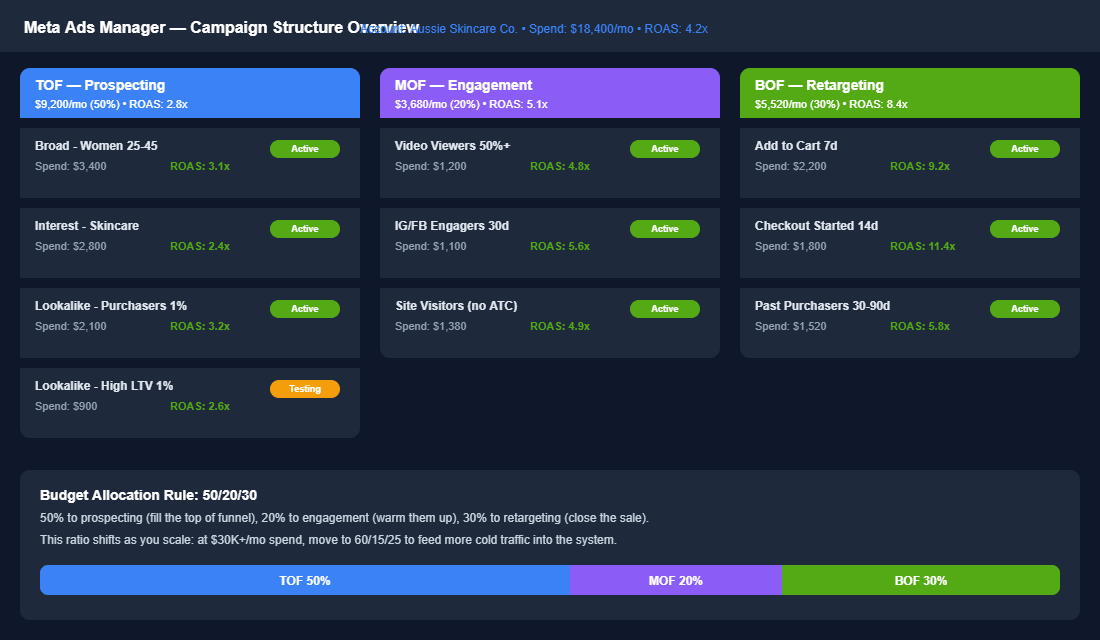
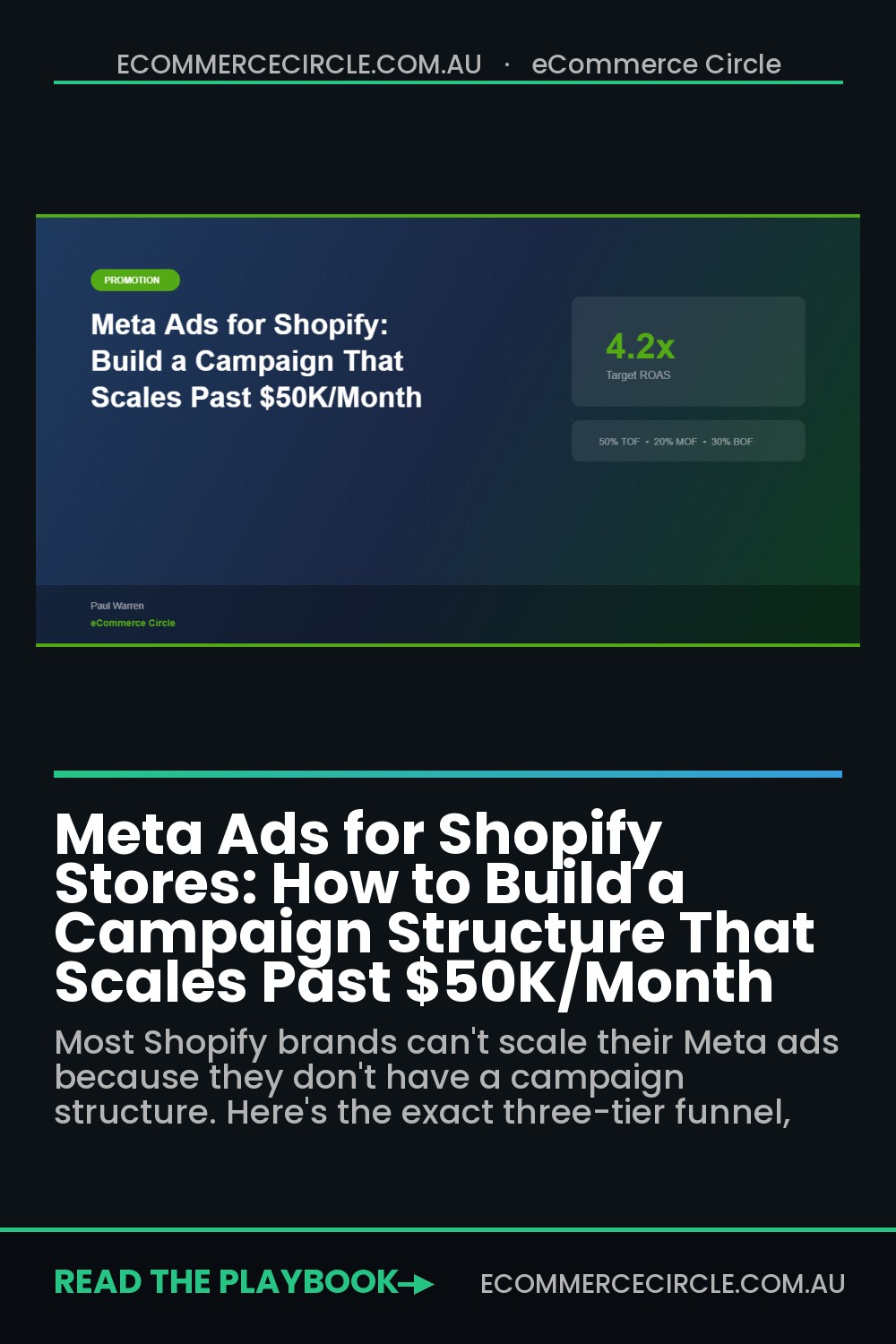
Top of Funnel (TOF) — Prospecting — 50% of budget. This is where you reach people who have never heard of your brand. The goal isn’t immediate sales — it’s getting the right people into your ecosystem at an acceptable cost. Audiences here include broad targeting (let Meta’s algorithm find buyers), interest-based audiences (skincare enthusiasts, online shoppers), and lookalike audiences built from your customer list or purchaser pixel data.
Middle of Funnel (MOF) — Engagement — 20% of budget. These people know you exist but haven’t visited your site or added to cart yet. They’ve watched your videos, engaged with your Instagram, or visited your site once. The goal is to deepen the relationship and drive site visits. Target video viewers (50%+ watched), social media engagers (30 days), and site visitors who haven’t added to cart.
Bottom of Funnel (BOF) — Retargeting — 30% of budget. These are your warmest audiences: add-to-cart abandoners, checkout starters, and past customers. This is where your ROAS will be highest (8-12x is common) because you’re reaching people who are already close to buying. These campaigns should run 24/7 and never be turned off.
The Creative Strategy That Actually Scales
Here’s a truth that experienced media buyers know: creative is the biggest lever in Meta ads. Not audiences, not bidding strategy, not campaign structure. The ad itself — what people see in their feed — determines 70%+ of performance.
The brands winning on Meta in 2026 are running UGC-style video at the top of funnel. Not polished brand videos. Real people, shot on phones, talking about the product like they’re recommending it to a friend. This format consistently outperforms studio content by 40-60% on CTR and CPA.
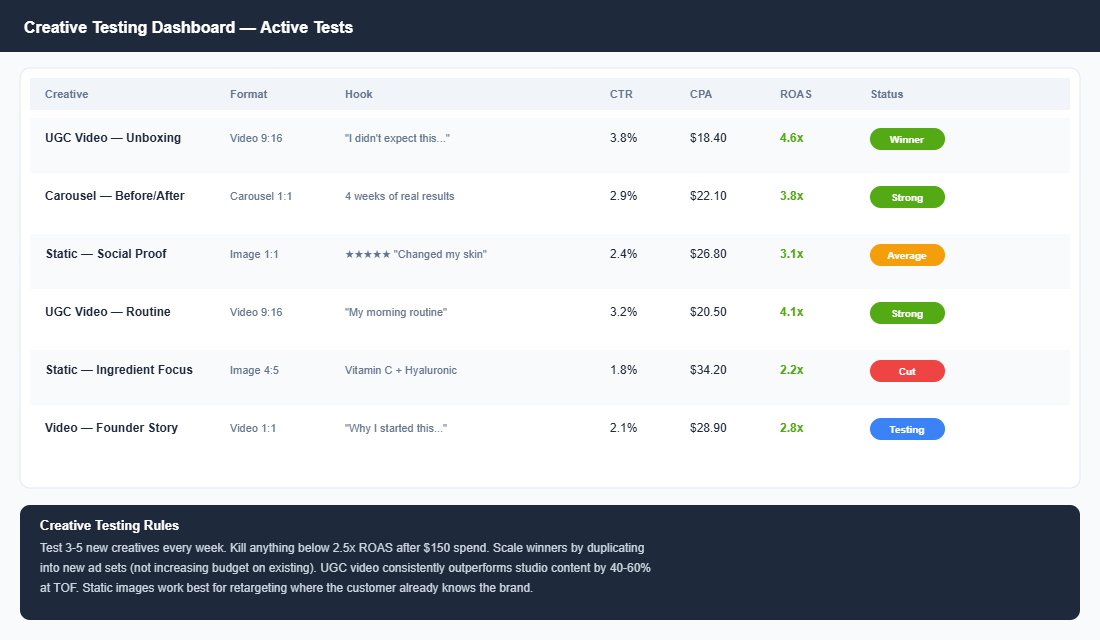
Your creative testing framework should look like this: launch 3-5 new creatives every week. Give each one $100-$150 in spend before making a call. Anything below 2.5x ROAS after that spend gets killed. Anything above 3.5x gets duplicated into a scaling ad set. The key is volume — you need to test enough creatives that you find winners consistently.
For creative formats by funnel stage: TOF works best with UGC video (unboxings, testimonials, routine videos) and carousel ads showing before/after results. MOF works with social proof (review compilations, user photos) and educational content. BOF works with dynamic product ads, urgency messaging (“Still thinking about it?”), and offer-focused creatives.
The Hook Is Everything
You have less than 2 seconds to stop someone from scrolling. That means the first frame of your video or the headline of your static ad is the single most important element. A great product with a weak hook will lose to an average product with a scroll-stopping hook every time.
Hooks that work for ecommerce: “I didn’t expect this to actually work…” (curiosity), “Stop buying [product category] until you see this” (pattern interrupt), “This replaced 3 products in my routine” (value proposition), “POV: you finally found a [product] that actually works” (relatability). Test different hooks on the same creative — often the hook alone determines a 2x difference in performance.
Scaling Without Breaking: The K to K Roadmap
Scaling Meta ads isn’t as simple as “spend more money.” Increase budget too fast and performance tanks. Increase too slowly and you miss the window on winning creatives. Here’s the phased approach that works.
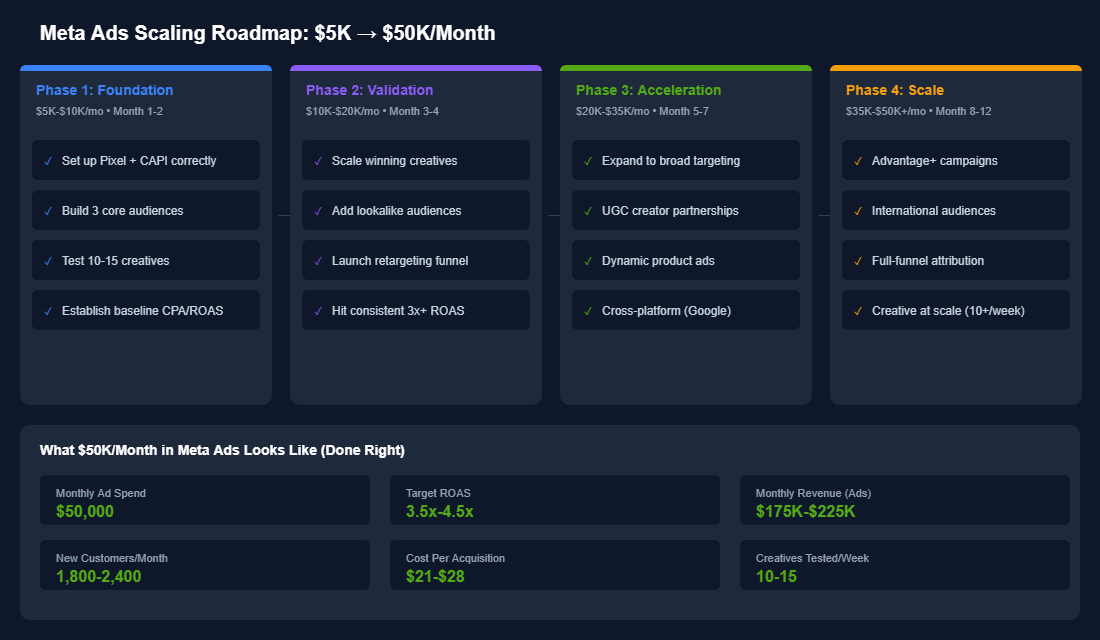
The golden rule: never increase a winning ad set’s budget by more than 20% per day. Bigger jumps reset Meta’s learning phase and tank performance. If you need to scale faster, duplicate the winning ad set at a higher budget rather than increasing the original. This preserves the algorithm’s learnings while giving you more spend.
The Numbers You Need to Watch
At any spend level, these are the metrics that matter: CPA (Cost Per Acquisition) — what you pay per customer. Know your breakeven CPA based on your AOV and margin. If your AOV is $80 and your margin is 65%, your breakeven CPA is $52. Anything below that is profitable. ROAS (Return On Ad Spend) — your target should be 3x minimum at TOF, 5x+ at MOF, and 8x+ at BOF. Blended across the account, aim for 3.5-4.5x. Hook rate — the percentage of people who watch past 3 seconds. Below 25% means your hook is weak. CTR — anything above 2% at TOF is strong. Below 1.5% means the creative isn’t resonating.
The Compound Effect: Ads + Retention = Profitable Scale
Here’s what most brands miss: Meta ads alone don’t build a profitable business. Meta ads fill the top of your funnel. But the profit comes from what happens after the first sale — your post-purchase flow, your email marketing, your loyalty program. A brand spending $50K/month on ads with a 22% repeat purchase rate is in a very different position than one spending the same with a 40% repeat rate. The second brand can afford to pay more per customer because each customer is worth more over time.
This is why campaign structure matters so much. When you know exactly what each tier of your funnel costs and produces, you can make intelligent decisions about how much to invest in acquisition versus retention — and build a business that compounds instead of one that’s stuck on the ad spend treadmill.
Your Next Step
Audit your current Meta ad account against the three-tier structure. Are your campaigns clearly separated into TOF/MOF/BOF? Do you know your CPA and ROAS by funnel stage? If everything is lumped into one or two campaigns, restructuring alone will improve performance.
Inside the eCommerce Circle, paid advertising strategy is one of the core pillars we build with every member — because profitable ads are the fuel that powers rapid growth. If you want hands-on help building a Meta ads structure that scales, let’s talk.
The Real Benchmarks to Hit at Each Spend Tier
Meta benchmarks shift by vertical, AOV, and offer strength, but here are the ranges Aussie Shopify brands should be targeting at each scale. Use them as a sanity check, not a target — if you are way outside the range, something is wrong with creative, audience structure, or your back-end economics.
Sub-$20K/month ad spend: CPM $12-$22 AUD, CTR 1.0-1.8%, CPC $0.80-$1.60, blended ROAS 3.5-5.0x (cold prospecting usually 2.5-3.5x, retargeting 6-10x). If your blended ROAS is under 2.5x at this spend, you almost certainly have a creative or offer problem, not a Meta problem.
$20K-$50K/month ad spend: CPM $14-$28, CTR 0.9-1.5%, CPC $1.00-$2.00, blended ROAS 2.5-4.0x. This is where Advantage+ shopping campaigns start outperforming traditional structures for most brands. If you are still running tight interest-based audiences here, you are leaving scale on the table.
$50K+/month ad spend: CPM $18-$35, CTR 0.8-1.3%, CPC $1.40-$2.80, blended ROAS 2.2-3.5x. ROAS compression is normal as you scale — the question is whether your Marketing Efficiency Ratio (revenue divided by total ad spend across all channels) is still healthy. See our MER framework for why this matters more than ROAS at scale.
Cost per acquisition (CPA) is the truer metric. Target a CPA at or below 25-35% of your first-order value if you have weak repeat purchase rates, and up to 80-100% if your customer LTV is 3x+ your AOV. Without LTV data, you are flying blind on what you can afford to pay for a customer — start with our CLV calculation guide.
Creative Volume: The Variable That Actually Moves Scale
At sub-$50K/month spend, the typical brand needs 5-8 fresh creative concepts per week to keep Meta’s algorithm fed and avoid creative fatigue. Above $50K/month, that number climbs to 10-15 per week. Most Aussie brands ship 2-3 ads a week and wonder why their ROAS slowly degrades — they are starving the machine.
Creative mix matters as much as volume. The reliable performers in 2026: UGC product demos (15-30 seconds, real customers, vertical format), founder-talking-to-camera ads (works especially well for under-$1M brands building trust), problem-solution carousels, before/after stills for “transformation” categories, and “social proof stack” ads showing 5-10 reviews in motion. Beautiful brand-led product photography ads still have a place, but they should be 20% of your spend, not 80%. For a deeper view, see our UGC ads playbook.
If you cannot ship 5+ ads a week internally, that is a hiring decision, not a creative agency decision. Aussie brands at $30K+/month ad spend should have a dedicated creative producer (in-house or contract) feeding the funnel. Production cost benchmark: $200-$500 per finished UGC ad (creator fee + lightweight editing).
Attribution: Stop Trusting Just the Meta Dashboard
If you are still making campaign decisions purely on Meta’s in-platform ROAS, you are working with a distorted picture. iOS 17, ATT, and the cookie-loss decade have made platform-reported ROAS unreliable, particularly for first-time customers. Brands that scaled past $50K/month in 2026 almost universally use a layered attribution stack:
Layer 1 — Platform ROAS (Meta Ads Manager): directionally useful, especially for retargeting and creative-level reads. Treat as overstated for prospecting.
Layer 2 — Blended ROAS (total revenue / total ad spend across Meta, Google, TikTok): the truth-teller. If blended is moving in the right direction, you are winning even if platform numbers wobble. Tools: Triple Whale ($129+/mo), Northbeam ($1,000+/mo for serious brands), or a basic spreadsheet pulled weekly.
Layer 3 — Post-purchase survey (“How did you first hear about us?” at checkout): catches the brand-awareness lift Meta gets credit for in dashboards but rarely directly clicks-through. Tools like Fairing or KNO Commerce make this trivial to wire up.
Layer 4 — Incrementality testing (geo-holdout or campaign on/off): the truth serum. Run quarterly. See our incrementality testing playbook for the exact method Aussie founders use.
The Mistakes That Stall Brands at -50K Spend
Most plateaus at this spend tier are not Meta problems — they are economics or operations problems wearing a Meta costume. The pattern we see weekly in coaching:
The AOV ceiling. Your AOV is $65 and your blended CAC is $42. You have no margin to scale aggressively. The fix is upstream: bundles, free-shipping thresholds, post-purchase upsells. Solve the AOV before you push ad spend.
The retention gap. Your 90-day repeat rate is under 15%. Every customer is a one-night stand. Cost per first-order is the only thing that matters, and it is climbing. Build the back-end (email, SMS, post-purchase flow) before you scale the front end.
The creative bottleneck. Same 3 ads since January, blaming “iOS” for ROAS decline. Refresh half your creative every 6-8 weeks at minimum.
The fragmented funnel. Cold traffic ads pointing at the homepage, no warmup, no retargeting layers. Even a basic 3-stage funnel (cold prospecting + 7-day retargeting + 30-day retargeting) consistently lifts blended ROAS by 20-40% over a flat structure.
If you are stuck below $50K/month and the issue is not obviously creative, it is almost always one of these four. The Meta side gets the blame because it is the most visible — but the lever is usually elsewhere in the business.